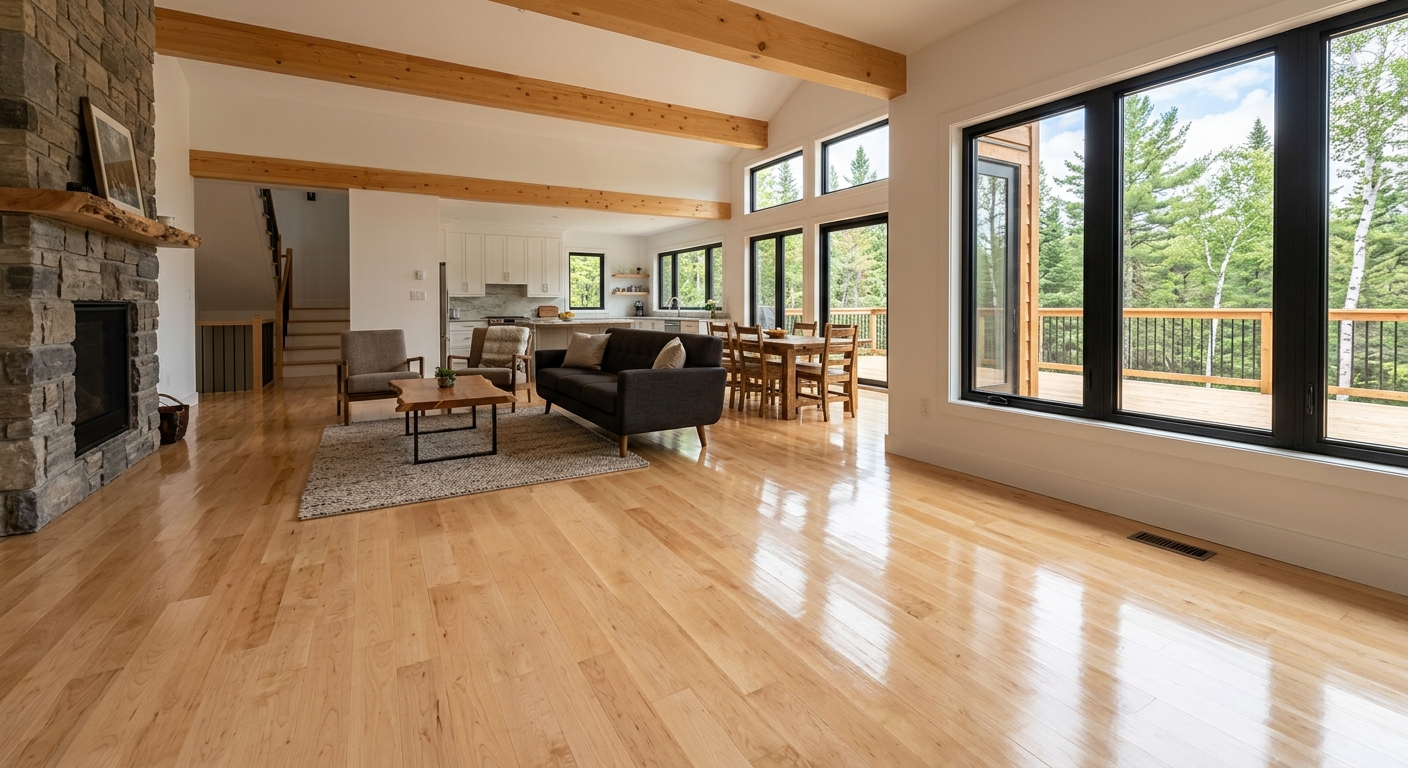
Flooring options and costs in Calgary
Calgary homeowners typically shop for flooring by balancing comfort, durability, and the realities of our dry, cold prairie climate. With 35.2% of homes in the region built before 1981 (Statistics Canada, 2021 Census), it’s common to uncover uneven subfloors, worn plywood, or inconsistent transitions that need levelling or repair before the new floor can go down. That prep step is one of the biggest “quote multipliers” you’ll see—sometimes adding roughly $1 to $3 per sq ft (and more if extensive patching is required), especially in basements where moisture migration through concrete can show up over time.
In Calgary, seasonal humidity swings are hard on dimensionally sensitive materials. Solid hardwood expands and contracts with indoor moisture, so it’s usually restricted to above-grade installations with a proper subfloor system. Engineered hardwood and luxury vinyl plank (LVP) are far more forgiving when humidity levels shift, and they also suit many on-grade and below-grade scenarios where you want safer performance. Tile can be extremely durable here, but it demands a flat substrate and careful installation practices (flatness and crack isolation), which is why contractors often price levelling and underlayment separately. For busy communities like Cranston (popular with newer families) and across established areas near downtown and Marda Loop, demand stays strong for mid-range LVP/SPC, engineered hardwood, and carpet—driving availability and keeping labour competitive.
Below is a realistic Calgary price comparison to help you anchor your budget before you request itemised quotes.
| Type |
Best Room |
Moisture Resistance |
Lifespan |
Price per sq ft |
| Solid hardwood (nail-down, above grade only) |
Living rooms, dining rooms, hallways (dry areas) |
Low to moderate (needs stable indoor humidity) |
20–35 years |
$8–$15 |
| Engineered hardwood (float or glue, above + on-grade) |
Living rooms, main floors, bedrooms |
Moderate to high (more stable than solid) |
15–30 years |
$8–$14 |
| Laminate (click-lock, above-grade) |
Above-grade living areas and bedrooms |
Low to moderate (water must be cleaned quickly) |
10–20 years |
$3–$7 |
| Luxury vinyl plank / LVP (waterproof, any level) |
Kitchens, basements, main floors |
High to waterproof (best practical choice in damp areas) |
15–25 years |
$4–$9 |
| Porcelain / ceramic tile |
Bathrooms, kitchens, entryways |
Very high (impervious surface) |
25–40 years |
$6–$12 |
| Carpet (broadloom or modular tile) |
Bedrooms and rec rooms |
Low (avoid in wet zones) |
8–15 years |
$3–$8 |
Prices are estimates only and vary by project scope, site access and material selection.
What affects the price of flooring in Calgary
In Calgary and across Alberta, two quotes for the “same” flooring can differ by 30% to 50% because the big variable isn’t just the top layer—it’s everything needed to make the install last. Indoor humidity swings in our dry-cold climate push contractors to choose more stable systems (engineered hardwood or LVP/SPC) and to spend more time on subfloor flatness. Below-grade moisture migration is also a recurring issue in Calgary-area basements (especially on concrete), which typically makes solid hardwood a poor fit and shifts many homeowners toward engineered wood, LVP, or SPC. Cold-season conditions also influence timelines and labour availability as trades juggle weather-dependent outdoor work and indoor turnovers.
Solid hardwood expands and contracts with humidity, and it generally cannot be glued or floated directly over concrete. That means if you’re considering solid oak, the contractor’s quote often includes extra steps: a suitable subfloor system and careful moisture control. Engineered hardwood and LVP handle relative humidity changes better and are more commonly compatible with slab and radiant heat scenarios. Older regional housing stock—35.2% built before 1981 (Statistics Canada, 2021 Census)—frequently needs subfloor levelling or repair; that prep commonly adds about $1 to $4 per sq ft depending on how out-of-level the surface is.
Concrete examples: (1) In a basement where moisture is an issue, switching from solid hardwood to LVP/SPC can raise material cost but prevents the hidden risk of cupping or gapping; (2) Tile in a kitchen often triggers additional levelling and, if the slab is cracked or inconsistent, a crack isolation membrane—pushing total pricing toward the higher end of the $6 to $12 per sq ft band. In contrast, a straight laminate install over a sound, flat subfloor might land nearer the $3 to $7 band when removal and stair work are minimal.
| Price Factor |
Why It Matters |
Cost Impact |
| Room area in sq ft |
More square footage increases both material and labour time, plus waste/trim |
Can shift totals significantly; small rooms often cost more per sq ft |
| Subfloor condition |
Levelling, patching, or replacing damaged plywood changes prep scope |
Commonly adds $1–$4 per sq ft in older homes |
| Moisture / below-grade install |
Determines product suitability and required vapour/moisture control |
Solid hardwood often ruled out; LVP/SPC and membranes may add cost |
| Material choice |
Solid vs engineered vs LVP vs tile affects price and installation method |
Typically moves you within bands (e.g., $3–$7 laminate vs $6–$12 tile) |
| Removal and disposal of existing flooring |
Adhesives, underlay, nails and disposal fees add labour |
Often a hidden line item that can materially change the final total |
| Stair nosing / transitions |
Stairs require precise cutting and finishing; transitions need labour and profiles |
Charged per step or linear foot; increases overall project cost |
| Radiant heat compatibility |
Some materials and underlays are not suitable over radiant systems |
May require specific underlay or product type; can reduce options |
| Installation method |
Float vs glue-down vs nail-down affects labour time and substrate requirements |
Glue-down and precision subfloors often cost more than simple click-lock |
Permits & regulations in Alberta
In Alberta, installing flooring itself typically does not require a building permit. However, related work can trigger permitting depending on what’s being modified. For example, if your project includes structural subfloor repair that changes load-bearing conditions, moisture remediation that involves more than simple surface prep, or work that ties into in-floor heating circuits, permits and inspections may be required—particularly where electrical scope is involved.
In condominiums, you also need to consider the building’s noise and sound rules. Many corporations set requirements for sound transmission (often referenced through STC/IIC considerations) and may restrict or require specific underlay systems under hard flooring (like engineered hardwood or tile) on upper floors. Before you start, review your condo declaration and request written board approval when the strata rules ask for it—especially for tile and hardwood in multi-unit buildings.
To verify your contractor in Calgary, follow a simple checklist. First, confirm Alberta licencing status using the appropriate online registry your contractor lists for their trade category (availability depends on the type of work). Second, ask for a current certificate of liability insurance showing coverage limits suitable for flooring trades. Third, confirm WSIB/WCB coverage (or a clearance letter where applicable) and keep it on file with your contract. Finally, request the contractor’s workers’ compensation account number or proof of registration/coverage—don’t accept verbal confirmation. This protects you if something goes wrong mid-project or if a worker is injured on site.
Best flooring for each room in your Calgary home
Choosing flooring in Calgary is really about matching the product to the room’s moisture exposure, foot traffic, and how comfortable you want it to feel through winter. Because our climate brings dry indoor air in colder months and humidity swings year-round, living and dining areas usually do best with engineered hardwood or a higher-quality laminate that can tolerate minor seasonal movement. In master bedrooms, comfort and sound matter; carpet offers warmth and reduces noise underfoot, while engineered hardwood is a good option if you want a harder surface with better stability than solid wood.
For kitchens, the winner is typically luxury vinyl plank (LVP) or large-format porcelain tile. LVP handles small spills and everyday splashes, and it tolerates the dry-cold cycling better than many thin-laminate options. Tile is also excellent for cleaning and long-term durability, but it’s less forgiving of an uneven subfloor—so levelling and proper underlayment often matter to your total cost. In basements, LVP is the clear practical choice: it’s waterproof, it can handle moisture vapour management layers, and it performs better on concrete than solid hardwood. Bathrooms should be porcelain or ceramic tile only, because the surface and grout system can be designed to manage wet-season conditions safely.
Radiant heat compatibility is increasingly common in Alberta new builds and renovations. In those rooms, contractors usually recommend products designed for radiant systems, and they’ll confirm allowable underlay and installation method. As a dollar example, homeowners who compare laminate at roughly $3 to $7 per sq ft versus porcelain tile at $6 to $12 per sq ft often justify tile in bathrooms and entry areas because tile’s longevity and water resistance reduce replacement risk—particularly in older homes where prep and patching are already part of the budget.
| Room |
Best Material |
Why |
Moisture Risk |
Price Band per sq ft |
| Living / dining room |
Engineered hardwood |
Warm underfoot, stable through Calgary humidity swings, easier upkeep than carpet |
Low |
$8–$14 |
| Master bedroom |
Carpet (broadloom or modular) |
Comfort and sound absorption; helps with winter warmth when air is dry |
Low to moderate (avoid leaks) |
$3–$8 |
| Secondary bedrooms |
Laminate (click-lock) or engineered hardwood |
Good balance of durability and cost; laminate can work well above grade |
Low |
$3–$8 |
| Kitchen |
Luxury vinyl plank (LVP) or large-format porcelain tile |
LVP is forgiving for spills; tile is best for long-term moisture and cleaning |
Moderate (spills and cleaning) |
$4–$12 |
| Basement (finished) |
LVP (waterproof) / SPC |
Handles moisture risk from concrete and vapour; stable through seasonal changes |
Moderate to high |
$4–$9 |
| Bathroom |
Porcelain / ceramic tile |
Designed for wet use; durable surface with proper installation system |
High |
$6–$12 |
How to choose a flooring contractor in Calgary
Choosing the right flooring contractor in Calgary starts with proof, not promises. In Alberta, you should verify the contractor’s Alberta licensing (as applicable to their trade category), request a current certificate of liability insurance, and confirm they carry workers’ compensation coverage under the correct WSIB/WCB framework. The practical “how to check” step is straightforward: ask for documents up front; then verify the certificate details match your contractor’s legal name and the project address. A contractor who won’t share proof usually isn’t organized enough to manage change orders, subfloor repairs, and proper jobsite cleanup.
Next, get 2 to 3 itemised written quotes. Don’t accept a lump sum that hides labour, material, underlay/membrane, levelling compounds, removal and disposal, transitions, and stair work. Ask whether levelling is included, whether a vapour barrier or moisture membrane is included for below-grade installs, and how transitions between rooms will be handled. Read the scope carefully for exclusions like moving furniture, repairing drywall, replacing damaged subfloor, or permit-related paperwork where electrical work is involved. For timelines, insist on a start date and a completion estimate in writing.
Warranty matters in flooring: confirm the workmanship warranty length, and whether the product manufacturer warranty is valid when installed by a certified installer. Also clarify whether warranties are transferable to the next owner. On payment, avoid paying more than about 10% to 15% upfront—then hold back a portion until completion and final walkthrough.
- Provide current liability insurance certificate and match it to the contractor’s legal name.
- Confirm workers’ compensation clearance/coverage letter (WSIB/WCB) before work begins.
- Show a written licence number (or trade registration proof) when applicable to their scope.
- Get 2 to 3 itemised quotes with labour and materials separated line-by-line.
- Ask what’s included for removal, underlay disposal, and stair finishing.
- Require a written description of subfloor prep: levelling, patching, flatness target, and repair scope.
- For basements, confirm moisture/vapour layers and which product is approved for below-grade.
- Verify radiant heat compatibility in advance if you have in-floor heating.
- Request transition details: T-moldings, reducers, stair nosings, and who supplies them.
- Confirm warranty details: workmanship duration, exclusions, and whether the product warranty is supported.
- Set payment milestones: no more than 10% to 15% upfront; retain a holdback until sign-off.
- Get a project schedule in writing including estimated completion date and day-to-day work plan.
Red flags to watch in Calgary: quotes that aren’t itemised, “we’ll figure out levelling later” language, refusing to provide insurance/WSIB/WCB proof, unrealistic start dates that don’t match the stated scope, and vague warranty terms that don’t separate workmanship from manufacturer coverage.
Frequently asked questions — flooring in Calgary
Hardwood vs laminate vs vinyl plank — which is best?
In Calgary, “best” depends on the room and moisture risk. Solid hardwood is beautiful but usually only works well above grade because Calgary humidity swings can cause movement; it also can’t be directly glued or floated over concrete. Laminate is budget-friendly (often in the $3 to $7 per sq ft band) and works best on a flat above-grade subfloor, but it’s not waterproof—standing water and slow leaks are the biggest problems. Luxury vinyl plank (LVP) or SPC is often the smartest all-around choice because it’s waterproof and more forgiving for minor humidity and below-grade conditions; many projects land roughly in the $4 to $9 per sq ft range, depending on product tier. For basements, I typically steer homeowners to LVP/SPC rather than solid wood.
What flooring is best for a Calgary basement?
The best baseline choice for Calgary basements is usually waterproof LVP or SPC, installed over a properly prepared concrete slab with appropriate moisture/vapour control. Basements often face moisture migration through concrete and greater seasonal swings in relative humidity, even when the space feels “dry.” Solid hardwood is generally a poor match because it expands/contracts more and relies on a stable environment. Laminate can also struggle if a moisture problem is present. With LVP/SPC, you get a surface that can tolerate occasional humidity and spills better, which reduces the risk of warping. If your basement has existing uneven concrete or aged subfloor layers, plan for subfloor levelling and patching, which can change your final total budget versus a new, flat slab.
Can I install hardwood over concrete?
Often, you can’t install traditional solid hardwood over concrete in a typical floating or direct glue setup. Solid hardwood needs a compatible subfloor system and stable indoor humidity; installing it on a concrete slab usually requires a specific approach (like an approved subfloor construction) and careful moisture control. That’s why many Calgary homeowners opt for engineered hardwood instead—engineered products are more stable and are commonly used above grade and on-grade, and they can sometimes be installed with proper prep and system choices depending on manufacturer requirements. If you have in-floor heating, you must confirm the product’s radiant compatibility. If your goal is “hardwood look” with fewer basement risks, LVP/SPC is frequently the practical alternative when concrete moisture is a concern.
How long does flooring installation take?
Typical timelines in Calgary depend on room count, square footage, and prep work—especially levelling in older homes. A small above-grade space with a click-lock laminate or LVP can take a few days from start to finish, but tile or engineered hardwood on an older, uneven subfloor often takes longer because prep and layout are more involved. Subfloor repair and levelling can add several days if patching is extensive or if multiple layers need attention. Basement jobs also require careful moisture planning and acclimation time for certain products. Expect the contractor to provide a written schedule with estimated completion dates. In general, the more transitions, stair work, and removal/disposal you have, the more calendar time you should budget—even if the finished “install day” sounds short.
What flooring works with radiant heat?
In Alberta, radiant heat compatibility matters because not every flooring and underlay combination tolerates temperature changes safely. Many engineered hardwood and LVP products are designed to work with radiant systems when installed with approved underlay (or without, if the manufacturer requires no underlay). Laminate can sometimes work, but only if it’s specifically rated for radiant heat by the manufacturer. Solid hardwood is the most limited option in cold climates because of movement with humidity and temperature cycling; if used, it must be approved for radiant and installed with strict requirements. The safest path is to confirm your radiant manufacturer’s requirements and then choose flooring that explicitly states compatibility. Your flooring contractor should also follow acclimation and installation method guidance to avoid issues like gapping or bond failures.
Engineered vs solid hardwood — what's the difference?
Solid hardwood is one species/thickness of wood and typically relies on nail-down installation over a stable above-grade subfloor. It’s sensitive to indoor humidity swings—Calgary’s dry-cold seasons can make it more prone to movement if conditions aren’t managed. Engineered hardwood uses multiple wood layers with a top veneer, making it more dimensionally stable than solid hardwood. That stability is why engineered options are often preferred for main floors and sometimes on-grade installs when homeowners want an authentic wood look without the same level of humidity risk. In price terms, you’ll often see engineered hardwood land closer to the $8 to $14 per sq ft range, while solid hardwood commonly sits around the higher $8 to $15 per sq ft band depending on grade and installation scope. Both can look great—engineered just tends to be more forgiving in our climate.