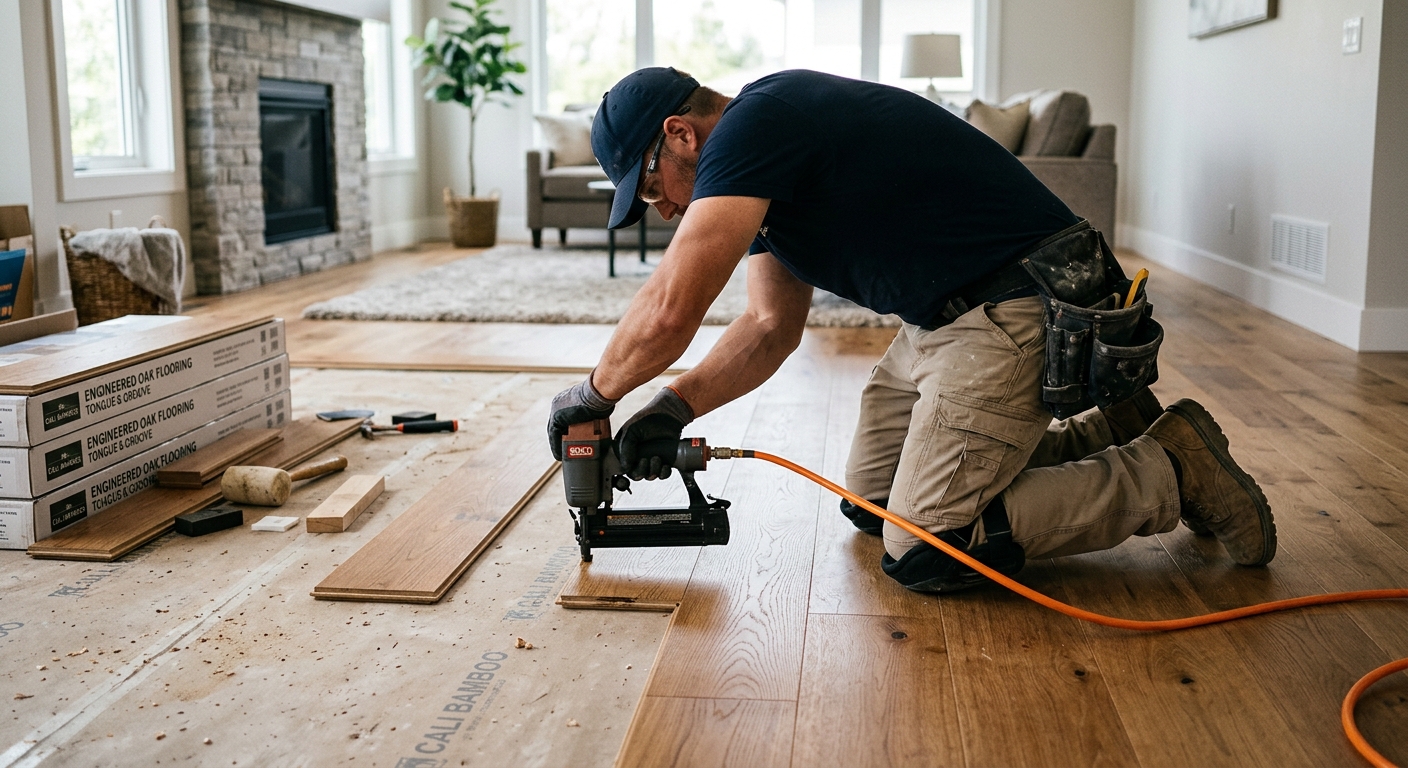
Flooring options and costs in Cardston
Cardston homeowners usually have more choice than they expect, but the right pick depends on how your home was built and how moisture behaves here. With a 2021 population of 3,724 and about 73.8% of households owning (Statistics Canada, 2021 Census), many properties get updates over time—especially in older neighbourhoods where the original floors may not meet today’s flatness and moisture standards. In Cardston, 58.3% of homes were built before 1981 (Statistics Canada, 2021 Census), and that age often means you’ll find uneven subfloors, aging plywood, or areas where a levelling compound and underlayment become part of the “real” project cost before any finish flooring goes down.
In the Lethbridge–Medicine Hat economic region, we see wide indoor humidity swings and a higher share of finished basements, which directly impacts material selection and prep labour. Contractors also factor in that many homes include radiant heat in basements or main floors; that compatibility can narrow options, especially for solid hardwood. In Cardston, trade demand tends to be strong around the more established residential areas near downtown (people there often renovate to modernize kitchens, main floors, and basement family rooms), so scheduling can also affect pricing—busy seasons can bring higher labour rates for removals, levelling, and floor transitions.
To help you budget, the table below compares common flooring types with realistic price bands for your city tier, plus where each option performs best in terms of moisture tolerance and lifespan.
| Type |
Best Room |
Moisture Resistance |
Lifespan |
Price per sq ft |
| Solid hardwood (nail-down, above grade only) |
Main living areas (above grade, controlled humidity) |
Low to moderate; sensitive to moisture and seasonal swings |
25–60 years |
$10–$18 |
| Engineered hardwood (float or glue, above + on-grade) |
Living/dining, hallways, bedrooms |
Moderate to high; better stability than solid |
20–35 years |
$11–$18 |
| Laminate (click-lock, above-grade) |
Bedrooms, offices, living rooms (dry use) |
Moderate; can fail at seams if exposed to water |
10–20 years |
$4–$9 |
| Luxury vinyl plank / LVP (waterproof, any level) |
Basements, kitchens, main floors needing easy care |
High to waterproof; tolerant of humidity changes |
15–25 years |
$5–$12 |
| Porcelain / ceramic tile |
Bathrooms, kitchens, entryways |
High; excellent against spills when properly installed |
25–50 years |
$12–$22 |
| Carpet (broadloom or modular tile) |
Bedrooms, stairs, family rooms for comfort |
Low to moderate; requires dry subfloor and good ventilation |
7–15 years |
$4–$10 |
Prices are estimates only and vary by project scope, site access and material selection.
What affects the price of flooring in Cardston
In Cardston and across the Lethbridge–Medicine Hat region, you’ll often see the same “type” of flooring quoted 30% to 50% apart, even before upgrades. The biggest reasons are technical: moisture behaviour in finished basements and the condition of older subfloors. Homes here commonly need moisture testing and prep on concrete and wood, and that step changes both material choices and labour time. For example, solid hardwood expands and contracts with humidity—so it cannot be glued or floated over concrete and performs poorly in basements. Engineered hardwood and luxury vinyl plank (LVP) handle humidity and below-grade applications far better, so you’ll see more of those products in basement renovations.
Cold winters also matter. If your home uses radiant heat, most solid hardwood becomes a tougher sell because not all product constructions tolerate temperature swings reliably. That’s why many contractors steer you toward radiant-compatible engineered hardwood or LVP. Meanwhile, older housing stock (58.3% built before 1981, Statistics Canada, 2021 Census) can mean levelling, repair, or new plywood before installation. In practice, that prep often adds roughly $1 to $4 per sq ft depending on how far out-of-flat the subfloor is and whether you’re correcting soft spots or moisture concerns.
Two common Cardston scenarios that swing price: (1) a main floor with radiant heat where laminate is restricted but engineered hardwood may still work—your choice can shift the quote by several dollars per sq ft; and (2) a basement where LVP is selected for waterproof tolerance, but you still pay for moisture barrier details, concrete prep, and sometimes patch/skim work. If one quote stays near the laminate/vinyl band (around $4–$9 per sq ft) but the other includes additional levelling and an approved underlayment system, the difference is usually justified—not just “higher markup.”
| Price Factor |
Why It Matters |
Cost Impact |
| Room area in sq ft |
Directly drives material quantity and labour hours (cutting, layout, waste) |
Higher area typically reduces waste rate but increases total labour and delivery |
| Subfloor condition |
Older homes may be uneven or have deteriorated plywood or joist issues |
Levelling/repair commonly adds $1–$4 per sq ft (sometimes more on larger defects) |
| Moisture / below-grade install |
Basements and slabs require testing, vapour management, and product compatibility |
Solid hardwood is often ruled out; engineered/LVP may require specific systems |
| Material choice |
Construction type (solid vs engineered vs LVP vs tile) changes installation method and stability |
Solid/engineered and tile generally land higher than laminate/LVP in this region’s banding |
| Removal and disposal of existing flooring |
Demo time and haul-away vary with thickness, glue type, and existing underlay |
Can add a noticeable labour line item; uneven floors often slow demo |
| Stair nosing / transitions |
Transitions are labour-intensive and charged per step or per linear foot |
Increases cost more than homeowners expect, especially for tile and hardwood transitions |
| Radiant heat compatibility |
Limits options and requires correct underlay/installation approach |
May rule out solid hardwood and some laminate; can raise material costs |
| Installation method |
Float vs glue-down vs nail-down affects labour time, tools, and prep |
Glue-down and tile often require more precision and time than click-lock floors |
Permits & regulations in Alberta
In Alberta, installing flooring itself generally does not require a building permit. That said, some associated work can trigger permit requirements—especially when you’re changing electrical systems or addressing structural components. Examples that may require electrical permitting include work that involves in-floor heating circuits, thermostat wiring, or any modifications to the electrical supply for radiant systems. If you’re doing structural subfloor repair beyond simple surface prep (for instance, significant joist repair or load-bearing adjustments), you should confirm the scope with the contractor and follow local requirements through the proper channels.
For condominiums, permits may not be the main issue—rules are. Even when a permit isn’t required, many condo corporations restrict or specify underlay materials and installation methods to meet sound transmission expectations (STC/IIC). Before installing hardwood or tile on upper floors, review the condo declaration and ask for board approval in writing when needed.
To verify your contractor in Cardston, follow a practical checklist: (1) confirm their Alberta business information and standing via the appropriate provincial licensing/registry resources available online; (2) request a certificate of insurance showing liability coverage that matches your job; and (3) verify WSIB/WCB clearance—ask for the clearance letter (or proof of coverage) and ensure it covers the period of the work. A reputable flooring company should provide these documents without pressure and in a way that aligns with your project start date.
Best flooring for each room in your Cardston home
Choosing flooring by room is how you avoid expensive mistakes in Cardston. In our climate, humidity can swing widely through the year, and many homes have finished basements where cool, damp concrete and vapour issues can show up even when everything “looks dry.” Living and dining areas are often best served by engineered hardwood or high-quality laminate: both keep warmth underfoot, and engineered hardwood adds stability compared with solid. For master bedrooms, carpet is a comfort win—plus it helps with sound absorption—while engineered hardwood can be a durable alternative if you prefer a cleaner look.
Kitchen floors need spill tolerance and easy maintenance. Luxury vinyl plank (LVP) is a strong fit because it’s waterproof and handles daily messes and seasonal humidity changes better than laminate; large-format porcelain tile is also excellent if you want a more rigid, long-lived surface. Basements are where product choice matters most: fully waterproof LVP is usually the clear winner because it tolerates below-grade moisture conditions far better than solid wood and most laminate. Bathrooms should be porcelain or ceramic tile only—tile is the practical solution where water exposure is constant.
Radiant heat compatibility can also shift the “best” answer. If your room is over in-floor heating, confirm the manufacturer’s installation instructions and underlay requirements; this is increasingly common in Alberta renovations. As a rough budgeting example, if tile and LVP both suit a kitchen but tile comes in near $12–$22 per sq ft while LVP may be $5–$12, the additional cost is justified when you want maximum longevity and a hard surface—otherwise, LVP often provides the better day-to-day value.
| Room |
Best Material |
Why |
Moisture Risk |
Price Band per sq ft |
| Living / dining room |
Engineered hardwood |
Warm look with better stability than solid in humidity swings |
Low (above-grade), but seasonal changes still affect products |
$11–$18 |
| Master bedroom |
Carpet |
Comfort and quiet, especially in colder months |
Low to moderate if subfloor stays dry; ventilation matters |
$4–$10 |
| Secondary bedrooms |
Laminate (high-quality click-lock) |
Good value for everyday traffic and easy cleaning |
Low (above-grade), but avoid long-term spills at seams |
$4–$9 |
| Kitchen |
Luxury vinyl plank (LVP) or porcelain tile |
LVP handles splashes and is forgiving; tile gives maximum hardness |
Moderate (spills are common, humidity can rise during cooking) |
LVP: $5–$12; Tile: $12–$22 |
| Basement (finished) |
Luxury vinyl plank (waterproof) |
Best tolerance for vapour and below-grade conditions |
High (cool slab, possible vapour movement) |
$5–$12 |
| Bathroom |
Porcelain / ceramic tile |
Water-resistant surface when installed with correct underlayment and grout details |
High (ongoing water exposure) |
$12–$22 |
How to choose a flooring contractor in Cardston
Hiring the right flooring contractor in Cardston is mostly about proof and clarity. Start by verifying Alberta licensing status where applicable, then request liability insurance and WSIB/WCB clearance. Ask directly: “Can I see your certificate of insurance and your WSIB/WCB clearance letter for this job date range?” If they can’t provide it promptly, treat that as a serious warning.
Next, get 2–3 itemised written quotes rather than one lump sum. A proper quote breaks labour and materials separately (including underlayment, vapour barrier details if needed, transition pieces, and stairs), and it states what’s included in removal and disposal. Read the exclusions list: many budget quotes omit levelling/repair, moisture testing, or transition work—those add-ons are common in older homes where 58.3% were built before 1981 (Statistics Canada, 2021 Census).
Warranty should be explicit. Confirm the length of workmanship coverage, the product manufacturer warranty terms, and whether the warranty is transferable to you as the homeowner. For payment, keep it controlled: never pay more than 10–15% upfront, and use a holdback until the job is complete and punch-list items are addressed. Finally, require a written start date and completion timeline; flooring projects can expand when subfloor repair or moisture remediation is discovered late, so the quote should include how that’s handled.
- Ask for itemised labour and material lines (not a single “package price”).
- Confirm what underlay/vapour barrier system is included for your specific subfloor type.
- Request moisture testing details for concrete/wood before installation on basements and slabs.
- Verify liability insurance certificate is current and names your property/coverage needs.
- Provide WSIB/WCB clearance letter covering the installation period.
- Check whether stair nosing and transitions are included or priced separately per step/linear foot.
- Clarify removal and disposal: what’s hauled away and where.
- Confirm who handles dump fees and any permit-related steps if radiant heating wiring is touched.
- Get a written timeline with an estimated completion date, including subfloor prep time.
- Require an explanation of the installation method (float, glue-down, nail-down) for your chosen product.
- Ask what the crew does to protect cabinets, railings, and door jambs during install and flooring acclimation.
- Make sure the warranty is in writing and includes workmanship coverage details.
Concrete red flags I see in Cardston: “hardwood in basements” being proposed without humidity/vapour safeguards, quotes that don’t mention subfloor flatness/repair, missing or outdated WSIB/WCB clearance or insurance documents, no written scope for transitions and stair nosing, and payment requests that exceed 10–15% upfront with no holdback plan.
Frequently asked questions — flooring in Cardston
Can I install flooring over existing tile in Cardston?
Sometimes, but it depends on the tile’s condition and how flat it is. In Cardston (and the Lethbridge–Medicine Hat region), tile can be a stable base, yet the biggest issue is often height and unevenness from grout lines or cracked tiles. Many contractors will either level over the tile with a proper underlayment system or remove tile if it’s lifting or causing excessive variation. For LVP, an additional approved underlayment may be required to avoid telegraphing; for laminate, you typically need a very smooth surface to prevent clicking-lock stress. If radiant heat exists, confirm compatibility and underlay requirements. A thorough quote should also state whether they’ll prepare the surface and how they handle uneven highs/lows.
What is the best flooring for a high-traffic area in Cardston?
For high-traffic main areas, engineered hardwood or LVP are usually the most practical. Engineered hardwood handles daily impacts better than softer surface options and has better dimensional stability than solid in Alberta humidity swings. If you want easy maintenance and heavy-duty tolerance, LVP (waterproof) is a strong choice, especially if you’re also dealing with a finished basement or frequent tracking in from winter boots. Budget-wise, LVP often fits the $5–$12 per sq ft band, while engineered hardwood commonly lands closer to $11–$18 per sq ft. The “best” depends on whether moisture risk exists (entryways and nearby basements increase it) and whether you need radiant-compatible flooring for in-floor heat.
How do I prepare my subfloor before new flooring?
Your contractor should prepare the subfloor, but you can help by making access easy and asking the right questions. Preparation in Cardston often includes checking flatness (for example, uneven boards require levelling), addressing squeaks, and repairing soft or damaged plywood. For basements and concrete slabs, moisture testing is critical because vapour can rise through concrete and affect sensitive materials. That’s why solid hardwood is usually not recommended below grade, and why engineered hardwood or LVP is often chosen instead. If you’re installing tile, you may need additional underlayment and careful surface finishing. A good quote will list prep tasks separately (levelling compound, patches, plywood replacement, barrier systems) rather than assuming “surface is ready.”
Is cork or bamboo flooring a good choice in Cardston?
Cork and bamboo can work, but in Cardston we treat them as “conditional” choices because stability and moisture tolerance matter. Cork has some natural resilience and is comfortable, yet it’s still vulnerable to prolonged moisture exposure and can be damaged by standing water; basements and slabs with vapour movement are where I’d be cautious. Bamboo is typically sold as engineered or strand-woven products, but you still need to follow manufacturer guidance for humidity and radiant compatibility (if you have in-floor heating). If you’re considering cork or bamboo, plan for a tight installation specification: approved underlayment, correct acclimation, and a dry, well-prepped subfloor. In many basement renovations, homeowners are happier switching to LVP ($5–$12 per sq ft band) for true waterproof performance instead.
What is the difference between floating and glued-down flooring?
Floating flooring “snaps” or clicks together and rests over an underlayment without rigidly bonding to the subfloor. It’s common with laminate and many engineered products. Glued-down flooring is mechanically more fixed to the subfloor, often used for certain engineered hardwood installations and sometimes for specialized systems. In Cardston, floating installations can be a great fit for above-grade areas when the subfloor is dry and properly prepped, but it still requires correct expansion gaps and an appropriate underlayment. Glued-down methods can be more sensitive to moisture conditions in concrete and still require the right adhesive and surface prep. For basements, glue-down hardwood is often restricted by moisture/vapour risk, whereas LVP is typically preferred because it tolerates humidity changes far better.
What flooring holds up best to pets in a Cardston home?
For pets, LVP is usually the safest “all-around” pick in Cardston because it’s waterproof, resists scratches better than many soft floors, and is easy to clean after accidents. If you want a natural look, engineered hardwood can work too, but you still need fast cleanup and you must ensure the installation is appropriate for your humidity levels and room type. Carpets offer comfort, but they stain and hold odours if moisture or urine is left unattended, so they require faster action and better cleaning habits. Price-wise, LVP typically sits in the $5–$12 per sq ft range, while engineered hardwood generally trends higher ($11–$18 per sq ft). Regardless of the product, strong prep and moisture management—especially if your pet spends time in the basement—will protect the installation longer.