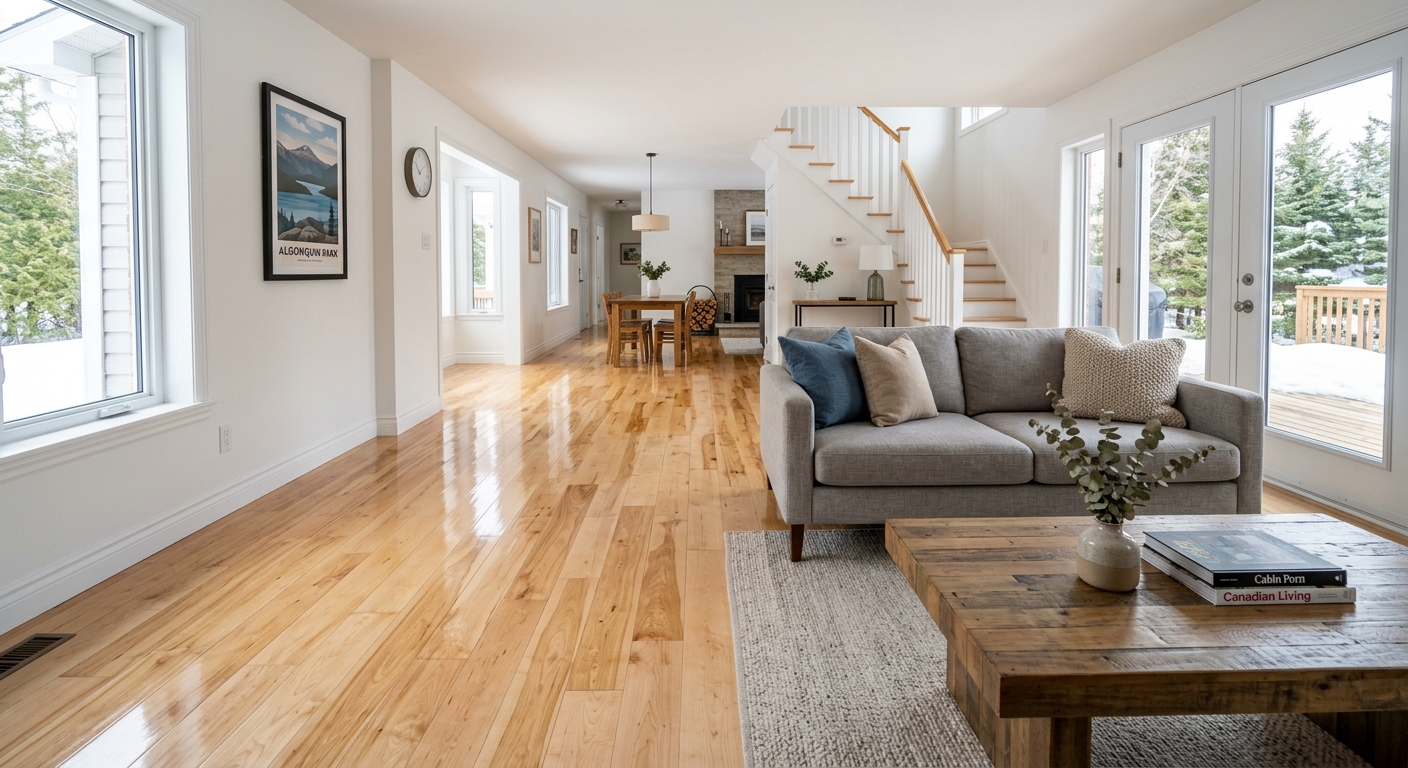
Flooring options and costs in Castleridge
Castleridge, Alberta is a great place to renovate, but flooring costs here are shaped by the same reality many homeowners feel day-to-day: dry, cold prairie winters plus big humidity swings through the year. With a population of 6,130 people (Statistics Canada, 2021 Census), the area draws from the wider Calgary labour pool, but scheduling still tightens during spring and early summer installs. Another price driver is the housing mix—older homes in the Calgary region often have floors that were never meant to be “perfectly flat” for modern flooring, so subfloor levelling and repairs are common before you can even start laying material.
In the Calgary economic region, below-grade moisture migration through concrete is a frequent issue in basements, so contractors typically steer homeowners away from ¾-inch solid hardwood in lower levels. Solid wood can expand and contract with indoor humidity swings and isn’t the right fit over concrete. Instead, engineered hardwood, luxury vinyl plank (LVP) or SPC are usually the safer, more dimensionally stable choices. Tile is also popular in kitchens and baths because it tolerates water and cleaning, but it is particularly sensitive to subfloor flatness—meaning levelling and crack-isolation work can add to the budget.
Trade demand is especially strong around newer infill and family-heavy pockets along the Castleridge corridor where homeowners upgrade “main floor” living spaces first. Once you’ve decided what kind of flooring fits your lifestyle, the next step is comparing typical cost ranges by product type—see the table below.
| Type |
Best Room |
Moisture Resistance |
Lifespan |
Price per sq ft |
| Solid hardwood (nail-down, above grade only) |
Living / dining, hallways |
Low to moderate (humidity-sensitive) |
25–60 years |
$8 – $15 |
| Engineered hardwood (float or glue, above + on-grade) |
Main floor bedrooms, living areas |
Moderate to high (more stable) |
20–40 years |
$9 – $14 |
| Laminate (click-lock, above-grade) |
Living areas, bedrooms |
Low to moderate (edge swelling risk) |
10–25 years |
$3 – $7 |
| Luxury vinyl plank / LVP (waterproof, any level) |
Basement (finished), main floor |
High (waterproof core) |
15–30 years |
$5 – $10 |
| Porcelain / ceramic tile |
Kitchen, baths, entries |
High (properly grouted) |
20–50 years |
$6 – $12 |
| Carpet (broadloom or modular tile) |
Bedrooms, stairs |
Low to moderate (needs moisture control) |
8–15 years |
$4 – $8 |
Prices are estimates only and vary by project scope, site access and material selection.
What affects the price of flooring in Castleridge
Homeowners in Castleridge can see quotes for the “same” flooring come in 30–50% apart across Calgary and Southern Alberta, even when the material line looks similar. The biggest reason is that a quote isn’t just the box price—it’s the full set of prep, labour method, transitions, and disposal work required to get a durable installation that holds up to our dry, cold winters and frequent indoor humidity swings.
Technically, humidity is a major cost driver. In Alberta, solid hardwood expands and contracts with seasonal moisture changes, and it performs poorly over concrete because you can’t glue or float it like engineered or vinyl. That’s why below-grade installs in the Calgary area usually budget for engineered hardwood, LVP or SPC instead of solid oak. In rooms heated by in-floor radiant systems—common in newer builds—colder regions favour radiant-compatible materials, which can also narrow choices and shift costs. Meanwhile, older regional housing stock often needs subfloor levelling or repair; levelling commonly adds about $1–$4 per sq ft depending on how out-of-flat the surface is.
Here are a few real-world examples of how local conditions change the number in Castleridge. If your basement has moisture migration through slab concrete, contractors may include additional moisture steps and switch you to waterproof LVP, pushing you toward the $5–$10 per sq ft band instead of solid hardwood. If your main floor has aged plywood transitions or an uneven patchwork feel, levelling can move a “simple” engineered hardwood project into the mid-range. And if tile is on your plan, the flatness requirements mean you may spend more on prep than the tile itself.
| Price Factor |
Why It Matters |
Cost Impact |
| Room area in sq ft |
Material consumption and labour time scale with footage |
Direct (often 20–60% of total) |
| Subfloor condition |
Levelling/repairs must be done for stability and warranty |
Typically +$1 – $4 per sq ft |
| Moisture / below-grade install |
Rules out solid hardwood; affects underlay and prep |
Often +$500 – $2,000 on basements |
| Material choice |
Solid vs engineered vs LVP vs tile carry different installation demands |
Hardwood: $8 – $15; LVP: often $5 – $10 |
| Removal and disposal of existing flooring |
Extra labour, dump fees and patching after demo |
Commonly +$1 – $3 per sq ft |
| Stair nosing / transitions |
Cutting, profiling and finishing are labour-intensive |
Charged per step or linear foot |
| Radiant heat compatibility |
Some materials shouldn’t be used over radiant circuits |
May add selection constraints or extra underlay |
| Installation method |
Float vs glue-down vs nail-down changes labour and substrate prep |
Can shift total by 10–25% |
Permits & regulations in Alberta
In Alberta, installing flooring itself typically does not require a building permit. However, associated work can. If the project involves structural subfloor repair (for example, major replacement of subfloor framing/joists), moisture remediation steps that affect building components, or changes tied to in-floor heating circuits, permits may be triggered—especially where electrical or controls are involved.
For condominiums, the bigger “rule” often isn’t a permit—it’s the building’s internal by-laws and sound-transmission expectations. Upper-floor hard-surface installations can be restricted or require specific underlay to meet sound performance requirements (STC/IIC targets). Always review the condo declaration and request board approval in writing before installing hardwood or tile on above-grade units, because flooring impacts neighbours through footsteps and vibration.
Step-by-step for checking your contractor in Castleridge:
1) Verify licensing: ask for their Alberta licence details (and confirm they’re eligible for the type of work they’ll perform).
2) Confirm liability insurance: request a certificate of insurance showing current coverage and your project named/covered under the contractor’s policy.
3) Check WCB/WSIB coverage: obtain proof of clearance or coverage for workers involved.
4) Ask for paperwork: request these documents before signing, not after demo.
Best flooring for each room in your Castleridge home
Choosing flooring for a Castleridge home is about matching the product to what the room “does” to moisture, how people move through it, and how comfortable you want the surface to feel in winter. In living and dining areas, homeowners usually want warmth and a solid look without constant worry about seasonal gaps—engineered hardwood or high-quality laminate are common choices because they balance style with stability. For master bedrooms, carpet remains popular in Alberta because it’s quiet and soft underfoot; it also helps manage noise between floors.
Kitchens need something that can handle spills and frequent cleaning, so luxury vinyl plank (LVP) or large-format porcelain tile are strong performers. In a dry but cold prairie climate, tile stays cooler, but it’s predictable and easy to maintain. Basements are where decisions matter most: LVP is often the clear winner because it’s fully waterproof and tolerant of below-grade humidity conditions that can transfer through concrete slabs. Solid hardwood and most laminate are typically poor matches in basements because they can’t handle moisture and vapour swings the way engineered or vinyl can.
Bathrooms should be porcelain or ceramic tile only, installed over an appropriate underlayment system with correct waterproofing at wet areas. If you have radiant heat, plan around compatibility—some product constructions and underlays are better suited than others. As a practical example: if you’re choosing between LVP (commonly $5–$10 per sq ft) and engineered hardwood (often around the $9–$14 range), the basement “extra” for engineered may not pay back as well as the simpler, more reliable LVP approach.
| Room |
Best Material |
Why |
Moisture Risk |
Price Band per sq ft |
| Living / dining room |
Engineered hardwood |
Warm feel with better stability than solid in Alberta humidity swings |
Low to moderate |
$9 – $14 |
| Master bedroom |
Carpet or engineered hardwood |
Comfort and sound control; engineered option if you prefer hard surfaces |
Low |
$4 – $10 |
| Secondary bedrooms |
Carpet |
Budget-friendly comfort for kids/guests; hides minor subfloor inconsistencies |
Low |
$4 – $8 |
| Kitchen |
Luxury vinyl plank (LVP) or porcelain tile |
Easy cleanup and spill tolerance; tile handles water best |
Moderate (spills) |
$6 – $12 |
| Basement (finished) |
LVP (waterproof) |
Designed for below-grade moisture conditions; avoids solid-wood issues |
High |
$5 – $10 |
| Bathroom |
Porcelain / ceramic tile |
Water-resistant system when properly underlayed and grouted |
Very high |
$6 – $12 |
How to choose a flooring contractor in Castleridge
When you’re hiring a flooring contractor in Castleridge, don’t rely on brand names or showroom photos—verify the business details that protect you on a real job site. First, confirm Alberta licensing for the scope you’re buying (ask what licence class applies if applicable to their trade services). Second, request a certificate of liability insurance so you know they’re covered if something is damaged. Third, check workers’ coverage—ask for WSIB/WCB proof (typically a clearance letter or equivalent documentation) for the time of your project. If they can’t provide these documents quickly, that’s a warning sign.
Next, get 2–3 itemised written quotes. You want a breakdown that separates labour (demo, prep/levelling, install, trim/transition work) from materials (underlay, moisture barriers, stair nosing, edge finishing, and special underlay for sound or radiant compatibility). Avoid vague lump-sum proposals that don’t explain what’s included. Confirm disposal and protect/patch items after removal, and ask whether permit pulls are included when the scope touches electrical or structural components.
For warranty, ask for both workmanship and product warranty terms, including who provides them, the length, and whether warranties are transferable if you sell. Payment schedules matter too: never pay more than 10–15% upfront, and hold back payment until the job is complete and issues are addressed. Finally, request a start date and completion estimate in writing so you’re not guessing during Alberta weather swings.
- Request proof of liability insurance before deposit.
- Confirm WSIB/WCB clearance for workers assigned to your job.
- Verify they’ll include subfloor inspection and flatness checks in the scope.
- Ask how they handle levelling (feather finish, patching, or underlayment) and what it costs if conditions change.
- Get itemised labour vs materials so you can compare like-for-like.
- Confirm underlay/moisture barrier type for your specific product and room (especially basement).
- Ask what transitions, stair nosing, and edge details are included.
- Confirm removal, disposal fees, and whether they include subfloor patching after demo.
- Write down what’s excluded (baseboards, doors undercut, painting, drywall touch-ups).
- Confirm warranty: workmanship length, what voids it, and whether it’s in writing.
- Use a payment schedule with 10–15% maximum upfront and a holdback until final sign-off.
- Get a written schedule and who you contact if weather or material lead times affect dates.
In Castleridge, watch for red flags like: quotes that don’t mention subfloor levelling for older homes, “we’ll figure it out later” language for moisture/underlay in basements, no proof of insurance or WCB/WSIB coverage, pressure for large upfront deposits, and warranties described vaguely (no written workmanship term or exclusions).
Frequently asked questions — flooring in Castleridge
How do I choose flooring for humidity in Castleridge?
Castleridge has the kind of indoor humidity swing that can make or break a long-lasting floor in Alberta. Solid hardwood is most sensitive because it expands and contracts; it also isn’t the right choice over concrete slabs, so basements are typically excluded. If you’re installing above grade, engineered hardwood is usually the safest “warmth” option because it’s more dimensionally stable than solid wood. For below grade, luxury vinyl plank (LVP) or SPC is preferred—these waterproof products handle moisture vapour and accidental spills far better. If you’re comparing budgets, note that LVP often lands in the mid-range (commonly around $5 – $10 per sq ft) versus solid hardwood ($8 – $15) for above-grade installs. The best choice still depends on your subfloor condition and whether the contractor includes moisture-safe prep.
Do condos restrict hard flooring?
Yes, in many Alberta condo buildings, the restrictions are about sound transmission rather than a building permit. In a multi-unit setting near Castleridge, the condo board can require specific underlay, restrict when construction happens, or limit installation methods that increase impact noise. Because footsteps and vibration can travel through the structure, corporations often set targets related to STC/IIC performance and may require a particular sound underlay for hardwood or tile on upper floors. The practical step for homeowners: review your condo declaration and request board approval in writing before you order materials. Then make sure your contractor’s plan includes the approved underlay and installation approach. This can affect your cost and timeline—particularly if tile needs additional prep to meet flatness requirements over a sound-safe assembly.
How do I compare flooring quotes?
To compare quotes fairly in Castleridge, treat each proposal like a recipe: you need to see what’s in it. Ask for itemised labour (demo, levelling/patching, install, trim and transitions, stair work) and itemised materials (flooring type, underlayment/moisture barrier, transition mouldings, fasteners/adhesive). Watch for “lump sum” quotes that don’t explain what happens if the subfloor is out of level—older homes in the Calgary region commonly need levelling, and prep can change the final number. Compare how each contractor handles moisture considerations for basements and whether they state that solid hardwood is above-grade only. For pricing context, if one quote offers solid hardwood around $8 – $15 but doesn’t discuss moisture/flatness prep, it may not be apples-to-apples. The best quote usually costs more slightly but includes the substrate steps needed for longevity and warranty.
Can I install flooring over existing tile in Castleridge?
Sometimes, but not always. Installing over existing tile depends on tile height, bond condition, and how flat the surface is. In many cases, tile needs to be evaluated for loose or cracked sections; any hollow spots or loose grout can lead to movement, which causes grout-line failure for tile or creates a “rocking” effect for floating floors. For LVP or SPC, you can sometimes install over hard, well-bonded surfaces if the tile is flat enough and the manufacturer allows it—your contractor should check flatness and provide the correct underlayment requirements. If you’re planning engineered hardwood or laminate, the margin for unevenness is smaller. If tile is removed, disposal and subfloor repairs add cost, but it can lead to a more reliable base. Ask your contractor to include an explicit subfloor prep plan in writing before you decide.
What is the best flooring for a high-traffic area in Castleridge?
For high-traffic areas in Castleridge—entries, hallways, and open living zones—durable, dimensionally stable products usually perform best. LVP/SPC is a top choice because it’s generally waterproof, resists everyday scuffs better than many laminates, and handles Alberta moisture swings more consistently. Engineered hardwood can also be excellent in main areas if you select a wear layer that suits traffic and if the installation is done over a properly prepared substrate. Carpet works well for comfort, but it can show matting sooner in heavy footfall zones if it isn’t high-density or protected with good maintenance. As a budgeting example, if LVP comes in around $5 – $10 per sq ft and engineered hardwood is closer to $9 – $14, the LVP option often makes sense where spill risk and abrasion are higher. The “best” pick is the one that matches your basement moisture situation, traffic level, and how strict you want to be on maintenance.
How do I prepare my subfloor before new flooring?
Subfloor preparation is where many Castleridge projects are won or lost. Start with a contractor-led inspection: they should check flatness (not just “looks straight”), evaluate for damage, and confirm that the surface is solid and clean. For older homes, plan for levelling and repair—between patches, aged plywood, and transitions, levelling is commonly part of the scope and can add roughly $1–$4 per sq ft depending on the condition. Moisture is the next step, especially in basements where vapour migration through concrete is common; the correct moisture barrier and installation method matter more than most homeowners expect. For tile, flatness and crack isolation are critical, so prep often includes specific membranes or patch systems. Ask for the prep details in writing: what products are used, what thickness/level targets are required, and what happens if additional repair is discovered after demo.