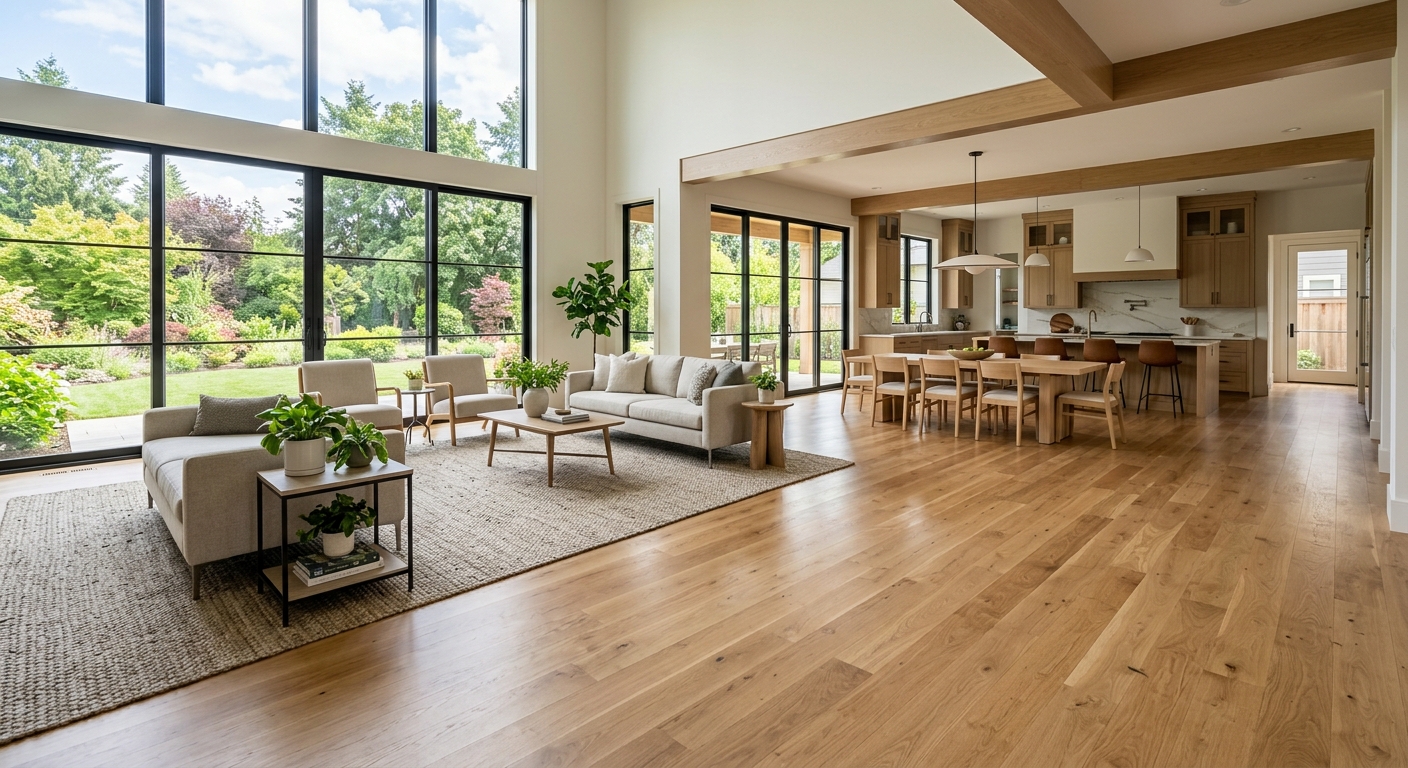
Flooring options and costs in Crestmont
Crestmont homeowners typically see flooring projects become a balancing act between comfort, durability, and the real “hidden” costs of getting the slab and subfloor ready. With a small population of 2,275 people (Statistics Canada, 2021 Census), local contractors often book quickly during peak season, and scheduling can affect how much labour time is priced into your quote. In the Calgary economic region, many older homes also require some degree of subfloor levelling or repair before new finishes go down—especially where plywood is aged or where transitions between rooms have uneven surfaces. That prep work can commonly add roughly 1–3 per sq ft depending on how out-of-level the base is.
Calgary’s dry, cold prairie climate brings big seasonal swings in humidity. That matters because solid hardwood expands and contracts with indoor moisture, and it’s not a basement-friendly choice over concrete. Moisture migration through slabs is also a common issue in the area, so below-grade installs generally favour engineered hardwood, luxury vinyl plank (LVP) or SPC, and in wet zones, porcelain/ceramic tile. The market in and around Crestmont—servicing Calgary and nearby communities—also means you’ll usually find the most competitive pricing on LVP/SPC and laminate because they’re stocked more consistently, while tile and labour-sensitive levelling steps can push costs higher.
If you’re in the busier South Hill–style infill pockets and near the main commuting corridors, installers tend to be in demand because families time renovations around school schedules and holiday breaks. Next, use the table below to compare typical material and installed-cost expectations so you can read quotes with confidence.
| Type |
Best Room |
Moisture Resistance |
Lifespan |
Price per sq ft |
Price Range |
| Solid hardwood (nail-down, above grade only) |
Living / dining |
Low (humidity sensitive; not for basements) |
20–30 years |
$8.00–$15.00 |
$9,500–$18,000 |
| Engineered hardwood (float or glue, above + on-grade) |
Main floor hallways |
Medium–high (more dimensionally stable) |
15–25 years |
$9.00–$14.00 |
$10,500–$17,500 |
| Laminate (click-lock, above-grade) |
Living areas |
Low–medium (water can damage core) |
10–20 years |
$3.00–$7.00 |
$4,000–$9,500 |
| Luxury vinyl plank / LVP (waterproof, any level) |
Kitchen + main floor |
High (waterproof surface) |
15–25 years |
$5.00–$10.00 |
$6,000–$13,000 |
| Porcelain / ceramic tile |
Bathrooms + entryways |
High (when properly installed) |
25–50 years |
$6.00–$12.00 |
$8,000–$16,000 |
| Carpet (broadloom or modular tile) |
Bedrooms |
Low–medium (stains; moisture should be controlled) |
7–15 years |
$4.00–$8.00 |
$4,500–$10,500 |
Prices are estimates only and vary by project scope, site access and material selection.
What affects the price of flooring in Crestmont
You can easily see the same type of flooring job come in 30–50% apart in Calgary-area quotes because the “scope” isn’t identical—labour hours, subfloor prep, moisture requirements, and product grade all shift the total. In Crestmont and surrounding communities, indoor humidity swings and below-grade moisture are the two technical drivers that most change outcomes. Solid hardwood expands and contracts with humidity; it’s also generally not installed directly over concrete in basements, so crews steer toward engineered hardwood or waterproof LVP/SPC for those spaces. Likewise, colder-region compatibility matters: many solid hardwood options (and some laminate) can perform poorly with radiant heat unless the product is specifically rated for it. Older housing stock frequently needs levelling or repair; in practice that can add about $1–$4 per sq ft depending on how much is out of flat and whether damaged underlay/plywood must be removed and replaced.
For concrete examples: if your main floor has older plywood with dips near doorways, levelling can become a major cost line item—especially before tile, where flatness is critical and crack isolation may be recommended. If you’re finishing a basement in Crestmont, the prep and materials frequently cost more upfront because contractors must address moisture migration through slab and use a waterproof system; that’s why LVP often lands as a better value than trying to force solid wood. Finally, stair work can tip the scale: stair nosings and transitions are commonly priced separately and can add meaningful labour time beyond “per sq ft” flooring.
When you’re comparing offers, use these bands as your anchor: laminate/vinyl may start closer to $3–$7 per sq ft, while tile commonly sits around $6–$12 per sq ft, and hardwood falls in the higher $8–$15 per sq ft range.
| Price Factor |
Why It Matters |
Cost Impact |
| Room area in sq ft |
Material plus labour scale directly with total surface area and waste |
Typically +/− $3–$8 per sq ft equivalent effect on totals |
| Subfloor condition |
Levelling, patching, or replacing damaged boards is often mandatory for long-term performance |
Commonly adds $1–$4 per sq ft on older or uneven bases |
| Moisture / below-grade install |
Basements need moisture-safe products; solid hardwood is generally not suitable |
Can add $2–$6 per sq ft in prep and material upgrades |
| Material choice |
Solid vs. engineered vs. LVP vs. tile have different installation requirements and price points |
Often swings the job by $4–$10 per sq ft |
| Removal and disposal of existing flooring |
Demos, haul-away and disposal fees add labour and truck time |
Often adds $1–$3 per sq ft depending on type and access |
| Stair nosing / transitions |
Stairs and transitions require extra boards, cuts, and labour detail work |
Typically billed per step or per linear foot; can add 10–20% to the quote |
| Radiant heat compatibility |
Only certain materials are designed to move safely with heat cycles |
May add $1–$5 per sq ft through product selection and acclimation |
| Installation method |
Float vs. glue-down vs. nail-down changes labour time, subfloor prep, and fastening/adhesive costs |
Can shift labour by several dollars per sq ft |
Permits & regulations in Alberta
In Alberta, a typical flooring installation does not require a building permit by itself. If you’re simply laying floating LVP/laminate, installing carpet, or nailing/gluing approved flooring systems on an existing stable subfloor, it’s generally a “no permit” scope. However, associated work can trigger permits. For example, if your project includes structural subfloor repair, moisture remediation that involves major substrate rebuilding, or any changes to in-floor heating controls/electrical circuits, that’s where permitting and electrical sign-off may come into play. In many condo buildings, the corporation’s rules also become the “real regulation”: hard flooring on upper floors may be restricted or require specific underlay to meet sound transmission expectations (STC/IIC) per the condo’s documents.
Step-by-step, a Crestmont homeowner can protect themselves:
- Ask for the contractor’s Alberta licence information and verify it through the appropriate provincial registry listings.
- Request proof of liability insurance with a current policy number and coverage amount (and confirm the effective dates).
- Ask for WSIB/WCB coverage evidence (or applicable exemption documentation if they’re legitimately not required to carry it).
- Get the contractor to list what they’re doing that could be permit-related (structural repair, electrical work, radiant system work).
- For condos, request board approval in writing before installing hardwood or tile on upper-level floors.
- Ensure the written contract specifies who is responsible for any required permits and inspections (if applicable).
Best flooring for each room in your Crestmont home
The best choice for each room in a Crestmont home comes down to moisture exposure, day-to-day traffic, and comfort—then matching that to Calgary-area climate realities. For living and dining spaces, engineered hardwood or high-quality laminate tends to be a sweet spot: it delivers the look homeowners want while tolerating humidity swings better than traditional solid wood. In the master bedroom, carpet is still a strong comfort option because it reduces noise and feels warm underfoot during cold prairie mornings. If you prefer a hard surface, engineered hardwood also works well as long as the home is kept at a reasonable indoor humidity level.
In kitchens, go waterproof: luxury vinyl plank (LVP) or large-format porcelain tile handles spills and frequent cleaning. For basements, LVP is usually the clear winner—waterproof surfaces plus better tolerance for below-grade conditions means you avoid the risk of solid wood reacting to moisture vapour. Bathrooms should be porcelain/ceramic tile only, with proper membranes and grout selection to manage water and movement. If you have (or plan) radiant heat, confirm the product is rated for it—many solid hardwood options (and some laminate) are limited because heat cycles can cause excessive movement.
Cost-wise, it’s not always “cheapest wins.” For example, if your living area is 400 sq ft, laminate at $3–$7 per sq ft can be far less than engineered hardwood around $9–$14 per sq ft, but the durability and feel difference may be worth it if you expect long-term ownership and heavy family traffic.
| Room |
Best Material |
Why |
Moisture Risk |
Price Band per sq ft |
| Living / dining room |
Engineered hardwood |
Warm look with better stability through prairie humidity swings |
Low (control indoor humidity) |
$9.00–$14.00 |
| Master bedroom |
Carpet or engineered hardwood |
Carpet adds comfort and sound absorption; engineered hardwood is a durable alternative |
Low |
$4.00–$14.00 |
| Secondary bedrooms |
Carpet (broadloom) or laminate |
Comfort for kids; laminate handles routine traffic when installed correctly |
Low–medium (spill risk) |
$3.00–$8.00 |
| Kitchen |
Luxury vinyl plank (LVP) or porcelain tile |
Easy cleaning; waterproof performance in splash zones |
Medium (spills and wet feet) |
$5.00–$12.00 |
| Basement (finished) |
LVP (waterproof) |
Handles below-grade moisture better than solid wood and most laminate |
High (vapour migration risk) |
$5.00–$10.00 |
| Bathroom |
Porcelain / ceramic tile |
Best long-term water resistance when paired with the right underlayment and waterproofing |
Very high |
$6.00–$12.00 |
How to choose a flooring contractor in Crestmont
Start by confirming the basics in Alberta: a competent flooring contractor should provide proof of current liability insurance and appropriate worker coverage (WSIB/WCB where required). How to check: ask for the certificate of insurance (with policy number and effective dates) and verify it hasn’t expired; then request their coverage documentation and ensure it matches the scope of work they’ll perform. For licensing, ask for their Alberta licence details and verify them through the appropriate provincial registry listings—don’t rely on “we’re licensed” statements without paperwork.
Next, compare quotes the right way. Get 2–3 itemised written quotes, not lump sums, so you can see separate line items for: material supply, underlayment (if required), prep/levelling, removal and disposal, transitions and stair work, and any membrane/crack isolation (especially for tile). Read exclusions carefully: find out what they won’t do (subfloor replacement limits, moisture remediation responsibilities, or how they handle out-of-flat concrete). Also confirm whether permits or electrical work are included if radiant controls or circuits are being modified.
For warranty, ask for both workmanship and product terms in writing, including whether the workmanship warranty is transferable to the next owner and how long it lasts. Payment schedule matters: never pay more than 10–15% upfront, and use a holdback until the job is complete and cleaned. Get the start date and completion estimate in writing too—Clarity reduces change orders when crews are scheduling around prairie weather.
- Written quote with an itemised breakdown (materials, labour, prep, disposal, transitions).
- Specific product names, thickness/grade, and plank/tile dimensions.
- Moisture plan for basements: what they use and how they verify conditions.
- Subfloor levelling method described (skim coat vs. patching vs. underlayment system).
- Tile flatness and membrane/crack isolation included where required.
- Stair work pricing per step/linear foot spelled out.
- Underlayment and vapour barrier details listed (not just “included”).
- Waste factor included in measurement assumptions.
- Clear start/completion timeline and what weather delays allow.
- Warranty terms for labour duration and conditions, plus product warranty period.
- Payment terms capped at 10–15% deposit and holdback until completion.
- Proof of insurance and WSIB/WCB coverage provided before work starts.
Red flags to watch for: a quote that skips subfloor/levelling details for an older Crestmont home, refusing to provide insurance/coverage proof, vague scope like “labour only” without a written breakdown, pushy requests for large deposits, or promises to install solid hardwood in basements without a moisture-safe approach.
Frequently asked questions — flooring in Crestmont
What's the most durable flooring for pets and kids?
For Crestmont families dealing with pets and kids, the most durable “day-to-day” option is usually waterproof luxury vinyl plank (LVP) or LVP/SPC. It resists moisture from wet paws and spills, and it handles the impacts of dropped toys better than tile grout areas that can chip if mishandled. If you want a softer feel, carpet is comfortable, but it’s easier to stain and can hold odours if spills aren’t cleaned quickly. In terms of typical costs in this Calgary-area market, LVP projects commonly land in the $5.00–$10.00 per sq ft material band, whereas carpet installation is often priced in the $3.00–$5.00 per sq ft range for the labour portion. If you’re considering hardwood, choose engineered and keep indoor humidity steady to reduce expansion issues.
How do I choose flooring for humidity in Crestmont?
Crestmont sits in a dry, cold prairie climate where indoor humidity can swing a lot through the year. That matters because solid hardwood expands and contracts—so it’s typically an above-grade choice only. In practical terms for Alberta basements, moisture vapour moving through concrete is a common concern, which is why solid hardwood generally performs poorly in those applications. Instead, engineered hardwood is usually more stable than solid, and LVP is the safer bet because it’s waterproof and dimensionally more tolerant of moisture exposure. If you have radiant heat, humidity and heat cycling together can widen movement—so use products rated for radiant systems. A good contractor will discuss acclimation time, recommended indoor humidity targets, and whether your subfloor needs levelling (sometimes $1–$4 per sq ft in older homes).
Do condos restrict hard flooring?
Yes, many condos in the Calgary area can restrict hard flooring, especially on upper floors, because of sound transmission concerns. In Alberta condos, the corporation’s rules typically control what you can install and what underlay system you must use to meet required STC/IIC targets. Before you book install day, ask the board/management for the condo declaration requirements and get written approval (not just an email promise). Practically, the installer should confirm the underlay and installation method so the system meets the building standard. If you’re choosing between carpet, laminate, and tile/hardwood, carpet often avoids the strictest sound requirements, while tile and some hardwood installs often require specific underlay. This is particularly important if you’re renovating close to neighbours—your best “value move” is choosing an approved assembly up front, rather than redoing the floor later.
How do I compare flooring quotes?
To compare quotes in Crestmont fairly, insist on itemised line items and the actual scope in writing. Look for whether each quote includes: subfloor levelling/repair, removal and disposal, underlayment/vapour barrier (where required), transitions and stair nosing, and any membranes/crack isolation for tile. If one quote is significantly lower, it often excludes prep work—especially important for tile flatness and for older plywood subfloors that need correction. Also check material bands: if one contractor quotes laminate in the $3–$7 per sq ft range but another uses a higher-grade engineered hardwood ($8–$15), totals can be misleading. Finally, confirm warranty details (workmanship duration and what voids coverage) and the payment schedule. A reputable contractor will provide a start and completion timeline and won’t ask for excessive upfront money.
Can I install flooring over existing tile in Crestmont?
Sometimes, but it depends on what you find once the edges and surface are assessed. Installing over existing tile usually requires that the tile is well-bonded, flat, and properly prepared (often through grinding and smoothing high spots). If the tile surface is uneven, loose, or has movement, it can telegraph through and cause problems—especially for click-lock products and for tile-on-tile over time. For LVP, contractors may consider it if they can meet flatness requirements, but the prep step can be substantial and cost-saving only if the existing tile is in very good condition. If you’re installing new tile, you typically need an appropriate underlayment/membrane system and confirmed substrate stability. In Calgary-area homes, moisture and levelling are recurring issues, so a site visit and flatness check are essential before deciding to leave the tile in place.
What is the best flooring for a high-traffic area in Crestmont?
For high-traffic areas in Crestmont—entryways, living rooms, and main hallways—porcelain/ceramic tile and quality LVP are often the best performers. Tile is extremely durable and easy to clean, but it’s sensitive to subfloor flatness and can be costlier once levelling and membranes are included. LVP can be a more budget-friendly “workhorse” because it’s waterproof, easier to maintain, and less affected by minor moisture vapour issues common in basements and on-grade concrete. In price terms, tile commonly sits in the $6–$12 per sq ft band, while LVP/SPC tends to come in closer to the $5–$10 per sq ft range depending on wear layer and click-lock system. Carpet can work in bedrooms, but in hallways it typically wears faster in Alberta’s dry, dusty seasons unless you’re diligent with cleaning and mat placement.