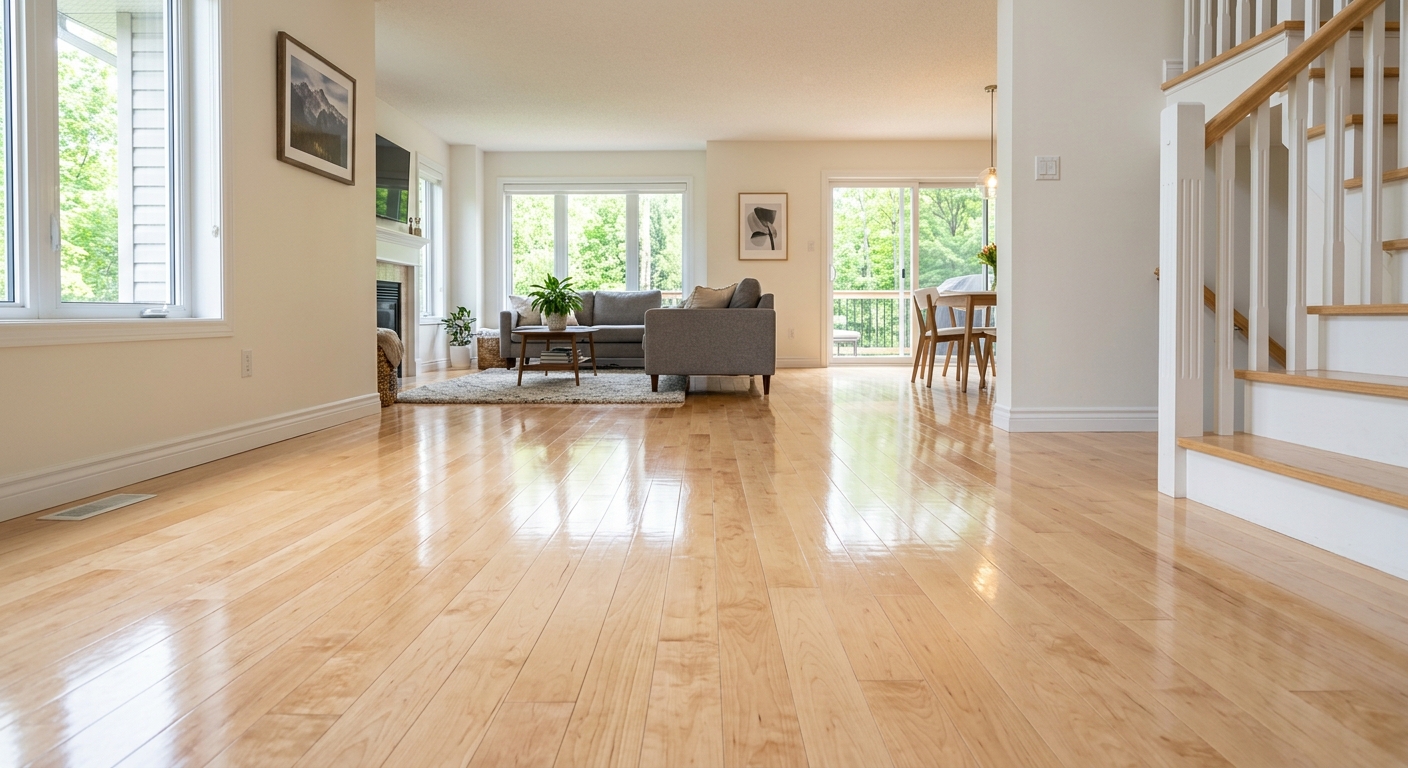
Flooring options and costs in Drayton Valley
Flooring in Drayton Valley is priced and planned with a very Alberta reality in mind: indoor humidity swings and frequent basement moisture. With 7,291 residents and 2,065 homeowner households, many projects involve older housing stock—45.6% of homes were built before 1981. In that situation, you commonly see floorboards, older plywood, or uneven subfloors that need patching or levelling before anything new goes down. That prep work can realistically add about $1.50–$4.00 per sq ft, depending on how out-of-level the area is and whether underlayment is being replaced.
In the Edmonton economic region, contractor demand is steady for moisture-tolerant flooring, especially for basements and main-floor renos in neighbourhood pockets similar to where many Drayton Valley families cluster around older subdivisions—where below-grade areas are more likely to show seasonal dampness. Because of the climate, solid hardwood is usually limited to above-grade installs; engineered hardwood and luxury vinyl plank (LVP) are the go-to choices when you want stability through summer humidity and winter dryness. If you’re adding radiant heat, that further shapes material selection: cold winters and in-floor heating compatibility make tile systems and many LVP/engineered options more practical than most solid hardwood.
Below is a homeowner-friendly comparison of what each option typically costs per sq ft in this tier, so you can budget first and then fine-tune with your contractor on site conditions and prep.
| Type |
Best Room |
Moisture Resistance |
Lifespan |
Price per sq ft |
Price Range |
| Solid hardwood (nail-down, above grade only) |
Living / dining / bedrooms (above grade) |
Low to moderate (humidity sensitive; avoid basements) |
25–60 years |
Installation-focused pricing |
$10–$25 |
| Engineered hardwood (float or glue, above + on-grade) |
Main floor, hallways, bedrooms |
Moderate to high (layered core handles seasonal swings better) |
15–35 years |
Installation-focused pricing |
$9–$22 |
| Laminate (click-lock, above-grade) |
Bedrooms, living rooms (dry zones) |
Moderate (seams resist short spills; avoid moisture exposure) |
10–25 years |
Material and install pricing |
$4–$8 |
| Luxury vinyl plank / LVP (waterproof, any level) |
Basements, kitchens, entryways |
High to waterproof (tolerates vapour and typical basement conditions better) |
15–25 years |
Material and install pricing |
$4–$10 |
| Porcelain / ceramic tile |
Bathrooms, kitchens, mudrooms |
Very high (excellent for wet use) |
25–50 years |
Installation-focused pricing |
$5–$15 |
| Carpet (broadloom or modular tile) |
Bedrooms, family rooms |
Low (avoid basements unless moisture-managed) |
7–15 years |
Installation-focused pricing |
$6–$12 |
Prices are estimates only and vary by project scope, site access and material selection.
What affects the price of flooring in Drayton Valley
Two homeowners can receive very different quotes for what sounds like the same flooring in the Edmonton economic region, with real-world bids varying roughly 30–50% once you include the “invisible” job drivers. The big ones are indoor humidity swings, basement moisture management, and the condition of the subfloor. In Drayton Valley, where many properties include pre-1981 builds (45.6% of homes), subfloor repair and levelling are common add-ons—not because contractors are “padding,” but because uneven surfaces and aging materials can prevent click-lock floors from seating correctly or cause tile to fail over time.
Technically, solid hardwood expands and contracts with humidity and should not be glued or floated over concrete. It also performs poorly in basements where moisture vapour and seasonal dampness are more likely. Engineered hardwood and luxury vinyl plank (LVP) are far more forgiving in Alberta’s cycle of winter dryness and spring/summer humidity. For radiant heat compatibility, cold winters push more customers toward LVP, many engineered woods, and tile, since most of those systems tolerate hydronic or electric heat when installed to manufacturer specs. That can affect both materials and labour—tile labour tends to be higher, while LVP often speeds installation over properly prepared subfloors.
Concrete examples: If your living room needs patching and levelling, add about $1.50–$4.00 per sq ft before you even compare products. If you’re switching from laminate at around $4–$8 per sq ft to waterproof LVP (often $4–$10 per sq ft), the price difference is often justified by reduced risk in damp zones. Conversely, choosing tile at roughly $5–$15 per sq ft may cost more, but it’s a “buy once” approach for bathrooms where durability matters most.
| Price Factor |
Why It Matters |
Cost Impact |
| Room area in sq ft |
Directly drives material quantity and labour hours. |
Typically 15–30% of total variance depending on cuts and access |
| Subfloor condition |
Levelling/repairs are required for flatness for best results and warranty. |
Often adds about $1.50–$4.00 per sq ft in Alberta projects |
| Moisture / below-grade install |
Moisture rules out solid hardwood and can change underlay choices. |
Can shift you from lower-cost products to engineered/LVP; sometimes +10–20% |
| Material choice |
Solid vs engineered vs LVP vs tile each has different prep and install requirements. |
Broadly spans $4–$25+ per sq ft tier differences |
| Removal and disposal of existing flooring |
Old adhesives, nails, and underlay disposal can be time-consuming. |
Commonly +$1–$3 per sq ft (varies with substrate) |
| Stair nosing / transitions |
Transitions are paid per step or per linear foot and take extra labour. |
Often adds a noticeable line item, especially in multi-level homes |
| Radiant heat compatibility |
Not every product is approved over in-floor heating systems. |
May increase material costs; can also reduce risk-related future repair |
| Installation method |
Floating vs glue-down vs nail-down changes labour and substrate prep needs. |
Can swing labour by ~10–25% depending on system |
Permits & regulations in Alberta
In Alberta, installing flooring itself usually does not require a building permit. However, associated work can trigger permitting—especially when you’re changing electrical systems or structural elements. If your project includes in-floor heating circuit modifications, that electrical scope may require permits and inspection, depending on what’s being altered. Similarly, moisture remediation that involves structural subfloor replacement or significant construction changes may require approvals if it crosses into more than straightforward repair (for example, removal of damaged subfloor portions, significant membrane work, or structural framing adjustments).
In condominiums, even when a permit isn’t required, condo rules can restrict what you install. Sound transmission requirements (commonly referenced through STC/IIC performance expectations) often dictate the type of underlay under hard flooring on upper floors, and some boards require specific products or pre-approval. Before you move ahead with hardwood, tile, or other impact-heavy surfaces, review the condo declaration and ask for written board approval when required.
To verify your contractor in Drayton Valley, start with licensing and coverage. Check Alberta’s contractor licensing search tools online for the appropriate licence category for flooring and related contracting scope. Then request a current Certificate of Insurance (liability) naming you as an interested party if they’re willing. For worker protection, confirm WSIB/WCB coverage through their proof letter or clearance documentation—ask for the certificate number and expiry date, not just a verbal confirmation. Finally, insist on a written scope that confirms disposal, underlayment choices, and any moisture mitigation steps, because those are common sources of “surprise” cost.
Best flooring for each room in your Drayton Valley home
Choosing the right flooring for each space in Drayton Valley means matching the material to moisture exposure, foot traffic, and comfort in Alberta’s seasonal swing. Living and dining areas typically benefit from engineered hardwood or quality laminate because they deliver warmth and a cleaner look than carpet, while remaining more tolerant of humidity changes than solid hardwood. In a master bedroom, carpet is still a top comfort choice—quiet underfoot and excellent for sound absorption—though it should be avoided in poorly controlled damp areas.
Kitchens are a different story: spills, humidity, and daily wet cleaning favour luxury vinyl plank (LVP) or large-format porcelain tile. LVP is widely used in Edmonton-region homes and basement suites because it’s waterproof and handles typical vapour exposure better than wood-based products. Basements are where this choice matters most; the layered construction of LVP helps tolerate below-grade conditions that can cause gapping or cupping in solid wood. Bathrooms should be tile (porcelain or ceramic), because it’s engineered for wet environments and easier to keep sanitary over time.
Radiant heat compatibility is increasingly important in Alberta. Many engineered wood and LVP products are approved for hydronic/electric radiant systems when installed under the manufacturer’s temperature and acclimation instructions; most tile systems also perform well. If you’re deciding between laminate at about $4–$8 per sq ft and LVP closer to the $4–$10 range, the extra cost is often justified when you’re covering a main floor that connects to a damp entry, or when part of the run crosses into an area with a history of basement moisture tracking.
| Room |
Best Material |
Why |
Moisture Risk |
Price Band per sq ft |
| Living / dining room |
Engineered hardwood |
Warm look with better humidity tolerance than solid in Alberta’s swing. |
Low to moderate (watch for tracked-in moisture at entrances) |
$9–$22 |
| Master bedroom |
Carpet or engineered hardwood |
Carpet adds comfort and sound control; engineered gives a cleaner, longer-lasting finish. |
Low (mainly normal household humidity) |
$6–$16 |
| Secondary bedrooms |
Laminate or engineered hardwood |
Laminate can be cost-effective; engineered holds up better if humidity is less predictable. |
Low (avoid soaking from leaks) |
$4–$18 |
| Kitchen |
Luxury vinyl plank (LVP) or porcelain tile |
LVP is waterproof and easy to maintain; tile handles water splashes and heavy cleaning. |
Moderate to high (spills and wet mopping) |
$5–$15 |
| Basement (finished) |
LVP (waterproof) |
Best match for below-grade moisture vapour and typical Alberta basement conditions. |
High (vapour and seasonal dampness) |
$4–$10 |
| Bathroom |
Porcelain / ceramic tile |
Non-porous surfaces handle wet use and are straightforward to waterproof properly. |
High (direct water contact) |
$5–$15 |
How to choose a flooring contractor in Drayton Valley
Picking the right flooring contractor in Drayton Valley comes down to verification, clarity, and workmanship habits that fit Alberta’s subfloor and moisture challenges. Start by confirming Alberta licensing for the work they’re performing and ask for their current liability insurance certificate. Coverage should list jobsite details or at least the general contractor/insured parties clearly. Next, verify WSIB/WCB coverage: request the proof document (clearance letter/certificate) and check the expiry date. If they can’t provide current documentation promptly, that’s a serious warning sign.
Then get 2–3 itemised written quotes. You want line items for labour and materials, including underlayment, patching/levelling (if needed), stair nosing and transitions, and disposal. Avoid “all-in lump sum” quotes that don’t state what’s included—especially with older Drayton Valley homes where uneven subfloors are common. Ask if permits are included for any electrical/radiant work and whether moisture remediation steps are part of the scope if they uncover issues.
Warranty should be in writing: confirm the workmanship warranty length, and separate it from the product manufacturer warranty. Also ask if the warranty is transferable if you sell the home. Payment matters: never pay more than about 10–15% upfront, and hold back a portion until the job is complete and you’ve inspected transitions, edges, and cut-outs. Finally, demand timeline details—start date and estimated completion—in writing.
- Provide licence number and proof of liability insurance before signing.
- Show WSIB/WCB clearance or coverage proof (with expiry dates).
- Use an itemised quote: labour, materials, underlay, prep, and disposal.
- State what “subfloor prep” includes (levelling, patching, underlayment type).
- Confirm moisture treatment steps if they find dampness in basements.
- List transition and stair nosing pricing per step or per linear foot.
- Include acclimation requirements for hardwood/engineered products.
- Clarify waste/disposal fees and whether they haul away underlay and debris.
- Write down warranty terms for workmanship and labour vs product coverage.
- Use a payment schedule with a holdback until final inspection.
- Provide a start date and a completion estimate in writing.
- Ask for references for Edmonton-area moisture-sensitive installs (especially basements).
Common red flags I see with flooring contractors in Drayton Valley include: they won’t provide WSIB/WCB or insurance documents on request, they refuse itemised pricing for prep/underlay, they minimize basement moisture concerns with “it’ll be fine” promises, they don’t specify acclimation or manufacturer install requirements, and they ask for large upfront deposits before any measurable work begins.
Frequently asked questions — flooring in Drayton Valley
What flooring is best for a Drayton Valley basement?
For most Drayton Valley basements, luxury vinyl plank (LVP) is the safest all-around choice because it’s waterproof and better suited to Alberta basement moisture vapour than solid hardwood or standard laminate. With many homes built before 1981 in the region (Statistics Canada, 2021 Census), older basements often show seasonal dampness or uneven slab/subfloor conditions, and LVP’s layered construction helps it perform more consistently. If you’re comparing budget options, laminate often lands around the $4–$8 per sq ft band, while waterproof LVP commonly runs higher (often roughly $4–$10 per sq ft). That difference is frequently justified by reduced risk of gapping, cupping, or edge swelling in below-grade areas.
Can I install hardwood over concrete?
In most Alberta homes, solid hardwood is generally not the right choice for direct concrete installs. Solid wood is humidity-sensitive and typically requires nail-down above grade (or a system specifically approved by the manufacturer). Over concrete, the more practical approach is engineered hardwood, installed per manufacturer instructions (often floating or glue-down with the correct moisture barrier where required). In Drayton Valley, where humidity swings are noticeable and basement moisture can be present, following the product’s concrete/membrane requirements is crucial. If you’re quoted for solid hardwood “over slab,” ask for the exact installation method and written manufacturer approval—otherwise you risk movement and warranty disputes.
How long does flooring installation take?
Timing depends on room size, subfloor prep, and how much removal is involved. In Drayton Valley, a straightforward above-grade job for a typical living space can be finished in a couple of days, but projects extend quickly when levelling, patching, or underlayment replacement is needed. As a rule of thumb, prep is often the pacing item in older homes; with 45.6% of area homes built before 1981 (Statistics Canada, 2021 Census), it’s common to budget extra time for correcting uneven subfloors and handling damaged underlay. Also note: acclimation for engineered products and drying time for patch compounds can add calendar time even if crews are working. Always ask your contractor for a start date and completion estimate in writing.
What flooring works with radiant heat?
Radiant heat compatibility is a major consideration in Alberta, especially during cold winters. Many LVP products and many engineered hardwood lines are approved over hydronic or electric radiant systems when installed to the manufacturer’s temperature limits and acclimation requirements. Tile systems (porcelain/ceramic) are also widely used over radiant heat because they handle temperature changes well and are stable. What to avoid: most solid hardwood installs are more restrictive due to humidity and temperature movement concerns. For your quote, ask the contractor to confirm the exact product model number is radiant-approved and to follow the approved underlayment/thinset or bonding method. This is one area where “close enough” can cause long-term problems.
Engineered vs solid hardwood — what's the difference?
Solid hardwood is one uniform piece of wood; it’s durable but more sensitive to humidity changes. That’s why in Drayton Valley we typically steer solid nail-down hardwood to above-grade rooms only and avoid basements. Engineered hardwood is made in layers (a stable core with a hardwood veneer on top). That layered construction makes engineered wood more tolerant of seasonal expansion and minor subfloor movement, and it’s usually a better fit over concrete when installed using approved methods. In practice, engineered hardwood can be a strong middle ground if you want a hardwood look without the same basement risk. Budget-wise, both can vary widely, but many projects in this tier commonly land around the $9–$22 per sq ft band for engineered.
Do I need to level my subfloor first?
Often, yes—especially in older Drayton Valley homes where uneven subfloors are common. Levelling matters because most modern flooring systems require a flat, stable surface: laminate and LVP can lock and sit better with a flatter substrate; tile demands proper flatness for thinset bonding; and engineered hardwood needs a consistent plane to prevent joint stresses. If the contractor finds humps, dips, or damaged plywood, they may recommend patching or underlayment changes. Preparation commonly adds about $1.50–$4.00 per sq ft in the Edmonton region when levelling is required. The best approach is to measure and document flatness during the estimate so you can see whether the added prep cost will protect your new floor investment.