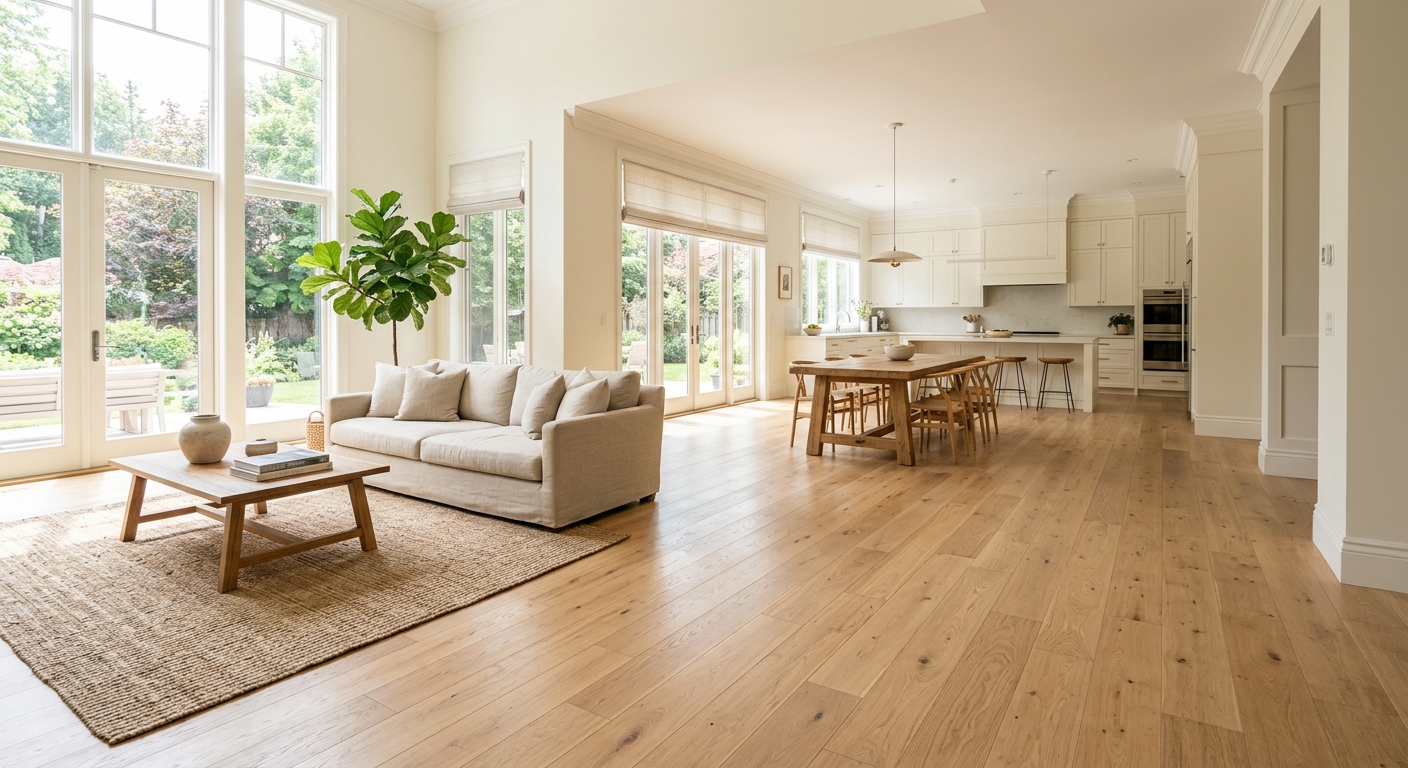
Flooring options and costs in Harvest Hills
In Harvest Hills, Alberta, the flooring you choose has to handle big seasonal swings—dry winters, warmer shoulder seasons, and quick shifts in indoor humidity that can move wood. With a population of 7,805 people (Statistics Canada, 2021 Census), the area draws steady trade activity from across the Calgary market, and contractors tend to be busier for basement and main-floor upgrades. You’ll also often see older homes in the region that need subfloor levelling or repairs before a new finish goes in; when plywood is wavy or concrete has dips, levelling commonly adds about $1–$4 per sq ft to the prep budget depending on how out-of-flat the surface is. That’s one reason two “similar” projects can price very differently even when the finish material is the same.
Calgary-area basements also frequently face moisture migration through slab and foundation transitions. That technical reality pushes many homeowners away from traditional ¾-inch solid hardwood for below-grade installs, and toward engineered hardwood, luxury vinyl plank (LVP) or SPC. At the same time, tile work in the region is sensitive to flatness, so levelling and crack isolation details are typically included more often than with click-lock laminate or waterproof vinyl.
In Harvest Hills, trade demand is especially noticeable around the newer growth pockets and the established household centres where families are finishing basements and refreshing main-floor layouts to match today’s open-plan living. Once you know your likely material category, the table below gives realistic price bands you can use to compare bids line by line.
| Type |
Best Room |
Moisture Resistance |
Lifespan |
Price per sq ft |
| Solid hardwood (nail-down, above grade only) |
Living, dining, hallways (no basements) |
Low to moderate (humidity-sensitive; keep above-grade) |
30–60 years |
$8–$15 |
| Engineered hardwood (float or glue, above + on-grade) |
Main floor, bedrooms, some entries |
Moderate to high (more stable with humidity swings) |
20–35 years |
$8–$14 |
| Laminate (click-lock, above-grade) |
Living areas, bedrooms (not wet rooms) |
Low to moderate (core can swell if soaked) |
10–20 years |
$3–$7 |
| Luxury vinyl plank / LVP (waterproof, any level) |
Kitchen, basement, main floor |
High to very high (waterproof core) |
15–25 years |
$4–$10 |
| Porcelain / ceramic tile |
Bathrooms, kitchens, foyers |
High (but grout and subfloor prep matter) |
25–50 years |
$6–$12 |
| Carpet (broadloom or modular tile) |
Bedrooms, stairways, family rooms |
Low (susceptible to moisture; manage humidity) |
7–15 years |
$3–$8 |
Prices are estimates only and vary by project scope, site access and material selection.
What affects the price of flooring in Harvest Hills
In Harvest Hills and across the Calgary region, it’s common to see quotes for the same square footage land 30–50% apart. The spread usually isn’t the finish material—it’s what the contractor must do to make the surface ready and to install it correctly for our climate and home construction styles. For example, indoor humidity swings are a major technical driver on the prairies. Solid hardwood expands and contracts with humidity, so it’s not a good match for below-grade concrete slabs and it cannot be properly glued or floated over concrete the way engineered and vinyl can. In a colder climate where many homes include in-floor hydronic radiant heat, the choice of products narrows further—solid hardwood and some laminate options may be restricted, which can affect both material and labour pricing.
Below-grade moisture is another cost driver. Basements often require moisture-safe products like engineered hardwood, LVP or SPC, and they may also need a vapour-aware system and careful detailing at transitions. Older regional housing stock also frequently means subfloor levelling or repairs before installation; that can add roughly $1–$4 per sq ft depending on how many areas are out of level and how much plywood or underlayment work is required.
Here are a few concrete ways local conditions raise or lower cost in Harvest Hills: (1) If your main floor has uneven plywood, levelling can add material and labour on top of the base flooring price band—meaning a laminate job at $3–$7/sq ft can effectively behave more like an engineered or LVP project once prep is included. (2) If you’re tiling, flatness requirements are strict; crack isolation membranes and extra thinset prep can push total cost closer to the $6–$12/sq ft tile band or higher. (3) If you already have carpet that needs removal, disposal, and stair/trim touch-ups, the “hidden” labour can make up a noticeable share of the budget—even if the finish is mid-range.
| Price Factor |
Why It Matters |
Cost Impact |
| Room area in sq ft |
Directly drives material quantity and labour hours |
Higher areas usually reduce per-sq-ft instalment slightly |
| Subfloor condition — levelling or repair needed before install |
Flatness affects everything from tile adhesion to click-lock performance |
Often adds about $1–$4 per sq ft in older homes |
| Moisture / below-grade install — rules out solid hardwood |
Moisture migration through slab/foundation needs waterproof or stable systems |
Can shift you from solid ($8–$15) to engineered/LVP ranges |
| Material choice — solid vs. engineered vs. LVP vs. tile |
Different products require different underlayment and installation methods |
Material bands can vary from about $3–$7 (vinyl/laminate) to $6–$12 (tile) |
| Removal and disposal of existing flooring |
Old materials add time, hauling, and sometimes subfloor damage repairs |
Often a sizeable line item on basements and stairs |
| Stair nosing / transitions — charged per step or per linear foot |
Trim and nosings aren’t “included everywhere” in basic quotes |
Can add hundreds depending on number of stairs and room changes |
| Radiant heat compatibility — limits material options |
Heat output affects adhesives and dimensional stability for some products |
May add engineering/underlay costs and change product selection |
| Installation method — float vs. glue-down vs. nail-down |
Labour and prep requirements differ by method |
Glue-down and tile work typically cost more than floating LVP |
Permits & regulations in Alberta
In Alberta, installing flooring itself typically does not require a building permit. That said, associated work can trigger permits depending on what else is being changed. For example, if your project includes structural subfloor repair that involves load-bearing elements, or moisture remediation that requires demolition beyond basic surface prep, a permit may be needed in some cases. If you have in-floor heating and you’re altering in-floor heating circuits, electrical scope can require electrical permitting through the proper channel. The key is that flooring is usually treated as finishing work, but anything electrical or structural becomes a permit conversation.
In condominiums, separate restrictions can apply. Even when no building permit is required, the corporation’s rules on sound transmission (STC/IIC ratings) often require specific underlay under hard flooring on upper floors. Always check the condo declaration and request board approval in writing before installing hardwood or tile above grade in a multi-unit setting.
To verify a contractor for your Harvest Hills project, start by checking their Alberta business licence/registration status (where applicable) and confirm they carry liability insurance. Ask for a current certificate of insurance showing you’re an additional insured where appropriate. For worker coverage, confirm WSIB/WCB coverage: request proof and the clearance/coverage letter so you know the installer is covered if there’s an injury on-site. Finally, ask for a written scope and warranty details before any deposit—legitimate contractors align their paperwork to the job they’re proposing.
Best flooring for each room in your Harvest Hills home
Choosing the best flooring for each room in Harvest Hills is mostly about matching performance to moisture, foot traffic, and comfort in our prairie climate. For living and dining areas, homeowners usually want a warmer feel and easier maintenance without overreacting to humidity swings. Engineered hardwood is a top choice because it handles indoor changes better than solid wood and installs cleanly over prepared surfaces. High-quality laminate can also work in these spaces when it’s paired with a proper underlay and installed on a flat subfloor.
For bedrooms, comfort matters. Carpet (broadloom or modular) is often the most comfortable and sound-absorbing option, and it helps with day-to-day noise in a family home. If you want a harder surface, engineered hardwood is a more climate-resilient alternative than solid in homes that see fast seasonal drying.
Kitchen and entry areas see spills and tracked-in moisture, so luxury vinyl plank (LVP) or large-format porcelain tile is the safest bet. LVP is fully waterproof, which is especially valuable if you get moisture events near the door. In basements, LVP is typically the clear winner: it’s waterproof and dimensionally stable for below-grade installs, whereas solid hardwood and most laminate are poor choices over concrete. Bathrooms should be porcelain or ceramic tile only.
If your home has radiant heat, confirm material compatibility before you order. In many Alberta setups, radiant systems make contractors cautious with solid hardwood and certain laminate products, steering you toward approved engineered wood or tile systems. A practical example: upgrading from $3–$7 laminate to $4–$10 waterproof LVP may cost more upfront, but it often avoids the long-term risk and future replacement that moisture-prone basements can trigger—especially when levelling and detailing are already budgeted.
| Room |
Best Material |
Why |
Moisture Risk |
Price Band per sq ft |
| Living / dining room |
Engineered hardwood |
Warm look with improved stability through humidity swings |
Low to moderate (manage indoor RH) |
$8–$14 |
| Master bedroom |
Carpet or engineered hardwood |
Carpet adds comfort and sound control; engineered keeps a harder finish stable |
Low |
$3–$8 |
| Secondary bedrooms |
Laminate (with quality underlay) or carpet |
Balanced durability and budget; carpet reduces noise |
Low |
$3–$7 |
| Kitchen |
LVP or large-format porcelain tile |
Easy cleanup and spill resistance; tile handles heavy moisture well |
Moderate to high |
$4–$12 |
| Basement (finished) |
LVP (waterproof) |
Best match for below-grade moisture and vapour migration concerns |
High |
$4–$10 |
| Bathroom |
Porcelain / ceramic tile |
Water-resistant finish with proper substrate prep |
Very high (steam and splashes) |
$6–$12 |
How to choose a flooring contractor in Harvest Hills
Choosing a flooring contractor in Harvest Hills comes down to proof, paperwork, and clarity—not just the best per-sq-ft number. In Alberta, verify the contractor’s liability insurance and confirm their worker coverage (WSIB/WCB). Ask for a certificate of insurance and a clearance/coverage letter before work starts. If they can’t provide current documentation, keep looking. Also check that they can supply product-specific installation requirements (for example, underlay, vapour barriers, acclimation timelines, and approved adhesives for your radiant heat system if applicable).
Next, request 2–3 itemised written quotes. A solid quote breaks labour and materials apart rather than bundling everything into a single lump sum. Make sure the scope includes: subfloor prep/levelling items, underlayment type, stair and transition work, and disposal/haul-away. Ask whether permits (if any associated electrical or structural work is triggered) are included in the quote and who pulls them.
Warranty is another differentiator. Confirm the workmanship warranty length and whether it’s transferable to the homeowner. For products, ask about the manufacturer warranty terms and what typically voids it (incorrect underlay, missing expansion gaps, or improper prep). Finally, protect your cash flow: never pay more than about 10–15% upfront. Use a holdback until the job is complete and measured.
- Confirm liability insurance and request updated proof before signing.
- Verify WSIB/WCB coverage with a clearance letter, not just a verbal claim.
- Ask for their written scope that includes levelling/repair targets (flatness standard).
- Request an itemised breakdown for materials, labour, and disposal.
- Confirm stair work and nosing pricing per step or per linear foot.
- Specify underlay/vapour barrier (and whether it’s included in the price).
- Ensure transitions and trim reinstallation are listed as separate line items.
- Ask how they handle transitions at doors and between rooms (T-moulding, reducers).
- Confirm acclimation requirements and jobsite humidity expectations.
- Ask about radiant heat compatibility and the approved installation method.
- Review warranty: workmanship term, product term, and whether it transfers.
- Set a start date and completion estimate in writing; request a change-order process.
Red flags to watch for in Harvest Hills: quotes that don’t mention subfloor levelling despite older plywood or uneven concrete; no proof of WSIB/WCB or liability insurance; “we’ll figure it out later” language around transitions, disposal, or stair work; vague warranties (no workmanship term); and payment schedules demanding large upfront deposits well beyond 10–15%.
Frequently asked questions — flooring in Harvest Hills
How do I choose flooring for humidity in Harvest Hills?
In Harvest Hills and throughout the Calgary region, humidity swings drive expansion and contraction, which is where flooring failures often start. Solid hardwood is the most humidity-sensitive choice, and it generally isn’t a good fit for basements over concrete. Engineered hardwood and waterproof LVP are usually safer because they’re more dimensionally stable through indoor RH changes and better suited to below-grade moisture concerns. If you’re comparing options, note that moving from laminate (often in the $3–$7 band) to engineered hardwood ($8–$14) or LVP ($4–$10) is commonly justified when your home has a history of uneven humidity, or if you’re finishing a basement.
Do condos restrict hard flooring?
Yes, often. In Alberta condo buildings, the installation itself may not require a permit, but the corporation’s rules commonly restrict hard flooring on upper floors based on sound transmission requirements (STC/IIC). That usually means you may need a specific underlay system under hardwood, tile, or engineered products to meet sound standards. Before you buy materials, review your condo declaration and request board approval in writing. Contractors in the Calgary area that work regularly in condos should be comfortable providing underlay recommendations and documenting the product/underlay setup.
How do I compare flooring quotes?
Compare quotes by line item, not just by the total. Ask for an itemised labour-and-materials breakdown that includes subfloor prep (levelling/repair), underlayment or vapour barrier, installation method, and disposal. Confirm whether stair work and transitions are priced per step or per linear foot—these can meaningfully change the outcome. Also check what’s excluded: moving heavy furniture, door jamb trimming, haul-away fees, and patching drywall are frequent exclusions. If one quote is much lower, it often skips levelling or uses a cheaper underlay. In Harvest Hills, where levelling can add about $1–$4 per sq ft in older areas, skipping that scope can make a “low” price unrealistic.
Can I install flooring over existing tile in Harvest Hills?
Sometimes, but only if the existing tile is stable, well-bonded, and level enough for your new floor system. Over tile, the key issues are height transitions, flatness, and whether you need a surface prep method like grinding and patching. For many homeowners, direct overlay is more common with LVP because it can handle minor irregularities when paired with the correct underlay, but you still need a flat substrate. For tile-to-tile, you must be careful about adhesion and the overall build-up. Your contractor should measure flatness and provide a recommended assembly rather than assuming an overlay will work. If your radiant heat is present, compatibility checks matter as well.
What is the best flooring for a high-traffic area in Harvest Hills?
For high-traffic areas like hallways, entries, and family zones, waterproof LVP and porcelain/ceramic tile are frequent winners in Harvest Hills because they handle spills and clean well. If you want warmer underfoot feel, engineered hardwood can also perform well on the main floor when it’s installed over a properly prepped, flat surface and maintained with stable indoor humidity. Laminate can be cost-effective in the $3–$7 range, but it can be more vulnerable if water gets into seams over time. For families, the “best” choice usually comes down to moisture risk: if it’s near an exterior door or basement entry, LVP ($4–$10) often offers the most reliable day-to-day durability.
How do I prepare my subfloor before new flooring?
Proper subfloor prep is what prevents gaps, squeaks, and failed finishes—especially in Calgary’s climate where moisture and temperature shifts are normal. Start with a flatness check: tile and many hard-surface systems need a very even surface, and older plywood may require levelling or repair. Basements often require attention to moisture and vapour considerations; your contractor should specify whether a vapour management approach is needed and which products are acceptable. For damaged or delaminating areas, repair or underlayment replacement is often required before any installation. Finally, ensure the subfloor is clean and dry, and that the installer follows acclimation instructions. In Harvest Hills projects, that levelling or repair step can add roughly $1–$4 per sq ft in older homes, but it’s usually the difference between a long-lasting floor and a call-back job.