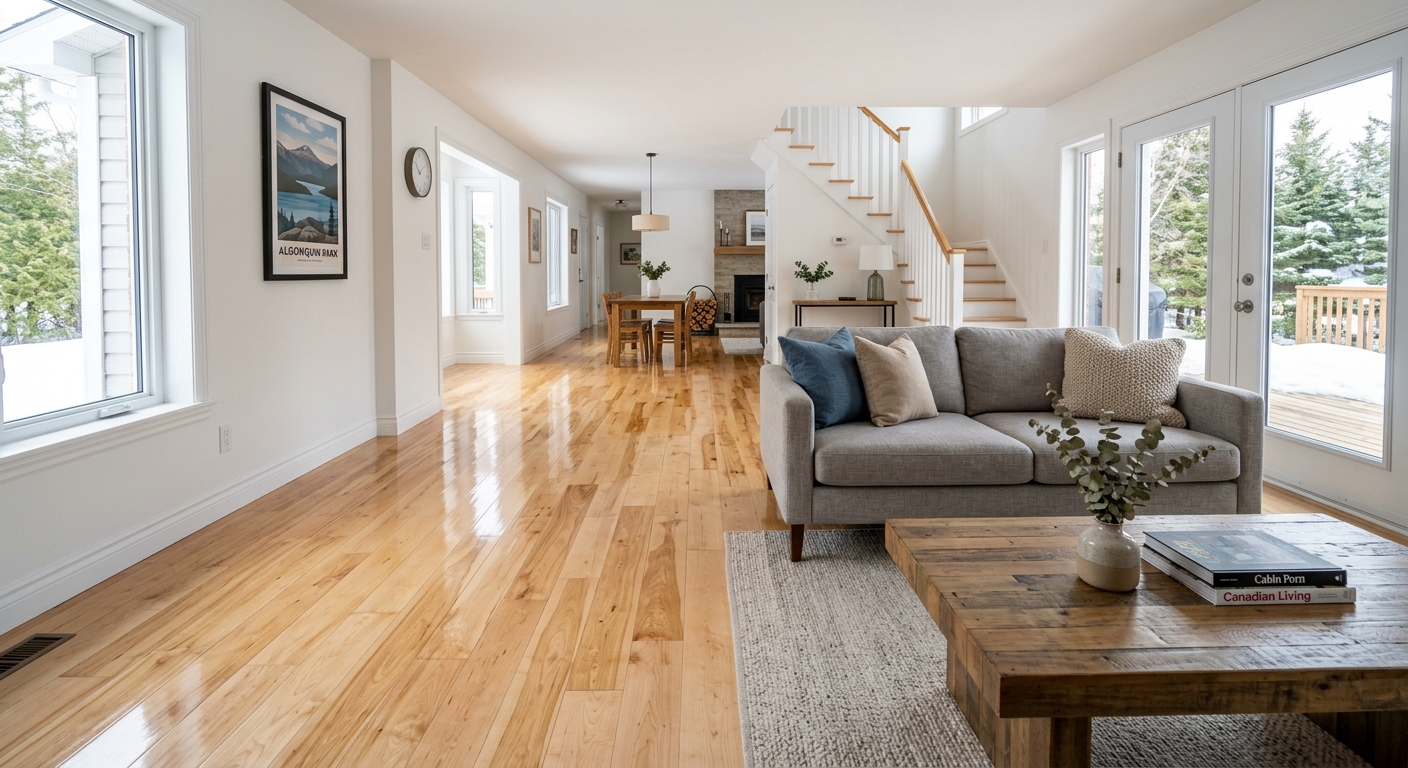
Flooring options and costs in Leduc
Leduc homeowners often start shopping for flooring by comparing look and price, but the right choice here also depends on how your home handles Edmonton-area humidity swings. With a 2021 population of 34,094 and about 9,490 homeowner households (73.2% owning), many projects in Leduc are full-home refreshes rather than single-room updates. That matters because older stock is common—26.6% of homes were built before 1981—so subfloor levelling, patching, or reworking the underlayment is frequently required before new floors can be installed correctly. In our area, that prep work can add roughly $1.50–$4.00 per sq ft, and it’s a common reason two “similar” quotes can end up far apart.
In the Edmonton economic region, basement moisture and below-grade vapour are recurring realities, especially in mature neighbourhoods like Ridgewood and Southfork where basements are common. Because solid hardwood is sensitive to humidity changes, it’s usually limited to above-grade rooms; engineered hardwood and luxury vinyl plank (LVP) typically tolerate seasonal movement and minor slab moisture far better. Also, cold winters make radiant-compatible surfaces more attractive—most LVP, many engineered floors, and tile work well over hydronic or electric heat, helping you avoid product damage and performance issues.
Use the table below as a practical budget starting point, then we’ll narrow your options by room and moisture risk in later sections.
| Type |
Best Room |
Moisture Resistance |
Lifespan |
Price per sq ft |
| Solid hardwood (nail-down, above grade only) |
Living / dining, hallways |
Low (humidity sensitive; not for basements or slab) |
25–50 years |
$10 – $25 |
| Engineered hardwood (float or glue, above + on-grade) |
Main floors, bedrooms |
Medium–High (layered core tolerates swings better) |
20–40 years |
$8 – $20 |
| Laminate (click-lock, above-grade) |
Bedrooms, living rooms |
Medium (spills at seams can cause swelling) |
10–25 years |
$4 – $8 |
| Luxury vinyl plank / LVP (waterproof, any level) |
Kitchen, entry, basement, radiant areas |
High / waterproof (resists vapour and minor moisture) |
15–25 years |
$5 – $12 |
| Porcelain / ceramic tile |
Kitchen, bathrooms, mudrooms |
High (tile surface is water-resistant) |
30+ years |
$5 – $15 |
| Carpet (broadloom or modular tile) |
Bedrooms, stairs, upper-level comfort zones |
Medium (needs proper subfloor dryness) |
7–15 years |
$3 – $10 |
Prices are estimates only and vary by project scope, site access and material selection.
What affects the price of flooring in Leduc
Two quotes for the same “1,200 sq ft” project in the Edmonton area can differ by 30–50% because the hidden drivers are rarely identical: prep, subfloor condition, transitions, and moisture management. Even in Leduc, where many homeowners refresh annually or every few years, older homes (26.6% built before 1981) often need additional underlayment work before the new flooring can be installed flat and properly bonded or floated. Edmonton-area contractors also face seasonal demand spikes—spring and early summer—so labour rates and availability can shift.
Technically, humidity swings and below-grade moisture are the key reasons pricing changes. In Edmonton, solid hardwood expands and contracts with indoor humidity; it also performs poorly when installed over concrete slabs or in basements where vapour can reach the underside. By contrast, engineered hardwood and LVP are designed with layered construction or stable cores that tolerate typical basement conditions far better. Cold winters also favour radiant heat compatibility, which limits some materials; most solid hardwood and some laminate options must be avoided or restricted over radiant systems.
Here are a few concrete local scenarios that move budgets: (1) If your basement slab has a history of damp patches, the contractor may specify a vapour-aware underlayment or recommend LVP, which typically costs within the vinyl band (roughly $4–$8 laminate/vinyl band for some lines, and higher for premium waterproof LVP). (2) If your existing subfloor has waves or old OSB is delaminating, levelling and patching commonly adds $1.50–$4.00 per sq ft before the finish floor. (3) If you choose tile over a large area, the product band for tile ($5–$15) can be true—yet the labour can increase with layout, subfloor flattening, and extra prep for a crack-resistant install. Use these drivers to evaluate whether you’re paying for “material only” or for the full system.
| Price Factor |
Why It Matters |
Cost Impact |
| Room area in sq ft |
Directly affects material quantity and labour time |
$500–$5,000+ depending on size and complexity |
| Subfloor condition |
Levelling/repair protects performance and reduces callbacks |
Often adds about $1.50–$4.00 per sq ft |
| Moisture / below-grade install |
Solid wood may fail; vapour management may be required |
Can shift product choice; typically +$1–$6 per sq ft total |
| Material choice |
Solid vs engineered vs LVP vs tile changes core stability and install method |
Within band ranges (e.g., $10–$25 hardwood; $5–$15 tile) |
| Removal and disposal of existing flooring |
Old flooring, nails, underpad and haul-away add labour |
Often +$300–$1,500+ total |
| Stair nosing / transitions |
Custom edges, mouldings and reducers are labour-intensive |
Often charged per step or per linear foot |
| Radiant heat compatibility |
Limits product selection and underlayment requirements |
May add +$0.50–$3 per sq ft or require higher-spec flooring |
| Installation method |
Float vs glue-down vs nail-down impacts prep and labour time |
Can swing labour by 10–30% on the same square footage |
Permits & regulations in Alberta
In Alberta, installing flooring itself typically does not require a building permit. Where permits can come into play is the work that flooring contractors may coordinate or cause indirectly—especially when you’re altering structure, moisture conditions, or in-floor heating systems.
Work that may require permits: (1) Electrical permitting if a project involves modifications to wiring for radiant heating, new circuits, or changes to existing electrical components. (2) Structural repairs to subfloor framing, beam/joist work, or any work that goes beyond surface-level patching. (3) Moisture remediation that requires trade coordination (for example, correcting drainage issues outside your scope or significant membrane/complex assemblies) may trigger additional requirements depending on the situation.
Work that typically does NOT require a permit: removing and installing new flooring, adding standard underlayment, levelling compounds (when used as a surface treatment), installing tile over an appropriate floor system (without electrical/structural alterations), and replacing stair treads or surface transitions.
To verify a contractor in Leduc, start by confirming their Alberta business registration and trade licensing/credentials as applicable, then request proof of liability insurance and WSIB/WCB clearance. Ask for a current certificate of insurance showing coverage amounts and effective dates, and a clearance letter (or equivalent proof) confirming workers are covered. Don’t rely on verbal assurances—request copies before the work starts, and keep them with your contract.
Best flooring for each room in your Leduc home
In Leduc, your best flooring choice is the one that matches the room’s moisture exposure, daily traffic, and comfort needs. Because indoor humidity can swing and basements are prone to vapour, the “same” floor isn’t always ideal everywhere. For living and dining rooms, many homeowners choose engineered hardwood or high-quality laminate: both bring warmth and style while better tolerating seasonal movement than solid hardwood. In master bedrooms, carpet is still popular for comfort and sound absorption, but engineered hardwood is a good alternative if you want an easier clean and a more consistent look.
For kitchens, LVP is hard to beat—water resistance and forgiving installation make it a practical choice in an active household. If you prefer a premium look, large-format porcelain tile is also excellent for water resistance and easy cleaning. Bathrooms should stick to porcelain or ceramic tile only to handle splashes and ongoing humidity. In finished basements, LVP is typically the clear winner because it’s waterproof and copes well with below-grade vapour conditions that can cause gapping or failure in solid wood and many laminate systems.
Radiant heat compatibility matters in Edmonton-area builds and renovations: LVP, many engineered woods, and tile are generally the safest bets when installed to the manufacturer’s over-heating and underlayment instructions. For a quick price reality check, consider that engineered hardwood often sits near the $8–$20 per sq ft range, while LVP can start closer to the $5–$12 range—if you’re comparing a basement finish, that difference is often justified because the material choice also reduces moisture risk and avoids costly replacement later.
| Room |
Best Material |
Why |
Moisture Risk |
Price Band per sq ft |
| Living / dining room |
Engineered hardwood |
Warm feel with better humidity tolerance than solid |
Low–Medium (main-floor seasonal swings) |
$8 – $20 |
| Master bedroom |
Carpet or engineered hardwood |
Carpet improves comfort; engineered offers easy care |
Low (unless you have a humidity issue) |
$3 – $10 |
| Secondary bedrooms |
Laminate (better lines) or LVP |
Good durability for daily use; quick to install |
Low–Medium (spills at seams can be a concern) |
$4 – $8 |
| Kitchen |
Luxury vinyl plank / LVP |
Water resistance and easy cleaning for spills and foot traffic |
Medium (wet-mop and sink splash exposure) |
$5 – $12 |
| Basement (finished) |
Luxury vinyl plank / LVP |
Waterproof core handles vapour and below-grade conditions |
High (vapour and seasonal moisture) |
$5 – $12 |
| Bathroom |
Porcelain / ceramic tile |
Best-in-class splash resistance and long service life |
Very high (continuous humidity and water exposure) |
$5 – $15 |
How to choose a flooring contractor in Leduc
Choosing the right flooring contractor in Leduc is mostly about verifying proof of coverage and matching your quote to the actual conditions in your home. First, confirm Alberta licensing or trade credentials where applicable, then ask for liability insurance and current WSIB/WCB clearance. How to check: request the certificate of insurance (with policy number, effective dates, and coverage limits) and the clearance letter showing workers are covered. If they can’t provide documents quickly, that’s a serious warning sign.
Next, get 2–3 itemised written quotes. A solid quote breaks down labour and materials separately and clearly lists scope: removal and disposal of existing flooring, subfloor prep (levelling/patching and underlayment), transitions, trim, and any stair nosing. Avoid lump-sum quotes that don’t specify what’s included. Read the scope line-by-line and ask: Are levelling compounds included or “as needed”? Is disposal included? Is the underlayment specified and correct for your moisture conditions and radiant system?
Warranty matters in Leduc’s climate. Ensure you receive a workmanship warranty with a defined start date and coverage terms, plus the manufacturer’s product warranty. Ask whether the warranty is transferable if you sell the home.
Payment schedule should be conservative: never pay more than about 10–15% upfront, and hold back until the job is complete and cleaned. Ask for a start date and completion estimate in writing so you’re not guessing during peak winter-to-spring scheduling.
- Request insurance certificate and WSIB/WCB clearance before signing.
- Confirm the contractor understands Leduc basement moisture realities (vapour-aware prep).
- Ask for written scope including underlayment and levelling/patching details.
- Ensure stair work, transitions, and reducers are priced per step/linear foot if applicable.
- Check that removal and disposal are included (or clearly excluded).
- Get start date and completion target dates in the contract.
- Verify warranty length and what counts as workmanship vs product defects.
- Ask who provides materials and whether you’ll get the exact product name/spec.
- Confirm acclimation procedures for hardwood/engineered where required.
- Review payment terms—limit upfront to 10–15% and hold final until completion.
- Ask about radiant heating compatibility requirements if you have in-floor heat.
- Request a cleanup standard and confirm dust control expectations.
In Leduc, red flags include: refusing to provide insurance/WSIB paperwork; quoting “hardwood” for a basement without an engineered/LVP moisture plan; not itemising levelling/underlayment or transitions; vague warranties (“up to 1 year” with no written scope); and pressuring you for large upfront payments.
Frequently asked questions — flooring in Leduc
What's the most durable flooring for pets and kids?
For pets and kids in Leduc, the most consistently durable options are typically waterproof luxury vinyl plank (LVP) and well-installed tile. LVP handles accidents and frequent clean-ups better than solid hardwood or laminate, especially when basements or below-grade sections are involved. If you’re comparing budgets, tile commonly sits in the $5–$15 per sq ft band, while many LVP options land roughly in the $5–$12 range depending on thickness and wear layer. For best results, prioritize high wear layers on LVP, use proper underlayment, and ensure the subfloor is flat—wavy floors can cause early joint or locking-system failures. With solid hardwood, scratches are more visible and humidity movement can be riskier, so it’s usually a tougher fit where pets and spills are frequent.
How do I choose flooring for humidity in Leduc?
Humidity in Leduc (Edmonton-area winters plus basement vapour) is why material choice and subfloor prep matter together. Solid hardwood expands and contracts with indoor humidity, and it isn’t the right system for basements or slab-on-grade conditions unless your home has unusually controlled moisture. For above-grade main floors, engineered hardwood is usually a safer choice because its layered structure tolerates seasonal swings better. For areas with higher moisture risk—especially finished basements—LVP is typically the best-performing option because many products are designed for waterproof performance and tolerate vapour better than wood-based floors. Older housing stock is also a factor here: with 26.6% of Leduc homes built before 1981, you’ll often see uneven or aging subfloors, which is why levelling/repair commonly adds about $1.50–$4.00 per sq ft.
Do condos restrict hard flooring?
Yes, many condominium corporations restrict hard flooring because of sound transfer. In Leduc and across the Edmonton region, the association’s rules on sound transmission (often expressed through STC/IIC expectations) commonly require specific underlay or an approved flooring build-up for upper floors. Before you buy material or book install, review the condo declaration, then ask for board approval in writing—especially if you’re planning hardwood or tile. Installation details matter: for example, tile usually needs a correct underlayment/membrane system, and engineered hardwood still often requires an acoustical underlay to meet the building’s requirements. The safest approach is to request the condo’s approved underlay list (if they have one) and confirm the exact product and underlay thickness with your installer before scheduling.
How do I compare flooring quotes?
To compare quotes fairly in Leduc, insist on itemised scopes, not just total price. Break each quote into: materials (exact product line/spec), labour, subfloor prep (levelling/patching and underlayment), removal and disposal, and any stair work or transitions (often priced per step or linear foot). Ask if radiant heating compatibility is included when relevant; radiant-compatible flooring may be required, and some products are excluded. Also, check how moisture risk is handled—if one quote assumes solid hardwood everywhere, but your project includes a basement, that quote may be missing critical prep or using an inappropriate product. As a reference point, solid hardwood projects often land in the $10–$25 per sq ft band, while LVP commonly comes in lower (often roughly $5–$12). A higher bid can be justified when it includes flattening, better underlayment, and the correct moisture-safe system.
Can I install flooring over existing tile in Leduc?
Often, you can install over existing tile in Leduc, but it depends on flatness, height transitions, and your new flooring type. For LVP, the key is that the tile surface is sound and flat enough for the flooring system; many installers will require grinding high spots, repairing loose grout/tiles, and using the correct underlayment (or sometimes none, depending on the product). For laminate, over-tile installs can work if the surface is stable and the prep meets the manufacturer’s flatness and underlay requirements; you still need to manage moisture and seams carefully. For new tile over old tile, it’s more involved and typically needs a proper substrate assessment. If the existing tile is cracked, uneven, or loose, the best long-term choice may be removal or remediation rather than covering it.
What is the best flooring for a high-traffic area in Leduc?
For high-traffic areas in Leduc—entries, main hallways, and busy living spaces—the most reliable performance usually comes from either LVP or porcelain/ceramic tile. LVP is tough under everyday wear, stands up well to pet accidents and regular cleaning, and handles minor moisture conditions better than wood-based floors. Tile is extremely durable, resists water, and can be ideal if you want a long service life. If you’re planning a budget-informed comparison, LVP often fits within a $5–$12 per sq ft range, while tile is frequently around $5–$15 per sq ft depending on the product. The biggest cost/quality factor for any high-traffic install is subfloor preparation: if your subfloor is uneven (common in older homes), levelling/patching can add roughly $1.50–$4.00 per sq ft to prevent premature wear and movement.