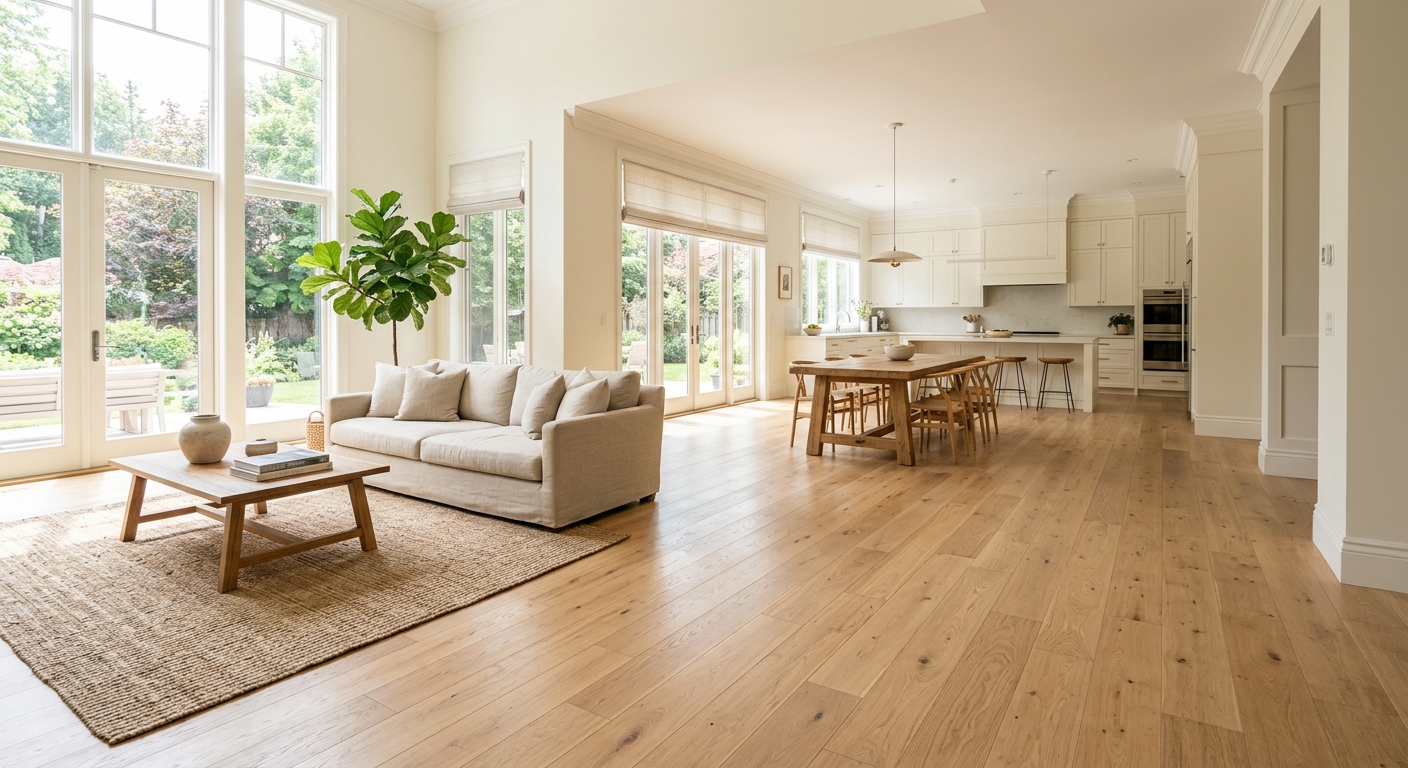
Flooring options and costs in Magrath
Magrath homeowners have a lot of choices for flooring, but the “best” option is strongly tied to local homes and local conditions. With 54.0% of dwellings in the region built before 1981 (Statistics Canada, 2021 Census), it’s common to encounter older subfloors that are uneven, aged, or need repair before any finish goes down. That prep step—levelling compounds, new plywood/underlayment, and sometimes a moisture-control layer—can add a noticeable premium before you ever see hardwood or tile.
In the Lethbridge–Medicine Hat economic region, wide indoor humidity swings and frequent finished basements affect cost and material selection. Contractors typically spend time on moisture testing (especially on concrete slabs and older wood) and on choosing dimensionally stable products. This is also why engineered hardwood and luxury vinyl plank (LVP) often price competitively against solid hardwood when a project includes basements or on-grade concrete.
Cold Alberta winters further shape the quote: many newer or renovated homes rely on radiant heat, and not all products are compatible. If you’re in an area with more recent builds—such as the newer residential edges of Magrath—expect more radiant-heat-ready installs, which can narrow your “solid hardwood” options and shift pricing toward engineered hardwood or radiant-compatible LVP.
Below are typical cost bands you’ll see for common flooring types in Magrath, followed by the real cost drivers behind them.
| Type |
Best Room |
Moisture Resistance |
Lifespan |
Price per sq ft |
| Solid hardwood (nail-down, above grade only) |
Living/dining, master (above grade) |
Low–moderate (humidity sensitive) |
25–60 years |
$10,0 – $18,0 |
| Engineered hardwood (float or glue, above + on-grade) |
Living/dining, master, hall |
Moderate–high (more stable) |
20–40 years |
$11,0 – $17,0 |
| Laminate (click-lock, above-grade) |
Secondary bedrooms, offices |
Low–moderate (water is the risk) |
10–25 years |
$4,0 – $9,0 |
| Luxury vinyl plank / LVP (waterproof, any level) |
Kitchen, main floor, finished basement |
High (waterproof core) |
15–25 years |
$5,0 – $11,0 |
| Porcelain / ceramic tile |
Kitchen, bathroom |
High (with proper grout/seal) |
25–50 years |
$12,0 – $22,0 |
| Carpet (broadloom or modular tile) |
Master and bedrooms |
Moderate (avoid flooding) |
7–15 years |
$6,0 – $14,0 |
Prices are estimates only and vary by project scope, site access and material selection.
What affects the price of flooring in Magrath
In Magrath, it’s common to see quotes for the “same” flooring run 30–50% apart across projects—especially between jobs that include basements, radiant heat, or problematic older subfloors. Even within Alberta, labour availability and the amount of prep work can swing the final number because every installation lives or dies on the surface underneath it.
Technically, the biggest cost drivers in the Lethbridge–Medicine Hat area are indoor humidity swings and below-grade moisture. Solid hardwood expands and contracts with humidity, so it generally can’t be glued or floated over concrete and it performs poorly in basements. Engineered hardwood and LVP handle humidity and below-grade applications far better, which is why they’re often recommended for finished basements and slab areas.
Cold-weather design also matters. If your home has radiant heat, many solid hardwood systems become more restrictive, and some laminate products need specific underlay/temperature limits. That can shift you from a lower material band (laminate around $4,0 – $9,0 per sq ft) into a higher one (engineered hardwood often $11,0 – $17,0 per sq ft) once the correct radiant-compatible layers are included.
Older housing stock adds real dollars too. With 54.0% of dwellings built before 1981 (Statistics Canada, 2021 Census), it’s not unusual to pay for subfloor levelling or repair before the finish floor goes down—often an added $1–$4 per sq ft depending on how far out-of-spec the surface is. In some homes, that prep brings the cost up; in others, it keeps the finish flooring on-budget by preventing future squeaks, gaps, or failure.
| Price Factor |
Why It Matters |
Cost Impact |
| Room area in sq ft |
Materials and labour scale with coverage |
Lower average cost on larger areas; higher per-sq-ft waste on small rooms |
| Subfloor condition |
Uneven or aged surfaces need prep |
Often adds a measurable per-sq-ft premium when levelling/patching is required |
| Moisture / below-grade install |
Rules out solid hardwood and changes underlayment |
Switches to engineered/LVP or adds moisture barrier testing and layers |
| Material choice |
Solid vs engineered vs LVP vs tile have different tolerances |
Moves you between common bands like $10,0 – $18,0 (hardwood) vs $5,0 – $11,0 (LVP) |
| Removal and disposal of existing flooring |
Old glue, underlay, and debris add time |
Can add significant labour if it’s fully adhered or includes multiple layers |
| Stair nosing / transitions |
Transitions are custom-measured and labour-heavy |
Charged per step or linear foot; often a surprise line item |
| Radiant heat compatibility |
Temperature limits and underlay requirements vary by product |
May require different flooring/underlayment, changing material selection and cost |
| Installation method |
Float vs glue-down vs nail-down changes labour and prep |
Glue-down and nail-down typically require stricter subfloor prep and add labour |
Permits & regulations in Alberta
In Alberta, the flooring itself usually does not require a building permit. Typically, swapping finishes—like installing laminate, LVP, engineered hardwood, carpet, or tile over an existing, code-compliant subfloor—is handled as a normal renovation and does not trigger a permit.
Where permits can come into play is the associated work. If the job includes electrical work—such as connecting or altering in-floor heating circuits, installing new thermostats, or modifying wiring—an electrical permit may be required. If you’re doing structural changes to the subfloor (for example, significant joist repair, beam work, or changes that go beyond simple patching/levelling), you may need permits depending on scope. For condos in particular, sound-control rules can effectively “restrict” hard flooring by requiring a specific underlay system and meeting sound transmission targets.
For Magrath homeowners, the practical checklist is: (1) confirm your contractor’s Alberta licence category (and whether it matches the work), (2) verify liability insurance and proof of coverage for workers, and (3) request a clearance letter or proof of WCB/WCB coverage from the contractor before the start date. Ask for certificates of insurance and the most current WSIB/WCB documentation directly—don’t rely on verbal reassurance. For condos, review the declaration and ask for board approval in writing before installing hardwood or tile on upper floors, especially if the strata requires an approved underlay to control impact noise.
Best flooring for each room in your Magrath home
Magrath homes can experience seasonal humidity swings that show up as expansion gaps, squeaks, or edge lifting if the wrong product is installed over the wrong surface. The safest approach is to match flooring to room moisture exposure, foot traffic, and comfort needs—then confirm product compatibility with radiant heat where applicable.
For living and dining areas, engineered hardwood or high-quality laminate often balances warmth with stability. In the master bedroom, carpet is a strong choice for comfort and sound absorption, while engineered hardwood remains a durable alternative if you want a harder finish. In kitchens, go with luxury vinyl plank (LVP) or large-format porcelain tile—both handle spills and daily cleanups better than wood-based floors.
Basements are the biggest decision point in the Lethbridge–Medicine Hat market. With cool, damp concrete slabs and a higher share of finished basement spaces, LVP is the clear winner: it’s waterproof and tolerates moisture vapour better than solid wood and most laminate systems. Bathrooms should be porcelain or ceramic tile only, because they’re designed for wet conditions.
Radiant heat is increasingly common in Alberta renovations and new builds. If your living area or bedrooms have in-floor heating, confirm the flooring is radiant-compatible before you buy. For a dollar example: if you’re choosing between laminate at about $4,0 – $9,0 per sq ft and engineered hardwood at $11,0 – $17,0 per sq ft, the higher upfront cost can be justified when the basement or on-grade sections need a more stable product, and when you want fewer restrictions around radiant heat and seasonal movement.
| Room |
Best Material |
Why |
Moisture Risk |
Price Band per sq ft |
| Living / dining room |
Engineered hardwood |
Warm look with better stability for humidity swings |
Low–moderate (controlled indoor environment) |
$11,0 – $17,0 |
| Master bedroom |
Carpet (with quality underlay) or engineered hardwood |
Comfort and sound control; engineered if you prefer hard flooring |
Low (avoid sustained wetting) |
$6,0 – $14,0 |
| Secondary bedrooms |
Laminate or engineered hardwood |
Durable, easier maintenance; engineered adds stability if humidity varies |
Low–moderate |
$4,0 – $17,0 |
| Kitchen |
Luxury vinyl plank (LVP) or porcelain tile |
Spill tolerance and straightforward cleaning |
Moderate–high (daily moisture exposure) |
$5,0 – $22,0 |
| Basement (finished) |
LVP |
Waterproof performance and better tolerance over damp slabs |
High (cool/damp concrete, possible vapour pressure) |
$5,0 – $11,0 |
| Bathroom |
Porcelain / ceramic tile |
Designed for wet areas; long-term durability |
High (wet surfaces and steam) |
$12,0 – $22,0 |
How to choose a flooring contractor in Magrath
Choosing the right flooring contractor in Magrath is mostly about documentation and clarity. In Alberta, you should verify three things before work starts: (1) the contractor’s Alberta licence appropriate to the scope, (2) liability insurance, and (3) WCB/WCB coverage for their workers. Ask to see certificates of insurance and current coverage documentation—then confirm the policy details match the company name you’re dealing with.
Next, request 2–3 itemised quotes. You want a breakdown that separates labour from materials (flooring, underlayment, moisture barrier, adhesives, patch/levelling), plus line items for removal, stair nosing/transitions, and disposal. Avoid a lump-sum number without scope details; it makes it easy for costs to expand after the fact. Check the scope for what’s included and excluded: subfloor moisture testing, levelling/patching, underlay choice, and whether disposal is included.
Warranty matters twice: workmanship (how long they stand behind install) and the product warranty (how long the material supplier covers defects). Confirm whether the warranty is transferable if you sell your home. Payment scheduling should be conservative: never pay more than 10–15% upfront, and hold back a portion until the job is complete and you’ve confirmed transitions, edges, and clean-up.
Finally, get a written start date and realistic completion estimate. In a smaller market like Magrath, scheduling gaps happen, especially when prep materials like levelling compounds or moisture mitigation products must be delivered and cured.
- Provide proof of Alberta licence (and matching scope) before you sign.
- Show current liability insurance certificate with dates and company name aligned.
- Confirm WCB/WCB clearance and coverage for workers (ask for the latest letter/document).
- Get 2–3 itemised quotes: labour, materials, underlay/moisture barrier, patch/levelling, disposal.
- Request an explicit moisture testing plan for concrete/wood subfloors.
- Confirm radiant heat compatibility in writing if you have in-floor heating.
- Verify the underlayment used matches product specs (especially for laminate and engineered over slabs).
- Ask who is responsible for subfloor levelling to tolerance (and what happens if it’s not achieved).
- Confirm whether trims, transitions, stair nosing, and caulking are included or extra.
- Get a workmanship warranty term and what it covers (gaps, lifting, edge failures, squeaks).
- Set payment terms: no more than 10–15% upfront; keep holdback until completion.
- Get a signed timeline with start date and completion estimate.
Red flags in Magrath include: offering only a lump-sum with vague scope, refusing to provide insurance/WCB clearance, skipping subfloor moisture testing on slab or below-grade areas, suggesting solid hardwood for basements without special control steps, and pressure to pay full amounts upfront before materials are on site.
Frequently asked questions — flooring in Magrath
Do condos restrict hard flooring?
Yes, in Alberta condos it’s common for restrictions to exist through the condominium corporation’s rules, even when the installation doesn’t require a permit. Many buildings focus on sound transmission (impact noise) and may require specific underlay systems under hard flooring on upper levels. Before you buy anything in Magrath, review your unit’s condo declaration and ask the board for approval in writing if required. Practically, that can affect what you choose: LVP, engineered hardwood, and tile all can be acceptable, but only if they meet the strata’s underlay and installation requirements. If your board requires approved underlay, you might pay more upfront, but it helps prevent costly rework or compliance issues later.
How do I compare flooring quotes?
Start by comparing apples-to-apples. Ask each contractor for an itemised quote that separates labour, materials, underlayment/moisture barrier, levelling/patching, removal, and disposal. In Magrath and the Lethbridge–Medicine Hat region, the biggest quote swings often come from subfloor prep and moisture management—especially in homes built before 1981 (Statistics Canada, 2021 Census). If one quote includes moisture testing and the right underlay for radiant heat while another doesn’t, the difference isn’t “overpricing,” it’s scope. Also compare product specs: solid hardwood vs engineered stability, and LVP waterproof cores. Use the price bands as a reality check—e.g., engineered hardwood typically lands around $11,0 – $17,0 per sq ft, while laminate is often nearer $4,0 – $9,0.
Can I install flooring over existing tile in Magrath?
Sometimes, but it depends on the tile condition and the type of new flooring. In Magrath, if the existing porcelain or ceramic tile is well-adhered, flat, and not rocking, contractors may be able to install floating floors (like click-lock laminate or some engineered systems) over top, using a proper underlayment and meeting product height requirements. However, for many installations—especially over uneven tile or where the floor height becomes too high—prep may require grinding high spots or removing tile to get the subfloor into spec. If you’re adding tile again, it’s a different approach and typically needs the correct underlayment and substrate checks. Moisture testing is still important on older builds where grout or subfloor materials may have absorbed moisture. Ask your contractor to measure flatness and confirm the installation method is approved by the flooring manufacturer.
What is the best flooring for a high-traffic area in Magrath?
For high-traffic areas, you want durability plus stability through Alberta humidity swings. Engineered hardwood is a strong choice when installed above grade/on-grade correctly and finished with a quality wear layer. Luxury vinyl plank (LVP) is also excellent in busy areas because it resists scuffs and is waterproof—useful when you track in slush or spills during winter. Laminate can work too, but it’s more sensitive to standing water at seams. If you’re balancing budget, laminate’s typical range is around $4,0 – $9,0 per sq ft, while LVP often sits around $5,0 – $11,0 per sq ft—so LVP can be a practical step up when real-life mess is expected. The right underlayment and a properly prepped subfloor matter just as much as the brand.
How do I prepare my subfloor before new flooring?
Proper subfloor prep is usually the difference between a long-lasting install and callbacks. In Magrath, preparation often includes checking flatness, verifying soundness (no soft spots or squeaks), and addressing any water-related issues. For concrete slabs or below-grade areas, the contractor should perform moisture testing and then choose the correct moisture barrier or system—this is where solid hardwood typically becomes a poor option due to humidity sensitivity. For older homes (many built before 1981), you may need levelling compound or patching, plus repair or reinforcement of worn plywood. If the floor is out of tolerance, new underlay can’t “fix” structural issues. A good contractor will document what’s wrong, what they’re doing to correct it, and confirm it meets the flooring manufacturer’s installation requirements before they lay planks or tile.
Is cork or bamboo flooring a good choice in Magrath?
They can be good, but they’re not always the easiest “set and forget” choice in Magrath’s climate. Cork is naturally resilient and comfortable, but many cork products still need careful attention to moisture exposure and underlayment selection—especially if you’re considering basements or on-slab installs. Bamboo is a wood product and can behave similarly to hardwood regarding humidity sensitivity. In the Lethbridge–Medicine Hat region, indoor humidity swings and cool/damp basement environments make engineered hardwood or waterproof LVP a more forgiving default. If you really like cork or bamboo, ask whether the specific product is rated for the installation level you’re using (above grade vs on grade vs below grade) and whether it’s compatible with radiant heat (if applicable). Also plan on the right moisture testing and surface preparation—those steps directly affect how long the floor performs and whether it stays stable through Alberta seasons.