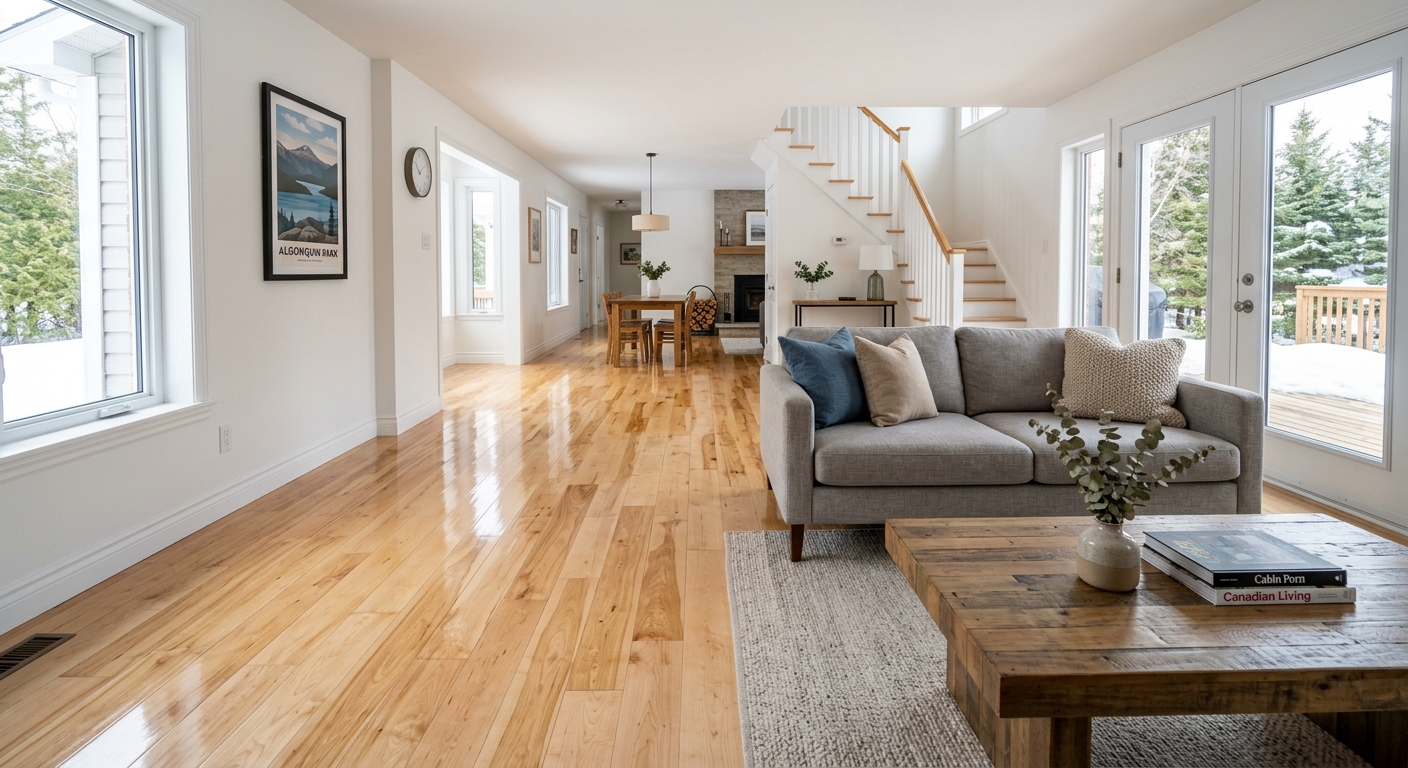
Flooring options and costs in Miller
Miller, Alberta is a small community (Population: 2,972, Statistics Canada, 2021 Census), and that matters for flooring pricing because the “local” part of a quote often includes hauling materials and coordinating crews from the broader Calgary labour pool. In older homes common around the Calgary region, uneven subfloors and dated construction methods frequently require levelling or repair before new flooring can lay flat—especially where transitions between rooms are tight. In practice, that kind of prep can add roughly $1–$3 per sq ft, and more if you’re correcting dips, high spots, or patching cracked concrete.
Calgary’s dry, cold prairie climate is another cost driver: winter indoor conditions swing in humidity, and below-grade areas can see moisture migration through slab or foundation walls. Because of those humidity and moisture realities, solid hardwood (even when installed well) is typically limited to above-grade rooms. For basements and any slab-on-grade application, engineered hardwood and waterproof luxury vinyl plank (LVP/SPC) are far more forgiving. Tile is durable, but it’s also unforgiving on flatness—so levelling, crack isolation, and proper substrate prep can be a meaningful part of the total budget.
In Miller, trade demand is especially high for projects along the main residential growth areas and during the peak spring–fall renovation windows—when homeowners are scheduling kitchens, basements, and whole-floor refreshes at the same time. Below is a practical comparison table to help you estimate materials and installation expectations before you request itemised quotes.
| Type |
Best Room |
Moisture Resistance |
Lifespan |
Price per sq ft |
| Solid hardwood (nail-down, above grade only) |
Main floor living areas |
Low to moderate (humidity sensitive) |
25–60 years |
$8 – $15 |
| Engineered hardwood (float or glue, above + on-grade) |
Main floor bedrooms & hallways |
Moderate to high (more stable than solid) |
20–40 years |
$10 – $16 |
| Laminate (click-lock, above-grade) |
Living/dining (non-wet zones) |
Moderate (surface resistant, seams hate standing water) |
10–25 years |
$4 – $7 |
| Luxury vinyl plank / LVP (waterproof, any level) |
Kitchen, basement, main floor |
High (waterproof core options) |
15–25 years |
$4 – $8 |
| Porcelain / ceramic tile |
Bathrooms & wet areas |
Very high (with correct grout/seal & prep) |
25–50 years |
$6 – $12 |
| Carpet (broadloom or modular tile) |
Bedrooms |
Low (moisture damage risk) |
7–15 years |
$6 – $10 |
Prices are estimates only and vary by project scope, site access and material selection.
What affects the price of flooring in Miller
Even when two homeowners in the Calgary region select the same flooring type, quotes can still vary by 30–50%. That’s usually because the “same floor” often has different prep requirements, different subfloor conditions, and different detailing (transitions, stair work, trim removal). In dry, cold prairie conditions, indoor humidity swings can also influence product selection: solid hardwood is humidity sensitive, while engineered hardwood and LVP/SPC handle changes far better—especially where basements or slab areas are involved. The bigger the humidity or moisture challenge, the more contractors lean toward more dimensionally stable systems, which can change both material cost and labour time.
In Miller homes, the most common technical reason for higher cost is older housing stock that needs levelling or repairs. Aged plywood, patchy OSB, and uneven concrete are typical culprits. Depending on how out-of-level surfaces are, levelling/prep is often budgeted around $1–$4 per sq ft, and tile jobs can increase further because tile requires a flat substrate for long-term performance and crack resistance.
Concrete examples we see: (1) A basement over slab with moisture concerns often rules out solid hardwood—so you’d budget LVP or engineered wood instead, which is usually safer over below-grade conditions. (2) Main floors with multiple transitions between rooms can add trim reinstallation and stair nosing details—commonly adding noticeable cost even if the square footage is modest. If you’re comparing LVP versus laminate, the laminate band often sits around $3–$7 per sq ft, while mid-range LVP can run roughly $4–$8 per sq ft; the extra cost is usually justified where spills, cleaning frequency, or below-grade risk is real. Radiant heat compatibility can also limit choices, pushing homeowners away from most solid hardwood and some laminate systems.
| Price Factor |
Why It Matters |
Cost Impact |
| Room area in sq ft |
Material quantity and labour hours scale directly with square footage |
Direct driver; bigger spaces cost more overall |
| Subfloor condition |
Levelling, patching, and fixing squeaks/weak spots must be done before install |
Common add-on: about $1–$4 per sq ft |
| Moisture / below-grade install |
Solid hardwood can’t tolerate slab moisture; basements need waterproof, stable systems |
May shift product choice to LVP/SPC or engineered |
| Material choice |
Solid vs engineered vs LVP vs tile have different prep and installation requirements |
Changes total budget; tile usually higher prep sensitivity |
| Removal and disposal of existing flooring |
Tear-out time, hauling, and dust control vary by existing material |
Can be a significant portion on full-floor jobs |
| Stair nosing / transitions |
Stairs require custom nosing/trim work and careful matching for safe edges |
Charged per step or per linear foot; adds fast |
| Radiant heat compatibility |
Some products won’t perform correctly with in-floor heat cycles |
May require specific underlay and flooring type |
| Installation method |
Float vs glue-down vs nail-down affects labour time, adhesives, and substrate tolerance |
Labour rates differ by method and prep intensity |
Permits & regulations in Alberta
In Alberta, installing flooring by itself typically does not require a building permit. What can trigger permitting is the associated work around the floor—especially anything that touches structure, electrical circuits, or moisture remediation that changes building conditions. For example, if your project involves structural subfloor repair, major moisture remediation (beyond simple surface prep), or in-floor heating circuit modifications (electrical scope), you may need to involve permitted trades and have the proper permits pulled.
Condominiums add a different layer of rules: even when permits aren’t required for the flooring, building management often has sound-transmission requirements (STC/IIC). That can mean specific underlay types, spacing rules, or limitations on hard flooring upstairs. Before installing hardwood or tile on upper floors, review the condo declaration and request board approval in writing.
Step-by-step, here’s how a homeowner in Miller can verify a contractor: (1) confirm the contractor’s Alberta business details and any relevant trade licensing tied to your scope; (2) request a certificate of insurance for liability; (3) verify Workers’ Compensation coverage (WSIB/WCB) so you’re not left exposed if a worker is injured; and (4) ask for a clearance letter if your project size or type requires it. If anything is missing or vague—no insurance certificate, no written scope, or no proof of coverage—pause and ask questions before signing.
Best flooring for each room in your Miller home
Choosing the right flooring for each room in Miller is about matching the material to moisture exposure, foot traffic, and comfort—then factoring in Calgary’s dry winters and cold-season humidity swings. In living and dining rooms, homeowners usually want warmth underfoot and long-term durability. That’s where engineered hardwood or high-quality laminate work well: they offer a similar look with better tolerance for seasonal movement than ¾-inch solid wood.
For bedrooms, comfort matters most. Carpet (broadloom or modular tile) is still a favourite in Alberta because it reduces sound and feels warmer in winter. Some homeowners choose engineered hardwood in the primary bedroom for a cleaner look, but carpet remains the most forgiving option for acoustics. In kitchens, spills and frequent cleaning are common, so waterproof LVP or large-format porcelain tile makes sense. LVP is also quick to maintain; tile is extremely durable but requires meticulous prep and flatness—especially on older main floors.
Basements are where Calgary-area moisture realities typically take over. Fully waterproof LVP is the clear winner for finished basements because it can handle vapour and below-grade conditions far better than solid hardwood or most laminate. For bathrooms, porcelain or ceramic tile is the standard because it’s built for wet environments.
Radiant heat compatibility is increasingly relevant in Alberta builds and renovations. If a room is over in-floor heating, it can rule out most solid hardwood and limit laminate selections—so confirm the product’s rated compatibility before you commit. For example, if you compare mid-range laminate around $3–$7 per sq ft to LVP in the $4–$8 per sq ft range, that extra cost is often justified for kitchens and basements where moisture and spills are realistic.
| Room |
Best Material |
Why |
Moisture Risk |
Price Band per sq ft |
| Living / dining room |
Engineered hardwood |
Warm look, better seasonal stability than solid, good everyday durability |
Low (above grade) |
$10 – $16 |
| Master bedroom |
Carpet or engineered hardwood |
Carpet improves comfort and sound; engineered hardwood gives a cleaner finish |
Low (above grade) |
$6 – $10 |
| Secondary bedrooms |
Carpet |
Comfort for kids and guests; easier maintenance than delicate flooring types |
Low (above grade) |
$6 – $10 |
| Kitchen |
Luxury vinyl plank (LVP) or porcelain tile |
Handles spills well; LVP is forgiving on floors, tile is long-lasting if prepped right |
Medium to high (spills, wet cleaning) |
$4 – $12 |
| Basement (finished) |
Waterproof LVP (or SPC) |
More stable over below-grade conditions; waterproof core reduces moisture-related failures |
High (below grade) |
$4 – $8 |
| Bathroom |
Porcelain / ceramic tile |
Built for wet areas; long lifespan with proper substrate and grout practices |
High (direct water exposure) |
$6 – $12 |
How to choose a flooring contractor in Miller
Start by verifying the contractor is properly covered for the job you’re hiring them for. In Alberta, ask for: (1) liability insurance certificate (so you’re not exposed if property is damaged), and (2) Workers’ Compensation coverage (WSIB/WCB). You should also confirm the business registration details and that their insurance/coverage matches the scope—removal, subfloor repair, and stair work should all be reflected in their coverage. Don’t accept verbal assurances; ask for documents before the work begins. If they can’t provide a current certificate of insurance or proof of coverage, that’s a serious credibility issue.
Next, get 2–3 itemised written quotes with a clear breakdown of labour and materials. A good quote won’t just say “install flooring”; it should list tear-out, subfloor prep/levelling, underlayment (if applicable), stair nosings/transitions, and disposal. Also confirm what’s excluded: for instance, drywall touch-ups, extra levelling if flatness is worse than expected, or tile crack isolation if required. Ask whether permits (if any associated electrical or structural work is needed) are included or if you’ll be responsible for scheduling.
Warranty matters in Alberta’s climate because seasonal movement can reveal installation issues. Make sure the workmanship warranty length is stated in writing, the product warranty is included correctly, and you understand whether coverage is transferable to future owners. For payment, a safe approach is never paying more than 10–15% upfront; hold back until the job is complete and you’ve confirmed the finish and transitions. Finally, insist on a start date and completion estimate in writing so you can plan around seasonal weather and household schedules.
- Request a written itemised quote (materials, labour, underlay/adhesives, disposal).
- Ask for certificate of liability insurance and confirm the effective dates.
- Verify WSIB/WCB coverage (and request a clearance letter if appropriate).
- Confirm who does subfloor levelling/repairs and whether it’s included in price.
- Ensure stair nosings and transitions are priced clearly (per step/linear foot if applicable).
- Clarify exclusions: what happens if the slab is more out-of-flat than expected?
- Confirm underlayment type and vapour barrier details for basements/on-grade installs.
- Ask about radiant heat compatibility if any rooms have in-floor heating.
- Get written workmanship warranty terms and how long they last.
- Confirm product warranty registration and whether it’s transferable.
- Set payment terms: keep upfront to 10–15% and hold back until completion.
- Review the schedule: stated start date, weekly timeline, and final completion date.
Red flags in Miller include: vague “all-in” lump sums with no line items, no insurance/WSIB proof, refusing to put levelling prep in writing, pressure to pay large deposits up front, and missing details on disposal, transitions, or stair work.
Frequently asked questions — flooring in Miller
Can I install hardwood over concrete?
In most Miller-area situations, solid hardwood over concrete is a problem. Solid wood is humidity sensitive and it generally cannot be nailed down unless you have an above-grade nailing surface; it also doesn’t perform reliably when installed over slab moisture vapour. If you have a concrete floor, your best bet is typically engineered hardwood (with the correct moisture barrier and the right installation method), or waterproof LVP/SPC where below-grade moisture is a concern. Calgary’s cold, dry winters and spring humidity swings can magnify seasonal movement, so it’s important to match the product to the substrate. If your quote is suggesting solid hardwood on slab without specifying moisture mitigation and flatness prep, ask for clarification before proceeding. (Statistics Canada, 2021 Census)
How long does flooring installation take?
Typical timelines in Miller depend on square footage, the condition of the subfloor, and whether you’re removing old flooring. For straightforward above-grade installs, many jobs progress quickly once demo is done, but older homes often require extra time for levelling, patching, or repairs—particularly where main floors transition between rooms. Tile generally takes longer because flatness, crack isolation where needed, and curing time are involved. Basements also add time due to moisture-aware prep and underlay/vapour barrier considerations. To avoid surprises, request a written schedule that includes demolition time, installation days, and (for tile) curing/finishing time. A contractor who can’t give a start date and completion estimate in writing usually isn’t planning the job tightly.
What flooring works with radiant heat?
Radiant heat compatibility is critical in Alberta because in-floor systems cycle and can change surface temperatures. Most solid ¾-inch hardwood installations are limited or require very specific conditions, and many laminate products have restrictions due to heat and expansion behaviour. Engineered hardwood is usually the safer option when it’s explicitly rated for radiant heating, and LVP/SPC can also work well when the manufacturer approves it for in-floor heat. The biggest mistake is choosing based on appearance alone—always confirm the product’s rated installation instructions for radiant heat (including recommended underlay and maximum temperature). If your room has radiant heat, ask the contractor to reference the flooring manufacturer’s guidance and include it in the scope before you order material.
Engineered vs solid hardwood — what's the difference?
Solid hardwood is one piece of wood and it’s far more sensitive to humidity changes. In Miller and across the Calgary region, that means solid hardwood is generally best for above-grade areas where humidity stays more consistent. Engineered hardwood is made with a layered core (often multiple plies) topped with a real hardwood veneer. That construction makes it dimensionally more stable, so it can handle Alberta’s seasonal humidity swings better and is often the preferred hardwood for on-grade applications when installed correctly. In budget terms, homeowners often find solid hardwood lands around the higher band (commonly $8–$15 per sq ft), while engineered hardwood is typically priced similarly or slightly higher depending on thickness and grade. The right choice depends on the room location and substrate—not just the look.
Do I need to level my subfloor first?
Yes, in most cases you do—especially if you’re installing tile or any product that relies on a flat surface for proper locking or long-term performance. Older regional housing stock in the Calgary area frequently has uneven plywood or inconsistent concrete, and that’s exactly the sort of issue that can lead to movement, squeaks, or early wear. Concrete levelling/repair isn’t always required everywhere, but it’s often budgeted because it prevents problems after the floor is installed. A realistic planning number you’ll hear is about $1–$4 per sq ft when levelling is needed. Tile is particularly sensitive to flatness, and it may require additional prep or isolation materials if cracks or substrate issues are present. A good contractor measures flatness before committing to a final product choice and price.
What's the most durable flooring for pets and kids?
For most Miller families with pets and kids, LVP/SPC is a strong practical choice because it’s waterproof, forgiving for everyday impacts, and easy to clean after accidents or mud tracking. In active households, you often need the “no drama” benefit of a surface that can handle spills without swelling—solid hardwood and carpet are more vulnerable in Alberta’s moisture-variable seasons. If you prefer the look of wood, engineered hardwood can work well above grade, but it’s not ideal for high-moisture zones. Tile is also very durable for pets and kids (especially in kitchens and bathrooms), but it’s harder underfoot and grout maintenance matters. Budget-wise, homeowners commonly compare mid-range laminate around $3–$7 per sq ft versus LVP around $4–$8 per sq ft—the extra cost usually pays back in moisture tolerance and reduced replacement risk.