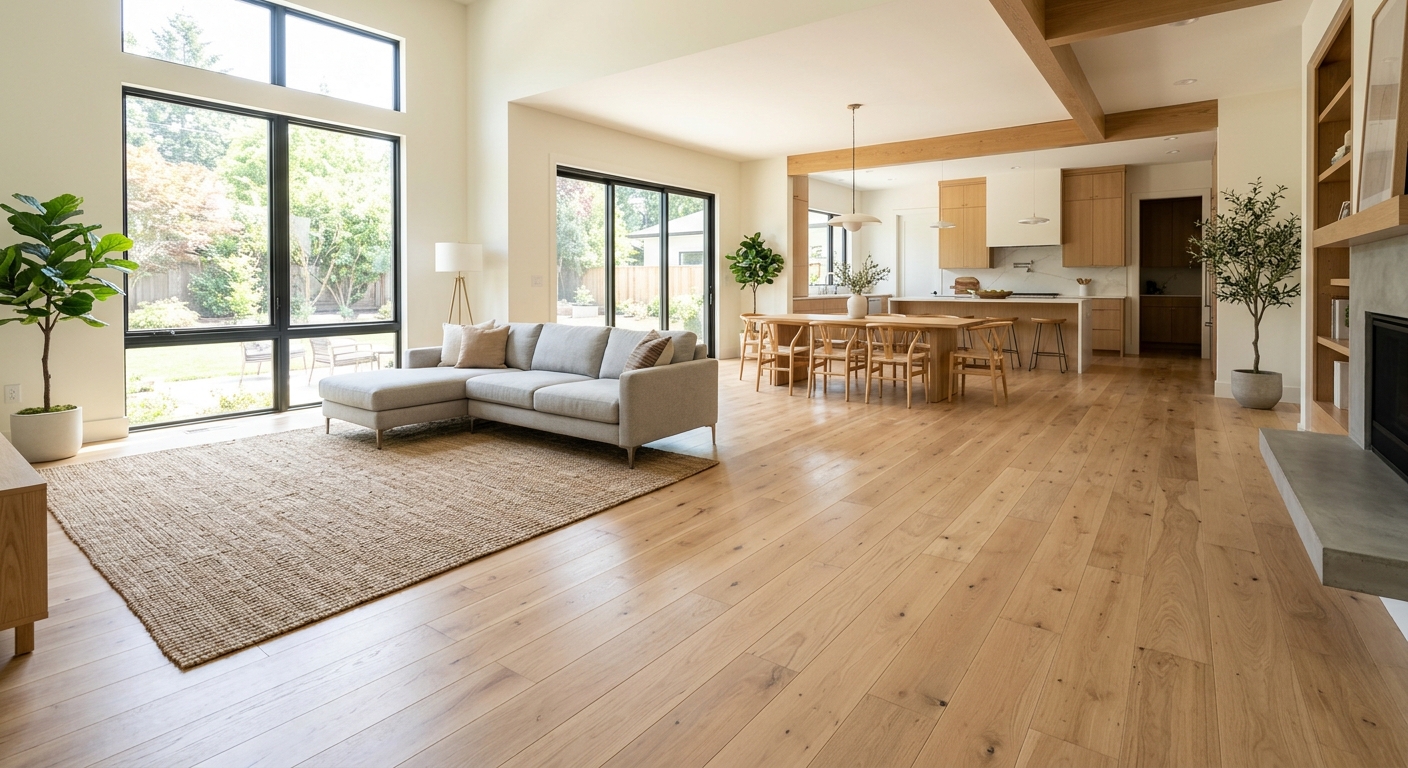
Flooring options and costs in Montrose
In Montrose, Alberta, choosing the right flooring is as much about climate fit as it is about look and budget. With a population of 3,241 (Statistics Canada, 2021 Census), Montrose sits within the Calgary market where installers are busy and pricing is sensitive to scheduling, material availability, and site prep. One common cost driver in this region is older housing—many homes have floors that aren’t perfectly flat, so subfloor levelling or repair is frequently needed before you lay tile or click flooring. Depending on how out-of-level things are, that prep often adds roughly $1–$3 per sq ft (and more where plywood is deteriorated or transitions need reworking).
Calgary’s dry, cold prairie climate brings big humidity swings through the year, and that matters for anything wood-based. Solid hardwood expands and contracts with indoor moisture, and it’s typically limited to above-grade installs on an appropriate subfloor—basements are usually a different story. Below-grade moisture migration through concrete means homeowners often choose engineered hardwood, luxury vinyl plank (LVP), or SPC for better dimensional stability. Where builders have in-floor heat (more common with modern builds), radiant compatibility also shapes material choices.
In neighbourhood pockets around Montrose Estates / the newer north-side developments, demand is especially strong for waterproof LVP in main levels and finished basements, because families want a faster, lower-risk install than solid hardwood. From there, the best way to compare budgets is to look at realistic per-square-foot ranges across popular options—see the table below.
| Type |
Best Room |
Moisture Resistance |
Lifespan |
Price per sq ft |
| Solid hardwood (nail-down, above grade only) |
Living / dining, main floor hallways |
Low in basements; sensitive to humidity swings |
25–60 years (if maintained) |
$9 – $15 |
| Engineered hardwood (float or glue, above + on-grade) |
Living / dining, main bedroom levels |
Good; handles normal humidity better |
20–35 years |
$8 – $13 |
| Laminate (click-lock, above-grade) |
Living, bedrooms (dry areas) |
Fair; seams can fail if kept wet |
10–20 years |
$3 – $7 |
| Luxury vinyl plank / LVP (waterproof, any level) |
Basements, kitchens, main floors |
Excellent; waterproof core |
15–25 years |
$4 – $10 |
| Porcelain / ceramic tile |
Bathrooms, kitchens, entries |
Excellent (once properly sealed/grouted) |
25–50 years |
$7 – $12 |
| Carpet (broadloom or modular tile) |
Bedrooms, family rooms |
Moderate; keep dry and well-vented |
8–15 years |
$4 – $8 |
Prices are estimates only and vary by project scope, site access and material selection.
What affects the price of flooring in Montrose
Two homeowners can receive quotes that look wildly different for the “same” flooring because the scope in the Calgary region often includes more than the surface you see. In practice, costs can swing by about 30–50% across Alberta depending on subfloor condition, moisture risk, and whether your contractor needs to level, repair, or handle moisture migration. Labour rates also vary with how tight the schedule is, how far materials must be brought in, and how complicated stair work and transitions are in older homes.
From a technical standpoint, indoor humidity swings and below-grade moisture are the main cost drivers in this prairie climate. Solid hardwood expands and contracts with humidity, and it generally cannot be glued or floated over concrete; it also performs poorly in basements. That’s why engineered hardwood and waterproof LVP/SPC usually price out better for basements and on concrete slabs. Colder-region radiant heat compatibility also matters: most solid hardwood is limited on some radiant systems, while many laminate and LVP products are engineered for heat exposure—still, you must follow the product’s temperature limits.
Older regional housing stock frequently needs levelling or repairs—often adding $1–$4 per sq ft—especially where you have wavy plywood, mismatched floor elevations, or ceramic tile that demands a flat substrate. For example, if your main floor is uneven, bringing it into plane may push a laminate project from “straight install” into a prep-heavy job. Conversely, switching to LVP can lower risk and sometimes reduce the amount of moisture remediation needed on a slab, even if the material itself isn’t the cheapest per sq ft. That’s also why you’ll often see budgets move from laminate ranges (around $3–$7) into LVP ranges (often $4–$10) once moisture protection, underlayment strategy, and concrete readiness are addressed.
| Price Factor |
Why It Matters |
Cost Impact |
| Room area in sq ft |
Material and labour scale directly with surface area |
Small rooms can cost relatively more per sq ft due to minimum labour |
| Subfloor condition |
Levelling/repair is required for flat, stable installation |
Often adds $1–$4 per sq ft for prep in older homes |
| Moisture / below-grade install |
Concrete moisture migration can damage wood-based materials |
Can require moisture barrier/planar prep; typically rules out solid hardwood |
| Material choice |
Solid vs engineered vs LVP vs tile each have different install requirements |
Solid hardwood typically costs more than laminate; tile costs more in labour/flatness |
| Removal and disposal of existing flooring |
Demo adds time, waste handling, and sometimes additional damage repair |
Can materially increase total budget, especially with glued-down materials |
| Stair nosing / transitions |
Stairs and thresholds add complexity and finishing work |
Charged per step or per linear foot; often adds hundreds |
| Radiant heat compatibility |
Not all products tolerate the same heat output/temperature cycles |
May limit options and require specific underlay/installation method |
| Installation method |
Float vs glue-down vs nail-down changes substrate prep and labour |
Glue-down and tile typically require tighter prep and longer labour time |
Permits & regulations in Alberta
In Alberta, installing flooring itself typically does not require a building permit. However, the “associated work” that sometimes comes with flooring projects can trigger permit needs—especially when you’re altering structure, addressing moisture remediation methods that affect other systems, or dealing with in-floor electrical components. For example, while swapping flooring or installing a floating LVP floor generally doesn’t need a permit, electrical work may require permits if you’re modifying circuits for in-floor heating, adding new wiring, or changing protected electrical components. Structural subfloor repair may also trigger permit requirements if it involves load-bearing changes or significant alterations beyond standard surface repair.
In condominiums around Montrose and the broader Calgary economic region, rules are often in the corporation’s documentation. Many buildings regulate sound transmission (STC/IIC) and can require specific underlay and installation details—particularly for hard-surface flooring on upper floors. Always review the condo declaration and ask for written board approval when required, especially for engineered hardwood or tile.
To verify a contractor in Montrose, follow a practical step-by-step checklist. First, confirm Alberta licensing where applicable (ask for their licence details and business information). Next, request a current certificate of liability insurance naming you as the certificate holder if your project scope requires it. Then verify workers’ compensation coverage (WSIB/WCB) by asking for their clearance letter or evidence of account status. Finally, keep everything in writing: the quote scope, warranty terms, and start/completion dates.
Best flooring for each room in your Montrose home
The best flooring in a Montrose home matches the room’s moisture exposure, foot traffic, and comfort needs—then fits Alberta’s humidity swings and cold-season operation. For living and dining areas, engineered hardwood or a high-quality laminate often hits a good balance: they’re warm underfoot and can look like real wood without the same sensitivity to seasonal movement as solid hardwood. For master bedrooms, carpet is still a practical choice in Alberta winters because it adds comfort and helps absorb sound—especially in busy households.
Kitchens and entry zones typically do better with luxury vinyl plank (LVP) or large-format porcelain tile. The reason is simple: spills, tracked-in moisture, and frequent cleaning are easier on waterproof products. If your home has a finished basement, LVP is usually the clear winner in this Calgary-area climate because it can handle below-grade conditions and concrete moisture risk far better than solid wood or most laminate. Bathrooms should stay with porcelain or ceramic tile for reliable water resistance.
Radiant heat compatibility is increasingly relevant as new construction and renovations grow in the region. If you’re installing over in-floor heating, confirm the flooring manufacturer’s installation method and temperature limits before you buy. A small material upgrade can be worth it: for example, moving from a basic laminate in the $3–$7 per sq ft range to waterproof LVP at roughly $4–$10 per sq ft can be justified when basement moisture risk would otherwise force expensive remediation or repeated failures.
| Room |
Best Material |
Why |
Moisture Risk |
Price Band per sq ft |
| Living / dining room |
Engineered hardwood |
Warm look with better humidity tolerance than solid |
Low (main level), manageable with proper HVAC humidity |
$8 – $13 |
| Master bedroom |
Carpet or engineered hardwood |
Carpet adds comfort; engineered maintains a refined finish |
Low, but watch for leaks or high indoor dampness |
$4 – $13 |
| Secondary bedrooms |
Laminate or carpet |
Laminate is durable for daily traffic; carpet for comfort |
Low to moderate (avoid prolonged wetting) |
$3 – $8 |
| Kitchen |
LVP or large-format porcelain tile |
Easy cleaning and strong impact/spill performance |
Moderate to high (spills and steam cycles) |
$4 – $12 |
| Basement (finished) |
Luxury vinyl plank (waterproof) |
Handles below-grade conditions and moisture migration risk |
High (concrete vapour pressure and seasonal swings) |
$4 – $10 |
| Bathroom |
Porcelain / ceramic tile |
Best long-term water resistance with correct grout work |
High (direct water exposure) |
$7 – $12 |
How to choose a flooring contractor in Montrose
Choosing the right flooring contractor in Montrose is mainly about verifying proof, not just promises. Start by confirming Alberta coverage and legitimacy. Ask for their Alberta licence details (or business registration information if licensing doesn’t apply to the same extent as other trades), then request a current certificate of liability insurance. Next, verify WSIB/WCB coverage: ask for their clearance letter or documentation showing they have coverage in good standing. If a contractor can’t provide these on request, move on—proper coverage protects you when accidents happen during demo, stair work, or tile setting.
Then get 2–3 itemised written quotes, not just a single lump sum. The quote should split labour and materials, list subfloor prep/leveling as a line item if needed, and specify underlay/moisture barrier details. Read the scope carefully: what’s included in removal and disposal? Are transitions, stair nosing, and mouldings included? Is permitting required (or explicitly not required) based on your specific scope? Finally, confirm warranty terms: workmanship warranty length, the product/manufacturer warranty, and whether it’s transferable to future owners.
For payment, never pay more than 10–15% upfront. Hold back a portion until the job is complete and your punch list is addressed. Get the schedule in writing too—start date and completion estimate—because material lead times in the Calgary market can affect timelines quickly.
- Request proof of liability insurance and ensure it’s current for the job dates.
- Ask for WSIB/WCB clearance documentation before demo begins.
- Ensure the quote is itemised: materials, labour, and any levelling/patching.
- Confirm moisture mitigation plan for any slab or below-grade area.
- Verify the underlay/moisture barrier brand and model used for your product.
- Check whether removal and disposal are included, and what’s excluded (e.g., stairs, baseboards).
- Confirm transition and stair work pricing (per step/per linear foot) before signing.
- Ask how floor flatness will be measured and what level is required for tile.
- Review warranty terms in writing: who issues it and what voids it.
- Ask about acclimation time for solid/engineered wood and how it’s handled onsite.
- Get an installation method commitment (float vs glue-down vs nail-down) matched to product specs.
- Make sure the schedule and completion date estimate are in writing.
Common red flags I see with flooring contractors in the Montrose area include: refusing to provide insurance/WSIB evidence, quoting without mentioning moisture barriers or flatness requirements, vague scopes that omit transitions/stairs/disposal, requiring full payment up front, and skipping written warranty details. If any of these show up, it’s usually safer to keep searching.
Frequently asked questions — flooring in Montrose
Can I install hardwood over concrete?
In most Montrose and broader Alberta cases, you should be cautious installing solid hardwood over concrete. Solid hardwood is typically intended for above-grade nail-down installs over an appropriate subfloor, because it relies on wood movement that can’t be controlled well when it’s directly exposed to slab moisture and temperature cycling. If you want wood over concrete, engineered hardwood is the usual path because it’s built to handle seasonal humidity better and is offered in installation methods designed for on-grade conditions. Before buying, ask your contractor to assess slab condition and discuss moisture testing and surface readiness—especially if you’re dealing with a basement slab. In practical budget terms, engineered hardwood often lands around $8 – $13 per sq ft, while solid hardwood generally runs higher at $9 – $15 per sq ft and is usually avoided on slabs.
How long does flooring installation take?
Installation timelines in Montrose depend less on “how fast” than on what prep is required. A straightforward main-floor LVP or laminate job can often move quickly once the room is cleared and the subfloor is ready, while tile takes longer because the substrate must be properly level and the setting/grout process requires cure time. If your home needs subfloor levelling or repair—common in older Calgary-area housing—add time for patching, drying, and re-checking flatness. Basement work can also take longer because contractors may need moisture mitigation steps before the flooring goes down. As a rule of thumb, expect a few days for a small space, about a week for an average main-floor layout, and longer if stairs, multiple transitions, or significant levelling are included. Your contractor should give a start date and completion estimate in writing so you can plan around material deliveries and acclimation.
What flooring works with radiant heat?
In Alberta, radiant heat compatibility is a must-check before you choose flooring—Montrose homeowners are increasingly installing in-floor heating during renovations. Many manufacturers will specify the approved flooring types and installation methods, along with temperature limits for the heating system. In general, LVP/SPC and some engineered hardwood options are designed to tolerate radiant conditions better than traditional solid hardwood. Tile is also commonly used with radiant heat because it transfers heat well, but it demands correct thinset and a flat substrate. Laminate may work with radiant heat when it’s rated and installed according to the manufacturer’s instructions. The biggest mistake homeowners make is assuming all “wood-look” products are automatically radiant-safe. Ask your installer to confirm the product’s radiant limits and underlay requirements, and ensure the contractor follows them.
Engineered vs solid hardwood — what's the difference?
Solid hardwood is one piece of wood and is typically installed nail-down on a suitable above-grade subfloor. It can look timeless, but it’s more sensitive to indoor humidity swings in Alberta; that makes it risky for basements and problematic over concrete slabs. Engineered hardwood is made with a plywood or composite core topped by a hardwood veneer, which allows more dimensional stability through seasonal humidity changes. That means engineered hardwood is often a better choice for Montrose homes that may have uneven subfloors, normal daily humidity variation, or parts of the house near concrete. From a practical homeowner perspective, engineered hardwood usually costs less than solid at comparable looks, with many projects landing around $8 – $13 per sq ft, while solid hardwood commonly sits around $9 – $15 per sq ft. In humid-prone or below-grade scenarios, LVP/SPC can still be the safer waterproof alternative.
Do I need to level my subfloor first?
Often, yes—especially in Montrose when you’re dealing with older floors and the need for a clean, flat installation surface. Whether you “need” levelling depends on the finished flooring type and how out-of-flat your subfloor is. Tile is the most unforgiving: without proper flatness, you can get cracked grout lines, hollow spots, and premature failure. Laminate and click-lock products also require a stable, smooth base to prevent joint stress and noise. Many regional basements and older main floors require patching or levelling because plywood can sag or concrete can vary. Levelling and repair add cost—commonly about $1–$4 per sq ft in older housing conditions—but it’s often cheaper than replacing a failed install. Ask your contractor how they’ll measure flatness and what they’ll do if the slab or plywood doesn’t meet the flooring manufacturer’s requirements.
What's the most durable flooring for pets and kids?
For pets and kids in an Alberta home, the most durable choice is usually a combination of impact resistance, stain resistance, and water tolerance—especially in a household with quick cleanups after accidents. In Montrose and Calgary-area basements, waterproof LVP/SPC is often the top pick because it handles moisture vapour and spills better than solid hardwood or standard laminate. It also stands up well to daily traffic and is easier to replace boards planks-by-plank depending on the product. For a budget-friendly direction, laminate can be durable, commonly around $3 – $7 per sq ft, but it’s less forgiving if liquid gets into seams. If you want “best durability + peace of mind,” LVP typically runs around $4 – $10 per sq ft and is a strong fit for active families. In wet areas like bathrooms, porcelain/ceramic tile remains the most resilient choice.