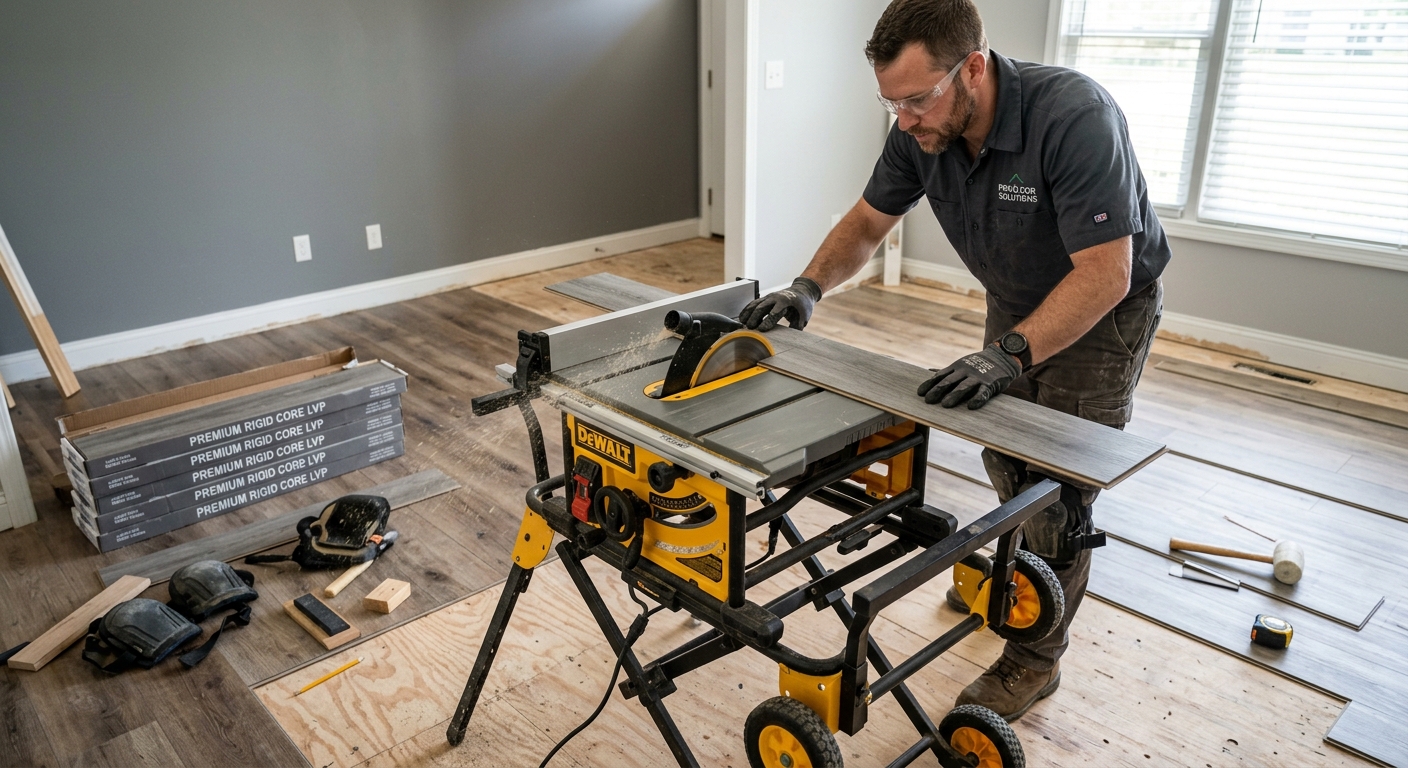
Flooring options and costs in Sherbrooke
Sherbrooke is a small community in Alberta (population 2,438 according to the Statistics Canada, 2021 Census), and that matters when you’re pricing flooring: local installers tend to bundle work efficiently, but scheduling can be tighter during peak renovations. You’ll also see a lot of older, seasonal homes across the Calgary economic region, where subfloor preparation is a common cost driver. In practice, many basements and main-floor areas require levelling or repair before installation—especially where aged plywood transitions to concrete—because even a small out-of-level condition can show through and cause click-lock seams or tile lippage.
On the climate side, Calgary’s dry, cold prairie weather brings large humidity swings. That technical reality is why contractor quotes often differ by 30–50% for the “same” look: solid hardwood expands and contracts with indoor humidity and also isn’t recommended for below-grade concrete. In contrast, engineered hardwood and luxury vinyl plank (LVP) are more dimensionally stable, which helps them perform through winter dryness and summer swings. If your project includes radiant heat, the available options narrow further—solid hardwood and some laminate profiles aren’t ideal over in-floor systems.
Demand is especially noticeable for durable, basement-friendly installs in the areas around newer growth corridors and established residential blocks—homeowners often want a waterproof solution that can handle moisture migration through slabs. With that in mind, the table below summarizes typical price bands and where each product generally makes sense in Sherbrooke.
| Type |
Best Room |
Moisture Resistance |
Lifespan |
Price per sq ft |
| Solid hardwood (nail-down, above grade only) |
Main living areas |
Low (not for basements or slab) |
25–60 years |
$8–$15 |
| Engineered hardwood (float or glue, above + on-grade) |
Living, dining, bedrooms |
Medium to high (grade-dependent) |
20–35 years |
$8–$14 |
| Laminate (click-lock, above-grade) |
Bedrooms, hallways |
Low to medium (standing water not recommended) |
10–25 years |
$3–$7 |
| Luxury vinyl plank / LVP (waterproof, any level) |
Kitchen, basement (finished) |
High (waterproof core) |
15–25 years |
$4–$9 |
| Porcelain / ceramic tile |
Bathrooms, kitchens, entries |
Very high (if installed correctly) |
25–50 years |
$6–$12 |
| Carpet (broadloom or modular tile) |
Bedrooms, media rooms |
Low (susceptible to prolonged moisture) |
7–15 years |
$3–$5 |
Prices are estimates only and vary by project scope, site access and material selection.
What affects the price of flooring in Sherbrooke
In Sherbrooke and the wider Calgary region, two quotes for the same square footage can land 30–50% apart because the price isn’t only “material × area.” It’s also preparation, transitions, stair work, and—most importantly in this climate—how the product handles Alberta’s indoor humidity swings and any below-grade moisture migration through concrete.
Technically, solid hardwood expands and contracts with humidity, and it can’t be installed on concrete slabs like a basement floor. That often pushes basements toward engineered wood or waterproof LVP/SPC, which are dimensionally more stable during dry winters and humid shoulder seasons. If your home is older (common across the region’s housing stock) you may need subfloor levelling or repair before any finish flooring goes down; depending on how out-of-level the surface is, that can add roughly $1–$4 per sq ft. Tile adds another variable: ceramic and porcelain require a very flat substrate, so levelling and crack isolation membranes are more likely budget items.
Concrete examples of cost swings you’ll see locally: (1) a main floor that’s out-of-level by more than “noticeable with a straightedge” will usually require patch/skim work that pushes you upward into the higher band for engineered hardwood, and (2) a basement with moisture migration often eliminates solid hardwood and laminate—so even if your goal looks like “wood,” the realistic choice becomes LVP in the mid-range you’d expect around $4–$9 per sq ft. Meanwhile, a bathroom that’s sized small but has lots of edges, niches, and cutouts can push porcelain/ceramic toward the $6–$12 per sq ft range, with levelling and membrane work potentially making tile land closer to the top end.
| Price Factor |
Why It Matters |
Cost Impact |
| Room area in sq ft |
Drives material quantity and labour hours |
Direct linear change; small rooms still have fixed prep |
| Subfloor condition |
Levelling or repair must be done before flooring |
Often adds $1–$4 per sq ft depending on flatness |
| Moisture / below-grade install |
Rules out solid hardwood on concrete and limits laminate |
Typically shifts you to engineered wood or waterproof LVP/SPC |
| Material choice |
Solid, engineered, LVP, and tile have different installation demands |
May move you between roughly $3–$15+ per sq ft all-in |
| Removal and disposal of existing flooring |
Labour + debris handling |
Can add a noticeable lump sum, especially with tile/thick underlay |
| Stair nosing / transitions |
Stairs and transitions are time-intensive and need matching details |
Charged per step or per linear foot; raises project total quickly |
| Radiant heat compatibility |
Limits product selection and underlayment options |
May require higher-spec materials and proper underlay |
| Installation method |
Float vs. glue-down vs. nail-down changes prep and labour |
Glue-down and nail-down often cost more due to prep/fasteners |
Permits & regulations in Alberta
In Alberta, installing new flooring itself typically does not require a building permit. What often changes the permitting picture is the related work around the floor. For example, if you’re doing structural subfloor repair beyond simple patching, moisture remediation that includes addressing damaged framing, or any work that intersects with in-floor heating circuits, permits (or trades-specific sign-offs) may be required. If your project touches electrical components tied to radiant heat controls or wiring, electrical permitting rules can apply through the electrical contractor.
In condominiums, the bigger “rule” isn’t usually a permit—it’s the building’s sound transmission requirements. Hard surface flooring on upper floors can be restricted or required to meet specific sound performance (often framed as STC/IIC targets) and may mandate certain underlay types. Even when permits aren’t required, you should review the condo declaration and request board approval in writing before installing hardwood or tile above grade in a multi-unit building.
For a Sherbrooke homeowner verifying a contractor, start with three checks: (1) Alberta licence/registration information online (use the contractor’s public business listing and any applicable provincial registry details), (2) liability insurance certificate (request the COI and confirm it’s current and includes flooring installation), and (3) WSIB/WCB coverage for workers (ask for proof of clearance/coverage, not just a verbal statement). These documents help protect you if something goes wrong—an issue that matters when projects include levelling, tile prep, or radiant heat timing.
Best flooring for each room in your Sherbrooke home
Choosing the right flooring in Sherbrooke is mainly about moisture behaviour, foot traffic, and comfort in Alberta’s dry-cold prairie swings. Living and dining areas benefit from warmth and appearance without needing “basement-proof” materials, so engineered hardwood or high-quality laminate are common picks. For master bedrooms, homeowners often prioritize comfort and sound control—carpet does that well, while engineered hardwood is a good choice if you want a wood look with better tolerance for daily humidity changes.
In kitchens, the practical answer is usually luxury vinyl plank (LVP) or large-format porcelain tile. LVP’s waterproof construction is forgiving for spills and helps in homes where humidity cycles are intense. In finished basements, LVP is the clear winner: it’s waterproof, tolerates below-grade conditions better, and is generally safer over concrete than solid hardwood (which is sensitive to moisture and indoor RH swings). Bathrooms should be porcelain or ceramic tile only—if you go tile, plan for correct substrate flatness and proper waterproofing at wet-area details.
If your home has radiant heat (increasing in Alberta new construction), confirm compatibility before choosing. Solid hardwood is often limited by heat requirements, and some laminate products aren’t designed to run at radiant setpoints. As a dollar example, if you’re comparing a bathroom-flooring direction, tile typically falls in the $6–$12 per sq ft band, while laminate/other surfaces are cheaper—however, the tile cost is justified because it’s the right material for repeated wet cleaning and splash zones, avoiding premature replacement.
| Room |
Best Material |
Why |
Moisture Risk |
Price Band per sq ft |
| Living / dining room |
Engineered hardwood |
Warm look with better stability through humidity swings |
Low |
$8–$14 |
| Master bedroom |
Carpet or engineered hardwood |
Carpet adds comfort; engineered keeps a cleaner, quieter hard-floor option |
Low |
$3–$14 |
| Secondary bedrooms |
Laminate or carpet |
Good durability for kids/pets with lower upfront cost |
Low to medium |
$3–$7 |
| Kitchen |
LVP or porcelain tile |
Easy cleanup and strong performance with spills |
Medium |
$4–$12 |
| Basement (finished) |
LVP (waterproof core) |
Handles moisture vapour and below-grade conditions better than solid wood |
High |
$4–$9 |
| Bathroom |
Porcelain / ceramic tile |
Built for wet-zone cleaning and long service life |
Very high |
$6–$12 |
How to choose a flooring contractor in Sherbrooke
Start by verifying Alberta coverage and credentials the way you would for any trade with indoor work risks. Ask for a current proof of liability insurance (certificate of insurance showing the policy is active and includes flooring installation). For labour coverage, request WSIB/WCB documentation and a clearance letter or proof of active coverage—don’t accept “we’re covered” without the paperwork. If you’re in a multi-unit building, confirm they understand sound requirements and can recommend the correct underlay assembly for hard flooring on upper floors.
Next, get 2–3 itemised written quotes. You want a line-by-line breakdown for materials and labour: prep/levelling, underlay, transitions, removal/disposal, and any stair work. Avoid lump-sum pricing that hides preparation costs—especially in older Sherbrooke basements where levelling can be the difference between a flat install and a callback. Also confirm what’s excluded: permit pull (if any related work triggers it), patching scope, disposal, moving appliances, and how they handle flooring haul-away.
Warranty matters in flooring more than many people expect. Make sure the workmanship warranty (how long they stand behind installation) is clear, and check whether it’s transferable if you sell your home. For payment schedule, never pay more than 10–15% upfront; hold back until the job is complete and clean-up is finished. Finally, require a start date and an estimated completion timeline in writing so you can plan around winter weather and humidity stability.
- Provide WSIB/WCB clearance proof (current document, not a screenshot of a webpage).
- Provide liability insurance COI and verify policy dates.
- Quote includes subfloor prep details (levelling/patch/repair) with quantities or allowances.
- Underlay type is specified (and compatible with radiant heat if applicable).
- Removal and disposal are itemised (how debris is handled and where it goes).
- Transitions and stair nosing details are listed per step or per linear foot.
- Moisture mitigation steps are described for below-grade areas (vapour strategy and materials used).
- Start date, completion date estimate, and crew availability are written in the contract.
- Workmanship warranty length is in writing; ask what constitutes a “defect.”
- Product warranty terms are stated and matched to installation method (float vs glue-down).
- Payment schedule: small deposit only (10–15% max) and holdback until completion.
- Ask for sample material and colour verification in writing to prevent mismatches.
Red flags to watch for in Sherbrooke: a contractor who won’t discuss subfloor flatness targets before quoting, a quote that “assumes” no levelling even when the slab/plywood is uneven, no proof of WSIB/WCB or insurance on request, a vague scope that doesn’t mention disposal or transitions, and any warranty wording that only covers “materials” but not workmanship.
Frequently asked questions — flooring in Sherbrooke
What is the difference between floating and glued-down flooring?
Floating floors (common with click-lock laminate and many LVP products) don’t attach directly to the subfloor; they rest on an underlayment and interlock. This method can be faster and is often more forgiving over minor irregularities, but it still requires a clean, properly prepared base—especially for preventing flex in corners. Glued-down flooring (used with some engineered hardwood and certain LVP installs) bonds the material to the subfloor, which can help with stability and sound transfer but demands a more consistent substrate and strict adhesive cure/temperature conditions. In Sherbrooke’s dry-cold swings, both methods must respect manufacturer acclimation guidelines, and basements usually call for waterproof cores like LVP rather than solid hardwood. If you’re comparing costs, floating options often align closer to $3–$7 per sq ft for laminate, while engineered wood and glue-down assemblies frequently trend higher.
What flooring holds up best to pets in a Sherbrooke home?
For pets, I usually steer homeowners toward waterproof and scratch-tolerant surfaces. In Sherbrooke and the Calgary region, that often means luxury vinyl plank (LVP) with a strong wear layer and a waterproof core—especially if your layout includes a finished basement where moisture risk exists. Carpet can be comfortable, but it’s more vulnerable to stains and prolonged dampness, so it’s best only if you manage spills quickly. Laminate can work for many households, but it isn’t meant for standing water, and claw scuffs can show depending on wear layer quality. Engineered hardwood is attractive and warmer than LVP, but it’s sensitive to moisture and the wrong environment can shorten its life. If you’re budgeting, LVP commonly sits in the $4–$9 per sq ft range, while tile typically runs $6–$12 per sq ft and can be excellent for claw-prone pets if installed on a well-prepped substrate.
How do I fix squeaky floors in my Sherbrooke home?
Squeaks usually come from movement between the subfloor boards, joists, or fasteners—not from the finished flooring itself. The first step is to identify the source: press down while you listen, or walk slowly and note which room sections squeak. In many older Sherbrooke homes across the Calgary area, aged plywood and loosened screws/nails create friction points; fixing them may require lifting small sections of flooring, adding fasteners, or correcting subfloor gaps. If you’re planning a replacement anyway, ask the contractor to inspect joist spacing and subfloor integrity before install—this can prevent callbacks where the new floor exposes old problems. Once the subfloor is corrected and levelled, a new installation over a proper underlayment (for floating systems) can reduce minor vibration. Note that “squeak sealing” without addressing loose subfloor fasteners rarely solves the problem long-term.
What is luxury vinyl plank and is it worth it in Sherbrooke?
Luxury vinyl plank (LVP) is a multi-layer floor product with a wear layer on top and a core that’s designed to be waterproof. In Sherbrooke and the Calgary economic region, it’s often worth it because it handles Alberta’s humidity swings better than solid hardwood and is a practical solution for below-grade conditions where moisture migration through concrete can occur. Solid hardwood is generally limited to above-grade installs, while LVP is commonly used “any level” because the waterproof core reduces the risk of damage from occasional moisture exposure. LVP can also be a cost-effective way to get a wood-look without the higher material and preparation costs that engineered or tile may require. Typical project pricing often lands in the $4–$9 per sq ft range for the LVP material tier, which can be more budget-friendly than tile (often $6–$12 per sq ft) while still meeting everyday spill needs.
How much does flooring cost in Sherbrooke?
Flooring costs in Sherbrooke depend on both material choice and prep work. A realistic starting point is to think in bands: laminate or vinyl plank often shows up around $3–$7 per sq ft for laminate and about $4–$9 per sq ft for LVP, while tile is typically in the $6–$12 per sq ft range. Hardwood varies more: solid hardwood commonly sits around $8–$15 per sq ft, and engineered hardwood often overlaps that higher band when you include the right product for stability. Your final number may move because older housing stock can require subfloor levelling or repair—often $1–$4 per sq ft depending on how out-of-level surfaces are. Basements also affect the decision: moisture migration can rule out solid hardwood and certain laminate choices, which can shift the quote up or down depending on what you select. If you want tighter budgeting, request an itemised quote that separates levelling, removal/disposal, and transitions.
Hardwood vs laminate vs vinyl plank — which is best?
The “best” option in Sherbrooke usually depends on where you’re installing and your tolerance for moisture risk. Solid hardwood looks excellent, and above-grade installs can last decades, but it’s not the right choice over concrete basements because humidity and below-grade moisture can cause movement and damage. Engineered hardwood is the closer cousin and handles humidity better, but it’s still not a universal basement floor if the substrate has active moisture. Laminate can be a good value for bedrooms and low-risk areas, typically aligning with the $3–$7 per sq ft band, but it generally isn’t designed for waterproof below-grade conditions. Vinyl plank (especially waterproof LVP) is often the most practical “all-weather” solution for Alberta homes, commonly in the $4–$9 per sq ft band, and it’s a safer pick for kitchens and finished basements where spill and vapour exposure are more likely. If radiant heat is present, confirm compatibility in writing before choosing—some options must be excluded.