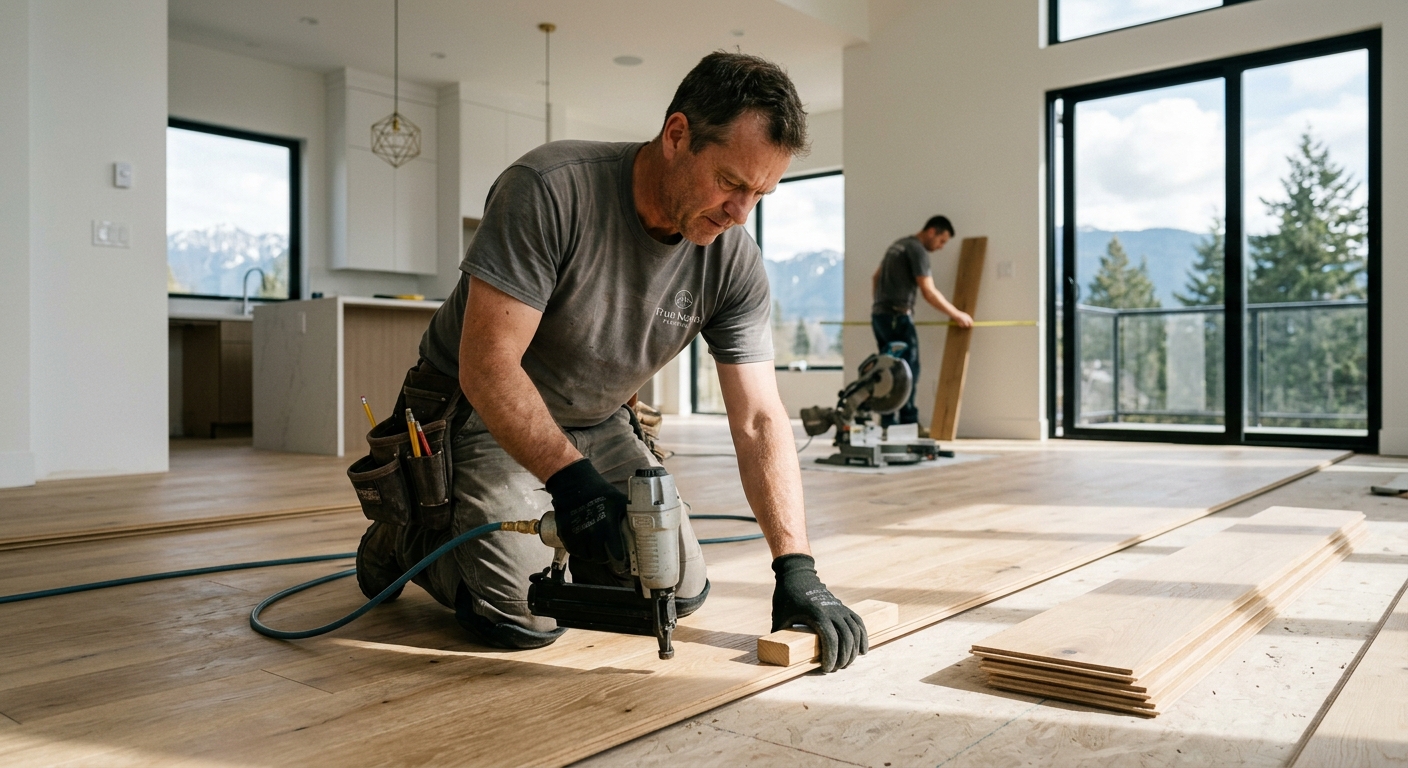
Flooring options and costs in Viking
Viking, Alberta homeowners usually choose flooring based on cold winters, indoor humidity swings, and the practical realities of older housing. In Viking specifically, many homes are long-established—78.2% were built before 1981 (Statistics Canada, 2021 Census)—and that matters because older subfloors often need levelling, patching, or sheet goods repair before any new product can sit flat. At the household level, there are 335 homeowner households, with 77.0% of households owning (Statistics Canada, 2021 Census), so many projects are “stay-and-renovate” decisions where comfort and longevity are weighed as heavily as upfront cost.
In the Camrose–Drumheller region, the climate tends to shift moisture conditions through the year, which is why engineered wood and luxury vinyl plank (LVP) are usually better practical fits than solid hardwood. Solid hardwood is more sensitive to seasonal movement; it’s also a poor match for basements or any below-grade concrete where vapour pressure can be an issue. Radiant heat compatibility is another recurring factor in Alberta homes—when in-floor heat is present or planned, it narrows product choices and influences the final material recommendation.
Labour availability and prep complexity also shape the budget. In Viking’s older areas—especially around the core where many homes are on older slabs or have uneven plywood—subfloor prep can become the difference between a “simple install” and a full-day prep-and-level scope. That’s why comparing quotes starts with what’s included, not just the product price. Use the table below as a baseline for typical price ranges in Viking, then we’ll break down what pushes those numbers up or down.
| Type |
Best Room |
Moisture Resistance |
Lifespan |
Price per sq ft |
Price Range |
| Solid hardwood (nail-down, above grade only) |
Living / dining where humidity is controlled |
Low (avoid basements and below grade) |
25–50 years |
$10–$18 |
$12 – $20 |
| Engineered hardwood (float or glue, above + on-grade) |
Main floor living areas |
Medium to high (better tolerance of movement) |
20–40 years |
$10–$18 |
$11 – $22 |
| Laminate (click-lock, above-grade) |
Bedrooms and hallways |
Low to medium (needs quick spill cleanup) |
10–25 years |
$4–$10 |
$6 – $12 |
| Luxury vinyl plank / LVP (waterproof, any level) |
Kitchen, basement (finished) |
High (waterproof core) |
15–30 years |
$4–$10 |
$6 – $14 |
| Porcelain / ceramic tile |
Bathrooms, kitchens, entryways |
Very high (with correct underlayment) |
25–50 years |
$12–$28 |
$14 – $34 |
| Carpet (broadloom or modular tile) |
Bedrooms |
Medium (must manage spills and humidity) |
8–15 years |
$4–$8 |
$6 – $14 |
Prices are estimates only and vary by project scope, site access and material selection.
What affects the price of flooring in Viking
In Viking and across Alberta, the same flooring can land anywhere from 30% to 50% apart when homeowners compare quotes. The biggest reason isn’t “contractor rip-offs” so much as scope differences—how much prep is needed, what’s included for removal and disposal, and whether the installer plans for moisture risk. In the Camrose–Drumheller region, humidity swings through the year can be significant. Solid hardwood expands and contracts with humidity, and it cannot be glued or floated over concrete; it also performs poorly in basements and other below-grade applications. That’s why, for most Viking basements and any on-slab areas, engineered hardwood or luxury vinyl plank (LVP) is typically priced in as the safer approach.
Colder Alberta conditions also drive radiant heat considerations. Where in-floor heat is present or planned, many installers steer away from solid hardwood and certain laminate setups, which can change both product and underlay costs. Another common local budget driver is older housing stock: because 78.2% of Viking homes were built before 1981 (Statistics Canada, 2021 Census), subfloor levelling or repair is frequently needed, commonly adding about $1–$4 per sq ft depending on how flat the surface is and whether patching/underlayment is required.
Concrete examples from Viking projects: if your main floor has waves in older plywood, a “$6–$12/sq ft” LVP range can move upward once levelling compound and new underlayment are included. Conversely, if the subfloor is already flat and moisture-safe, a “$10–$18” solid hardwood option above grade may stay close to budget—while a basement with vapour risk often makes solid wood impractical, pushing the realistic budget closer to the LVP band. In short, climate and prep scope decide the number as much as the flooring type.
| Price Factor |
Why It Matters |
Cost Impact |
| Room area in sq ft |
Directly affects materials and labour time |
Usually scales linearly; larger rooms can reduce waste rate but increase total spend |
| Subfloor condition |
Levelling or repair before new flooring |
Can add roughly $1–$4 per sq ft in older homes when patching/levelling is needed |
| Moisture / below-grade install |
Rules out solid hardwood; may require vapour control |
Typically shifts options to engineered or waterproof LVP; may add moisture testing and extra layers |
| Material choice |
Solid vs engineered vs LVP vs tile have different installation systems |
Solid/engineered hardwood often falls above laminate/vinyl; tile usually higher in total |
| Removal and disposal of existing flooring |
Labour, dump fees, and subfloor cleaning |
Often a material-to-material surprise; can be hundreds for multi-room work |
| Stair nosing / transitions |
Complex edging and matching heights |
Typically charged per step or per linear foot; can materially affect total quotes |
| Radiant heat compatibility |
Limits what can be installed reliably over warm floors |
May require specific underlay/method; can add cost if a product must be changed |
| Installation method |
Float vs glue-down vs nail-down affects prep and labour |
Glue-down often needs stricter subfloor flatness; nail-down requires above-grade moisture control |
Permits & regulations in Alberta
In Alberta, installing flooring itself generally does not require a building permit. Plain flooring replacements—like removing old carpet and installing LVP, laminate, engineered hardwood, or tile—are typically considered a renovation rather than a permit-triggering structural change. However, related work may require permits depending on what’s being modified.
What usually does require a permit in Viking projects: structural subfloor repairs that involve engineered changes, any moisture remediation tied to significant moisture sources (especially if it becomes a broader building envelope issue), and in-floor heating circuit work (electrical) where wiring, thermostats, or circuit alterations are involved. If a job includes electrical scope—adding or modifying radiant floor controls—electrical permits are typically required and the installer should coordinate it.
For condominiums, the permit question is often less important than the building’s rules. Many condo corporations restrict hard flooring in units because of sound transmission. They may require specific underlay for tile and wood, or they may require approval before installing hard-surface flooring on upper floors. In practice: request the board’s written approval, confirm STC/IIC requirements (or underlay specs), and keep the product/underlay information for compliance.
To protect yourself, verify your contractor before signing: check Alberta licensing status (where applicable for trades involved in the scope), confirm liability insurance and ask for a current certificate of insurance, and ensure Workers’ Compensation Board coverage (WSIB/WCB clearance letter or confirmation). A reputable flooring contractor will provide documents promptly and match them to your project scope.
Best flooring for each room in your Viking home
Choosing flooring room-by-room in Viking is about matching comfort and durability to local conditions. Cold winters and indoor humidity swings mean you want stable assemblies upstairs, and waterproof or well-controlled moisture solutions downstairs. For living and dining rooms, engineered hardwood or high-quality laminate often hits the sweet spot: they look closer to hardwood than laminate, while engineered products handle dimensional change better than solid wood in Alberta’s seasonal cycles.
For the master bedroom, comfort and sound matter. Carpet (broadloom or modular) gives warmth underfoot, reduces noise, and performs well in bedrooms where spills are less frequent. In the kitchen, moisture and cleaning are the deciding factors; luxury vinyl plank (LVP) with a waterproof core is usually the practical best choice, and large-format porcelain tile is a strong alternative if you want maximum water resistance and a “set it and forget it” cleaning routine.
Basements (finished) are where Viking homeowners typically benefit most from waterproof resilient flooring. LVP is the clear winner because it tolerates moisture vapour and below-grade installs that solid wood and many laminate setups struggle with. Bathrooms are the most straightforward: porcelain or ceramic tile only, with proper waterproofing and suitable underlayment.
Radiant heat compatibility is increasingly common in Alberta new construction and renos, so if a room has (or will have) in-floor heat, choose products and underlay systems rated for warm-floor use. A realistic budget example: if LVP is quoted around the $6–$14/sq ft band and tile is coming in closer to the $14–$34/sq ft range, tile can still be worth it in a bathroom, while choosing LVP in the basement usually delivers better moisture performance per dollar.
| Room |
Best Material |
Why |
Moisture Risk |
Price Band per sq ft |
| Living / dining room |
Engineered hardwood |
Warm feel with better movement tolerance than solid wood |
Low to medium (humidity swings affect solid more than engineered) |
$11–$22 |
| Master bedroom |
Carpet |
Comfort and sound absorption for Alberta winters |
Low (as long as ventilation and spills are managed) |
$6–$14 |
| Secondary bedrooms |
Luxury vinyl plank (LVP) or laminate |
LVP adds durability; laminate works if spills are controlled |
Low to medium |
$6–$12 (laminate) / $6–$14 (LVP) |
| Kitchen |
Luxury vinyl plank (waterproof) |
Easy cleaning and high spill tolerance |
Medium to high (daily water exposure) |
$6–$14 |
| Basement (finished) |
Luxury vinyl plank (waterproof) |
Handles moisture vapour and below-grade conditions reliably |
High (vapour and condensation risk) |
$6–$14 |
| Bathroom |
Porcelain / ceramic tile |
Maximum water resistance with long service life |
Very high |
$14–$34 |
How to choose a contractor in Viking
Choosing the right contractor in Viking comes down to verifying coverage, getting itemised quotes, and ensuring the scope matches your house conditions. Start with Alberta coverage checks: ask for a current certificate of insurance for liability and confirm Workers’ Compensation coverage (WSIB/WCB clearance or proof). If the project includes electrical work for radiant heat controls or any wiring changes, confirm the electrical trade is properly covered for that permitable scope.
Next, get 2–3 written, itemised quotes—ideally with labour and materials broken out separately rather than one lump sum. Flooring quotes should list what’s included for removal and disposal, subfloor prep, underlayment, transitions, stair work, and how they’ll handle floor height differences at doorways. Pay attention to exclusions: some quotes omit levelling compound, vapour barriers, patch-and-level materials, or stair nosing, which can turn a “good price” into a higher final bill.
Warranty matters in Alberta climate. Ask for the workmanship warranty length (for example, defects in installation), the product manufacturer warranty, and whether it’s transferable if you sell the home. Payment schedule should stay conservative—never pay more than about 10–15% upfront. Hold back a portion until the job is complete and you’ve received final documentation. For timelines, get a start date and a realistic completion estimate in writing, plus a plan for what happens if materials arrive late.
- Ask for itemised labour vs materials (not a single number)
- Confirm subfloor prep plan and included levelling/patching
- Verify moisture plan for basements and on-slab areas
- Confirm underlay/vapour barrier type and thickness (by written spec)
- Request details on transitions and stair nosing pricing
- Ask whether removal and disposal are included and how it’s priced
- Get warranty terms in writing (workmanship + manufacturer)
- Ask if warranties are transferable
- Check certificate of insurance date and coverage limits
- Request WSIB/WCB clearance or proof of coverage
- Review the exact payment schedule and holdback amount
- Ensure the contract states an estimated start and completion date
Red flags to watch for in Viking: (1) quoting only “per sq ft” without listing subfloor prep, (2) refusing to put moisture-vapour steps in writing for basements, (3) asking for large upfront payments beyond 10–15%, (4) no written warranty terms, and (5) “we don’t need to check anything” talk about product acclimation and subfloor flatness.
Frequently asked questions — flooring in Viking
Do condos restrict hard flooring?
Yes—many condo corporations in Alberta restrict or control hard flooring because of sound transmission. In Viking, that usually shows up as requirements for specific underlay systems under tile and engineered/laminate on upper floors. Before you buy materials, check your condo declaration and confirm what the board expects. If the board requires written approval, request it before installation so you don’t end up removing flooring after the fact. Also note that even when hard flooring is allowed, the thickness and type of underlay can affect compliance. If you’re comparing product choices, it’s smart to budget for the correct underlay rather than assuming “any underlay works.” For reference, if you’re choosing between laminate in the $6–$12/sq ft band and tile in the $14–$34/sq ft band, the underlay and transition details often matter as much as the surface material for condo approval.
How do I compare flooring quotes?
Start by comparing scope, not just price. Two quotes may both show a similar total, but one might include subfloor levelling and moisture prep while the other excludes it. Ask every contractor for an itemised breakdown: materials, labour, removal/disposal, underlayment/vapour control, transitions, and stair work. Confirm whether the quote includes acclimation time, waste allowance, and patch-and-level products. For moisture-sensitive areas—especially basements in Viking—require a written plan that explains what they’ll do to manage below-grade vapour and condensation risk. It’s also useful to compare within realistic bands: for example, LVP commonly lands around the $6–$14/sq ft band, while porcelain tile often comes closer to the $14–$34/sq ft range depending on format and prep. If one contractor’s “cheap tile” quote doesn’t mention underlayment system or subfloor flatness requirements, it likely won’t stay inexpensive at the end.
Can I install flooring over existing tile in Viking?
Sometimes, but it depends on tile condition and flatness. In Viking renovations, existing tile can be a workable base for resilient flooring or some laminate systems if the surface is firmly bonded and acceptably level. However, tile grout lines, height differences, and any cracked or loose tiles can telegraph through and cause problems later—especially with click-lock laminate. For LVP, an installer may require surface smoothing (self-levelling compound) so the planks sit flat; for tile-on-tile, proper prep is essential to ensure adhesion for the new flooring system. Tile also raises height and transition concerns at doorways. Before you proceed, ask your contractor how they’ll check flatness and what prep step they include (grinding, patching, or levelling). If the existing tile is in a basement and moisture is present, the correct moisture plan matters more than simply laying new flooring over top.
What is the best flooring for a high-traffic area in Viking?
For high-traffic areas in Viking—think entryways, hallways, and main-floor living—LVP is often the best practical balance of durability and moisture tolerance. It’s waterproof, which helps when snowmelt and salt residue get tracked in during Alberta winter months. In many homes, LVP also handles indoor humidity swings better than solid hardwood, which can be sensitive to seasonal movement. If you prefer a “harder” finish and want a longer service life, porcelain tile is another excellent option, but it usually costs more (commonly the $14–$34/sq ft range when all prep and installation are included). Carpet can be comfortable, but in busy areas it often needs faster stain management and replacement cycles. When comparing options, make sure the quote includes proper subfloor prep; in older Viking homes (many built before 1981), uneven surfaces can shorten the life of any installation.
How do I prepare my subfloor before new flooring?
Subfloor prep is where many project budgets are won or lost. In Viking, older housing stock often means the subfloor is not perfectly flat or has localized damage that needs patching. If the scope includes engineered hardwood, laminate, or LVP, the contractor should check flatness and fix dips and high spots before installation. For basements, preparation typically also includes confirming the moisture condition and using the correct underlayment or vapour control system. Homeowners can help by clearing the area, moving furniture, and making sure pets are out of the work zone. Avoid trying to “fix it later” with extra trim—use professional levelling compound and patching as part of the job. Ask your contractor to list prep materials in the quote. As a rough budgeting note, levelling/repair in older homes can add about $1–$4 per sq ft depending on what’s required, which is why two quotes for the same square footage may vary even with the same final floor covering.
Is cork or bamboo flooring a good choice in Viking?
Cork and bamboo can be good products in the right application, but they’re usually not the first choice for Viking basements or any below-grade areas. Cork is more forgiving underfoot and offers acoustic benefits, yet it’s still vulnerable to standing water and can be affected by high humidity if the system isn’t designed for moisture-prone installations. Bamboo is a type of hardwood, and like other wood products, it can be sensitive to seasonal dimensional change when humidity swings are larger. In a climate with cold winters and moisture risk (especially lower levels), engineered hardwood and LVP are typically the safer, more predictable picks. If you love cork or bamboo for a main floor, choose products that are explicitly rated for your intended installation method and ensure the installer includes proper acclimation and subfloor flatness prep. If you’re comparing cost, remember that while laminate might fall around the $6–$12/sq ft band and LVP around $6–$14/sq ft, moisture-tolerant systems often prevent costly rework later.