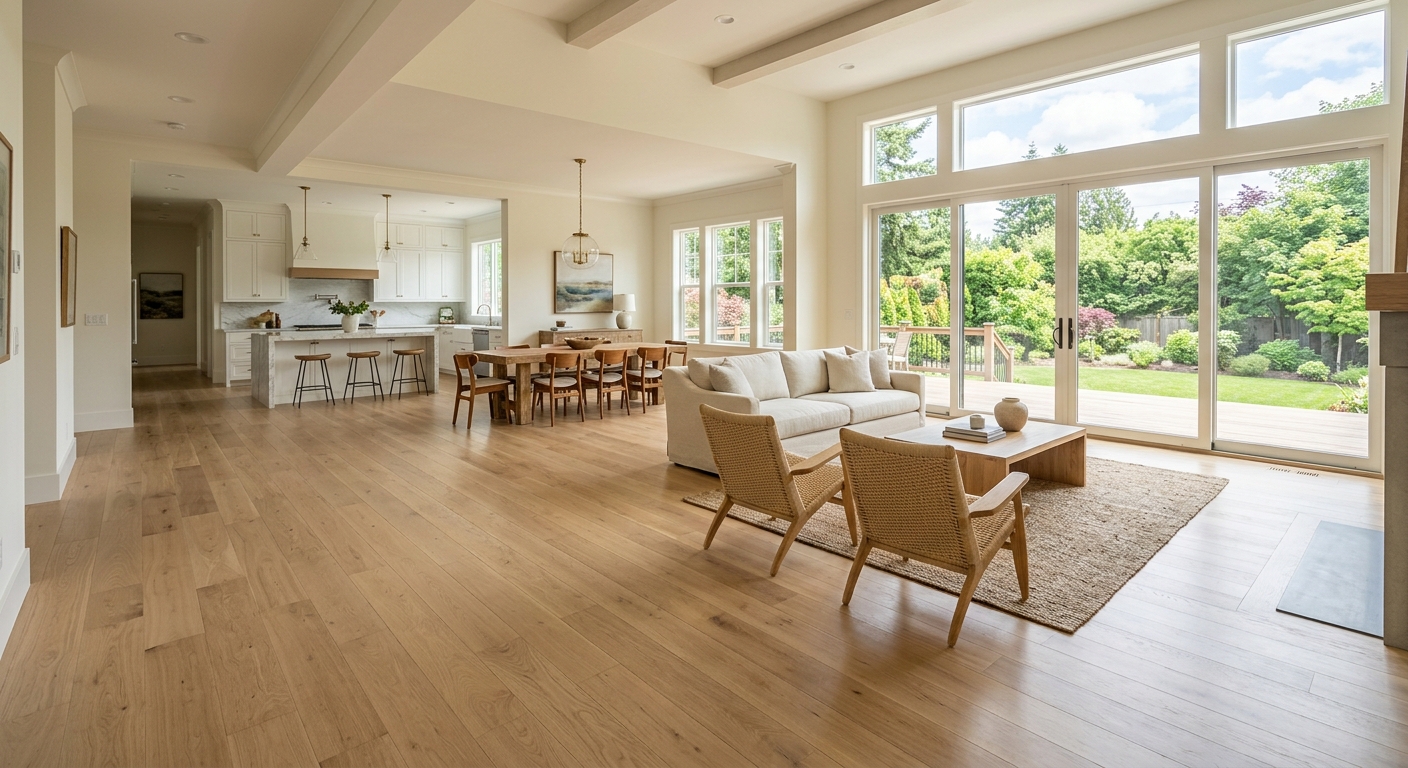
Flooring options and costs in Broadmoor
In Broadmoor, British Columbia, the right flooring choice starts with matching the material to our wet, marine climate and the way homes move seasonally. With a population of 23,050 in 2021 (Statistics Canada, 2021 Census), the area’s housing stock is busy year-round, but many nearby neighbourhoods in the Lower Mainland–Southwest still lean on older construction. That matters because older homes frequently have uneven plywood or concrete that needs levelling or even resurfacing before installation—commonly adding about $1–$3 per sq ft to the total project.
Cost can also shift quickly in the Lower Mainland–Southwest because indoor humidity swings in winter and shoulder seasons affect how materials expand and contract. Solid hardwood is popular in main living areas, but it must be installed above grade with proper expansion gaps and humidity control to prevent cupping and gapping. Below grade (basements and slab-on-grade), we generally avoid solid hardwood and recommend engineered wood or waterproof luxury vinyl plank (LVP), because their layered cores handle moisture better. Labour availability is another factor: Greater Vancouver trades are in high demand, so installation labour is a significant portion of the quote for Broadmoor homeowners—especially when removal, disposal, and subfloor prep are needed.
We see especially strong demand in Broadmoor’s older pockets near the major commercial nodes along the highway corridor, where renovations often overlap with stair and transition work. From there, it’s easiest to compare options side-by-side in the table below.
| Type |
Best Room |
Moisture Resistance |
Lifespan |
Price per sq ft |
| Solid hardwood (nail-down, above grade only) |
Main living areas |
Low to moderate (humidity sensitive) |
25–50 years |
$9 – $18 |
| Engineered hardwood (float or glue, above + on-grade) |
Living spaces, hallways |
Moderate to high (layered core) |
20–40 years |
$9 – $16 |
| Laminate (click-lock, above-grade) |
Bedrooms, dens |
Low to moderate (not for basements) |
10–25 years |
$4 – $10 |
| Luxury vinyl plank / LVP (waterproof, any level) |
Kitchen, main floors, basements |
High to waterproof (better for damp slabs) |
15–25 years |
$6 – $12 |
| Porcelain / ceramic tile |
Bathrooms, entryways, kitchens |
Very high (water-tolerant) |
30–60 years |
$10 – $20 |
| Carpet (broadloom or modular tile) |
Bedrooms, stairs |
Low (needs clean-up discipline) |
7–15 years |
$4 – $8 |
Prices are estimates only and vary by project scope, site access and material selection.
What affects the price of flooring in Broadmoor
In Broadmoor and the wider Lower Mainland–Southwest region, the same flooring concept can land 30–50% apart between contractors, even when the material looks similar. The biggest reasons are technical requirements (especially moisture control and subfloor readiness), how much levelling/repair is included, and how labour-intensive the job becomes when disposal, transitions, or stair work is part of the scope. In addition, larger projects often take place in older housing stock where uneven plywood or slab conditions require more prep—commonly adding roughly $1–$4 per sq ft once you include resurfacing, patching, and sometimes moisture barrier upgrades.
Humidity swings are a key technical driver here: solid hardwood expands and contracts with moisture, so it can’t be glued or floated over concrete and performs poorly in basements where moisture vapour can wick up through slab. That’s why engineered wood and luxury vinyl plank (LVP) tend to price more predictably for below-grade installs. If your project crosses into colder inland pockets or you’re installing radiant heating, that can also limit options; most homeowners choose engineered wood or LVP, while solid hardwood needs very careful specification. In main living areas, solid hardwood can still be a great match, but the quote may include extra steps like acclimation and stricter humidity management—especially if the subfloor is uneven.
Concrete examples from Broadmoor: (1) a 600 sq ft living area with modest subfloor irregularities might price higher than expected once levelling is added, while (2) a basement where moisture control is required can shift you from a “solid wood” plan into LVP or engineered to protect your investment. For perspective, if hardwood is priced in the local band (about $9–$18 per sq ft) and LVP is $6–$12 per sq ft, the added subfloor prep for solid wood below grade can quickly erase the material savings.
| Price Factor |
Why It Matters |
Cost Impact |
| Room area in sq ft |
Drives material quantity and labour hours |
Directly proportional; small rooms can be less efficient and costlier per sq ft |
| Subfloor condition |
Levelling or repair may be needed before any finish |
Often adds about $1–$4 per sq ft in older homes |
| Moisture / below-grade install |
Solid hardwood is typically ruled out; barriers may be required |
Can add moisture barrier materials/labour; can increase scope by 10–25% |
| Material choice |
Solid vs. engineered vs. LVP vs. tile have different install demands |
Moves the base price into local bands (hardwood, vinyl plank, tile) |
| Removal and disposal of existing flooring |
Concrete/adhesive cleanup is labour-heavy |
Often a meaningful line item; can add several hundred dollars on typical jobs |
| Stair nosing / transitions |
Charged per step or per linear foot and requires extra labour/trim |
Commonly adds a noticeable premium versus a simple flat-floor job |
| Radiant heat compatibility |
Some materials are temperature-limited |
May require different underlay or engineered/LVP upgrades |
| Installation method |
Float vs. glue-down vs. nail-down changes labour and prep requirements |
Glue-down and tile prep generally cost more than click-lock, flat installs |
Permits & regulations in British Columbia
In British Columbia, the flooring installation itself usually does not require a building permit—so a homeowner typically doesn’t need to “pull a permit” just to replace hardwood, LVP, carpet, or even ceramic tile finishes. However, associated work can trigger permitting. The most common examples are electrical permits for changes involving in-floor heating circuits (such as replacing or adding thermostat wiring), and any work that touches electrical components or requires inspection as part of an electrical scope. If a contractor is addressing structural subfloor repairs beyond routine patching (for example, significant structural corrections), you may see permitting requirements depending on the extent of the changes.
For condominiums, the bigger restriction is often the building’s rules, not a municipal building permit. Sound transmission requirements (STC/IIC expectations) commonly affect what underlay is allowed under hard surfaces, and some corporations require specific underlays or installation methods to reduce impact noise. Before installing hardwood or tile on upper floors in a multi-unit building, review your condo declaration and request board approval in writing. Keep that approval for your records.
Step-by-step in Broadmoor: (1) verify the contractor’s British Columbia licence status using the applicable online registry; (2) request a certificate of liability insurance naming you as an additional insured where appropriate; (3) confirm WSIB/WCB coverage and ask for clearance letters or proof documents; (4) make sure the quote references who is responsible for permits when radiant heating or electrical work is involved; and (5) match the contractor’s stated scope to their insurance coverage so there are no surprises if issues arise.
Best flooring for each room in your Broadmoor home
Choosing flooring by room is the most reliable way to handle Broadmoor’s wet marine climate and indoor humidity swings. In living and dining areas, homeowners want warmth and a natural look, so engineered hardwood or high-quality laminate is often the sweet spot: it’s more tolerant than solid hardwood when humidity fluctuates, while still giving you that wood appearance. In master bedrooms, comfort matters—carpet is still a strong option for softness and sound control, but engineered wood is a popular upgrade if you prefer easy cleaning. For kitchens, the biggest risks are spills and frequent mopping; luxury vinyl plank (LVP) or large-format porcelain tile both handle water well and clean up quickly.
Basements in the Lower Mainland–Southwest are where material rules really show. Moisture vapour can wick through concrete, so LVP is typically the clear winner: it’s waterproof and handles below-grade installations far better than solid wood and most laminate. Bathrooms should stay in the porcelain/ceramic category for water safety and durability. If you have radiant heating—common in newer builds and some cold-inland designs—plan for compatibility: engineered wood and tile pair well, while solid hardwood requires careful product selection and strict installation details.
Here’s a practical dollar example: if your living area is 400 sq ft, moving from laminate at roughly $4–$10 per sq ft to engineered hardwood at about $9–$16 per sq ft can be justified when you want longer life and better humidity stability. But if the same choice is considered for a basement, the better value usually shifts to LVP because it prevents cupping/warping risks that can cost far more to fix later.
| Room |
Best Material |
Why |
Moisture Risk |
Price Band per sq ft |
| Living / dining room |
Engineered hardwood |
Looks like wood, tolerates humidity swings better than solid |
Low to moderate (manage indoor humidity) |
$9 – $16 |
| Master bedroom |
Carpet or engineered hardwood |
Carpet adds comfort and sound absorption; engineered stays practical |
Low to moderate (avoid spills) |
$4 – $14 |
| Secondary bedrooms |
Laminate (click-lock) or LVP |
Good value for rooms with everyday traffic; LVP boosts spill resilience |
Low to moderate |
$4 – $12 |
| Kitchen |
Luxury vinyl plank (LVP) or porcelain tile |
Handles water and frequent cleaning; durable finish |
Moderate (spills and splash zones) |
$6 – $20 |
| Basement (finished) |
Luxury vinyl plank (waterproof) |
Best match for below-grade moisture vapour and uneven slabs |
High (moisture vapour through concrete) |
$6 – $12 |
| Bathroom |
Porcelain / ceramic tile |
Water-tolerant, stable under wet conditions |
High (direct moisture) |
$10 – $20 |
How to choose a flooring contractor in Broadmoor
In Broadmoor, choosing the right contractor is about more than price—it's about risk control. Start with licensing and coverage. For British Columbia, verify the contractor’s licence using the applicable online registry, then request their certificate of liability insurance and make sure it’s current. Next, confirm workers’ compensation coverage (WSIB/WCB proof) and ask for a clearance letter or documentation showing active coverage. If the contractor can’t provide these cleanly, treat it as a major warning sign.
Get 2–3 written, itemised quotes rather than one lump sum. You want a breakdown for: materials, underlay/moisture barrier, labour, removal and disposal, stair and transition details, and any levelling or patching. Also ask what’s excluded (for example: replacing subfloor damage beyond X%, replacing doors/trim, or finishing transitions). If radiant heating is involved, confirm who is responsible for electrical permitting and how compatibility is handled. Warranty matters too: workmanship warranty length, who honours it, whether it’s transferable, and the manufacturer warranty terms for the specific product batch.
Payment schedule should protect you. Never pay more than 10–15% upfront; use progress payments tied to milestones, and hold back a portion until the job is complete and cleaned up. Lock in timeline expectations: request a start date and a completion estimate in writing, including any subfloor prep lead time and drying/acclimation requirements.
- Confirm BC licence status using the correct online registry before signing anything.
- Ask for current liability insurance and verify the policy dates.
- Request WSIB/WCB clearance documentation and keep a copy for your records.
- Get quotes that separate labour vs materials vs accessories (underlay, trims, barriers).
- Ensure levelling/repair is specified in measurable terms (what subfloor issues are included).
- Clarify moisture testing or moisture barrier inclusion for below-grade or slab areas.
- Ask who handles removal and disposal of existing flooring and what disposal charges are included.
- Confirm stair nosing, transitions, and moulding/trim pricing (per step or per linear foot).
- Request the exact product names (brand, model, thickness, wear layer) and underlay specs.
- Review warranty paperwork in writing: workmanship + manufacturer terms.
- Set a payment schedule with a small deposit (10–15%) and a holdback until completion.
- Get a written schedule and confirm materials lead times so you don’t pay for delays.
Red flags we commonly see in Broadmoor: (1) quotes that refuse to itemise labour/materials, (2) promises of solid hardwood in basements without discussing humidity/moisture vapour, (3) missing or expired insurance/coverage documents, (4) vague warranty statements (“we stand behind it”) without dates and scope, and (5) contractors who rush installation without subfloor prep, acclimation, or a clear transition plan.
Frequently asked questions — flooring in Broadmoor
How do I choose flooring for humidity in Broadmoor?
Broadmoor’s wet marine climate means indoor humidity swings, especially in winter and during shoulder seasons. Solid hardwood can work beautifully in above-grade living spaces, but it’s humidity sensitive and needs proper expansion gaps and careful acclimation. For basements or slab-on-grade areas, avoid solid hardwood; moisture vapour can wick through concrete and lead to cupping or gapping. In practice, engineered hardwood and luxury vinyl plank (LVP) perform much better because layered or PVC-core systems tolerate humidity changes more consistently. If you’re deciding between options, consider your room: for a basement, LVP (often in the local band of about $6–$12 per sq ft) is usually the safer long-term value than trying to force solid wood into a below-grade environment. (Statistics Canada, 2021 Census)
Do condos restrict hard flooring?
Yes, in many British Columbia condos the restrictions are driven by sound transmission rules, not a building permit for the flooring itself. Even when hardwood or tile is approved, the corporation may require specific underlays to meet impact and airborne sound targets (STC/IIC expectations). That can affect the underlay thickness, installation method, and sometimes the allowable flooring type on upper floors. In Broadmoor, where multi-unit renovations are common, always review your condo declaration and request written board approval before installing hard surfaces like hardwood or porcelain tile. If you’re switching from carpet to hard flooring, ask about inspection requirements and whether they need proof of the underlay product. This step prevents costly rework and ensures the installation stays compliant with your building’s rules.
How do I compare flooring quotes?
To compare quotes fairly in Broadmoor, don’t focus only on the total price—compare what’s included line-by-line. Look for an itemised breakdown for materials, labour, underlay or moisture barrier, removal and disposal, levelling/repair, transitions, and stair nosing. Quotes that only provide a lump sum often hide scope gaps that can swing your cost by 30–50%. Confirm whether below-grade moisture treatment is included; solid hardwood installations should not be treated the same as engineered wood or LVP on concrete. Also ask about warranty terms: workmanship coverage length and product warranty specifics. If one quote lists engineered hardwood in the approximate $9–$16 per sq ft band and another lists a different thickness/wear layer, the “cheaper” quote may actually be a lower-grade product or missing prep work. Always insist on the exact product names and installation method.
Can I install flooring over existing tile in Broadmoor?
Sometimes, but it depends on tile condition and flatness. In many Broadmoor renovations, tile removal is preferred because cracked or uneven tile can telegraph through finished floors and create a weak base. If the existing tile is stable, well-adhered, and doesn’t require grinding or major prep, you may be able to install certain floating floors (such as click-lock laminate) or underlayment systems over it—but you must verify the manufacturer requirements for substrate flatness and moisture. For LVP, it can work over suitable hard surfaces when the subfloor is properly prepared, level, and compatible with the underlay requirements. For tile over tile, adhesives and floor transitions must be planned carefully to avoid uneven transitions. Ask your contractor to measure flatness and explain what they will do to meet the flooring manufacturer’s substrate specs before you decide.
What is the best flooring for a high-traffic area in Broadmoor?
For high-traffic areas in British Columbia’s Lower Mainland–Southwest—like entryways, hallways, and main living zones—the best choice is usually something durable, easy to clean, and stable through humidity swings. Engineered hardwood is a strong option when installed above grade with the right humidity control; it offers a wood look with better tolerance than solid. For maximum practicality, luxury vinyl plank (LVP) is also excellent because it’s waterproof and resists everyday moisture from tracked-in wet weather—particularly helpful in Broadmoor when seasons turn fast. Tile is the most wear-resistant and water-tolerant option, though it’s typically a higher-cost install (often about $10–$20 per sq ft) and can feel colder underfoot unless you have radiant heating or floor warming. If you want a balance of durability and comfort, engineered wood or quality LVP is usually the most “liveable” approach for busy households.
How do I prepare my subfloor before new flooring?
Good subfloor prep is what prevents failures later—especially in Broadmoor, where moisture vapour and older subfloor conditions can show up after the new floor is installed. The contractor should first check flatness (so floors don’t “bridge” over dips), then assess moisture conditions for concrete or below-grade areas. For basements or slab-on-grade installs, they should include the correct moisture barrier strategy and ensure the slab is suitable for the chosen product type. If levelling is needed, it should be addressed before any finished flooring goes down; many older homes require patching, self-levelling compound, or resurfacing, commonly adding about $1–$4 per sq ft depending on severity. Finally, confirm acclimation and appropriate installation method (nail-down vs glue-down vs floating), because the wrong method on the wrong substrate can lead to cupping, gapping, or separation. Ask your contractor to describe the exact prep steps in writing.