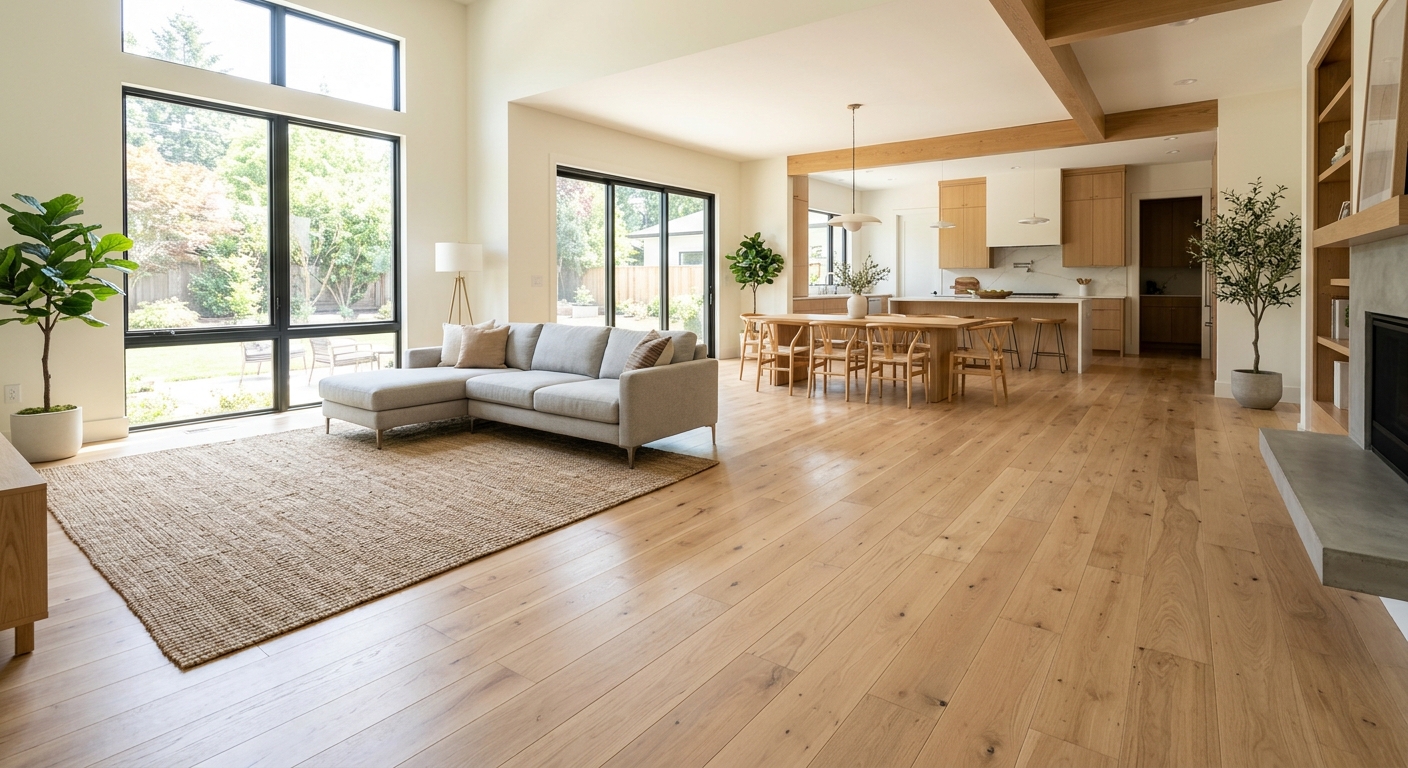
Flooring options and costs in Coquitlam West
Coquitlam West homeowners usually start shopping for flooring by price and look—but the right choice depends heavily on moisture and how your home was built. With a population of 25,656 in 2021 (Statistics Canada, 2021 Census), there’s a steady stream of work across the Lower Mainland–Southwest, including many older houses where subfloors can be uneven. It’s common to find patchy plywood or worn concrete that needs levelling or resurfacing before new flooring goes in; that preparation can add roughly $1–$3 per sq ft to the project in practice. In a wet, marine climate like ours, indoor humidity swings (especially winter and shoulder seasons) can also push solid wood to cup or gap if it’s not installed above grade with the right acclimation and expansion gaps.
Because labour in Greater Vancouver is among the highest in Canada, installation details—prep, transitions, and waste—matter almost as much as the flooring material. In neighbourhoods with lots of family homes and frequent renovations, such as around Maple Creek and north of David Avenue, contractors tend to be booked earlier for kitchen and main-floor upgrades, and pricing reflects that demand. When you’re comparing options, it helps to think in total installed cost: moisture control, subfloor work, and whether the material can handle below-grade humidity.
Below is a practical cost comparison for typical Coquitlam West installations, followed by what those numbers usually include in real projects.
| Type |
Best Room |
Moisture Resistance |
Lifespan |
Price per sq ft |
Price Range |
| Solid hardwood (nail-down, above grade only) |
Living / dining, bedrooms |
Low to moderate (humidity-sensitive) |
25–45 years |
$9–$18 |
$9,500–$18,500 |
| Engineered hardwood (float or glue, above + on-grade) |
Main floor, hallways, bedrooms |
Moderate to high (better stability) |
20–35 years |
$9–$16 |
$9,000–$16,000 |
| Laminate (click-lock, above-grade) |
Living areas, bedrooms |
Low to moderate (spills can damage) |
10–25 years |
$4–$10 |
$4,500–$10,500 |
| Luxury vinyl plank / LVP (waterproof, any level) |
Kitchen, basement (finished) |
High (waterproof core) |
15–25 years |
$4–$10 |
$5,000–$11,000 |
| Porcelain / ceramic tile |
Kitchen, bathrooms, entries |
High (when installed correctly) |
25–50 years |
$10–$20 |
$10,500–$21,000 |
| Carpet (broadloom or modular tile) |
Bedrooms, stairs, rec rooms |
Moderate (can trap moisture if damp) |
8–15 years |
$4–$10 (carpet + install) |
$4,200–$10,800 |
Prices are estimates only and vary by project scope, site access and material selection.
What affects the price of flooring in Coquitlam West
In Coquitlam West and across the Lower Mainland–Southwest, two quotes for what looks like the “same” flooring can differ by 30–50% once you add preparation and moisture detailing. That gap shows up in British Columbia because we often deal with older housing stock, higher labour costs, and homes that experience real indoor humidity swings. For example, solid hardwood expands and contracts with humidity—so it should not be glued or floated over concrete and it performs poorly in basements where moisture vapour can wick up through slab or below-grade assemblies. That’s why engineered hardwood and luxury vinyl plank (LVP) are the default for many below-grade or near-slab installs in our region.
Radiant heating is another factor. In colder inland pockets and newer builds in B.C., radiant heating is increasingly common, and that tends to rule out most solid hardwood and some laminate products that aren’t rated for higher surface temperatures. Older regional subfloors frequently need levelling or repair before installation, and in real Coquitlam West jobs that prep commonly adds $1–$4 per sq ft. If your home needs moisture barrier work, underlay upgrades, or partial subfloor resurfacing, you’ll see that reflected in the labour line more than the material line.
Concrete examples from recent local projects: (1) a main floor with uneven plywood required a full levelling compound and extra sanding—raising total cost closer to the higher end of laminate/LVP pricing. (2) a finished basement slab needed a vapour-management approach—pushing the homeowner from laminate to waterproof LVP, often closer to the mid-band of $4–$10 per sq ft rather than $9–$18 solid hardwood. (3) adding tile in a bathroom can feel expensive, but the jump from $10–$20 per sq ft is often justified when the alternative would be replacing moisture-damaged flooring again in a few years.
| Price Factor |
Why It Matters |
Cost Impact |
| Room area in sq ft |
Directly drives material quantities and labour hours for cutting, fitting and cleanup. |
Typically the single largest driver; larger areas spread setup costs but still increase total spend. |
| Subfloor condition — levelling or repair needed before install |
Uneven floors cause joint failure, squeaks, and visible ridges—especially with click-lock laminate and floating engineered. |
Often adds about $1–$4 per sq ft depending on repair scope and depth of prep. |
| Moisture / below-grade install — rules out solid hardwood |
Slabs and basements can wick moisture; solid hardwood is humidity-sensitive and not recommended below grade. |
Switching to engineered or LVP may cost more at the start but prevents early failure and rework. |
| Material choice — solid vs. engineered vs. LVP vs. tile |
Each material has different stability, underlayment needs, and installation method requirements. |
Hardware ranges in Coquitlam West often land near $9–$18 (hardwood) vs. $4–$10 (laminate/vinyl) vs. $10–$20 (tile). |
| Removal and disposal of existing flooring |
Demo, hauling, and subfloor salvage take time and can expose hidden moisture or damage. |
Can meaningfully increase labour; projects with adhesive residue typically cost more than “lift and haul.” |
| Stair nosing / transitions — charged per step or per linear foot |
Transitions are detail work and require matching height, movement gaps and clean edges. |
Often a noticeable add-on, especially with multiple stair flights or complex thresholds. |
| Radiant heat compatibility — limits material options |
Temperature swings can damage incompatible products and reduce lifespan. |
May require engineered wood, specific laminate, tile, or approved installation systems—sometimes increasing material cost. |
| Installation method — float vs. glue-down vs. nail-down |
Method affects labour time, substrate prep, and tolerance requirements. |
Nail-down and glue-down typically require more precise prep; float installs can be faster when the floor is flat. |
Permits & regulations in British Columbia
In British Columbia, most flooring installations themselves do not require a building permit. What commonly does change the permit situation is when the flooring project involves work beyond simple surface covering—especially anything that touches structure or electrical systems. For example, you may need electrical permits if your scope includes alterations to in-floor heating wiring, thermostat circuits, or other electrical components. Structural subfloor repair can also trigger permitting requirements depending on the extent of framing or load-bearing changes, and moisture remediation may be regulated when it involves more than routine surface treatment.
Condominiums add another layer: even when no permit is required for the flooring, the strata corporation’s rules on sound transmission (STC/IIC targets) can restrict underlay selection and may require specific underlayment for hard flooring on upper floors. In multi-unit buildings in Coquitlam West, always review the condo declaration and request board approval in writing before installing hardwood or tile upstairs. For waterproof materials like LVP, you still want to follow noise requirements, not just moisture performance.
To verify your contractor, start with their business licensing (where applicable) and check liability insurance. Ask for a current certificate of insurance showing coverage for flooring/install work, and confirm they carry WSIB/WCB coverage. Then request a clearance letter or proof of good standing and keep copies for your records. If you’re having work performed in a strata, ensure the contractor is willing to provide documentation the board may request before start date.
Best flooring for each room in your Coquitlam West home
Choosing the right floor in Coquitlam West is mostly about matching the material to the room’s moisture profile, traffic level and comfort needs under a wet, marine climate. In living and dining rooms, engineered hardwood or a high-quality laminate tends to be a good balance: you get warmth and a more natural look without the same humidity sensitivity as solid hardwood. For master bedrooms, many homeowners prefer carpet for comfort and sound absorption—especially on busy streets where footfall noise matters—though engineered hardwood can also work well if your humidity control and subfloor are solid.
Kitchens take the toughest daily abuse from spills and cleaning. Luxury vinyl plank (LVP) with a waterproof core is an easy winner, and large-format porcelain tile is another excellent choice when you want maximum water resistance and a crisp, durable surface. In basements (finished), LVP is usually the clear leader because it’s waterproof and more tolerant of below-grade moisture vapour than solid wood and most laminate systems. Bathrooms should be porcelain or ceramic tile only, with proper waterproofing at wet-wall transitions and grout/edge details.
Radiant heat compatibility is increasingly relevant in British Columbia construction and renovations. If you have in-floor heating, engineered wood, tile, and selected laminates perform better with the right installation spec—while most solid hardwood needs careful approval (and often isn’t the best fit).
As a cost example, upgrading a basement from laminate to LVP can feel like a jump, but laminate is often in the $4–$10 per sq ft band while LVP also commonly lands in that same band. The difference is usually justified because waterproof performance can prevent costly replacement after moisture-related failures. For bathrooms, tile’s $10–$20 per sq ft pricing is frequently worth it versus carpet or vinyl because it holds up to repeated wet cleaning.
| Room |
Best Material |
Why |
Moisture Risk |
Price Band per sq ft |
| Living / dining room |
Engineered hardwood |
Stable across indoor humidity swings; warmer feel than hard tile; easier than solid hardwood with subfloor realities. |
Low to moderate (managed with humidty control) |
$9–$16 |
| Master bedroom |
Carpet or engineered hardwood |
Carpet adds comfort and sound dampening; engineered offers a clean look and better stability than solid. |
Low (if the space stays dry and well-ventilated) |
$4–$10 |
| Secondary bedrooms |
Laminate (good-quality) or LVP |
Laminate is cost-efficient and looks great for family traffic; LVP works if there’s occasional moisture exposure near entries. |
Low to moderate (depends on windows/ventilation) |
$4–$10 |
| Kitchen |
Luxury vinyl plank (LVP) or porcelain tile |
LVP handles spills and frequent mopping; tile offers the most durable, water-ready surface. |
Moderate to high (spills, humidity from cooking) |
$4–$20 |
| Basement (finished) |
Luxury vinyl plank (LVP) |
Waterproof core tolerates below-grade humidity vapour; reduces risk compared with solid wood or laminate. |
High (slab and below-grade moisture is common) |
$4–$10 |
| Bathroom |
Porcelain / ceramic tile |
Best for wet areas; long lifespan when waterproofing and detailing are done correctly. |
High (direct water exposure) |
$10–$20 |
How to choose a flooring contractor in Coquitlam West
When you’re choosing a flooring contractor in Coquitlam West, don’t rely on a nice showroom pitch—verify the basics. In British Columbia, ask for proof of liability insurance and confirm they have WSIB/WCB coverage (or equivalent clearance documents showing they’re in good standing). You can start by checking the contractor’s business details publicly, then request their certificate of insurance and any clearance letter they can provide. For flooring work that touches electrical (like radiant heat wiring changes) or adds significant subfloor repairs, you also want to ensure they have the right qualifications for the related trades.
Next, get 2–3 itemised written quotes that show materials and labour separately. A good quote lists underlay/vapour barrier, removal and disposal, transition pieces, stair nosing, fasteners/adhesive, and the specific installation method (nail-down, glue-down, or float). Avoid vague “all-in” totals unless the scope is extremely clear. Carefully review what’s excluded: sometimes removal, subfloor levelling, underlayment, or permit paperwork is not included. Ask whether disposal is included, especially if your existing floor is glued down or if subfloor damage is discovered during demo.
Warranty is another key filter. Confirm the workmanship warranty length, whether it’s transferable, and what product warranty covers (and what it won’t). Finally, protect your cashflow: never pay more than about 10–15% upfront, and hold back funds until completion—especially for punch-list items.
Timing should be documented. Request a start date and a realistic completion estimate in writing, and ensure the schedule includes acclimation time for wood products when applicable.
- Ask for a sample contract or work order with the installation method stated (nail-down, glue-down, or float).
- Verify liability insurance before work starts; request the COI and confirm effective dates.
- Confirm WSIB/WCB coverage and obtain a clearance letter or proof of good standing.
- Get 2–3 quotes with labour and material breakdowns (not just a single lump sum).
- Ensure subfloor levelling/repair scope is explicitly included or excluded, with an allowance number.
- Ask what moisture control steps are planned (vapour barrier/underlay, acclimation, and expansion gaps).
- Confirm removal and disposal are included, including how they handle old adhesive or underlay.
- Require line items for transitions, thresholds, and stair nosing (charged per step/linear foot).
- Check that radiant heat compatibility is addressed if applicable (manufacturer installation requirements).
- Review product specs: wear layer thickness (for LVP), AC rating (for laminate), and warranty terms.
- Get a clear warranty document: workmanship coverage, exclusions, and whether it’s transferable.
- Use a staged payment plan: keep 10–15% or more held back until punch list completion.
Red flags I see too often in Coquitlam West: promises of “no subfloor prep needed” on an uneven floor, a quote that doesn’t specify the installation method or underlayment/vapour barrier, refusing to provide insurance/WSIB/WCB proof, asking for large upfront payments, and missing written timelines or a detailed scope of work.
Frequently asked questions — flooring in Coquitlam West
What flooring is best for a Coquitlam West basement?
For most Coquitlam West basements, luxury vinyl plank (LVP) with a waterproof core is the safest choice. Our wet, marine climate and local housing realities mean moisture vapour can move through slab and below-grade assemblies, especially in older homes. Solid hardwood is humidity-sensitive and typically isn’t recommended in basements, and many laminate products can suffer at seams if moisture gets underneath. LVP’s waterproof construction handles day-to-day spills and is far more forgiving with minor humidity swings. Budget-wise, LVP often fits the $4–$10 per sq ft band, while laminate can look similar on paper but carries higher risk in below-grade conditions. If your basement is fully finished and dry, some engineered products can work—provided the contractor uses the correct underlayment and moisture-control approach.
Can I install hardwood over concrete?
Yes, but with important caveats. Solid hardwood is the most restrictive: it’s generally not a good fit over concrete in Coquitlam West because it needs stable humidity conditions and is usually installed nail-down over an appropriate substrate. Engineered hardwood is the more common solution for concrete, but it must follow the manufacturer’s requirements—often using a glue-down system or a permitted floating method with the correct underlay. Before any hardwood goes on concrete, a good contractor checks flatness and addresses moisture management (vapour barriers or manufacturer-approved systems). If your concrete is part of a basement slab or shows signs of dampness, engineered wood is usually the better direction than solid. If you want to compare pricing, solid hardwood is often in the $9–$18 band, whereas engineered wood more often lands closer to $9–$16 depending on the grade.
How long does flooring installation take?
Install time depends on room size, subfloor prep, and whether you’re removing existing flooring. In Coquitlam West, projects that require levelling or resurfacing can add several days even if the new flooring itself is quick to lay. A straightforward, above-grade floating install (like laminate or floating engineered) is often faster than nail-down or glue-down work because it’s less dependent on meticulous surface flatness. Tile generally takes longer because it includes layout, cutting, setting, grout timing, and curing considerations. For larger jobs, your contractor should provide a start date and completion estimate in writing, including acclimation time for wood products where required. As a rule of thumb, small rooms can be done in a day or two, while multi-room renovations frequently run longer once you include demo, prep, transitions, and punch-list touch-ups.
What flooring works with radiant heat?
Radiant heat compatibility depends on the flooring product’s temperature rating and the installation method. In British Columbia, radiant heating is increasingly used in new builds and renovations, and that often pushes homeowners toward tile, engineered hardwood, and selected laminates designed for higher temperature exposure. Porcelain/ceramic tile is usually a reliable radiant choice because it handles heat well. LVP can work too, but only when the product is specifically rated for radiant heat and the underlayment/system meets manufacturer requirements. Most solid hardwood needs very careful specification, and many installations will not meet the required stability or surface temperature limits. The best approach is to give your contractor your radiant system details (set-point, mat type, and controls) so they can select a flooring spec that the manufacturer approves. This prevents premature gapping or finish damage.
Engineered vs solid hardwood — what's the difference?
Solid hardwood is one piece of wood throughout its thickness and is typically installed nail-down (above grade only) so it can expand and contract in a controlled way. Engineered hardwood is made of a real wood veneer on top of layered construction, which gives it more dimensional stability—an advantage in Coquitlam West’s humidity swings. That’s why engineered is often preferred over laminate or solid in homes where subfloor conditions aren’t perfectly flat, and it’s generally a better option than solid for on-grade installations where moisture tolerance matters. Pricing commonly reflects this: solid hardwood often sits around $9–$18 per sq ft, while engineered wood frequently lands in the $9–$16 range depending on thickness, wear layer, and brand. In both cases, successful installation depends on acclimation, expansion gaps, and proper subfloor prep.
Do I need to level my subfloor first?
Usually, yes—especially if you’re installing click-lock laminate, floating engineered, or any product that relies on a smooth, stable base. In Coquitlam West, older subfloors can be uneven due to plywood aging, uneven underlayment layers, or prior repairs. If the subfloor has dips or ridges, you can get joint separation, squeaks, and premature wear. Levelling (or repair) also helps control noise and improves how transitions line up at doorways. The cost is real: levelling and prep commonly add roughly $1–$4 per sq ft depending on the extent of work. For waterproof LVP in basements, you still need a flat surface—though it’s more forgiving with minor variations. The best contractors measure flatness, then recommend the least disruptive prep to meet the flooring manufacturer’s limits.