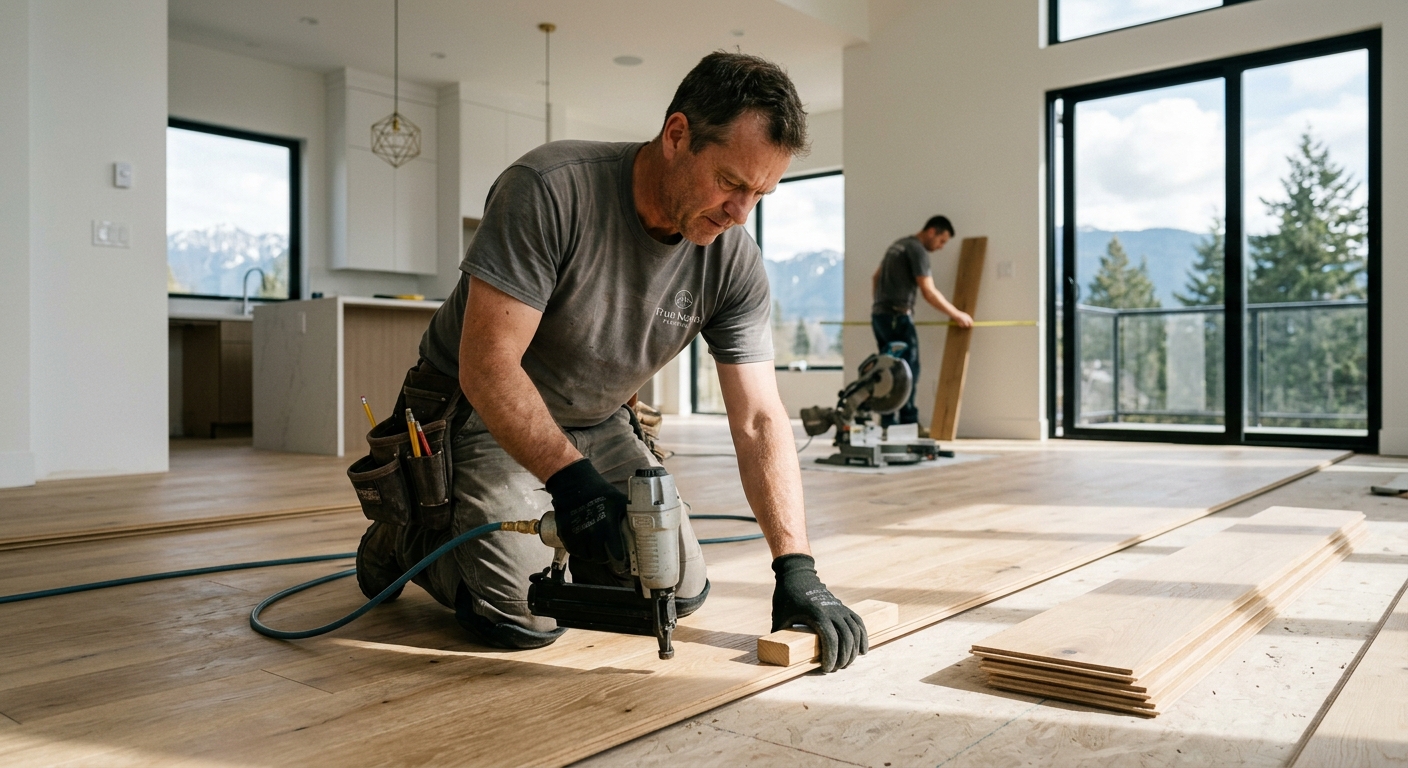
Flooring options and costs in Garden City
In Garden City, British Columbia, the right flooring choice usually comes down to how you want the space to feel and how well the floor can handle moisture movement. With a population of 5,885 (Statistics Canada, 2021 Census), Garden City homes often reflect the Lower Mainland’s mix of older builds and recent renovations, and that matters because older subfloors frequently need levelling or patching before new flooring can go down. Even when the finish is “simple,” levelling and repair commonly add about $1 to $3 per sq ft, and in uneven areas the scope can push higher. In the Lower Mainland–Southwest, the wet, marine climate creates indoor humidity swings in winter and shoulder seasons. That’s why solid hardwood is generally limited to above-grade installs, while engineered hardwood and luxury vinyl plank (LVP) are often the safer, more forgiving options. In practice, you’ll also see strong demand for trades around the older, established residential pockets near the Garden City neighbourhood core, where basements and slab sections are more common and homeowners want upgrades without cupping or gaps.
Labour availability and rates are also a factor: Greater Vancouver installs are labour-intensive, so a quote can vary substantially depending on prep work like moisture barriers, grinding, or patching. To help you compare apples-to-apples, use the guide below for typical materials and installed price ranges for Garden City projects.
| Type |
Best Room |
Moisture Resistance |
Lifespan |
Price per sq ft |
| Solid hardwood (nail-down, above grade only) |
Main living areas above grade |
Low to moderate (humidity sensitive) |
25–60 years |
$9,50 – $18 |
| Engineered hardwood (float or glue, above + on-grade) |
Living areas, bedrooms (above/on grade) |
Moderate to high |
20–40 years |
$9,00 – $16 |
| Laminate (click-lock, above-grade) |
Bedrooms, living rooms (where not exposed to standing water) |
Low to moderate |
10–25 years |
$4,50 – $10 |
| Luxury vinyl plank / LVP (waterproof, any level) |
Kitchens, basements, main floors in busy homes |
High (waterproof cores) |
15–25 years |
$4,50 – $10 |
| Porcelain / ceramic tile |
Bathrooms, kitchens, entryways |
Very high |
25–50 years |
$10 – $20 |
| Carpet (broadloom or modular tile) |
Bedrooms, stairs (comfort-focused) |
Low to moderate (needs good moisture control) |
7–15 years |
$4,00 – $8 |
Prices are estimates only and vary by project scope, site access and material selection.
What affects the price of flooring in Garden City
In the Lower Mainland–Southwest, you can see the same flooring type quoted 30–50% apart because the job is rarely “just install.” The region’s wet, marine climate drives extra prep: indoor humidity swings and potential below-grade moisture can force moisture barriers, additional underlay specifications, or subfloor corrections. Meanwhile, contractor capacity and scheduling can also impact labour costs in Greater Vancouver, since experienced crews are booked earlier for pre-season installs.
Technically, humidity is the key driver. Solid hardwood expands and contracts with moisture, so it can’t be glued or floated over concrete and typically performs poorly in basements or over slab where moisture vapour is present. Engineered hardwood and LVP are far more forgiving for above-grade and on-grade applications. If you’re in a colder inland pocket or installing over in-floor radiant heating (increasing in newer local builds), that can rule out most solid hardwood and many laminate products; you’ll need products that tolerate higher temperature swings. Older regional housing stock also frequently requires levelling or repair—commonly adding roughly $1 to $4 per sq ft depending on how uneven the subfloor is.
In Garden City, two common cost examples are: (1) an older basement with uneven concrete may require grinding/patching plus a proper moisture system before LVP—often keeping you in the LVP band of about $4 to $10 per sq ft, (2) a main-floor hardwood replacement where plank heights differ may require transitions and step returns, pushing the overall hardwood budget toward the upper end of the $9 to $18 range. Those differences are why quote comparisons should focus on prep, underlay, and installation method, not just the flooring headline price.
| Price Factor |
Why It Matters |
Cost Impact |
| Room area in sq ft |
Materials and labour scale directly with coverage and waste |
Often the biggest driver |
| Subfloor condition |
Levelling or repair prevents squeaks, lippage and joint failure |
Commonly +$1 to $4 per sq ft |
| Moisture / below-grade install |
Moisture vapour can ruin solid wood and some laminates |
May force engineered wood or LVP (+prep + barrier) |
| Material choice |
Solid vs. engineered vs. LVP vs. tile have different build-ups and underlay needs |
Shifts you between approx. $4–$10 (vinyl/laminate) and $9–$20 (hardwood/tile) |
| Removal and disposal of existing flooring |
Old flooring removal, nail pulls, and haul-away add time and labour |
Can add a noticeable line-item cost |
| Stair nosing / transitions |
Custom work is charged per step or per linear foot and is easy to underestimate |
Often +$150 to $400 per staircase section |
| Radiant heat compatibility |
Heat tolerances limit products and require correct installation parameters |
May move you to engineered/LVP/tile; can add spec labour |
| Installation method |
Float, glue-down, and nail-down each need different prep and time |
Glue-down and nail-down typically cost more than click-lock |
Permits & regulations in British Columbia
In British Columbia, flooring installation itself usually does not require a building permit. What often does trigger permitting is the associated work that comes with flooring projects—particularly any electrical or structural tasks. For example, adding, modifying, or repairing in-floor radiant heating circuits can require electrical permits and inspections, because those are electrical scope items. Similarly, significant structural subfloor replacement, load-bearing framing repairs, or moisture remediation that involves more than minor patching may require approvals depending on the work plan and conditions.
Condominiums are a different layer of rules. Many strata corporations restrict hard flooring due to sound transmission and may require specific underlay systems to meet sound performance expectations (commonly referenced via STC/IIC targets). Before you purchase hardwood or tile for an upper-floor condo, request written confirmation from the board/manager and follow the condo’s declaration and bylaws. For work in Garden City and across the Lower Mainland–Southwest, this step prevents costly rework if the product or underlay doesn’t meet the building’s requirements.
To verify a flooring contractor in Garden City, start with a licence check using the appropriate provincial registry for their trade category, then ask for a certificate of liability insurance showing coverage for your project. If the contractor subcontracts, confirm the subcontractor coverage too. Finally, request proof that workers are covered under the appropriate workplace coverage arrangement (WCB/WSIB coverage depending on their setup) and keep those documents with your written quote and contract.
Best flooring for each room in your Garden City home
In Garden City’s Lower Mainland–Southwest climate, choosing flooring by room is the fastest way to avoid problems. Living and dining spaces benefit from warmth and a natural look: engineered hardwood or high-quality laminate works well because it handles typical indoor humidity swings better than solid wood and stays comfortable underfoot. Bedrooms usually do best with carpet for quiet, comfort and reduced echo, or engineered hardwood if you prefer an easier-clean surface. Kitchens demand water resistance and impact durability; luxury vinyl plank (LVP) or large-format porcelain tile are practical choices for spills and frequent wet cleanups.
Basements are where local moisture realities show up. LVP is the clear winner for finished basements because it’s fully waterproof and tolerant of minor moisture vapour from concrete subfloors; solid hardwood and most laminate are poor matches for below-grade installs. Bathrooms should be porcelain or ceramic tile only, with proper underlayment and correct sealing where required—tile is proven for wet areas and daily cleaning. If your home has radiant heat (increasing in newer builds), pick products rated for radiant compatibility; that usually means engineered hardwood, LVP, tile, and certain laminate specs. Solid hardwood over radiant needs very careful installation requirements to prevent gapping.
For a concrete example: if you’re choosing between laminate at about $4 to $10 per sq ft and LVP at a similar band, the price difference is often justified in a basement where one extra moisture-prep step can protect the whole investment. In a dry main-floor living room, laminate can be a good value if you control indoor humidity.
| Room |
Best Material |
Why |
Moisture Risk |
Price Band per sq ft |
| Living / dining room |
Engineered hardwood |
Warm look with better humidity tolerance than solid; good for day-to-day movement |
Low (above grade) |
$9,00 – $16 |
| Master bedroom |
Carpet or engineered hardwood |
Carpet improves comfort and sound; engineered keeps a clean, modern feel |
Low |
$4,00 – $8 |
| Secondary bedrooms |
Laminate or LVP (kid-friendly) |
Easy maintenance and faster install than tile; LVP is more forgiving if spills happen |
Low to moderate |
$4,50 – $10 |
| Kitchen |
LVP or porcelain tile |
Handles spills and frequent cleaning; tile adds durability for heavy traffic |
Moderate (spills) |
$10 – $20 |
| Basement (finished) |
LVP (waterproof) |
Designed for on-grade/below-grade moisture realities; best chance of long-term stability |
High (concrete moisture vapour) |
$4,50 – $10 |
| Bathroom |
Porcelain / ceramic tile |
Reliable wet-area performance; long service life with correct installation |
High |
$10 – $20 |
How to choose a flooring contractor in Garden City
Choosing a flooring contractor in Garden City starts with proof, not promises. In British Columbia, confirm the contractor’s licensing for their scope and that they carry liability insurance that specifically covers flooring installation work. Ask to see the current certificate of insurance before you sign—then confirm the name on the policy matches the company you’re hiring. For workplace coverage, request proof that their workers are covered through the appropriate workplace arrangement (WCB/WSIB coverage depending on their setup). If you’re dealing with a subcontractor, ensure their coverage is confirmed too.
Next, get 2 to 3 written itemised quotes. You want a breakdown of labour, materials, underlay/moisture barrier components, stair work, transitions, and removal/disposal. Avoid lump-sum quotes that don’t say what’s included—especially in the Lower Mainland–Southwest where prep can swing costs. Read exclusions carefully: is disposal included? Are floor edge details, mouldings, and caulking part of the scope? Does the quote include permit-related electrical work if you have radiant heating changes? For warranties, ask for (1) workmanship warranty length, (2) manufacturer warranty terms for the product, and (3) whether warranties are transferable if you sell your home.
Payment terms should be reasonable. Never pay more than 10 to 15% upfront; keep a holdback until the job is complete and the floors are inspected. Insist on a written start date and a completion estimate so humidity-sensitive materials aren’t left exposed longer than necessary.
- Request licence details for the trade scope and match it to the work they’re offering.
- Ask for a current certificate of liability insurance and verify coverage limits.
- Confirm workplace coverage proof for workers (WCB/WSIB as applicable).
- Get 2 to 3 itemised quotes with labour + materials + underlay/moisture system listed separately.
- Make sure the quote includes removal, prep, and disposal (or explicitly states otherwise).
- Verify stair labour and stair nosing/transitions are priced per step or per linear foot.
- Confirm subfloor levelling scope: patching vs. grinding, and how flatness is measured.
- Ask about moisture testing/proof before installing engineered wood or LVP over concrete.
- For hardwood, confirm expansion gap and acclimation plan in the contract.
- Check underlay and vapour barrier specifications match the flooring manufacturer.
- Review warranties in writing: workmanship term + product warranty details + transferability.
- Use a payment schedule with a 10–15% maximum upfront and a holdback until inspection.
Red flags in Garden City: contractors who won’t provide insurance and workplace coverage paperwork, quotes that omit levelling/moisture prep for concrete, “too-good-to-be-true” pricing that skips underlay or vapour barriers, pressure to pay large deposits upfront, and no written start/completion dates—especially risky in the Lower Mainland’s humid winter swings.
Frequently asked questions — flooring in Garden City
Do I need to level my subfloor first?
In Garden City and across the Lower Mainland–Southwest, subfloor levelling is one of the most common reasons quotes change. Even small dips can cause click-lock laminate to fail at seams, and they can create hollow spots that lead to squeaks or joint separation in engineered and LVP. Whether you “need” levelling depends on the existing flatness, but many older homes have uneven plywood or concrete patches that require grinding, self-levelling compound, or spot repair before installation. If you’re comparing options, ask whether levelling is included and how flatness is measured (not just a visual check). The added work can raise the project by roughly $1 to $4 per sq ft, but it’s often what keeps a floor within the expected lifespan—especially when indoor humidity swings are more pronounced in winter (Statistics Canada, 2021 Census).
What's the most durable flooring for pets and kids?
For pets and kids in British Columbia, durability usually means scratch resistance, water tolerance, and easy cleanup. In most Garden City homes, waterproof LVP is the practical top pick because it handles minor spills and everyday messes without swelling. If you prefer a more natural look, engineered hardwood can be durable too, but you still need careful humidity control and fast cleanup of wet spots. Carpet is comfortable and forgiving for falls, but it can stain and it’s less ideal in basements where concrete moisture vapour can be an issue. If you want a real price anchor, LVP and laminate commonly land around the $4 to $10 per sq ft band in this market, while tile is higher in the $10 to $20 per sq ft range but is extremely resilient. The best choice depends on whether you’re installing above grade only or dealing with a finished basement.
How do I choose flooring for humidity in Garden City?
Humidity is the deciding factor in the Lower Mainland–Southwest. Garden City homes experience wet marine weather and indoor humidity swings—especially in winter and shoulder seasons—so product stability matters. Solid hardwood is typically reserved for above-grade installs because wood expands and contracts with moisture, and solid planks generally shouldn’t be glued or floated over concrete. Engineered hardwood and LVP are better suited for on-grade conditions, and LVP is the safest option for finished basements because many products are truly waterproof and tolerate moisture vapour movement from slab. When you get quotes in Garden City, ask your contractor to explain the moisture plan: vapour barrier/underlay type, acclimation approach, and whether they’ll recommend engineered or LVP over concrete. That prep is often what protects your investment and reduces the chance of gapping and cupping.
Do condos restrict hard flooring?
Often, yes. In British Columbia condo buildings, strata rules frequently restrict hard flooring due to sound transmission requirements. Even when it’s technically “legal” to install flooring, the corporation may require specific underlay systems and may ask for board approval before work starts. For Garden City owners, the key step is to review the condo declaration and request written confirmation that your planned underlay and flooring type meet the building’s sound performance rules (commonly referenced through STC/IIC targets). This can affect both product selection and installation layers, and it’s not always included in a basic quote unless you ask. If you’re planning tile or hardwood on an upper floor, include the sound requirements in your quote scope so you’re not paying for a product you can’t use.
How do I compare flooring quotes?
To compare quotes properly in Garden City, don’t start with the total price—start with what’s included. Ask for itemised labour and materials: removal/disposal, subfloor levelling/patching, underlay/vapour barrier, transitions/stair work, and any moisture-prep steps. For example, two engineered hardwood quotes that both list “engineered hardwood” can still differ by hundreds of dollars if one includes proper floor prep and the other doesn’t. Also check warranty terms: workmanship duration, product warranty conditions, and whether warranties transfer to a buyer. A good check is to compare your likely budget against the local bands: LVP and laminate are often around $4 to $10 per sq ft, while hardwood and tile typically land around $9 to $20 per sq ft depending on level and scope. If a quote sits far outside the band without a clear explanation, ask why.
Can I install flooring over existing tile in Garden City?
Sometimes, but it depends on the condition of the tile and the type of new flooring. Over existing tile, the biggest issues are whether the surface is flat, well-bonded, and appropriately prepared (no cracked loose tiles, proper smoothing of grout ridges). For click-lock laminate, a major limitation is that tile grout lines can create unevenness that leads to joint stress. For LVP and engineered hardwood, many contractors will install over tile if it’s stable and flat enough, using the correct underlayment system and moisture plan. However, if the tile is uneven or in a wet, below-grade context, removal may be the better long-term choice. In Garden City’s climate, moisture management matters—so discuss whether you need additional vapour control. If you’re also adding radiant heat changes, that’s where permit-related electrical scope can come into play.