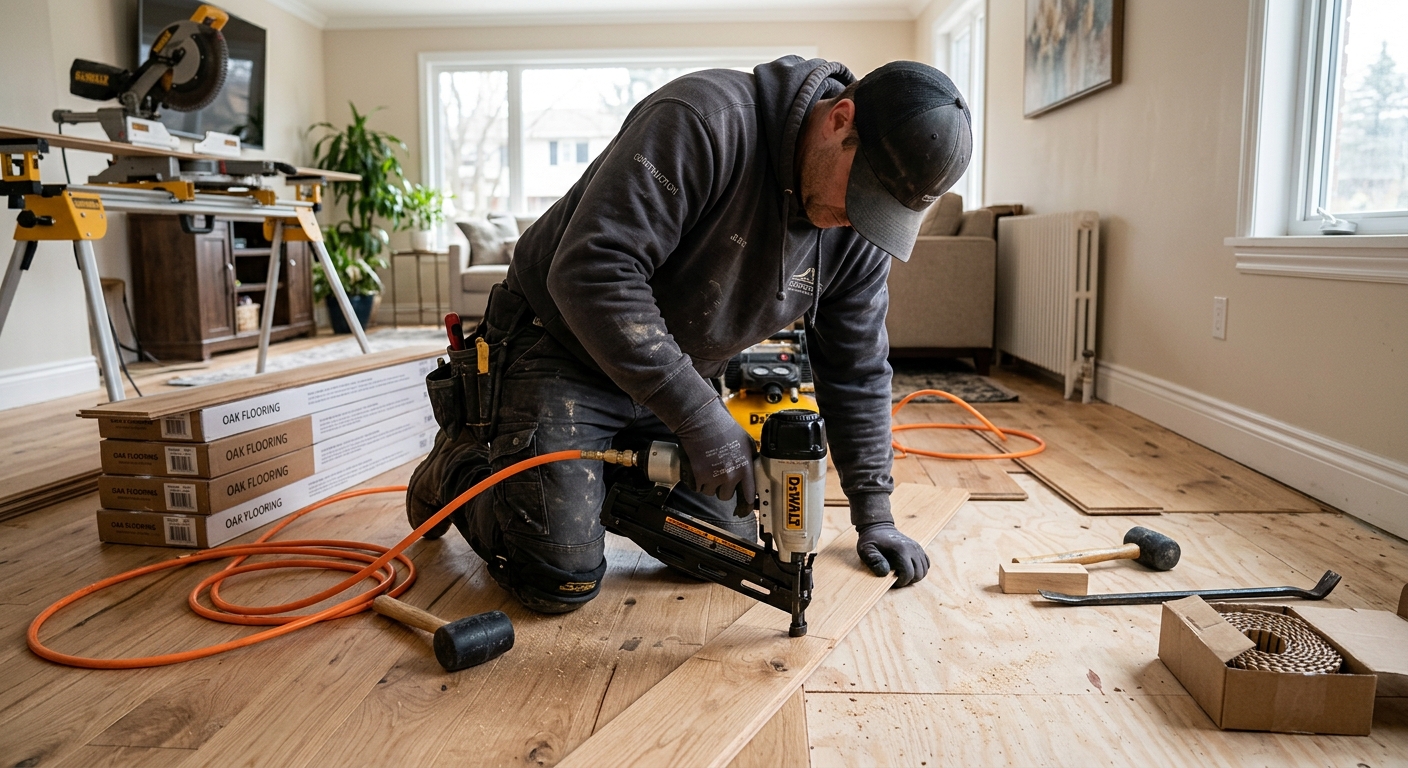
Flooring options and costs in Guildford
In Guildford, choosing the right flooring starts with matching the material to how Lower Mainland–Southwest homes actually live: humid winters, temperature swings between heated rooms and cooler hallways, and—because many homes sit on older foundations—occasional moisture wicking from concrete slabs. Guildford’s housing mix also matters. With a population of 64,985 (Statistics Canada, 2021 Census), the demand you’ll see from local installers is strongest around Surrey-like family pockets near Guildford Town Centre and the surrounding residential streets, where renovations are constant and schedules book up fast.
On older properties, it’s common to find uneven plywood or minor slab irregularities that need levelling or repair before installation. That “prep work” can add roughly $1–$3 per sq ft to project costs in the Lower Mainland–Southwest market, especially when a crew has to raise low spots, patch dips, and sometimes install a moisture barrier. The wet marine climate also pushes homeowners to avoid solid hardwood below grade; solid wood expands and contracts with humidity, and it performs poorly in basements where moisture vapour is more likely. For main living areas, solid hardwood is still popular above grade, but it needs correct spacing and indoor humidity control. Where you want “set it and forget it” moisture performance, engineered hardwood and luxury vinyl plank (LVP) are typically the practical choices because their layered construction handles humidity better and tolerates minor movement.
Below is a realistic side-by-side of common materials you’ll be quoted in Guildford, including moisture performance and typical installed price ranges. Use it to compare apples to apples before you book a site visit.
| Type |
Best Room |
Moisture Resistance |
Lifespan |
Price per sq ft |
| Solid hardwood (nail-down, above grade only) |
Living / dining |
Low (avoid basements and slab-on-grade below indoor humidity targets) |
25–60 years |
$9 – $18 |
| Engineered hardwood (float or glue, above + on-grade) |
Main living areas |
Medium–high (better humidity stability) |
20–40 years |
$10 – $17 |
| Laminate (click-lock, above-grade) |
Bedrooms / hallways |
Low–medium (water-resistant with proper installation) |
10–25 years |
$4 – $10 |
| Luxury vinyl plank / LVP (waterproof, any level) |
Kitchen / basement |
High (waterproof core options) |
15–25 years |
$6 – $12 |
| Porcelain / ceramic tile |
Kitchen / bathrooms |
Very high (water-friendly when set correctly) |
20–50 years |
$10 – $20 |
| Carpet (broadloom or modular tile) |
Bedrooms |
Low (needs protection from spills/visible moisture) |
8–15 years |
$5 – $12 |
Prices are estimates only and vary by project scope, site access and material selection.
What affects the price of flooring in Guildford
In Guildford and across the Lower Mainland–Southwest, you can see the same “type” of flooring quoted 30–50% apart, even when the square footage is similar. That’s usually not because contractors are padding numbers—it’s because the technical scope changes with humidity exposure, subfloor condition, and whether the installer can work efficiently on site. When you compare across British Columbia, labour and mobilization costs can also shift, but in Surrey/Guildford specifically, labour is often a major driver due to tight schedules and high demand in established neighbourhoods.
Humidity swings are the key technical reason. Solid hardwood expands and contracts with indoor moisture, and it can’t be glued or floated over concrete; it’s typically a poor choice for basements where moisture vapour may migrate upward through slab-on-grade. Engineered hardwood and luxury vinyl plank (LVP) handle humidity and minor temperature changes far better, so they’re frequently recommended for on-grade and below-grade areas. For colder-inland pockets and newer builds using radiant heating, the material compatibility becomes another cost driver: it rules out most solid hardwood and some laminates unless the product is rated for higher temperature performance.
Older regional housing stock is another frequent reason costs rise. If the subfloor needs levelling or repair, expect roughly $1–$4 per sq ft added to the overall line items, depending on how far the crew has to go to correct dips and build up low areas. A practical example: if your living space is $12–$15 per sq ft with engineered hardwood, but your subfloor issues push levelling and patching to the point that you end up at the upper end (or higher), LVP might look better on paper because the waterproof installation tolerates minor subfloor imperfections better. Conversely, if your subfloor is flat and stable, solid hardwood can be competitive—often closer to the $9–$18 band—because there’s less remedial work.
In Guildford, I also see pricing move up when clients choose wider planks, premium underlay/systems, or when stairs and transitions need careful finishing. Those details are where “low” quotes sometimes fall short.
| Price Factor |
Why It Matters |
Cost Impact |
| Room area in sq ft |
Materials and labour scale directly with square footage, plus waste allowance |
Major (sets the overall baseline) |
| Subfloor condition — levelling or repair needed before install |
Uneven plywood or concrete needs patch/level; unevenness can telegraph through |
Medium to major (+$1–$4 per sq ft is common in older homes) |
| Moisture / below-grade install — rules out solid hardwood |
Below-grade moisture vapour increases cupping/gapping risk in solid wood |
Medium (often shifts you to engineered wood or LVP) |
| Material choice — solid vs. engineered vs. LVP vs. tile |
Different price bands for materials, underlay, and set methods |
Major (drives $4–$20+ per sq ft ranges) |
| Removal and disposal of existing flooring |
Demo time, hauling, and any damaged subfloor discovered during removal |
Medium (can materially increase the quote) |
| Stair nosing / transitions — charged per step or per linear foot |
Transitions require trim, profiling, and precise fitting |
Small to medium (often surprises first-time renovators) |
| Radiant heat compatibility — limits material options |
Not all products are rated for in-floor heating temperature cycles |
Medium (changes both product and installation details) |
| Installation method — float vs. glue-down vs. nail-down |
Method affects labour time, subfloor prep, and moisture detailing |
Medium (nail-down and glue-down can cost more) |
Permits & regulations in British Columbia
In British Columbia, most flooring installations themselves don’t require a building permit. A typical above-grade carpet or floating click-lock laminate install, for example, is generally straightforward from a “permit” standpoint. However, permitting can come into play when your project includes work that affects building systems or electrical components. Specifically, if the flooring scope includes electrical work tied to in-floor heating circuits (or modification/addition of electrical components for those systems), electrical permits may be required.
Condominiums are another place where homeowners must be careful. Even if flooring doesn’t require a permit, the strata corporation’s rules about sound transmission (STC/IIC) often restrict or require specific underlay systems for hard surface flooring on upper floors. Before ordering materials, review your condo declaration and request board approval in writing if your flooring choice is hard surface (hardwood, engineered wood, tile, or LVP). Sound rules are where projects in Greater Vancouver can stall without proper documentation.
To verify a contractor in Guildford, start with their professional licensing status through the appropriate online provincial registry listings (if applicable for the contractor’s trade category), then check their liability insurance certificate and confirm they carry coverage for workers (WCB/WSIB coverage as applicable). Ask for: (1) a current certificate of insurance naming you/your strata as required, (2) a clearance letter or evidence of coverage, and (3) a copy of their business information that matches the quote. If they won’t provide documentation up front, treat that as a red flag.
Best flooring for each room in your Guildford home
In Guildford’s wet marine climate, the best flooring choice comes down to how the room gets used, how much water exposure it sees, and whether moisture can reach the underside (especially in basements and near slab-on-grade sections). For living and dining areas, engineered hardwood or high-quality laminate is a common sweet spot: you get warmth and a hardwood look without the same humidity sensitivity as solid wood. In master bedrooms, carpet remains popular because it’s comfortable and quiet—helpful during colder shoulder seasons—while engineered hardwood is also a strong upgrade if you want less maintenance.
In kitchens, choose luxury vinyl plank (LVP) for day-to-day spills, leaks, and easy cleaning, or consider large-format porcelain tile if you want maximum water resistance and a durable surface. Bathrooms should be porcelain or ceramic tile only because it handles frequent wet conditions and supports correct waterproofing details. For basements (finished or being finished), LVP is usually the clear winner in Lower Mainland homes: it’s waterproof, tolerates moisture vapour, and holds up better where solid hardwood and many laminates struggle.
If your home has radiant heat in newer sections, focus on materials rated for that system. Engineered wood, LVP, tile, and some laminates can be compatible when installed correctly; solid hardwood often needs very careful specification, including moisture and temperature controls.
Dollar-wise, the difference can be justified. For example, if solid hardwood is quoted in the $9–$18 per sq ft band but your basement has moisture concerns, stepping up to LVP (often $6–$12 per sq ft) can cost less overall and avoids the higher risk of warping and costly replacement later. In other words: spend where it prevents failure.
| Room |
Best Material |
Why |
Moisture Risk |
Price Band per sq ft |
| Living / dining room |
Engineered hardwood |
Warm look with better humidity stability than solid wood |
Low–medium (main-floor humidity swings) |
$10 – $17 |
| Master bedroom |
Carpet or engineered hardwood |
Comfort and sound dampening with carpet; durable warmth with engineered |
Low (typical bedroom conditions) |
$5 – $12 (carpet) or $10 – $17 (engineered) |
| Secondary bedrooms |
Carpet or laminate (grade-rated) |
Budget-friendly and comfortable underfoot; laminate works if installed correctly |
Low |
$4 – $10 (laminate) or $5 – $12 (carpet) |
| Kitchen |
Luxury vinyl plank (LVP) |
Waterproof core options handle spills and frequent cleaning |
Medium (spill and splash frequency) |
$6 – $12 |
| Basement (finished) |
Luxury vinyl plank (LVP) |
Waterproof performance for moisture vapour and slab-on-grade realities |
High (Lower Mainland moisture wicking risk) |
$6 – $12 |
| Bathroom |
Porcelain / ceramic tile |
Best match for wet conditions and long-term durability |
Very high (regular wet use) |
$10 – $20 |
How to choose a flooring contractor in Guildford
Choosing the right contractor in Guildford protects your floor and your budget—especially with the Lower Mainland’s humidity and moisture realities. Start with licensing/coverage checks. Ask whether they carry general liability insurance and request a certificate of insurance; then confirm worker coverage through WCB/WSIB evidence (a clearance letter or current account status). If they’re self-performing with crews, you still want to see current coverage documents in your name or in a way that confirms the work is protected.
Next, get 2–3 itemised written quotes. You want labour and materials broken out separately—underlay/moisture barrier, transition profiles, adhesives (for glue-down), underlayment, stair nosing, demo and disposal, and any levelling compound. Avoid quotes that only state “supply and install.” If you’re dealing with older homes that need levelling or moisture barriers, this is where the scope must be clear. Ask whether permits are needed for any electrical work (e.g., radiant heating modifications) and whether disposal and hauling are included.
Warranty matters twice: workmanship and product. Confirm the workmanship warranty length and what it covers (installation defects, not just product wear). Ask if the manufacturer warranty is transferable if you sell the home, and keep the product data sheets and proof of purchase.
Payment schedule: never pay more than 10–15% upfront. Hold back part of the balance until substantial completion and final cleanup. Finally, get the timeline—including start date and completion estimate—in writing so you can plan around school schedules and weather delays.
- Provide proof of insurance and worker coverage (certificate of insurance + WCB/WSIB clearance evidence)
- Show experience with above-grade and below-grade installs common in Guildford
- Itemised quote with labour, materials, underlay/moisture barrier, demo, and transitions
- Written start date and target completion date
- Moisture plan: how they assess subfloor dryness and vapour risk
- Confirm installation method (float vs. glue-down vs. nail-down) in the scope
- Stair nosing and transition pricing listed per step or per linear foot
- Detail waste factor and cutting strategy for board direction
- Confirm warranty terms and whether they’ll register the warranty correctly
- Spell out what’s excluded (e.g., replacing damaged subfloor, levelling beyond a stated depth)
- Include disposal/hauling of old flooring in the quote or specify the cost
- Clear communication on indoor humidity targets during and after installation
Red flags in Guildford: (1) “We’ll just glue it anywhere” pitches for basements with concrete moisture wicking risk, (2) no documentation for insurance/WCB/WSIB coverage, (3) lump-sum quotes that don’t specify underlay/moisture barrier or levelling scope, (4) refusing an on-site measurement and moisture/subfloor assessment, and (5) demanding a large upfront payment (well beyond 10–15%).
Frequently asked questions — flooring in Guildford
Can I install flooring over existing tile in Guildford?
Often, yes—but only if the existing tile is stable, flat, and well-bonded. In Guildford and the Lower Mainland–Southwest, the bigger risk is not the tile itself; it’s the condition of what’s underneath and whether the new flooring system can meet the manufacturer’s thickness/flatness requirements. For floating floors (click-lock laminate or some engineered products), the tile surface typically needs to be level within the required tolerance; otherwise, you’ll feel movement and seams can fail. For LVP, many systems can go over tile with the right underlayment, but you still must ensure flatness and account for transitions. If tile is loose or uneven, removal plus underlayment/levelling is usually the safer path.
What is the best flooring for a high-traffic area in Guildford?
For high-traffic zones (entries, hallways, and living rooms with constant foot traffic), LVP and engineered hardwood are the most reliable “everyday” choices in British Columbia’s humid, marine climate. LVP offers waterproof performance for everyday spills and is more forgiving over minor subfloor irregularities, which matters in older Guildford homes where levelling is sometimes needed. Engineered hardwood can be excellent in main living areas and usually performs better than solid hardwood when humidity swings happen in winter and shoulder seasons. If you’re choosing between cost bands, LVP often lands around the $6–$12 per sq ft range, while engineered hardwood can be closer to $10–$17 per sq ft depending on the wear layer and installation method. The better option depends on whether the traffic area is near slab-on-grade or basement sections.
How do I prepare my subfloor before new flooring?
Preparation is where projects succeed or fail in the Lower Mainland–Southwest. First, the contractor should assess flatness and the condition of the subfloor (and check for any signs of moisture vapour from concrete in slab-on-grade areas). If there are dips or uneven plywood, levelling compound or proper repairs are usually needed; in older regional homes this commonly adds roughly $1–$4 per sq ft. Next, the correct moisture barrier/underlayment must be selected for your specific flooring type—especially for engineered hardwood and LVP. For solid hardwood, moisture detailing is stricter because wood movement with humidity can cause gapping or cupping if conditions aren’t controlled. Finally, keep indoor humidity stable during and after installation. In Guildford, that often means using the HVAC/dehumidification strategy the manufacturer recommends before and during the job.
Is cork or bamboo flooring a good choice in Guildford?
Cork can be a good comfort-focused option because it’s warm underfoot and can help with sound, but it’s still sensitive to moisture exposure. In Guildford’s wet marine climate, cork is usually best for above-grade, low-moisture rooms (like bedrooms or living rooms), not basements where moisture vapour can migrate through slab-on-grade. Bamboo is often marketed as a “hard” flooring, but it behaves like a wood product and can still react to humidity swings unless it’s a properly engineered product with a suitable core. If you’re considering bamboo or cork, prioritize engineered formats (when available), verify the manufacturer’s moisture limits in writing, and ensure your installer uses the correct underlayment and vapour management. If your scope includes a basement or any on-grade concrete, LVP at the $6–$12 per sq ft band is typically the safer moisture-tolerant choice.
What is the difference between floating and glued-down flooring?
Floating flooring means the planks/boards are connected to each other (usually click-lock) and rest on top of an underlayment or foam layer, without being permanently bonded to the subfloor. Glued-down flooring is attached directly to the subfloor using adhesive, which can improve stability when installed over suitable subfloors. In Guildford, floating floors can be a practical choice for engineered or laminate in above-grade areas, but flatness is critical—uneven subfloors can lead to movement and premature wear. Glued-down methods can reduce movement in some scenarios, but adhesives also require correct moisture conditions for the subfloor and a compatible moisture barrier plan. For below-grade areas with concrete moisture vapour risk, glued-down solid hardwood is typically not the route; engineered wood and LVP are more forgiving. Always match the installation method to the product spec.
What flooring holds up best to pets in a Guildford home?
For pets, “best” usually means scratch resistance, easy cleaning, and moisture tolerance. LVP is a top choice in British Columbia because it’s waterproof (great for accidents) and is generally more forgiving of everyday spills, while also being more comfortable than tile. Many homeowners who choose LVP find the $6–$12 per sq ft range offers strong performance for entryways and main living spaces. Engineered hardwood can also work well for pets, but it depends on wear layer thickness and your ability to manage humidity swings—cupping and gapping are concerns in Guildford’s winter humidity swings if indoor conditions fluctuate. Carpet can be comfortable and sound-friendly, but pet hair and stains may require more frequent cleaning and faster spot treatment. Whatever you choose, plan for protective measures (rugs at entry points, trim mats, and prompt clean-up) and ask installers how they’ll protect surfaces during installation.