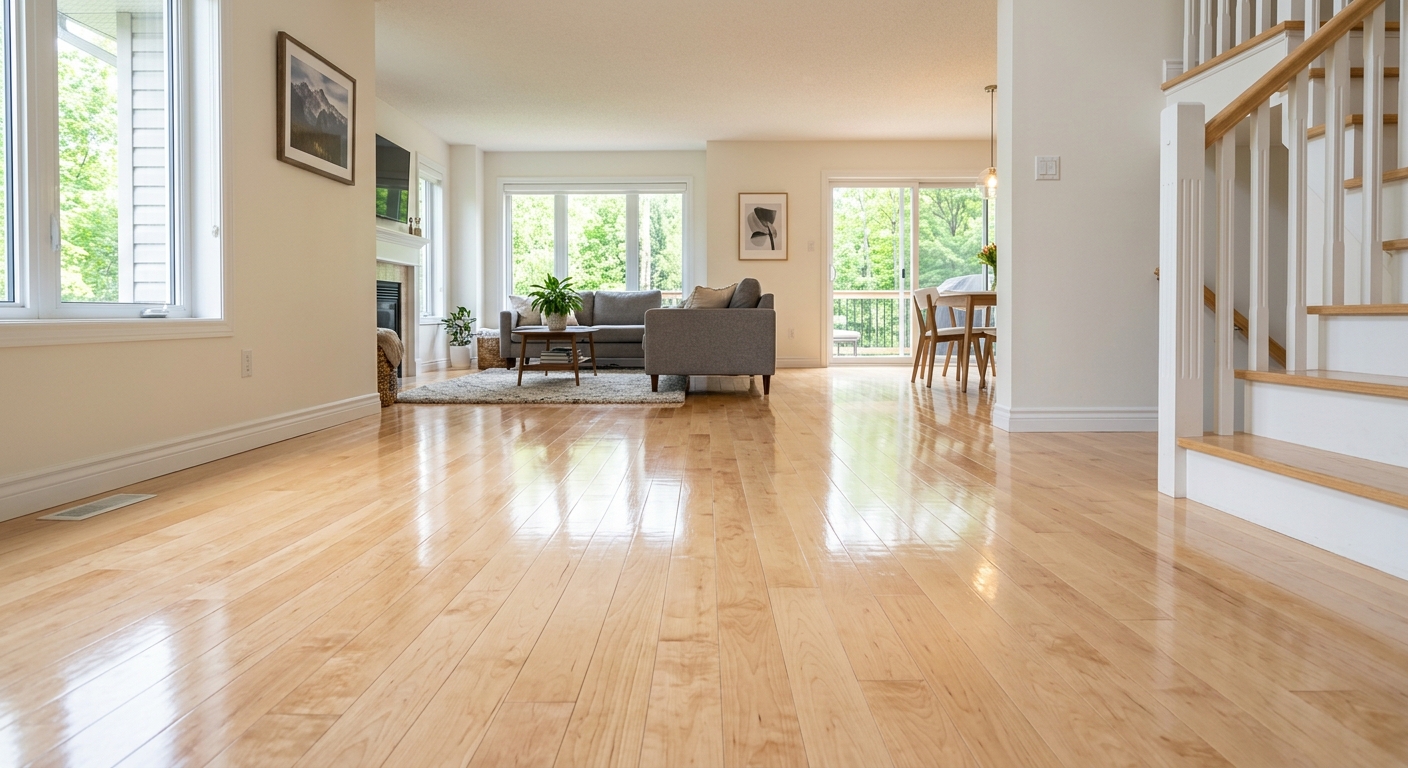
Flooring options and costs in Kaslo
Kaslo homeowners typically have a straightforward starting point—what works in a small town with older housing and real seasonal swings. In Kaslo specifically, many homes were built before 1981 (58.1% of dwellings), which means pre-install subfloor patching, levelling, or replacing tired underlayment is common before any new surface goes down. That extra prep is one of the main reasons the “same” floor can quote differently from contractor to contractor. On top of that, Kootenay basements and slab-on-grade areas can feel damp longer than you’d expect, so the climate can push you toward materials that tolerate movement.
With a 2021 population of 1,049 and 380 homeowner households (72.4% owning), there’s steady demand, but not every specialist is available year-round. During spring thaw and shoulder seasons, humidity spikes make timing and subfloor conditioning more important, which affects labour schedules and sometimes shortens the list of readily available installers. In areas like Lakeside and the downtown corridor, where many homes are older and renovations are frequent, you’ll often see more requests for engineered hardwood and luxury vinyl plank because they perform well on the kind of subfloors that show minor waves, patches, or historic finish layers.
Below is a practical comparison of common flooring types, including moisture tolerance and realistic installed pricing for Kaslo—then we’ll cover what drives quotes up or down.
| Type |
Best Room |
Moisture Resistance |
Lifespan |
Price per sq ft |
| Solid hardwood (nail-down, above grade only) |
Living room, dining room |
Low (not recommended for basements; sensitive to humidity swings) |
25–50 years (site must be dry and stable) |
$12, $18 – $16, $24 |
| Engineered hardwood (float or glue, above + on-grade) |
Living room, hallways, bedrooms |
Medium to good (handles seasonal movement better than solid) |
20–35 years |
$12, $18 – $18, $26 |
| Laminate (click-lock, above-grade) |
Bedrooms, above-grade living spaces |
Low to medium (water-resistant top layer, but edges can suffer) |
10–25 years |
$5, $7 – $8, $12 |
| Luxury vinyl plank / LVP (waterproof, any level) |
Kitchen, entry, basement (finished) |
High (waterproof core; best choice for moisture-prone areas) |
15–25 years |
$7, $9 – $10, $14 |
| Porcelain / ceramic tile |
Bathrooms, kitchen, entries |
High (porcelain especially; relies on proper underlayment) |
25–50 years |
$12, $18 – $18, $28 |
| Carpet (broadloom or modular tile) |
Bedrooms, media room |
Low to medium (avoid basements unless well-managed) |
7–15 years |
$4, $6 – $8, $12 |
Prices are estimates only and vary by project scope, site access and material selection.
What affects the price of flooring in Kaslo
In Kaslo and across the Kootenays, it’s common to see the same flooring idea come in 30–50% apart when you compare quotes from different crews. The biggest reasons aren’t just the material brand—they’re the technical work that protects your floor from Kaslo’s moisture behaviour and the condition of older subfloors. Many homes here have below-grade space, and when humidity swings with spring melt and winter heating cycles, solid hardwood expands and contracts with indoor moisture. That’s why solid hardwood generally can’t be installed over concrete and performs poorly in basements; engineered hardwood and luxury vinyl plank handle humidity and movement far better.
Cold-weather homes are also driving change. Where radiant heat is present (or being added), contractors often steer homeowners toward radiant-heat compatible engineered wood, certain laminates/vinyls, or tile rated for in-floor heat. Solid hardwood is usually ruled out or heavily limited in those scenarios. On older housing stock, you’ll also see subfloor levelling or repair before install—commonly adding roughly $1–$4 per sq ft—especially when there are wavy sections, old patch jobs, or leftover adhesive/flooring layers.
Concrete examples: in a finished basement, choosing waterproof LVP can avoid the risk and extra framing/underlayment work that a solid wood floor would trigger, even if tile or engineered looks appealing at the start. In an older living room with uneven plywood, the labour to grind, re-fasten, and level may be similar whether you pick laminate ($5–$10/sq ft typical band) or engineered wood, but the “extra” becomes more costly if the subfloor needs repairs to meet the flatter tolerances required for nail-down or tighter click systems. Understanding the right product for the moisture profile is how you keep total project cost from creeping.
| Price Factor |
Why It Matters |
Cost Impact |
| Room area in sq ft |
Drives material quantity and labour hours, plus waste |
Higher square footage usually lowers per-sq-ft labour cost slightly; still multiplies total spend |
| Subfloor condition |
Levelling and repairs are required for a flat, sound base |
Often adds about $1–$4/sq ft depending on how much patching is needed |
| Moisture / below-grade install |
Solid wood is humidity-sensitive and often unsuitable over concrete/basements |
Can shift you from $12–$20 hardwood territory to engineered or LVP (often $5–$10 for LVP bands, plus prep) |
| Material choice |
Different products carry different installation complexity and tolerances |
May move pricing from laminate/vinyl bands ($5–$10) to tile/hardwood bands ($12–$25) |
| Removal and disposal of existing flooring |
Old flooring, underlay, and adhesive can be time-consuming |
Can add a noticeable labour line item; cost increases with thickness and glue-down remnants |
| Stair nosing / transitions |
Transitions and stair work are labour-intensive and material-specific |
Charged per step or per linear foot; commonly a mid-project “surprise” if not scoped |
| Radiant heat compatibility |
Not all products survive in-floor heating cycles |
May require a pricier product or specific underlayment; can add testing or allowance |
| Installation method |
Float vs. glue-down vs. nail-down changes prep, adhesives, and labour |
Glue-down and nail-down usually require stricter subfloor prep than click-lock |
Permits & regulations in British Columbia
In British Columbia, a typical flooring replacement (like installing laminate, vinyl plank, engineered hardwood, carpet, or tile over an existing substrate) usually does not require a building permit by itself. However, related work can. For example, if your project includes structural subfloor repair (sistering joists, replacing subfloor members, or changing load paths), moisture remediation that requires mechanical or barrier systems, or anything electrical such as modifying in-floor heating wiring/circuits, permits and inspections may be triggered through the electrical scope.
For condominiums, the bigger issue is often not “permits,” but the building’s rules. Many condo corporations restrict hard flooring on upper floors unless you use approved underlay systems to help meet sound transmission expectations (STC/IIC). Before you buy, review your condo declaration and request board approval in writing—especially for hardwood and tile installations.
How a Kaslo homeowner checks a contractor in BC, step-by-step: first, verify the contractor’s business licence/credentials as applicable in the province and confirm their liability insurance certificate is current. Ask for proof of WCB/WSIB coverage (or the correct coverage for the employer type) and request a clearance letter where available. Then, match the quote scope to the certificate—if the quote includes tile setting or subfloor structural repairs, ensure the contractor’s coverage reflects the work they’ll actually do. Finally, don’t rely on verbal confirmation; ask for documents before scheduling demolition.
Best flooring for each room in your Kaslo home
In Kaslo, choosing flooring is less about “what looks best” and more about matching materials to moisture risk, daily traffic, and comfort with winter heating. For living and dining areas, engineered hardwood or a high-quality laminate can deliver warmth without the same humidity sensitivity as solid wood, particularly helpful when your home goes through heater-on winters and humid spring conditions. For bedrooms, carpet is a favourite because it’s comfortable, quieter underfoot, and it reduces sound—while engineered hardwood is also a solid option if you prefer an all-hard surface look.
In the kitchen, waterproof luxury vinyl plank (LVP) or large-format porcelain tile is the practical win. Spills happen, and Kootenay seasonal humidity plus occasional wet footwear at entrances means you want a surface that can handle cleaning and small moisture events. In finished basements, LVP is usually the clear winner: it’s waterproof, tolerates minor subfloor movement, and is much more forgiving over below-grade conditions than solid hardwood or typical laminates. For bathrooms, porcelain or ceramic tile is the standard choice because it’s durable against moisture—assuming the underlayment system is done correctly.
Radiant heat compatibility matters too. If you have in-floor heating (or plan it), select products specifically rated for in-floor heat so you avoid de-bonding or damage from winter temperature cycles.
As a pricing reality check: if your goal is durable coverage for a kitchen, LVP often lands in the $7–$10/sq ft band, while porcelain tile commonly comes in at about $12–$25/sq ft. That extra tile cost can be justified if you want maximum longevity and a stone-like surface, but it’s not necessary if your top priority is warm underfoot and easy maintenance—LVP usually gets you 90% of the everyday performance for less.
| Room |
Best Material |
Why |
Moisture Risk |
Price Band per sq ft |
| Living / dining room |
Engineered hardwood |
Warm look with better tolerance to Kaslo humidity swings than solid |
Low to medium (manage indoor humidity for best results) |
$12, $18 – $18, $26 |
| Master bedroom |
Carpet or engineered hardwood |
Comfort and quiet for carpet; stable beauty with engineered wood |
Low (unless you have a damp foundation or active seepage) |
$5, $7 – $13, $20 |
| Secondary bedrooms |
Laminate or carpet |
Laminate balances durability and budget; carpet improves comfort |
Low (avoid installing in wet-prone lower areas) |
$5, $7 – $10, $14 |
| Kitchen |
Luxury vinyl plank (LVP) or porcelain tile |
LVP handles everyday spills; tile offers maximum wear resistance |
Medium (cleaning frequency and moisture tracking from doors) |
$7, $9 – $10, $14 |
| Basement (finished) |
Luxury vinyl plank (waterproof) |
Best fit for below-grade conditions and moisture vapour movement |
High (solid wood and many laminates are poor choices here) |
$7, $9 – $10, $14 |
| Bathroom |
Porcelain / ceramic tile |
Moisture-safe surface that can last for decades |
High (use proper underlayment and grout/caulk maintenance) |
$12, $18 – $18, $28 |
How to choose a flooring contractor in Kaslo
Choosing the right contractor in Kaslo means verifying coverage and getting pricing that’s itemised enough to protect you. Start with British Columbia compliance checks: request proof of liability insurance (so you’re covered if there’s accidental damage), and confirm proper WCB/WSIB coverage for the contractor and any workers. Ask to see a current certificate of insurance and, where provided, a clearance letter. Then, verify the licence/registration as applicable for their business activity in BC. Don’t guess—ask for documents before you schedule demolition.
Next, get 2–3 written quotes that break down labour and materials rather than one lump sum. A clear quote should show removal/disposal, subfloor levelling or repair scope, underlayment (if required), transition pieces, stair nosing, and whether permits are included if electrical or structural work is part of the project. In older Kaslo homes, subfloor prep is often the largest variable—so ensure the quote states how they’ll correct out-of-flat conditions and what happens if they uncover additional damage.
Warranty and payment matter just as much. Confirm the workmanship warranty length and what it covers; also note whether the manufacturer warranty transfers to you if the product changes ownership after installation. Payment schedule should be conservative: never pay more than 10–15% upfront, and hold back until the job is complete and you’ve accepted the final workmanship. Finally, ask for a written start date and a realistic completion timeline.
- Ask for liability insurance and WCB/WSIB proof before signing anything.
- Request proof of work history in Kootenays (photos of similar basement/tile jobs).
- Insist on an itemised quote: demo, prep/levelling, underlayment, and transitions.
- Confirm what’s included for subfloor repair (and what’s excluded).
- Clarify removal and disposal (old flooring and adhesive residue).
- Check if stair nosing and transitions are priced per step/linear foot.
- Ask about acclimation for hardwood/vinyl and recommended indoor humidity range.
- Get the product spec sheet (thickness, wear layer, underlayment requirements).
- Confirm radiant-heat compatibility when applicable.
- Review workmanship warranty terms in writing.
- Use a payment schedule with a holdback until you pass final inspection.
- Get start/completion dates and communicate how delays are handled.
Red flags we commonly see in Kaslo: contractors who won’t provide insurance/WCB documents; quotes that only list a single “installed price” with no line items for levelling or transitions; promising solid hardwood in basements without moisture mitigation; skipping written timelines and warranty details; and asking for large upfront payments without a signed scope.
Frequently asked questions — flooring in Kaslo
What's the most durable flooring for pets and kids?
If you’re dealing with pets and kids in Kaslo, the most durable choice is usually waterproof luxury vinyl plank (LVP) with a quality wear layer. It’s designed to handle accidents, frequent cleaning, and the everyday dents that come from toys and active paws. For bathrooms and entries, tile is also tough, but dropped items can chip grout or crack thin settings if the system isn’t installed properly. Carpet can be comfy, but it’s the hardest to keep looking new after repeated spills and tracked moisture from our seasonal swings.
On typical installed pricing in the Kootenays, LVP often falls in the $7–$10/sq ft band, while porcelain tile is commonly higher (about $12–$25/sq ft). If you want “durable first, pretty always,” LVP in the main living and basement zones is often the best balance—then tile can be reserved for wet areas where you want a rigid surface.
How do I choose flooring for humidity in Kaslo?
Humidity is a big deal in British Columbia, and Kaslo is no exception—especially where basements and below-grade slabs are involved. Solid hardwood expands and contracts with indoor moisture, and it’s generally not recommended for basements or direct slab installations. Engineered hardwood is more stable and can work well on above-grade floors or on-grade areas when the subfloor is properly prepared. Luxury vinyl plank is the safest general-purpose pick for moisture-prone zones because it’s waterproof and tolerates vapour and minor movement better than wood-based products.
Practically, I recommend you treat humidity as a design constraint: if your plan includes a finished basement, budget for LVP instead of solid wood. If you’re picking engineered hardwood, ask your installer about acclimation and subfloor flatness. For older homes built before 1981, plan on some level of levelling or repair, which commonly adds roughly $1–$4 per sq ft to the prep scope.
Do condos restrict hard flooring?
Yes—often. In condos across British Columbia, the building’s rules are frequently focused on sound transmission, not just appearance. Even if the installation itself doesn’t require a permit, the condo corporation may restrict hardwood, tile, or other “hard flooring” systems on upper floors unless you use an approved underlay and follow specific installation methods. It’s best to request written board approval before you start so you don’t get stuck removing and redoing the floor.
For carpet, laminate, and LVP, approvals are sometimes easier, but the underlay (and how it’s installed) still matters. For hardwood and tile, the board may require specific acoustic underlay products to help with STC/IIC expectations. If you’re in Kaslo, ask the contractor to provide the product specs and the underlayment details so you can show the board exactly what’s being installed. Then keep your approval email/letter for your records.
How do I compare flooring quotes?
Comparing quotes is where homeowners in Kaslo often get misled, because two “installed price” numbers can hide very different scopes. Start by ensuring each quote includes removal and disposal of existing flooring, the subfloor prep (levelling/repair), underlayment/underlay requirements, and transitions/stair nosing. Ask whether the contractor is pricing per room or per sq ft, and whether waste allowance is included.
Then compare the product specifications: wear layer thickness for LVP, thickness/top veneer for engineered hardwood, and for tile confirm the tile type and whether it’s porcelain/ceramic. If one quote is in the $12–$20 hardwood or $12–$25 tile territory and another is lower, confirm whether the cheaper one is skipping levelling or using a different installation method. Finally, verify coverage: ask for liability insurance and WCB/WSIB proof before work begins so you know you’re comparing contractors—not just materials.
Can I install flooring over existing tile in Kaslo?
Sometimes, but it depends on what’s under the tile and how flat it is. In many Kaslo renovations, existing tile can be removed for best results—especially if the tile is uneven, loose, or installed over questionable substrate. If the tile is well-adhered and you can achieve a smooth, flat surface, some flooring systems may be installed over it with the correct preparation (such as grinding high spots and using an appropriate underlayment strategy).
For LVP, the key is flatness and moisture performance—vinyl can work over tile better than solid hardwood, but you still need a stable base. For engineered hardwood, installers are much more sensitive to surface flatness and may require additional prep to avoid failure. If you’re considering tile-over-tile, ask the contractor to measure flatness and outline what prep they will do. If they can’t specify the prep method, assume removal is safer and more likely.
What is the best flooring for a high-traffic area in Kaslo?
For high-traffic areas in Kaslo—think main hallways, entries, and open living zones—the best blend of durability and maintenance is usually LVP or porcelain tile. LVP provides good impact resistance, handles small spills, and is waterproof, which matters when humidity swings and wet boots get tracked in. Porcelain tile is also extremely durable and long-lasting, and it stands up well to frequent cleaning, making it ideal for entries and kitchens.
If you’re weighing cost, LVP commonly lands in the $7–$10/sq ft band installed, while tile often sits in the $12–$25/sq ft range depending on product and labour scope. That extra tile budget can be worth it if you want maximum longevity and don’t mind grout maintenance. If your high-traffic zone is connected to a basement or on-grade area, LVP is often the easiest way to protect against moisture vapour and seasonal movement without costly reworks.