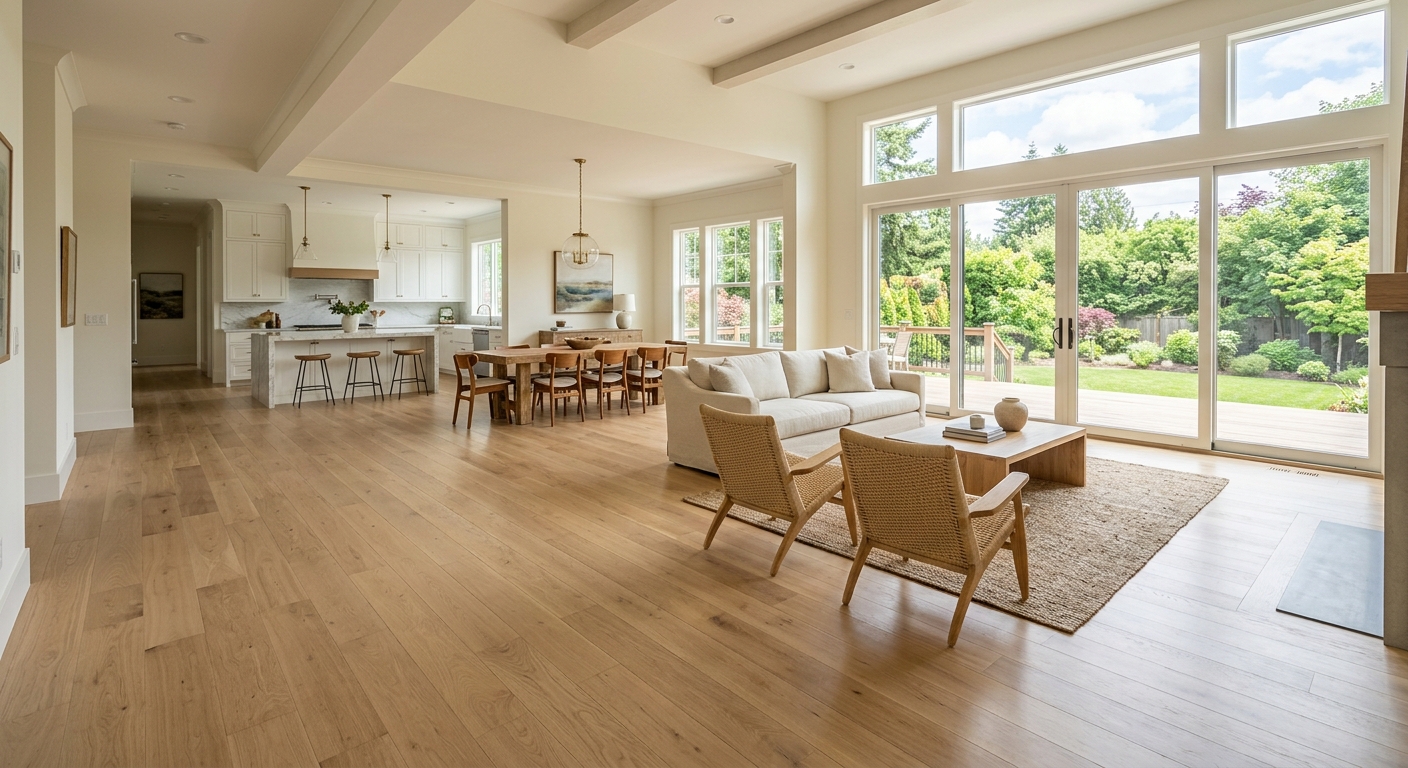
Flooring options and costs in Shaughnessy
In Shaughnessy, homeowners typically start by comparing flooring options that can handle everyday life and the Lower Mainland–Southwest’s wet, marine swings in indoor humidity. With a population of 8,430 (Statistics Canada, 2021 Census), the neighbourhood market is smaller than downtown Vancouver, but demand is steady—especially around core residential pockets where older homes and renovations are common. That older housing stock often means uneven plywood or concrete subfloors, so many projects include levelling/repair before a new finish goes down. In practice, that prep frequently adds roughly $1–$3 per sq ft to the job, and in tougher spots it can land higher once you account for labour time and patching materials.
Lower Mainland–Southwest conditions also affect total cost because moisture can wick through concrete slabs and into wood-based products. That’s why, below grade and in finished basements, we usually avoid solid hardwood and recommend engineered wood or luxury vinyl plank (LVP) instead. For main living areas above grade, solid hardwood is still popular, but installation must respect expansion gaps and indoor humidity control to prevent cupping or gapping. Labour availability and scheduling also influence pricing in Greater Vancouver—installation is a major portion of the total, so any access issues (tight stairs, furniture moves, or long carry distances) can push labour up quickly.
If you want a quick way to compare “apples to apples” pricing, start with the options below, then we’ll narrow it based on your room list and whether you have radiant heat or a below-grade slab.
| Type |
Best Room |
Moisture Resistance |
Lifespan |
Price per sq ft |
Price Range |
| Solid hardwood (nail-down, above grade only) |
Living / dining |
Low (sensitive to humidity) |
25–50 years |
$9–$18 |
$9,–$18 |
| Engineered hardwood (float or glue, above + on-grade) |
Living / dining, bedrooms |
Medium–High (layered construction) |
20–35 years |
$10–$17 |
$10,–$17 |
| Laminate (click-lock, above-grade) |
Bedrooms, hallways |
Medium (edges can swell) |
10–20 years |
$4–$10 |
$4,–$10 |
| Luxury vinyl plank / LVP (waterproof, any level) |
Kitchen, basements, main floors |
High (waterproof cores) |
15–25 years |
$6–$12 |
$6,–$12 |
| Porcelain / ceramic tile |
Kitchen, bathrooms, mudrooms |
Very High (with proper underlayment) |
30–50 years |
$10–$20 |
$10,–$20 |
| Carpet (broadloom or modular tile) |
Bedrooms |
Low–Medium (can hold odours if damp) |
8–15 years |
$4–$8 |
$4,–$8 |
Prices are estimates only and vary by project scope, site access and material selection.
What affects the price of flooring in Shaughnessy
Even when two homeowners are choosing the same flooring brand and room size in the Lower Mainland–Southwest, quotes can differ by 30–50% across the region and compared to other parts of British Columbia. The biggest reason is labour and prep work: in Greater Vancouver, installation demand is high and subfloor conditions in older homes often require more labour than the “square footage” number suggests. Climate adds another layer—Shaughnessy is in a wet marine zone where indoor humidity swings are common in winter and shoulder seasons. That matters because solid hardwood expands and contracts with humidity. Solid hardwood also can’t be installed as a floating or glued system over concrete, and it performs poorly in basements where moisture vapour is more likely.
For that same reason, engineered hardwood and LVP typically price more predictably because they’re built for layered/engineered structures or waterproof cores. Cold-season expectations also influence product selection: if your home has radiant heating (increasingly common in newer builds), the specification must match temperature tolerances. Solid hardwood and some laminate products require more care there, which can reduce your “budget” options and affect the material spread—while engineered, LVP, and tile generally offer better compatibility.
Concrete examples you’ll see in Shaughnessy include: (1) a 500 sq ft living area where subfloor flattening/patching is needed—adding about $1–$4 per sq ft can turn a “$9–$18” hardwood scenario into a higher-end project; and (2) a finished basement where moisture mitigation and a waterproof floor choice can add cost at install time, but prevents future buckling or odour issues that cost far more to fix later. When you compare price bands, a shift from laminate (often “$4–$10”) to engineered hardwood (“$10–$17” range) is usually justified when you want better longevity in our humidity swings and fewer compromises in installation method.
| Price Factor |
Why It Matters |
Cost Impact |
| Room area in sq ft |
Directly drives material quantity and labour hours. |
Varies proportionally; larger jobs often reduce $/sq ft slightly. |
| Subfloor condition |
Levelling, patching, or resurfacing is often required in older homes. |
Typical add: $1–$4 per sq ft depending on repairs. |
| Moisture / below-grade install |
Solid hardwood is sensitive; below-grade needs vapour control and moisture-ready products. |
Can add $2–$6 per sq ft with mitigation and waterproof systems. |
| Material choice |
Solid wood, engineered, LVP, and tile have different base costs and underlay needs. |
Changes the “backbone” price band (e.g., $4–$10 vs. $10–$20). |
| Removal and disposal of existing flooring |
Old flooring removal can be labour-heavy, especially with glued-down layers. |
Often adds a noticeable per-project line item; can raise total by 10%+. |
| Stair nosing / transitions |
Transitions are charged per step or per linear foot and require careful finishing. |
Frequently adds several hundred dollars on multi-level homes. |
| Radiant heat compatibility |
Some products need special approvals and tolerances to avoid performance issues. |
May shift you to higher-cost compatible materials. |
| Installation method |
Float vs. glue-down vs. nail-down affects labour time and prep requirements. |
Glue-down often increases labour and prep versus click-lock. |
Permits & regulations in British Columbia
In British Columbia, the act of installing flooring itself typically does not require a building permit. Where permits can enter the picture is when the flooring project includes “associated work” that touches electrical systems, structural components, or moisture remediation that crosses into regulated trades. For example, if you’re adding or modifying in-floor radiant heating circuits, that electrical work may require the appropriate electrical permits and inspections. If the job includes structural subfloor repair that changes load paths or requires engineering sign-off, that can also trigger permitting requirements.
Condominiums are another common compliance area. Even when permits aren’t required, the building’s rules for sound transmission usually matter. Upper-floor hard surfaces often have restrictions related to STC/IIC performance, and underlay requirements may be mandatory. Before installing hardwood or tile on an above-grade suite level, always review the condo declaration and get board approval in writing if the corporation requires it.
To verify a contractor in Shaughnessy, start with these checks: (1) confirm their business is properly licensed/qualified for the work they advertise in British Columbia (ask for their registration details); (2) request a current certificate of liability insurance naming you as an additional insured where available; and (3) confirm their workforce coverage—Workers’ compensation coverage (WSIB/WCB) for their employees. Then ask for clearance/coverage letters or proof suitable for projects. If they can’t provide documents or rush you without paperwork, treat that as a red flag.
Best flooring for each room in your Shaughnessy home
In Shaughnessy’s wet, marine climate, the “best” flooring is the one that matches each room’s moisture exposure, foot traffic, and comfort needs—plus the reality of how moisture vapour behaves over time. For living and dining rooms, many homeowners want warmth underfoot without fighting humidity, so engineered hardwood or a high-quality laminate are popular choices. Carpet is also comfortable, but it’s best reserved for bedrooms where you’re less likely to track in wet shoes.
In kitchens, go with luxury vinyl plank (LVP) or large-format porcelain tile. Both handle spills and frequent cleaning far better than wood-based floors, and tile also resists standing water when seals and grout are maintained. For master bedrooms, engineered hardwood or carpet gives you comfort and sound reduction. In a Shaughnessy basement, LVP is usually the clear winner because it’s fully waterproof and tolerates moisture vapour far better than solid hardwood and most laminates. Bathrooms should be porcelain or ceramic tile only—hard, non-absorbent surfaces with the right underlayment system.
Radiant heat compatibility is becoming more important in British Columbia. If you have in-floor heating, engineered wood, LVP, and tile generally coordinate more easily; solid hardwood and some laminate products require careful limits and documentation.
A quick price reality check: if you’re deciding between laminate at the typical $4–$10 per sq ft band and engineered hardwood closer to $10–$17, the higher spend often makes sense when your subfloor is only “okay” and you want fewer humidity-related service calls over the long run.
| Room |
Best Material |
Why |
Moisture Risk |
Price Band per sq ft |
| Living / dining room |
Engineered hardwood |
Warm look with better stability through marine humidity swings. |
Low (above grade), moderate with big seasonal swings |
$10–$17 |
| Master bedroom |
Carpet or engineered hardwood |
Comfort and sound absorption; engineered offers easier humidity tolerance than solid. |
Low |
$4–$17 |
| Secondary bedrooms |
Laminate (high-quality) or LVP |
Durable, usually easier maintenance; LVP helps if humidity is higher in those rooms. |
Low to moderate |
$4–$12 |
| Kitchen |
Luxury vinyl plank (LVP) or porcelain tile |
Handles spills and cleaning; tile adds superior water resistance. |
Moderate to high |
$6–$20 |
| Basement (finished) |
LVP (waterproof) |
Built for moisture vapour and below-grade realities; reduces callback risk. |
High |
$6–$12 |
| Bathroom |
Porcelain / ceramic tile |
Non-absorbent surface with the right underlayment and grout care. |
High |
$10–$20 |
How to choose a flooring contractor in Shaughnessy
Choosing the right flooring contractor matters in Shaughnessy because prep work, moisture handling, and installation workmanship are where projects succeed or fail—especially with our humidity swings and frequent subfloor unevenness. Start by verifying British Columbia requirements properly: ask for their business information and licence/qualification details for the work they’re offering. Next, request a certificate of liability insurance and confirm the coverage limits are current. For workers, ensure they have Workers’ compensation coverage appropriate to British Columbia—ask for proof/clearance documentation (commonly provided as a clearance letter or equivalent). A contractor who won’t provide documentation is taking an unnecessary risk with your home.
Then request 2–3 itemised, written quotes (labour + materials breakdown), not one lump sum. The breakdown should show: subfloor levelling/repair scope, moisture mitigation (if any), underlay details, transition and stair work, removal and disposal, and installation method (float, glue-down, nail-down). Carefully read exclusions—things like moving appliances, disposal fees, patch/skim depth limits, or subfloor uncoverage conditions can change costs later.
Warranty clarity is key: confirm the workmanship warranty length, the product/manufacturer warranty terms, and whether warranties are transferable to the next owner. For payment scheduling, keep upfront payment to about 10–15% (never more than that if possible) and use a holdback until completion. Finally, get a written timeline: start date, estimated completion, and any weather-related or materials lead-time assumptions.
- Ask for proof of insurance (liability) and current workers’ compensation coverage documents.
- Verify they’ve installed the same product type (engineered/LVP/tile) in humid conditions and can explain their moisture approach.
- Require an itemised quote with labour and materials separate.
- Confirm what’s included in removal and disposal (and whether there’s separate dumping/haulage).
- Check whether subfloor levelling includes flattening/patching depth and materials.
- Ensure the underlay/vapour barrier is specified by type and brand (especially for laminate and below-grade floors).
- Get a written plan for transitions, stair nosing, and door jamb undercutting.
- Ask what they do to protect your home during install (dust control, floor protection).
- Confirm acclimation requirements for wood and what indoor humidity conditions they expect before install.
- Review warranty terms in writing: workmanship vs. manufacturer, and transferability.
- Use a milestone payment schedule with holdback until punch-list items are done.
- Make sure lead times for flooring and trim are included in the timeline.
Concrete red flags in the Shaughnessy market: they won’t show insurance/coverage proof; they quote without assessing subfloor flatness or moisture conditions; they dismiss expansion gaps and acclimation for solid/engineered wood; they offer only lump-sum pricing with unspecified underlayment; or they push large upfront payments with no defined completion milestones.
Frequently asked questions — flooring in Shaughnessy
How much does flooring cost in Shaughnessy?
In Shaughnessy, your flooring cost comes down to material choice plus the reality of labour and subfloor prep in older homes. As a baseline, many homeowners see carpet installation land in the $4–$8 per sq ft range, while laminate and vinyl plank typically sit around $4–$10 and $6–$12 per sq ft respectively (before considering site-specific prep). Hardwood is usually higher—solid hardwood commonly fits the $9–$18 per sq ft backbone band, with engineered often overlapping depending on brand and thickness. When subfloor levelling/repair is needed, it can add roughly $1–$3 per sq ft, and sometimes more on problem areas. Because the Lower Mainland–Southwest is wet and marine, moisture mitigation for basements can also affect total project pricing and timelines. We recommend getting an itemised quote so you can separate flooring, underlay/vapour control, and levelling rather than comparing only the final total.
Hardwood vs laminate vs vinyl plank — which is best?
There isn’t one “best” for every room in British Columbia, especially in Shaughnessy where indoor humidity swings and occasional basement moisture are common. Solid hardwood is attractive for living spaces above grade, but it’s sensitive to humidity and should be installed with proper expansion gaps; it’s also not the right choice for basements. Laminate is often the best value for dry, above-grade rooms, but it can be vulnerable at seams if moisture gets in over time. Luxury vinyl plank (LVP) is usually the most forgiving option for kitchens and finished basements because it’s waterproof and handles vapour and minor temperature shifts better than wood-based products. If you want a simple rule: choose hardwood for rooms you can control and ventilate, laminate for budget-friendly dry spaces, and LVP when there’s any chance of moisture exposure—especially in basement slabs. If radiant heat is involved, we’ll also confirm the product’s temperature compatibility before you buy.
What flooring is best for a Shaughnessy basement?
For a Shaughnessy basement, LVP is typically the safest, most cost-effective choice long term. The Lower Mainland–Southwest has a wet marine climate, and many homes have moisture vapour movement through concrete, so solid hardwood and most laminate can struggle in below-grade conditions. Waterproof LVP is designed to handle that moisture environment better, reducing the risk of cupping, gapping, and odour issues that show up later. You’ll usually still need the correct preparation—like checking subfloor flatness and managing any active moisture—but the finish itself is more resilient. If your basement is finished and you’re aiming for a warm, wood-look appearance, engineered wood can work only in specific “above/on-grade” moisture-stable scenarios with proper specification; below grade is where engineered decisions must be careful. Budget-wise, LVP commonly falls in the $6–$12 per sq ft band, while repairing moisture problems after the fact often costs more than getting the right system the first time.
Can I install hardwood over concrete?
In many Shaughnessy basements or slab-on-grade areas, you generally can’t install traditional solid hardwood as a nail-down product over concrete. Solid hardwood needs a suitable nailable subfloor and careful humidity conditions; it also doesn’t perform well where moisture vapour is present. Over concrete, homeowners typically consider engineered hardwood rather than solid, and even then the installation method and moisture conditions matter (often including proper vapour control and subfloor prep). If you have a main-floor slab and want the wood look, we’ll evaluate moisture risk and ensure the product is specified for that application. The key point is that “over concrete” isn’t automatically the problem—uncertain moisture and the wrong product type are. A reputable contractor will assess and document subfloor conditions, then recommend the correct system. If you’re on radiant heat, we’ll also confirm the temperature compatibility to avoid performance issues.
How long does flooring installation take?
Typical installation timelines in Shaughnessy depend on room count, product type, and subfloor prep. For example, a straightforward above-grade laminate or LVP install in a single room might be completed in a day, while multiple rooms with transitions, stair detailing, and trim work can take several days. Solid hardwood often takes longer because it usually includes more precise layout, acclimation considerations, and nail-down workflow. The biggest schedule variable is subfloor prep—levelling/patching or moisture mitigation can add days, not just hours, if materials need proper curing time. If your home is older, that levelling step is often what extends the timeline. Also consider delivery lead times for premium engineered or tile. A good contractor will give you a written start date, completion estimate, and an explanation of what’s included, plus a plan if materials arrive late. If you’re planning around furniture moves, we recommend building a small buffer for drying and inspection-related steps.
What flooring works with radiant heat?
In British Columbia, radiant heating is increasingly used in newer construction, and the flooring system must be compatible with the heating profile. In general, engineered hardwood, luxury vinyl plank, and porcelain/ceramic tile are the most commonly successful options because they handle temperature changes more predictably than solid hardwood. Solid hardwood can work only with very careful specification (and often stricter moisture/humidity controls), and some products can be voided if temperature tolerances aren’t met. Laminate can work when it’s specifically rated for radiant heat, but not all click-lock products are suitable. For tile, radiant heat performs well when the correct underlayment and installation method are used. The best approach is to confirm your radiant system’s temperature range and ask the installer to match it to the manufacturer’s written recommendations before purchase. In Shaughnessy’s marine climate, maintaining stable indoor conditions during ramp-up is also important to prevent movement and performance issues.