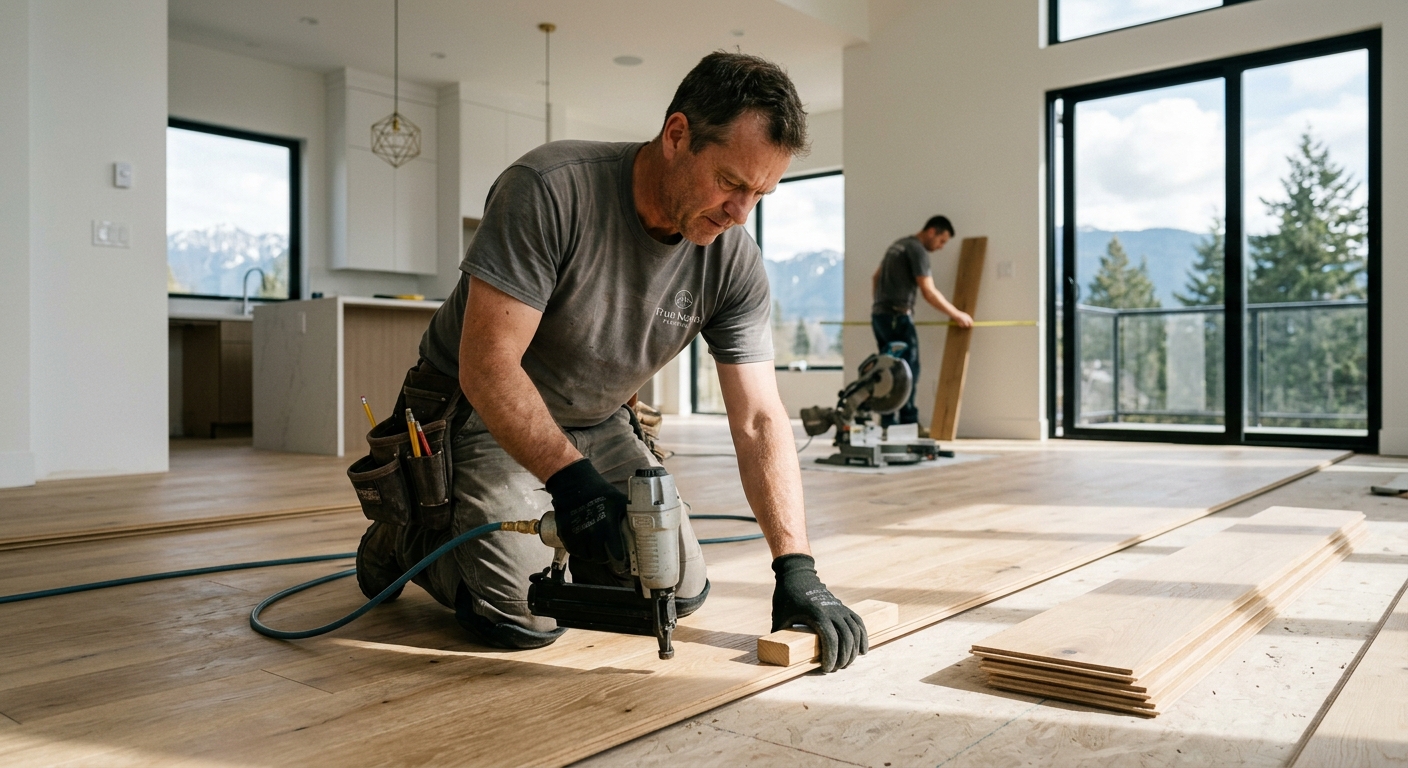
Flooring options and costs in Brockville
Brockville homeowners typically have a straightforward set of flooring choices, but the final price can swing based on how much prep the job needs. In this area, 71.6% of homes were built before 1981, which often means you’ll be dealing with older subfloors, uneven patches, or worn OSB that must be levelled or repaired before a new finish goes down. With 22,116 residents and a large share of owner-occupied homes, there’s steady demand for durable, good-value installs—especially in long-established neighbourhoods where basements and crawlspaces are common.
In the Kingston–Pembroke region, quotes are shaped by humidity swings and the below-grade moisture risk that comes with older housing stock. Solid hardwood can expand and contract with indoor moisture, and it also isn’t a good fit for basement or concrete installs. That’s why many Brockville projects steer toward engineered hardwood (more stable) or luxury vinyl plank (waterproof and tolerant of vapour), while tile tends to price higher because it’s labour-intensive. If your home has in-floor heating, radiant-compatible flooring becomes an extra constraint—helpful for comfort in colder seasons, but it can narrow product choices.
In demand areas like the older housing pockets near the downtown core and along the waterfront corridors often require more subfloor prep before the finish floor can be installed, which is where the real “apples-to-apples” difference shows up. Use the table below as a baseline, then we’ll talk scope and site conditions that can move your final total.
| Type |
Best Room |
Moisture Resistance |
Lifespan |
Price per sq ft |
Price Range |
| Solid hardwood (nail-down, above grade only) |
Living / dining (above grade) |
Low (humidity-sensitive) |
25–40 years |
Installed |
$11,00 – $25,00 |
| Engineered hardwood (float or glue, above + on-grade) |
Living, hallways, bedrooms (above/on-grade) |
Medium–high (more stable) |
20–35 years |
Installed |
$11,00 – $23,00 |
| Laminate (click-lock, above-grade) |
Bedrooms, living areas (above grade) |
Low–medium (water can swell seams) |
10–25 years |
Installed |
$4,00 – $10,00 |
| Luxury vinyl plank / LVP (waterproof, any level) |
Kitchen, entry, basement (finished) |
High (waterproof) |
15–25 years |
Installed |
$6,00 – $12,00 |
| Porcelain / ceramic tile |
Kitchen, bathrooms, foyers |
High (water-resistant) |
25–50 years |
Installed |
$8,00 – $20,00 |
| Carpet (broadloom or modular tile) |
Bedrooms, stairs, family rooms |
Low (absorbs moisture) |
7–15 years |
Installed |
$5,00 – $10,00 |
Prices are estimates only and vary by project scope, site access and material selection.
What affects the price of flooring in Brockville
In Brockville and across the Kingston–Pembroke region, the same flooring choice can come in 30–50% apart from one quote to the next because the cost is driven less by the “finish” and more by what happens before it goes down—subfloor prep, moisture control, and installation complexity. In Ontario’s colder seasons, indoor humidity swings are real: spring humidity rises, winters dry out, and older homes respond differently room-to-room. Solid hardwood moves with that cycle and can’t be glued or floated over concrete; it also performs poorly where basement moisture vapour is present. That’s why engineered hardwood and waterproof LVP are usually better when there’s any chance of below-grade humidity, and it’s also why basement installs often cost more to prep but less to finish.
Colder-region comfort is another driver. Where in-floor radiant heating is installed (or planned), contractors often recommend radiant-compatible products—this can raise material options for some homeowners but prevent future cupping/gapping issues. The big labour variable in Brockville is the older housing stock: with 71.6% of homes built before 1981, uneven floors, failing underlay, and patchwork subfloors aren’t rare. Levelling/repair commonly adds roughly $1–$4 per sq ft before the finish floor even starts.
Two concrete examples we see often: (1) a living room on an uneven subfloor can turn an “$11–$25 per sq ft” hardwood plan into a higher all-in total once self-levelling/patching is included; (2) a finished basement that needs moisture mitigation usually makes solid wood a poor-value option, while LVP at the “$4–$10 per sq ft” laminate band isn’t comparable—LVP’s waterproof benefit and better suitability can be worth the extra finish cost. Next, let’s break down the specific factors your quote should include.
| Price Factor |
Why It Matters |
Cost Impact |
| Room area in sq ft |
Direct driver of material quantity and labour hours |
Low to high; larger rooms spread fixed prep costs |
| Subfloor condition |
Levelling or repair needed before install |
Commonly $1–$4 per sq ft additional prep |
| Moisture / below-grade install |
Rules out solid hardwood; needs vapour strategy |
Can add material/extra labour; often shifts you to engineered/LVP |
| Material choice |
Solid vs. engineered vs. LVP vs. tile changes complexity |
Big swing: hardwood often $11–$25 vs LVP/laminate $4–$10 |
| Removal and disposal of existing flooring |
Demolition, hauling, and cleaning time |
Often adds a noticeable labour line item |
| Stair nosing / transitions |
Charged per step or per linear foot |
Can add hundreds depending on number of steps |
| Radiant heat compatibility |
Limits product options and affects underlayment choice |
Usually material-driven; can require specific install methods |
| Installation method |
Float vs. glue-down vs. nail-down changes labour and substrate prep |
Nail-down hardwood often needs flatter subfloors for best results |
Permits & regulations in Ontario
In Ontario, flooring installation itself typically does not require a building permit. Most projects—like installing LVP, laminate, carpet, or tile over an existing subfloor—are considered finish work. Where things can trigger requirements is the “associated work” you might do at the same time. For example, electrical permits may be required if you install or modify in-floor heating wiring or controls, or if any electrical work is tied to the flooring system. If you’re doing structural changes (like repairing subfloor framing beyond normal patching), you may also need to involve the proper approvals depending on scope.
In condominiums, even when there’s no permit, you can still face restrictions. Many condo corporations have rules tied to sound transmission (STC/IIC) and may require specific underlay under hard flooring on upper floors. Before ordering hardwood or tile, review the condo declaration and ask for board approval in writing—especially if you’re changing from carpet to engineered hardwood, or adding a hard surface in hallways and living spaces.
To verify contractor credentials in Brockville, start by confirming your installer’s Ontario business presence and licence/registration if applicable for their trade. Then request: (1) a certificate of insurance showing general liability (ask for expiry dates), (2) proof of WSIB/WCB coverage or a clearance letter where appropriate, and (3) references for similar moisture-sensitive installs (basements) or radiant-compatible floors if that’s your plan. Don’t rely on verbal assurances—ask for documents before the job is scheduled.
Best flooring for each room in your Brockville home
Choosing flooring in Brockville comes down to matching the material to the room’s moisture, traffic, and comfort needs—while respecting the local reality of humidity swings and older basements. For living and dining areas, homeowners usually want warmth and a clean look without constant maintenance. Engineered hardwood or high-quality laminate can work well above grade, offering stability and easier installation than solid hardwood. In a master bedroom, comfort matters: carpet helps with sound and feels warmer underfoot in winter, but engineered hardwood is also a strong upgrade if you prefer a harder surface.
For the kitchen, choose something that can handle spills and frequent cleaning. Luxury vinyl plank (LVP) is a common Brockville pick because it’s waterproof and tolerant of day-to-day moisture. Large-format porcelain/ceramic tile is also excellent for water resistance, though it can be colder unless you have radiant heat. Basements are where many decisions get simplified: if you’re finishing a below-grade space, LVP is often the clear winner because it’s designed to tolerate moisture vapour and accidental spills. Solid hardwood and most laminate systems are higher risk in basements because they can be affected by movement and moisture exposure.
Bathrooms should be porcelain or ceramic tile only. If you have (or plan) in-floor radiant heat, stick to radiant-compatible products and installation methods so you don’t trap problems under the floor. A practical dollar example: upgrading from laminate (often in the $4–$10 per sq ft band) to engineered hardwood (commonly $11–$23 per sq ft installed) can be justified in living areas if you expect long-term wear, but in a basement it’s usually smarter to invest in LVP rather than pay for hardwood that may react to moisture.
| Room |
Best Material |
Why |
Moisture Risk |
Price Band per sq ft |
| Living / dining room |
Engineered hardwood |
Warm look, better stability than solid in changing humidity |
Low to medium (mostly above grade) |
$11,00 – $23,00 |
| Master bedroom |
Carpet or engineered hardwood |
Carpet for comfort/sound; engineered for easy upkeep |
Low (above grade) |
$5,00 – $23,00 |
| Secondary bedrooms |
Luxury vinyl plank or laminate |
Good durability for kids; easier cleaning than carpet |
Low (above grade) |
$4,00 – $12,00 |
| Kitchen |
Luxury vinyl plank (LVP) or porcelain tile |
Spill tolerance and wipe-clean performance |
Medium (spills and routine wet mopping) |
$8,00 – $20,00 |
| Basement (finished) |
Luxury vinyl plank (waterproof) |
Best moisture tolerance for below-grade environments |
High (vapour/seasonal humidity) |
$6,00 – $12,00 |
| Bathroom |
Porcelain / ceramic tile |
Water-resistant surface and long service life |
High (direct wet areas) |
$8,00 – $20,00 |
How to choose a flooring contractor in Brockville
Choosing the right flooring contractor in Brockville is mostly about proof—coverage, documented scope, and realistic timelines. Start with Ontario credential checks: request the contractor’s certificate of insurance for general liability and confirm WSIB/WCB coverage (or a clearance letter, when that applies). You can usually verify WSIB/WCB status through the insurer/coverage documents they provide, and then confirm dates and names match the business doing the work. If they can’t provide current paperwork, that’s a major warning sign.
Next, get 2–3 written, itemised quotes that separate labour and materials. Ask for details on what’s included: subfloor levelling/patching (if any), moisture mitigation steps (if any), underlayment/required membranes, and the method of installation (float vs. glue-down vs. nail-down). Make sure the quote spells out removals and disposal, and whether demolition starts only after materials are on-site. A clear payment schedule matters too: don’t pay more than about 10–15% upfront, and hold back retainage until completion and clean-up. Finally, get the start date and completion estimate in writing.
- Provide current general liability insurance certificate (with expiry date).
- Provide WSIB/WCB clearance letter or proof of coverage.
- Itemise labour vs. materials (no single lump-sum only).
- List what’s excluded (e.g., subfloor replacement, patching, moisture remediation).
- Confirm removal and disposal are included or priced separately.
- Detail transition pieces and stair nosing charges (per step/linear foot).
- Specify underlayment/membrane type and brand for your floor system.
- State acclimation requirements for hardwood/engineered products.
- Include warranty lengths for both workmanship and materials.
- Confirm if workmanship warranty is transferable to future owners.
- Set a clear payment schedule with a final holdback.
- Provide a written start date and completion timeframe.
Concrete red flags in Brockville: (1) they won’t show insurance/WSIB paperwork, (2) they quote a “flat” price without mentioning subfloor levelling or moisture prep, (3) they won’t list underlayment/membrane specs (critical for LVP and tile), (4) they dismiss radiant heat compatibility issues, and (5) they want large deposits up front with no schedule or contract details.
Frequently asked questions — flooring in Brockville
Can I install hardwood over concrete?
In most Brockville homes, the short answer is: you generally shouldn’t nail or float solid hardwood over concrete. Solid hardwood needs proper conditions and movement allowance; it’s typically installed nail-down over an appropriate above-grade subfloor, not directly over a concrete slab. If you’re working with concrete, an engineered hardwood system is usually the correct direction because it’s more dimensionally stable and can be installed with the right glue-down or click/float method depending on product specs. Also, if the slab is in a basement or has vapour issues, the moisture risk becomes a bigger factor—often favouring waterproof LVP instead of wood. Quotes should explicitly address moisture testing and prep, especially in older homes where floors may not be flat or sealed.
How long does flooring installation take?
Timelines in Brockville vary mostly by prep and floor type. A straightforward above-grade laminate or LVP install in a small room can feel “fast,” but subfloor levelling, patching, and acclimation add time. Tile is usually slower because of layout, underlayment/setting considerations, and cure times. For older homes built before 1981 (71.6% in the local profile), plan for extra time if the contractor finds uneven spots, damaged underlay, or moisture remediation needs. As a rule of thumb, many typical living-area projects land in the range of a few days for demo and install, then additional time for transitions and any curing steps. Ask for a start date and completion estimate in writing so prep surprises don’t stretch your schedule.
What flooring works with radiant heat?
Radiant heat compatibility is important in Ontario winters, and it often changes what can be installed. In general, you should use products and underlay systems that explicitly state they’re compatible with radiant in-floor heating. This is one reason solid hardwood may be limited—because of how it reacts to movement and the need for strict humidity/moisture conditions. Many homeowners go with engineered hardwood or LVP designed for radiant systems, while tile is also commonly used over radiant heat due to its stability. The key is the installation method and manufacturer instructions, including temperature limits. Make sure your contractor discusses this before you approve a product, and confirm the quote includes the correct underlayment or membrane for the radiant setup.
Engineered vs solid hardwood — what's the difference?
Solid hardwood is made from a single piece of wood and depends more heavily on stable indoor conditions; it’s typically installed above grade in Ontario. Engineered hardwood uses multiple layers with a real wood veneer on top, making it more dimensionally stable when humidity shifts occur through the year. In Brockville’s older housing stock, where basement moisture vapour and uneven subfloors can be concerns, engineered tends to be the safer choice for many installs. Solid hardwood can be a great long-term option when the environment is controlled and the subfloor is appropriate—often matching the higher $11–$25 per sq ft band. Engineered often competes in a similar quality tier, frequently landing around $11–$23 per sq ft installed depending on product and prep.
Do I need to level my subfloor first?
Usually, yes—if you want a floor that locks together properly, stays flat, and doesn’t create squeaks or gaps. Many Brockville homes built before 1981 can have uneven patches from past repairs, worn plywood/OSB, or sagging areas, which may require levelling or patching before installation. The depth of levelling needed depends on the existing surface condition and the flooring type: tile expects flatter substrates, LVP needs solid support to avoid movement, and click-lock products require a suitable flatness tolerance. If your quote doesn’t mention subfloor evaluation and levelling/repair, it’s missing one of the most important cost drivers. In local pricing, levelling/repair commonly adds roughly $1–$4 per sq ft, so it’s best to confirm before comparing quotes.
What's the most durable flooring for pets and kids?
For pets and kids in Brockville, durability usually means stain resistance, scratch tolerance, and—most importantly—handling everyday messes without damage. Luxury vinyl plank (LVP) is often the top choice because it’s waterproof, easy to clean, and less sensitive to minor moisture events than laminate or carpet. Laminate can be durable for kids, but if spills get into seams, it can swell. Carpet is comfortable for play and helps with sound, but it can stain and hold odours if moisture gets down into the fibres. If you’re comparing price bands, LVP commonly lands around $6–$12 per sq ft installed, while carpet often sits around $5–$10. Tile is also very tough (especially in high-traffic zones), but it can be harder on dropped items and can feel colder unless you have radiant heat.