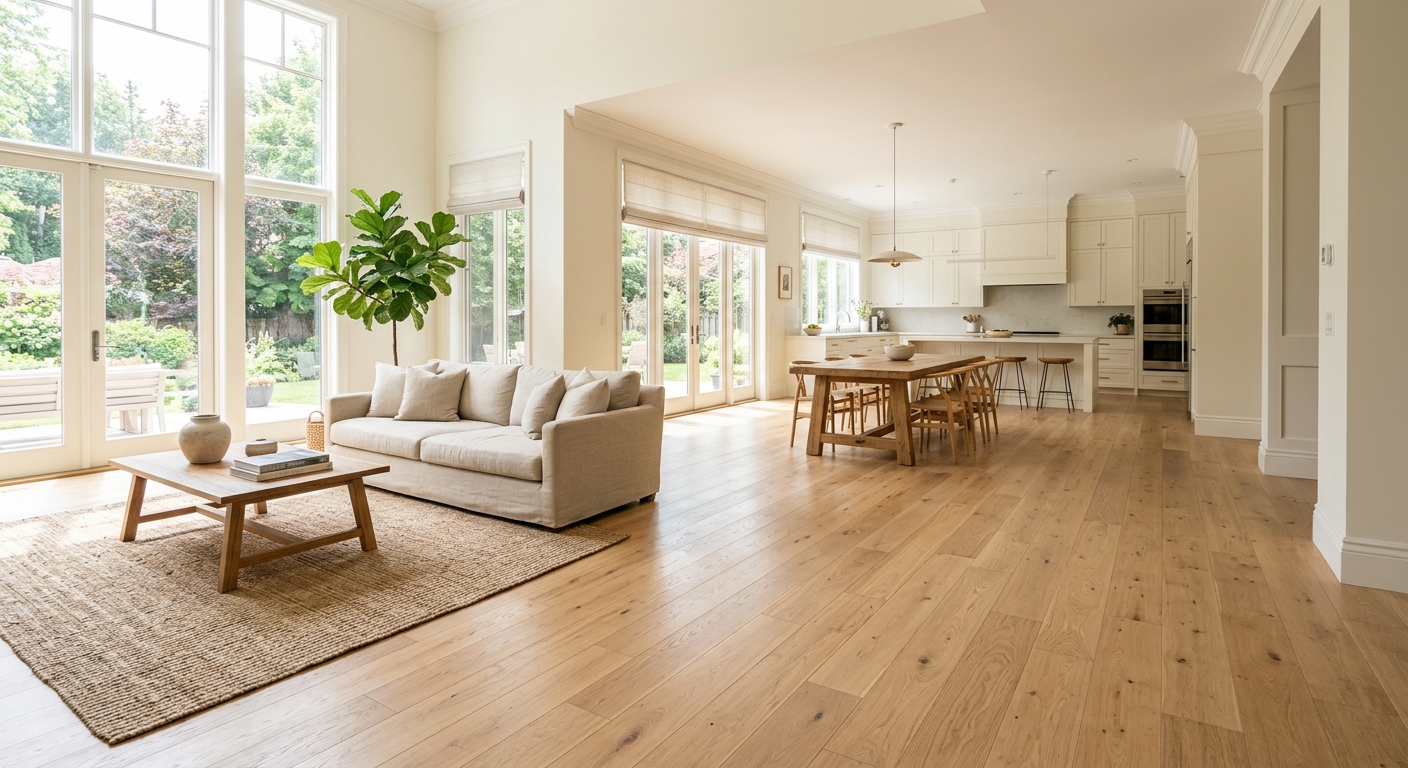
Flooring options and costs in Dorset Park
Dorset Park flooring choices start with the reality that you’re upgrading in a mature Toronto-area housing market. With a population of 25,003 in the neighbourhood (Statistics Canada, 2021 Census), there’s steady demand for renovation work, which helps contractors stay available—but it also means competition for skilled installers during peak seasons. Many homes here were built in the 1960s–1990s; in that kind of stock, it’s common to see subfloor levelling, plywood patching, or moisture mitigation before a new finish can be installed. That prep often adds a meaningful line item even if you pick a mid-range option.
Toronto-area indoor humidity swings drive part of the cost. When indoor moisture rises and falls seasonally, some materials move more than others. Solid hardwood can expand and contract with humidity and isn’t a good fit over concrete or in basements; engineered hardwood and luxury vinyl plank (LVP) are typically more dimensionally stable. In addition, labour rates in the Toronto region tend to be higher than in many other parts of Ontario, so two homes with the same square footage can land in different price brackets based on access, demolition, and subfloor repair needs.
This is especially noticeable in busier renovation pockets where many homeowners are updating older interiors and finishing basements—St. Clair Avenue area side streets and the surrounding residential blocks tend to see frequent flooring refreshes. Once the subfloor and moisture plan are confirmed, pricing becomes much easier to compare across flooring types. Use the table below as your baseline, then we can narrow it to your exact room sizes and prep scope.
| Type |
Best Room |
Moisture Resistance |
Lifespan |
Price per sq ft |
Price Range |
| Solid hardwood (nail-down, above grade only) |
Living / dining, main bedrooms |
Low to moderate (moves with humidity) |
25–40 years (with proper conditions) |
$9.00–$18.00 |
$9,000–$18,000 |
| Engineered hardwood (float or glue, above + on-grade) |
Main floors, hallways, stairs (as specified) |
Moderate (more stable in humidity swings) |
20–35 years |
$8.00–$16.00 |
$8,000–$16,000 |
| Laminate (click-lock, above-grade) |
Bedrooms, living rooms (dry areas) |
Low to moderate (spills can cause swelling) |
10–20 years |
$4.00–$9.00 |
$4,000–$9,000 |
| Luxury vinyl plank / LVP (waterproof, any level) |
Kitchen, finished basement, mud areas |
High (waterproof core) |
15–25 years |
$5.00–$11.00 |
$5,000–$11,000 |
| Porcelain / ceramic tile |
Kitchen, bathrooms, entryways |
Very high (resists water; grout care matters) |
25–50 years |
$12.00–$25.00 |
$12,000–$25,000 |
| Carpet (broadloom or modular tile) |
Bedrooms, stairs, comfort-focused rooms |
Moderate (susceptible to spills; good drying matters) |
8–15 years (varies by pad and traffic) |
$5.00–$11.00 |
$5,000–$11,000 |
Prices are estimates only and vary by project scope, site access and material selection.
What affects the price of flooring in Dorset Park
In Dorset Park and the wider Toronto region, quotes for the “same” flooring can swing by 30–50% because the hidden drivers—prep work, moisture conditions, and labour scheduling—often differ more than the finish material itself. Two homeowners can both choose mid-range engineered hardwood, yet one needs plywood replacement and levelling while the other is starting with a flat, dry subfloor.
Toronto-area indoor humidity swings are a key technical factor. Solid hardwood expands and contracts with moisture, and it also can’t be installed over concrete slabs or in basements without a suitable moisture-management system. That’s why engineered hardwood and LVP typically price better for peace of mind: they handle humidity and are designed for on-grade and below-grade applications more reliably. In colder Ontario winters, many newer builds add radiant floor heating; when radiant is involved, it can guide you toward engineered wood, tile, and certain vinyl products, while ruling out most traditional solid hardwood and some laminate installations due to heat and expansion considerations.
Older regional housing stock also pushes costs: subfloor levelling or repair commonly adds about $1–$4 per sq ft depending on the extent of low spots, damaged OSB/plywood, and whether moisture mitigation is required. For example, a basement refresh that looks inexpensive on paper with laminate can become a bigger spend after you address vapour control, while switching to waterproof LVP may reduce the risk of callbacks. Similarly, upgrading from laminate at roughly $4–$9 per sq ft to engineered hardwood often makes sense when you’re factoring longer lifespan and fewer moisture-related limitations—especially over on-grade slabs and high-humidity households.
Because renovation demand is strong in the Toronto market, contractor availability can also affect scheduling and crew efficiency, which can move labour labour line items even when materials are similar. The table below breaks down the cost factors we use when we build a clear, comparable quote.
| Price Factor |
Why It Matters |
Cost Impact |
| Room area in sq ft |
Drives material volume, trim, and labour hours. |
Higher area usually lowers per-sq-ft labour slightly, but increases total cost. |
| Subfloor condition — levelling or repair needed |
Flatness affects click-lock performance and prevents squeaks. |
Typically adds about $1–$4 per sq ft when levelling/plywood repair is required. |
| Moisture / below-grade install — rules out solid hardwood |
Humidity swings can cause cupping/gapping in solid wood. |
May increase costs through mitigation steps; can also change material choice to engineered or LVP. |
| Material choice — solid vs. engineered vs. LVP vs. tile |
Different materials carry different installation complexity and underlay needs. |
Hardwood and tile carry higher labour and prep requirements; LVP often simplifies moisture risk. |
| Removal and disposal of existing flooring |
Concrete dust, nail patterns, and hauling vary by existing system. |
Can add a meaningful line item; usually higher with tile, hardwood, or layered builds. |
| Stair nosing / transitions |
Transitions are charged by step or linear foot and require precise fitting. |
Often adds $150–$600+ depending on number of stairs and complexity. |
| Radiant heat compatibility |
Heat cycles affect expansion and underlay selection. |
May require specific product lines and installation methods; can add labour and material premiums. |
| Installation method — float vs. glue-down vs. nail-down |
Method changes subfloor requirements and labour time. |
Glue-down can cost more on prep; nail-down requires dry above-grade conditions. |
Permits & regulations in Ontario
In Ontario, installing flooring itself generally does not require a building permit. What can trigger permit or professional requirements is the associated work that changes building systems or involves electrical components. For example, if you’re repairing or replacing structural subfloor elements beyond simple patching, doing significant moisture remediation with membrane systems, or altering in-floor heating circuits, you may need the right permits and approvals depending on scope and the electrical scope involved. If you’re adding radiant heat, the electrical portion typically requires the correct electrical permit path and must be completed by appropriately licensed trades.
For condominiums in the Dorset Park area, regulations usually come from the building’s rules—not from flooring permits. Hard flooring on upper floors can be restricted or conditioned due to sound transmission requirements (often referenced with STC/IIC expectations). Underlay choices and installation details can be mandatory. Always review your condo declaration and request board approval (or written permission) before installing hardwood or tile above grade in a multi-unit building, particularly if the unit’s bylaws specify underlay ratings.
To verify your contractor in Ontario, confirm three things step-by-step: (1) Ontario contractor licensing/registration status as required for the type of work they’re doing (check any applicable online registry entry); (2) liability insurance with a certificate of insurance showing your address/project name if available; and (3) WSIB/WCB coverage proof (or clearance letter) so you’re not exposed if a worker is injured on site. Ask for the documents before work starts, and keep copies with your contract paperwork.
Best flooring for each room in your Dorset Park home
In Dorset Park, the best flooring choice is less about trends and more about how the room behaves: moisture exposure, traffic, and comfort in Ontario’s humidity swings. For living and dining areas, engineered hardwood or a high-quality laminate can give you warmth without the same movement risk as solid wood, especially on main floors where indoor moisture levels fluctuate. In the master bedroom, carpet is a top comfort option because it softens sound and feels warmer underfoot during winter mornings; if you have allergies, consider a sealed installation with a vacuum-friendly pile.
For the kitchen, we typically steer homeowners to luxury vinyl plank (LVP) or large-format porcelain tile. LVP is waterproof and forgiving around spills, while porcelain tile handles water well and can be easier to clean. In finished basements, LVP is usually the clear winner: basements are more vulnerable to moisture vapour and below-grade conditions, and traditional solid hardwood plus most laminate systems are riskier in those environments. Bathrooms are porcelain or ceramic tile only because water management and long-term durability matter more than comfort.
If you’re planning radiant floor heating—more common in some new builds in the Toronto market—engineered wood and tile are often the best matches. Traditional solid hardwood can be problematic due to expansion considerations when the heating system cycles.
Here’s a practical price example: moving from laminate at about $4–$9 per sq ft to LVP at roughly $5–$11 per sq ft might cost only a little more on paper, but it can prevent the “swollen edge” surprises that happen after a wet mopped day or a humidity-driven expansion mismatch—especially in basements where solid wood and many laminates struggle.
| Room |
Best Material |
Why |
Moisture Risk |
Price Band per sq ft |
| Living / dining room |
Engineered hardwood |
Warm look with better stability through seasonal humidity swings. |
Low to moderate (main-floor moisture) |
$9.00–$18.00 |
| Master bedroom |
Carpet |
Comfort and sound absorption; stays inviting year-round. |
Low (if well ventilated) |
$5.00–$11.00 |
| Secondary bedrooms |
Laminate (click-lock) or engineered hardwood |
Affordable durability; engineered is preferred if humidity is higher. |
Low to moderate |
$4.00–$9.00 |
| Kitchen |
Luxury vinyl plank (LVP) |
Waterproof practicality for spills and frequent cleaning. |
Moderate (water exposure) |
$5.00–$11.00 |
| Basement (finished) |
Luxury vinyl plank (LVP) |
Designed for below-grade and higher humidity vapour conditions. |
High |
$5.00–$11.00 |
| Bathroom |
Porcelain / ceramic tile |
Best long-term water performance and resilience. |
Very high |
$12.00–$25.00 |
How to choose a flooring contractor in Dorset Park
Choosing the right flooring contractor in Dorset Park comes down to proof, clarity, and workmanship details. First, verify Ontario licensing/registration status as applicable for the type of work being performed, and don’t skip insurance. Ask for a certificate of liability insurance and confirm the coverage is active for your project dates. Next, request WSIB/WCB proof (or a clearance letter) so you’re protected if a worker is injured on-site. If a contractor can’t provide these documents quickly, that’s a major warning sign.
Second, get 2–3 itemised written quotes—ideally broken into labour, removal/disposal, subfloor prep/levelling, underlay, transitions, and stair work, not just a single lump sum. Scope clarity prevents common disputes: ask what’s excluded (baseboards removal/reinstall, grinding high spots, moving furniture, bathroom readiness, or subfloor patch types). Confirm disposal is included and whether levelling is based on a flatness standard or “best effort.” For warranties, insist on both product and workmanship coverage in writing, including the length, what qualifies as a valid claim, and whether the warranty is transferable if you sell your home.
Third, manage payments: never pay more than about 10–15% upfront, and hold back the final payment until the job is fully complete and you’ve done a walkthrough. Get a start date and estimated completion in writing, along with any weather-dependent allowances if the job involves adhesives or outdoor storage.
- Confirm Ontario licence/registration status (as applicable to their scope) before they start.
- Collect a current certificate of liability insurance showing your address/project details if possible.
- Request WSIB/WCB clearance or coverage documentation for their workers.
- Ask for a written scope: what’s included in subfloor levelling and moisture mitigation.
- Get labour and materials separated (not one blended line).
- Verify underlay type and thickness matches your product and climate needs.
- Confirm transition/stair pricing: per step or per linear foot, with quantities listed.
- Ask who handles furniture moving and how protected items/railings are covered.
- Check removal and disposal inclusion (and whether recycling is arranged).
- Ensure delivery timelines and material lead times are stated in the contract.
- Read warranty terms: workmanship duration, exclusions, and product warranty registration steps.
- Use a payment schedule with a final holdback until final inspection and punch list completion.
In Dorset Park, common red flags include contractors who won’t show insurance/WSIB proof, quotes that ignore subfloor flatness or moisture testing, “free” underlay/hidden inclusions that don’t match the specified product, no clear stair/transition line item, and vague timelines without a written start/finish estimate.
Frequently asked questions — flooring in Dorset Park
Do I need to level my subfloor first?
In most Dorset Park renovations, yes—either fully level or at least correct problem areas. Click-lock laminate and floating engineered floors need a reasonably flat surface to prevent noise, gaps at seams, and early wear. Solid hardwood also depends on flatness, but more importantly it depends on dryness; if your basement or concrete slab has moisture concerns, levelling alone won’t solve the root issue. Many Toronto-area homes from the 1960s–1990s have humps, dips, or damaged OSB/plywood that require patching and levelling before flooring goes down. If levelling is omitted from a quote, you may see additional costs after the fact. A fair quote will describe what they’re doing for flatness and whether plywood replacement is included, and it should align with the flooring manufacturer’s installation requirements.
What's the most durable flooring for pets and kids?
For pets and kids in Ontario, luxury vinyl plank (LVP) is often the most practical “durable and forgiving” choice because it’s waterproof and handles everyday spills better than wood or laminate. It also tolerates minor accidents without swelling like laminate can. In a Dorset Park home, durability isn’t only about scratches—Toronto’s indoor humidity swings can widen gaps or stress certain finishes over time. LVP’s stable core typically performs better across seasons. If you want a natural look, engineered hardwood can still work, but it’s more sensitive to moisture events and may require faster cleanup and stricter humidity control. For a rough budget anchor, Dorset Park LVP projects often land in the $5–$11 per sq ft band; that tends to beat the long-term risk of installing laminate in high-traffic, spill-prone zones.
How do I choose flooring for humidity in Dorset Park?
Dorset Park homeowners should plan for indoor humidity swings across seasons, especially if your home is older and relies on typical forced-air cycles. Solid hardwood can expand and contract with humidity and isn’t a good bet over concrete or in basements; it’s also higher risk if there’s any moisture vapour present. Engineered hardwood is the usual step-up when you want wood aesthetics with better stability, and LVP is the most forgiving when moisture conditions are less predictable. If you’re considering radiant heat, that also affects your choice: engineered wood, tile, and certain vinyl products are typically better aligned with heat-cycling than traditional solid hardwood. Practically, we recommend choosing waterproof options in basements and bathrooms, and using engineered or well-installed laminate in dry main-floor rooms. If your quote is only comparing materials by appearance, insist they address moisture conditions and installation method.
Do condos restrict hard flooring?
Yes, condominiums in Ontario commonly restrict or condition hard flooring, especially on upper floors. The reason is sound transmission—buildings often have expectations around STC/IIC performance and may require a specific underlay system or installation method. Even when permits aren’t required for flooring itself, condo corporations may require board approval for hardwood or tile above grade. In Dorset Park condo buildings, the most reliable step is to check your unit’s rules and condo declaration, then request approval in writing before work begins. A contractor should be able to specify the underlay they’ll use, provide product details, and help you match what the building requires. Don’t assume “waterproof” means “allowed”—sound is the key variable, and underlay selection can matter as much as the flooring itself.
How do I compare flooring quotes?
Start by comparing apples to apples. In Dorset Park, quotes differ most because of prep scope, moisture remediation, and installation method—not just the final material. Ask each contractor to provide an itemised breakdown: material type and grade, underlay, stair nosing/transitions, removal and disposal, subfloor levelling/patching, and any moisture mitigation steps. Confirm whether labour includes moving furniture, what protection is used, and whether baseboards are removed/reinstalled. Also compare warranty terms: how long workmanship coverage lasts and whether it’s transferable, plus the manufacturer warranty requirements (like acclimation and approved adhesives). A useful check is per-sq-ft pricing against the typical bands: for example, laminate/vinyl plank is commonly budgeted around $4–$9 or $5–$11 per sq ft bands respectively, while tile is often higher. If one quote is dramatically cheaper, it usually means exclusions.
Can I install flooring over existing tile in Dorset Park?
Sometimes, but it depends on tile condition, flatness, and what the “tile-to-finish” plan is. For LVP, you may be able to install over sound, firmly bonded tile if the surface is properly prepared and flat, because LVP is tolerant of many subfloor surfaces when they meet stability requirements. For laminate, it’s more sensitive to moisture and underlayment setup, so the prep has to be careful. For engineered hardwood, tile can be more challenging if moisture conditions exist, and it often requires an engineered approach rather than a simple overlay. In Dorset Park homes, tile removal is sometimes avoided to reduce dust and labour, but only if the existing tile is stable and not too uneven. Ask your contractor to measure flatness and describe the underlayment plan in writing. If the tile has loose sections, significant grout ridges, or moisture issues, removal and proper subfloor work is usually the safer route.