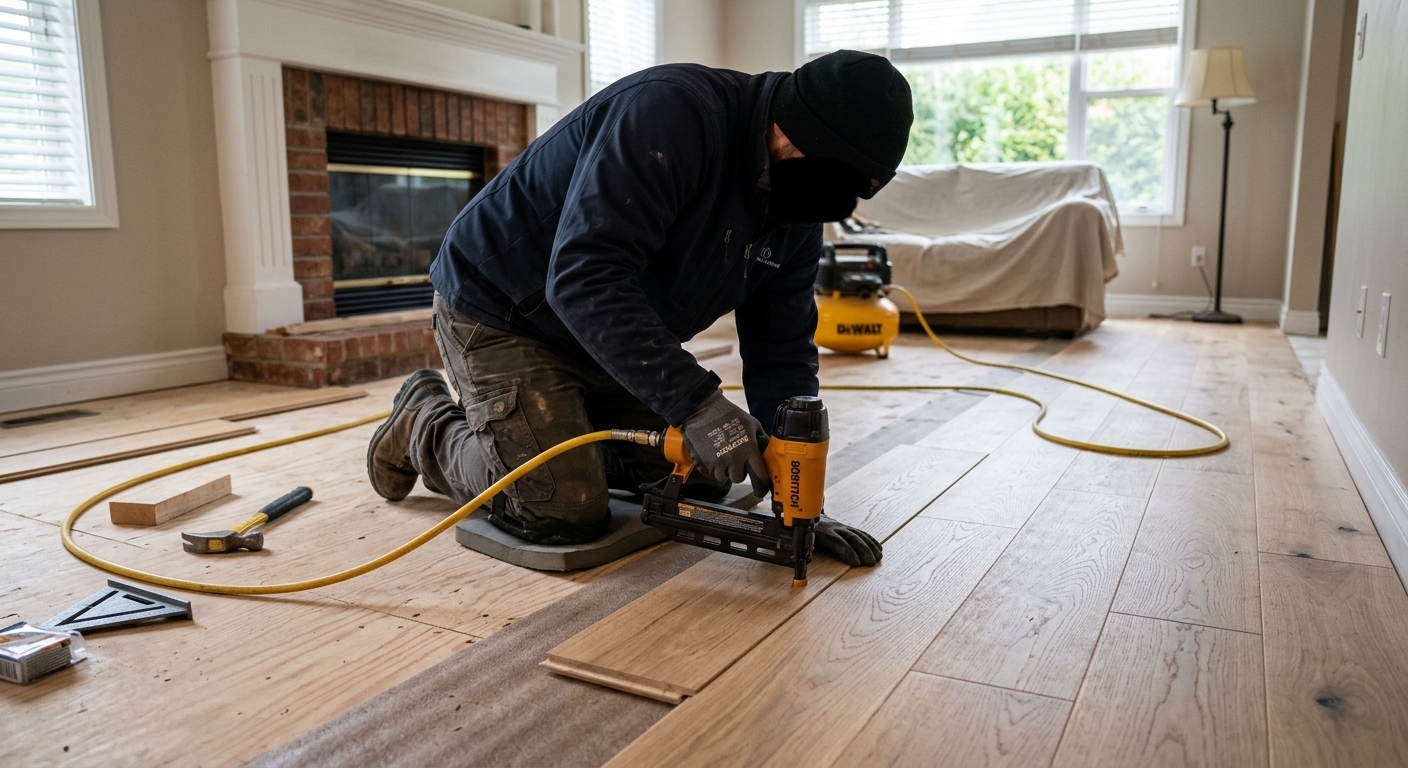
Flooring options and costs in Maple Leaf
Maple Leaf, Ontario is a great place to own a home—but it comes with real flooring challenges. With a 2021 Census population of 10,111 people in the city (Statistics Canada, 2021 Census), Maple Leaf’s demand is concentrated around common Toronto-area renovation corridors, and pricing typically reflects the broader Toronto labour market. Toronto-area humidity swings are wide across seasons, and that’s why many owners steer toward engineered hardwood or luxury vinyl plank (LVP) instead of traditional solid hardwood. Another cost driver is housing age: much of the local stock is older (often 1960s–1990s builds), which frequently needs subfloor levelling, plywood replacement, or moisture mitigation before install—prep that can add meaningful budget even when you select a mid-range product.
In practical terms, the same finished floor can land quite differently depending on how much levelling is required, whether the slab is ready for glue-down, and if there’s below-grade moisture to manage. Labour availability also affects quotes; Toronto-area renovations move quickly, and contractors price in scheduling and jobsite conditions. In areas like Maple Leaf Village and around transit-access neighbourhood pockets, hardwood and LVP installs are especially common because homeowners want a warmer look without moisture-related callbacks. From there, you can compare realistic material ranges and how they fit Toronto’s indoor comfort and below-grade realities—then we’ll break down the biggest price variables in the next section.
| Type |
Best Room |
Moisture Resistance |
Lifespan |
Price per sq ft |
| Solid hardwood (nail-down, above grade only) |
Living room, dining room (dry zones) |
Low to moderate; reacts to humidity |
25–60 years (good conditions) |
$9 – $18 |
| Engineered hardwood (float or glue, above + on-grade) |
Living spaces, hallways, bedrooms |
High; better with Toronto humidity |
20–35 years |
$10 – $16 |
| Laminate (click-lock, above-grade) |
Bedrooms, living areas (not basements) |
Low to moderate; sensitive at seams |
10–20 years |
$4 – $9 |
| Luxury vinyl plank / LVP (waterproof, any level) |
Kitchen, finished basement, main floor |
Very high; designed for below-grade |
15–25 years |
$6 – $12 |
| Porcelain / ceramic tile |
Kitchen, bathrooms, foyers |
Very high; excels in wet areas |
25–50 years (with proper grout care) |
$12 – $25 |
| Carpet (broadloom or modular tile) |
Bedrooms, stairs, family rooms |
Moderate; needs dry subfloor |
7–15 years |
$5 – $11 |
Prices are estimates only and vary by project scope, site access and material selection.
What affects the price of flooring in Maple Leaf
In Maple Leaf and the Toronto region, two quotes for the “same” floor can differ by about 30% to 50% because the labour steps and moisture prep aren’t always the same. Toronto-area homes often sit on slabs or older substructures that were never intended for today’s tight installation tolerances. If the job needs levelling, moisture mitigation, or material changes to suit radiant heat, your finished cost climbs even when the product price looks similar. That’s also why contractors may quote different labour hours even with the same square footage.
Technically, indoor humidity swings are the key driver. Solid hardwood expands and contracts with humidity and is typically limited to above-grade, nail-down installs; it’s a poor match for basements and it cannot be glued or floated over concrete as a like-for-like substitute. Engineered hardwood and luxury vinyl plank handle humidity better and are designed for on-grade and below-grade applications, which reduces risk and rework. In colder parts of the region and in new custom homes, radiant floor heating is increasingly common, and that compatibility can shift you toward engineered wood, tile, or certain vinyl systems.
Older regional housing stock is another cost lever. It may require subfloor levelling or repair—commonly adding roughly $1 to $4 per sq ft depending on how much plywood needs replacing and whether flattening compounds are required. For example, if a 600 sq ft main floor needs levelling, you might see an added $600 to $2,400 before materials. And if you choose a more forgiving option like LVP (often in the $6 to $12 per sq ft range) versus laminate (commonly $4 to $9), that extra material cost can be offset by lower moisture-related prep and fewer callbacks. Next, we’ll map these variables to the exact cost impacts contractors track during estimating.
| Price Factor |
Why It Matters |
Cost Impact |
| Room area in sq ft |
Directly drives material quantity and labour hours |
Lower per-sq-ft pricing sometimes on larger jobs |
| Subfloor condition — levelling or repair needed before install |
Toronto-area older subfloors can be uneven or deteriorated |
Can add several hundred dollars to multiple thousands |
| Moisture / below-grade install — rules out solid hardwood |
Concrete and basements require the right system and moisture controls |
May require vapour barrier/mitigation or change flooring type |
| Material choice — solid vs. engineered vs. LVP vs. tile |
Different products have different underlay, prep needs and install methods |
Broad range across typical bands ($4–$18+ per sq ft) |
| Removal and disposal of existing flooring |
Pulling old carpet, underlay, glue residue or ceramic can be labour-heavy |
Often adds a noticeable line item even with similar square footage |
| Stair nosing / transitions — charged per step or per linear foot |
Transitions affect finishing time and materials |
Commonly one of the “surprise” costs in renovations |
| Radiant heat compatibility — limits material options |
Heat and expansion require products rated for radiant systems |
May add costs for rated underlay or different flooring selection |
| Installation method — float vs. glue-down vs. nail-down |
Method determines prep, adhesives, and labour intensity |
Glue-down and nail-down are usually higher labour than floating |
Permits & regulations in Ontario
In Ontario, installing new flooring by itself typically does not require a building permit. Replacing surface finishes like hardwood, LVP, laminate, carpet, or tile over an existing properly prepared subfloor is generally treated as finishing work. Where it can change is when your flooring project includes associated work that touches electrical systems or structural/subfloor changes beyond “routine” repairs.
Work that may require a permit usually includes: electrical permit work related to in-floor heating circuits (or any electrical changes), and more substantial subfloor or structural repairs that involve engineering-level changes. If you’re adding or modifying radiant heating, ask your contractor whether they will pull the electrical permit and confirm the work is done by the appropriate licensed trade. In condominiums, the bigger practical constraint is often corporation policy: sound transmission requirements and underlay rules can restrict certain hard floors or require specific IIC/STC-approved underlay on upper levels.
What typically does NOT require a permit is the standard removal and install of flooring materials, routine subfloor levelling, and moisture mitigation steps that do not alter electrical or structural elements (though they must still be done correctly for longevity).
To verify an Ontario contractor in Maple Leaf: (1) check the contractor’s licence status/registration (Ontario has licensing and eligibility requirements depending on work scope), (2) request a certificate of insurance for general liability, and confirm whether they carry WSIB/WCB clearance for their workers, and (3) ask for clearance letters where applicable. Get these documents before work starts—your best quotes are the ones backed by proof, not promises.
Best flooring for each room in your Maple Leaf home
Choosing flooring room-by-room matters in Maple Leaf because Toronto-area humidity swings stress materials differently, and because many homes have basements or slabs where moisture behaviour is a daily reality. For living and dining areas, most homeowners want comfort and appearance without overreacting to seasonal changes—so engineered hardwood or high-quality laminate often hit the right balance. In Toronto conditions, engineered wood typically performs better than solid hardwood because it’s engineered to tolerate humidity changes more consistently, especially across changing indoor seasons.
For a master bedroom, carpet is still one of the best comfort choices: it’s warm underfoot, soft for early mornings, and it reduces sound. If you have pets, carpet can work well, but choose a quality underlay and stain-resistant treatment. For kitchens, owners usually choose luxury vinyl plank (LVP) or large-format porcelain tile. LVP gives you waterproof practicality and easier cleaning, while porcelain tile provides maximum resistance to spills and wet mopping.
Basements are where the difference becomes non-negotiable. For finished basements, LVP is the clear winner because it’s built for below-grade moisture conditions; solid hardwood and most laminate are riskier if vapour transfer or concrete moisture is present. Bathrooms should be porcelain or ceramic tile only. If any rooms are over radiant floor heating, confirm the product rating and install method—radiant heat changes the performance expectations, and many solid hardwood systems are not the right match.
Example: for a 300 sq ft kitchen, upgrading from laminate (often about $4 to $9 per sq ft) to LVP (often $6 to $12 per sq ft) might look like an extra $600 to $900 in material cost, but many homeowners find that justified because it handles accidental water and mop frequency without worrying about seam swelling.
| Room |
Best Material |
Why |
Moisture Risk |
Price Band per sq ft |
| Living / dining room |
Engineered hardwood |
Warm look with better humidity stability than solid |
Low to moderate; protect from wet tracking |
$10 – $16 |
| Master bedroom |
Carpet or engineered hardwood |
Comfort and sound control (carpet) or stable warmth (engineered) |
Low |
$5 – $16 |
| Secondary bedrooms |
Laminate or carpet |
Cost-effective durability with comfortable walking feel (carpet) |
Low |
$4 – $11 |
| Kitchen |
Luxury vinyl plank (LVP) or porcelain tile |
Easy cleaning and high spill tolerance |
Moderate to high |
$6 – $25 |
| Basement (finished) |
Luxury vinyl plank (waterproof) |
Designed for below-grade moisture conditions |
High (vapour and slab moisture possible) |
$6 – $12 |
| Bathroom |
Porcelain / ceramic tile |
Water-resistant and long-wearing |
Very high |
$12 – $25 |
How to choose a flooring contractor in Maple Leaf
Picking the right flooring contractor in Maple Leaf is mostly about proof and process. First, verify Ontario licensing and ensure they carry appropriate insurance: ask for a current certificate of general liability and confirm WSIB/WCB coverage (or a clearance letter where required) for their workers. If a contractor can’t provide documents quickly, that’s a real warning sign—especially when your project includes subfloor levelling or moisture mitigation that can lead to costly corrections if mishandled.
Next, get 2–3 itemised written quotes with a clear breakdown of labour and materials. Look for separate lines for removal/disposal, subfloor prep, underlay or vapour barrier, and the exact flooring spec. Avoid lump-sum quotes that don’t define exclusions. Confirm whether permits (when relevant), disposal, and transition pieces are included. For warranty, ask for both the workmanship warranty length and the manufacturer product warranty terms, and whether the warranty is transferable if you sell the home.
Payment schedules matter: never pay more than about 10% to 15% upfront. Use a holdback until the job is complete and any punch-list items are corrected. Finally, insist on a start date and an estimated completion timeline in writing, including when materials will be delivered and when subfloor prep will begin.
- Ask for proof of insurance (general liability) before any site work starts.
- Confirm WSIB/WCB coverage or provide the relevant clearance documentation.
- Get the quote in writing with labour and materials separated.
- Verify what’s included in subfloor prep (levelling, patching, fastener changes, underlayment).
- Confirm removal and disposal: what gets hauled away and who pays tipping fees.
- Ask how they handle uneven subfloors and what flattening target they follow.
- For LVP/tile, ask about moisture testing or vapour mitigation steps for slabs/basements.
- Check transition and stair pricing: per step or per linear foot, and what profiles are used.
- Confirm underlay/vapour barrier product names and thickness (and who supplies them).
- Request warranty details in writing: workmanship term and manufacturer coverage.
- Set a payment schedule with a holdback until completion and final walkthrough.
- Schedule a written timeline: start date, milestones, and completion estimate.
Red flags in Maple Leaf include: refusing to provide insurance/WSIB documentation, quoting without addressing subfloor moisture risk, vague scopes (“flooring supply and install” with no prep detail), pushing for large upfront payments, and missing warranty terms in the contract or invoice.
Frequently asked questions — flooring in Maple Leaf
What's the most durable flooring for pets and kids?
For most Maple Leaf households with pets and kids, luxury vinyl plank (LVP) is the safest “durable + practical” choice because it’s waterproof and handles the daily realities of spills, muddy paws, and frequent cleaning. In Toronto-area homes, humidity swings can affect seams and joints on some floating products, but well-installed waterproof LVP is typically more forgiving. If you want a warm look similar to wood, pick an LVP with a wear layer designed for traffic.
In terms of cost bands, many projects land around $6 – $12 per sq ft for LVP, while engineered hardwood often runs $10 – $16 per sq ft. Carpet can be comfortable, but it stains more easily and may be harder to keep looking new with frequent accidents. For kids’ play-heavy rooms, choose stain-resistant carpet or go with LVP for the long game.
How do I choose flooring for humidity in Maple Leaf?
Humidity is a core consideration in Maple Leaf and the wider Toronto region. Indoor moisture levels can swing across seasons, and that affects how materials expand and contract. Solid hardwood is the most moisture-sensitive: it’s intended for above-grade, nail-down installs and can be risky in basements or on concrete where moisture vapour and slab conditions vary. If you’re dealing with a basement (or any below-grade area), solid hardwood and most laminate choices are typically a higher call-back risk.
For humidity-prone homes, many owners select engineered hardwood or luxury vinyl plank. Engineered wood is built to tolerate changes better than solid, and LVP is designed for below-grade moisture scenarios. Budget-wise, laminate often sits around $4 – $9 per sq ft, but if your home has frequent dampness issues, spending within the LVP range of $6 – $12 per sq ft can be money well spent on performance rather than regret.
Do condos restrict hard flooring?
Yes—often. In Ontario condominiums around Toronto, the corporation’s rules commonly focus on sound transmission. Even if the flooring install itself doesn’t require a permit, the condo may require specific underlay, prohibit certain products, or require proof of performance (STC/IIC style requirements) for hard surfaces installed on upper floors. For homeowners, the practical rule is to review the condo declaration and any board guidelines before you purchase materials.
In Maple Leaf, that can mean your flooring contractor provides the required underlay system and installation details so the building manager can approve it in writing. Always request board approval before installation, especially when installing engineered hardwood, tile, or other hard flooring. Also confirm whether the condo has restrictions on moisture remediation products or specific underlayment types used over slabs.
How do I compare flooring quotes?
Start by comparing like with like. In Maple Leaf, quotes can vary by 30% to 50% because the scope differs—not just because of flooring choice. Ask each contractor for an itemised breakdown: flooring material spec, underlay/vapour barrier, removal and disposal, subfloor prep/levelling, labour hours, and transitions/stair nosing pricing. If one quote lumps everything together, you can’t accurately evaluate value.
Also compare exclusions: what happens if subfloor levelling is more extensive than expected? Is moisture mitigation included if needed in a basement? Is disposal included? Confirm whether any permits are included where relevant (for example, radiant heating electrical changes). Finally, review warranties: workmanship warranty length and manufacturer warranty terms. Even when the product band looks similar—like laminate around $4 – $9 per sq ft—your total can differ widely when prep work is handled differently.
Can I install flooring over existing tile in Maple Leaf?
Sometimes, but it depends on the tile’s condition, flatness, and what flooring you’re installing over it. In Maple Leaf basements and bathrooms, tile is often stable, but grout lines and uneven tiles can create a problem for floating floors unless the surface is properly prepared. For LVP, many installers will check flatness and may recommend skim-coating or appropriate underlayment depending on the system—especially if the old tile is cracked or “rocking.” For carpet, tile is typically not a direct underlay surface unless there’s a suitable plan for levelling.
Important: if moisture is a concern (common in below-grade situations), don’t skip the moisture and subfloor assessment. In some cases, removing tile is the right call for a longer-lasting install. Your contractor should state whether they’re installing over tile directly or preparing/flattening the surface first—this should be written into the quote.
What is the best flooring for a high-traffic area in Maple Leaf?
For high-traffic areas in Maple Leaf—like entryways, hallways, and family rooms—the best option usually comes down to balancing scratch resistance, cleaning ease, and moisture tolerance. LVP is often the front-runner because it’s durable, waterproof, and can handle daily impact without worrying about spills or mopping. Choose a product with a strong wear layer and ensure correct subfloor prep so it doesn’t telegraph imperfections.
If you prefer a more traditional look, engineered hardwood is a good alternative, but it still requires attention to humidity and above-grade performance (or proper engineered suitability for your specific installation). Tile is also excellent for traffic and cleaning, especially in entries, and it holds up well over time; it typically costs more, commonly around $12 – $25 per sq ft.
For many families, the value sweet spot lands in LVP pricing (often $6 – $12 per sq ft) because it offers durability without the higher maintenance risk that can come with more moisture-sensitive products in Toronto-area homes.