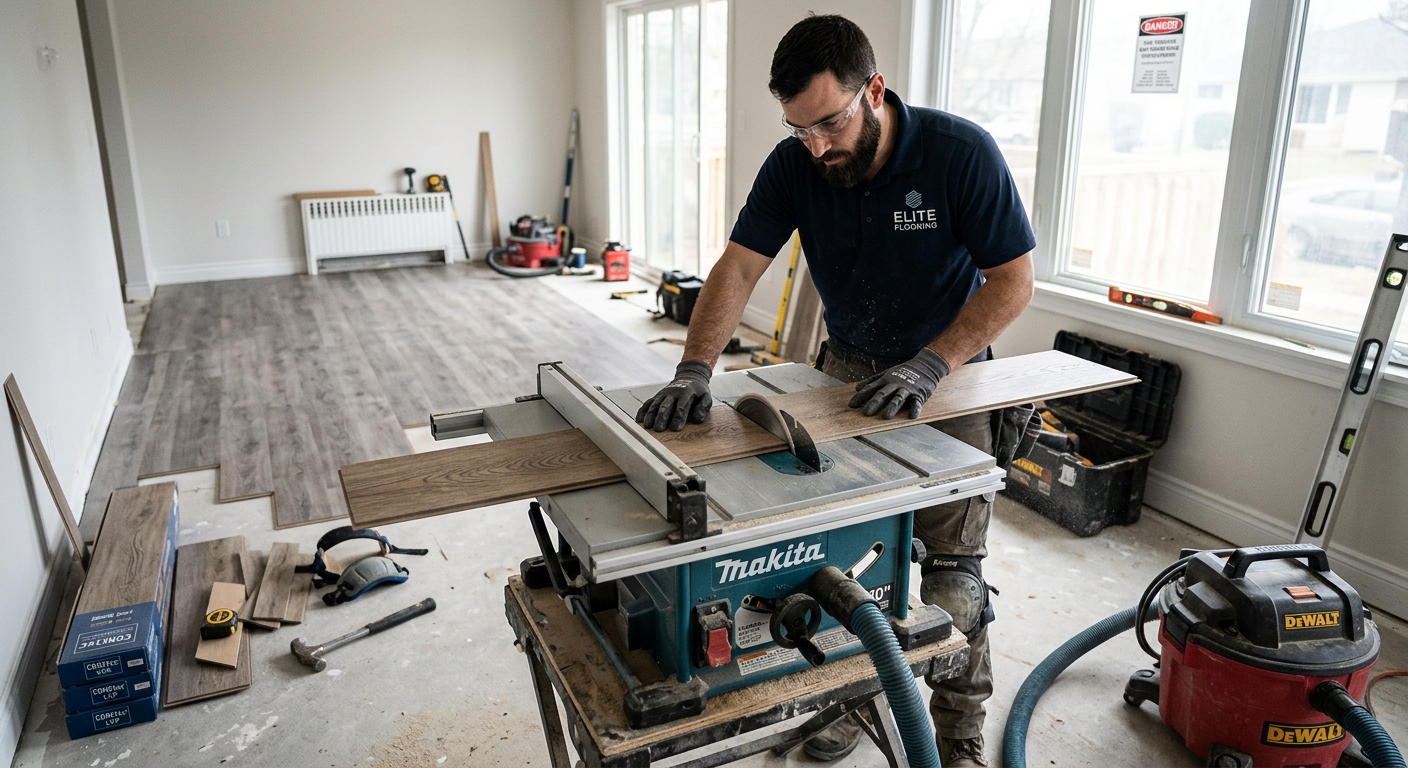
Flooring options and costs in Orléans
In Orléans, flooring choices usually come down to three realities: our seasonal humidity swings, the number of older homes needing subfloor prep, and the growing expectation that floors should work with energy upgrades like radiant heat. With Orléans’ population at 125,937 (Statistics Canada, 2021 Census), there’s steady demand from homeowners in nearby, established areas—especially around Place d’Orléans / Trim Road—which keeps contractor availability good, but it can raise labour rates during peak months.
One cost surprise in this part of Ottawa is that many mid-20th-century houses (and older additions) have uneven subfloors and transitions. Even when you don’t “see” the problem, a levelling skim or replacing damaged OSB/plywood before installation is common. In practical terms, that prep work can add roughly $1–$4 per sq ft before the new floor ever goes down. Ottawa’s climate also matters: large indoor humidity swings between dry winters and humid summers make solid hardwood expand and contract, so it’s typically limited to above-grade use.
Basements and below-grade areas are where moisture and hydrostatic pressure show up most often in the Ottawa region. That’s why engineered hardwood and luxury vinyl plank (LVP) are frequently chosen over solid wood, especially when paired with the right underlayment and vapour barrier. If you’re considering radiant floor heating, colder winters mean compatibility matters—many homeowners end up with engineered wood, quality vinyl, or tile systems instead of solid hardwood.
Below is a quick comparison of common flooring types and realistic Orléans price ranges, so you can budget before you request quotes.
| Type |
Best Room |
Moisture Resistance |
Life span |
Price per sq ft |
| Solid hardwood (nail-down, above grade only) |
Living / dining, main floor bedrooms |
Low (humidity-sensitive) |
25–50 years |
$11–$22 |
| Engineered hardwood (float or glue, above + on-grade) |
Main floor hallways, living areas, stairs (with matching trim) |
Medium–high (dimensionally more stable) |
20–40 years |
$13–$25 |
| Laminate (click-lock, above-grade) |
Bedrooms, living rooms (not recommended below grade unless approved) |
Medium (water-resistant only with proper setup) |
10–25 years |
$6–$14 |
| Luxury vinyl plank / LVP (waterproof, any level) |
Kitchen, basement (finished), main floors |
High (waterproof cores in good systems) |
15–30 years |
$7–$17 |
| Porcelain / ceramic tile |
Kitchen, bathrooms, entries |
Very high (with correct underlayment) |
25–50 years |
$12–$25 |
| Carpet (broadloom or modular tile) |
Bedrooms, media rooms |
Low–medium (avoid basements unless very dry) |
7–15 years |
$6–$12 |
Prices are estimates only and vary by project scope, site access and material selection.
What affects the price of flooring in Orléans
In Orléans and across the Ottawa region, quotes for the same floor can vary by 30–50% because the “real” work behind the scenes isn’t always identical: subfloor condition, removal/disposal, transitions, and moisture mitigation can change the total fast. Two contractors might price “engineered hardwood” similarly, but one may include subfloor levelling, floor prep for humidity control, and proper vapour barrier alignment—while the other might not, even if it seems like it should be part of the job.
Technically, indoor humidity swings are a major driver. Solid hardwood expands and contracts with moisture and is not a good fit over concrete or in basements. That’s why solid wood is usually limited to above grade. Engineered hardwood and LVP are far more forgiving with humidity changes, and they’re commonly approved for many below-grade situations when installed with the correct underlayment and vapour barrier. In colder Ontario winters, many homeowners add or plan radiant floor heating; that compatibility eliminates some options—most solid hardwood and some laminate products won’t perform well over heat without manufacturer approval.
Older housing stock also matters here. If your subfloor needs levelling or repair, typical prep can add about $1–$4 per sq ft. For example, if you’re comparing laminate at $6–$14 per sq ft to engineered hardwood at roughly $11–$25 per sq ft, the laminate may still look cheaper until you factor in additional underlayment requirements and tighter moisture constraints. Likewise, tile at $12–$25 per sq ft can become “more reasonable” when you’re already paying for moisture-safe transitions in areas like kitchens and entrances.
Local examples I see often in Orléans: basements with older slab moisture issues require moisture-tolerant systems; main floors with previous flooring removed sometimes reveal uneven plywood seams; and homes with radiant heating require manufacturer-approved installation details that can add labour time. Those differences are exactly why the same material line can land at very different totals.
| Price Factor |
Why It Matters |
Cost Impact |
| Room area in sq ft |
Materials and labour scale directly with square footage and waste factor |
Typically +/− 10–20% across similar layouts |
| Subfloor condition |
Levelling/repair is required for click-lock, glue-down, and tile underlayments |
Add about $1–$4 per sq ft when work is needed |
| Moisture / below-grade install |
Can rule out solid hardwood and some laminate; requires vapour control |
Often adds moisture mitigation labour/materials (project-dependent) |
| Material choice |
Solid vs engineered vs LVP vs tile changes labour complexity and tolerances |
Can shift installed totals by $3–$10+ per sq ft |
| Removal and disposal of existing flooring |
Disposal fees, subfloor cleaning, and haul-out time add cost |
Commonly adds several hundred dollars to a typical room |
| Stair nosing / transitions |
Custom edging and transitions are labour-heavy and priced per step/linear foot |
May add $150–$600+ depending on stairs and complexity |
| Radiant heat compatibility |
Not all products tolerate heat cycling; manufacturer specs must be followed |
May add prep time and require specific underlayments |
| Installation method |
Float, glue-down, and nail-down each have different prep and labour demands |
Can shift labour cost by 10–25% even with same material |
Permits & regulations in Ontario
In Ontario, flooring installation by itself usually does not require a building permit. You typically do not need a permit to replace finished flooring such as laminate, vinyl, engineered wood, carpet, or tile when you’re not altering structural elements. However, permits can become relevant when your flooring project includes electrical or significant building-scope work.
Work that may require permits includes: electrical permits for radiant floor heating circuit work (or thermostat wiring), and any structural subfloor repair that goes beyond fixing minor damage—especially if there’s replacement/engineering involved. In condominiums, the corporation’s rules and documentation around sound transmission (often referencing STC/IIC expectations) commonly restrict what underlayments you can use and can require specific products for hard flooring on upper floors.
For a homeowner in Orléans, verify your contractor step-by-step before signing:
- Confirm they carry liability insurance—request a certificate of insurance and confirm it lists the correct business name and coverage amounts.
- Confirm they have WSIB/WCB coverage (or clearance) where applicable—ask for proof and check it’s current.
- Verify their Ontario licence/registration where required for the work type they’re doing (ask the contractor what they’re licensed for, then confirm using the online registry resources they provide).
- In condos, request approval in writing before installation starts, especially for hardwood or tile above grade.
- Keep all documents: quote, product specs, proof of coverage, and the signed scope of work.
Best flooring for each room in your Orléans home
Choosing the right floor by room is the fastest way to control both comfort and long-term problems in Orléans. Living and dining areas are typically stable above grade, so engineered hardwood or high-quality laminate balances warmth, looks, and durability without the same humidity sensitivity as solid wood. For master bedrooms, many homeowners prefer carpet for sound dampening and softness underfoot, but engineered wood is a solid alternative if you want a cleaner, low-allergen finish.
In kitchens, the big threats are spills, standing water, and frequent cleaning. Luxury vinyl plank (LVP) or large-format porcelain tile tend to win because they’re more forgiving with moisture and easier to maintain. In bathrooms, porcelain/ceramic tile is typically the safe choice because it’s designed for wet areas when installed with the right system.
Basements deserve special attention. Ottawa-region homes can experience moisture and hydrostatic pressure in older below-grade areas, so the clear winner is usually LVP with a proper vapour barrier/underlayment system. Solid hardwood and most laminate aren’t designed for these conditions—even if they look fine initially, performance can suffer when moisture gets into the assembly.
Radiant floor heating is increasingly common, and in Orléans it’s often part of energy-efficiency upgrades. Engineered wood, most quality vinyl, and tile systems generally pair well when installed to manufacturer specifications; solid hardwood often gets ruled out or limited to very specific product approvals.
For cost justification: if you’re deciding between laminate at $6–$14 per sq ft and LVP at about $7–$17 per sq ft, spending the extra margin is often worth it in kitchens and basements because it reduces the risk of swelling and seam separation during humidity swings.
| Room |
Best Material |
Why |
Moisture Risk |
Price Band per sq ft |
| Living / dining room |
Engineered hardwood |
Warm look, more stable during seasonal humidity changes than solid |
Low (above grade) |
$13–$25 |
| Master bedroom |
Carpet or engineered hardwood |
Carpet adds comfort and sound absorption; engineered wood stays tidy and consistent |
Low (above grade) |
$6–$12 |
| Secondary bedrooms |
Laminate (click-lock) or quality carpet |
Good value with straightforward installation when the subfloor is flat |
Low (above grade) |
$6–$14 |
| Kitchen |
Luxury vinyl plank (LVP) or porcelain tile |
Easy cleanup and strong performance with spills and humidity |
Medium (spill risk) |
$7–$25 |
| Basement (finished) |
LVP (waterproof) |
Designed for below-grade moisture exposure when installed with correct vapour control |
High (moisture and vapour pressure) |
$7–$17 |
| Bathroom |
Porcelain / ceramic tile |
Most reliable surface for wet areas; long service life with proper underlayment |
High (direct water contact) |
$12–$25 |
How to choose a flooring contractor in Orléans
In Orléans, the best flooring contractors are the ones who can prove they’re covered, can explain the details of subfloor prep, and provide a fully itemized quote. Start by verifying Ontario coverage and legitimacy. Ask for a certificate of liability insurance and confirm the expiry date and correct legal business name. Request proof of WSIB/WCB coverage (or a clearance letter where applicable) so you’re not left exposed if a worker is injured on your property.
Then compare quotes correctly: get 2–3 itemised written estimates with labour and materials broken out (not a lump-sum with vague allowances). Ensure the quote specifies removal/disposal, the subfloor prep scope, underlayment/vapour barrier details, and how transitions and stair nosing will be handled. Confirm whether permits are included when radiant heating circuit work or other electrical-related scope applies—this is where homeowners often get surprised.
Warranty matters too. Ask for: the workmanship warranty length, the manufacturer warranty10–15% upfront, and hold back payment until the job is complete and you’ve reviewed the finished areas.
For timeline, insist on a start date and a completion estimate in writing. If the contractor won’t commit to a schedule, expect delays—especially with freight and seasonal demand peaks.
- Request proof of liability insurance (certificate) and verify coverage is current.
- Ask for WSIB/WCB clearance/proof and confirm it matches the installing business.
- Get the quote in writing with an itemized labour vs materials breakdown.
- Confirm exactly what subfloor prep is included (levelling, repairs, underlayment type).
- Require the quote to spell out vapour barrier and underlayment for LVP/engineered wood.
- Clarify removals and disposal (what’s hauled away, what’s not).
- Ask how transitions, stair nosing, and mouldings are priced (per step/linear foot).
- Check whether the contractor handles floor levelling products and patching material sourcing.
- Confirm radiant heat compatibility and what products are approved for your system.
- Review the warranty terms in writing (workmanship and product).
- Set a payment schedule: 10–15% upfront max; holdback until complete.
- Get start date and completion target in writing, plus what happens if delays occur.
Red flags in Orléans: contractors who won’t provide insurance/WSIB proof, quotes that omit underlayment/vapour barrier details, “cheap” pricing with unclear subfloor prep scope, refusing to put the timeline in writing, or pressuring you to pay most of the total upfront without a clear work plan.
Frequently asked questions — flooring in Orléans
Is cork or bamboo flooring a good choice in Orléans?
In Orléans, cork and bamboo can work well above grade if your home stays reasonably dry and you use the correct underlayment and installation method. That said, both materials can be affected by the same humidity swings that impact hardwood comfort—Ottawa winters can be very dry, while summers can be humid. If you’re thinking about a basement, these are typically not the first choice because below-grade moisture and vapour pressure are common in older homes, and flooring assemblies need robust vapour control. In practice, many homeowners choose engineered wood or LVP for basements because they’re more dimensionally stable. If you want natural feel upstairs, cork can be a comfortable option; budget-wise, you’d still want to compare overall installed pricing against common bands like laminate at $6–$14 per sq ft and engineered/wood options often landing in the higher teens depending on product.
What is the difference between floating and glued-down flooring?
Floating flooring is installed over an underlayment with the planks/tiles “locking” together, and it typically does not get permanently bonded to the subfloor. Because it can move slightly with seasonal humidity changes, it’s a common approach for click-lock laminate and many engineered floors. Glued-down flooring is bonded directly to the subfloor using manufacturer-approved adhesive—this gives a more rigid feel and can improve stability on some subfloors, but it requires careful prep so moisture and irregularities don’t interfere with adhesion. In Orléans, where humidity swings can be noticeable indoors, floating systems often perform well above grade when installed to spec; glued-down setups still demand correct moisture conditions. For below-grade spaces, you usually want a moisture-tolerant system (often LVP) rather than relying on hardwood-style methods.
What flooring holds up best to pets in a Orléans home?
For pets in Orléans, durability plus scratch and moisture resistance is the winning combination. LVP is often the top pick because many waterproof products handle accidents and cleanup better than carpet or laminate, and they’re more forgiving in areas that see indoor humidity swings. If you have hardwood-look preferences, engineered wood can work in main living areas, but it’s best kept above grade and installed with correct prep. Carpet can be great for comfort, but it’s harder to manage if your pet has frequent spills or if the room is prone to humidity. In terms of budget, you’ll typically see LVP installed around $7–$17 per sq ft while laminate commonly ranges $6–$14 per sq ft; the difference often shows up in wear layer quality and how well the product resists dents and moisture. For basements, stick to waterproof options and ensure proper vapour control.
How do I fix squeaky floors in my Orléans home?
Squeaks are usually caused by movement at joists, loose subfloor sheets, or friction between layers—not by the finished flooring itself. Before replacing flooring, the best contractors identify the source: fastener gaps (like under old plywood/OSB), movement in the subfloor, or issues around transitions. Common fixes include re-screwing or adding fasteners to subfloor panels, shimming or correcting loose areas, and sometimes replacing damaged subfloor sections. If you’re installing new flooring, ask your contractor how they’ll treat squeaks before the install—because a new floor won’t “fix” a moving subfloor. In older Orléans homes with additions, squeaks often show up near seams or around cutouts, and addressing them can add to the prep line item. It’s worth doing before you move ahead with tile, engineered, or LVP so the finished surface stays stable for the long run.
What is luxury vinyl plank and is it worth it in Orléans?
Luxury vinyl plank (LVP) is a waterproof flooring with a layered construction that’s designed to resist moisture better than laminate and solid hardwood. In Orléans, where humidity swings are real and below-grade moisture issues are common, LVP is often “worth it” because it reduces the risk of swelling at seams and makes cleanup easier in kitchens and basements. Many modern LVP products are truly waterproof, but they still need the right installation details: a flat subfloor, appropriate underlayment/vapour barrier where required, and careful sealing around transitions. Cost-wise, LVP typically sits around $7–$17 per sq ft, which overlaps with other options like laminate at $6–$14 per sq ft but can be a better long-term value in moisture-prone areas. If you’re adding radiant heat, confirm compatibility with your specific LVP product and installation method.
How much does flooring cost in Orléans?
In Orléans, installed flooring costs depend on the material, room size, subfloor prep, and whether moisture mitigation is needed. As a budgeting baseline, hardwood flooring often ranges from $11–$22 per sq ft, laminate or vinyl plank commonly falls around $6–$14 per sq ft, and tile is often $12–$25 per sq ft. Carpet installation is frequently in the $5–$11 range depending on the product and job scope. Your final price can be higher if your home needs levelling, repairs to OSB/plywood, or moisture-related prep for basements—those tasks can add meaningful per-square-foot cost. Because Orléans is part of the Ottawa market, labour and disposal fees can influence totals, especially during busy seasons. If you share your room measurements and whether the area is above or below grade, a contractor can tighten the estimate quickly.