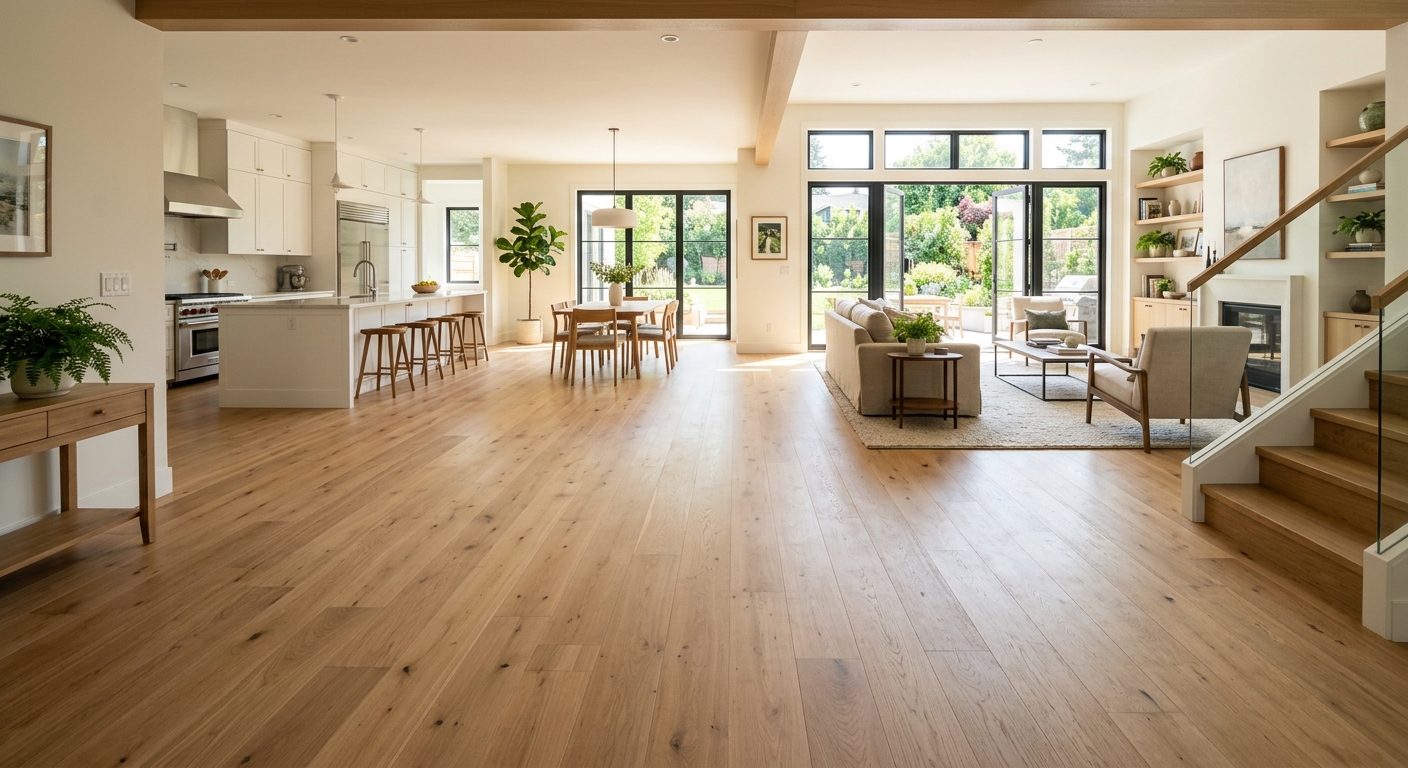
Flooring options and costs in St. Marys
St. Marys homeowners typically choose flooring based on how the floors will perform through Ontario’s indoor humidity swings and seasonal basement moisture. In your area, 54.2% of homes were built before 1981 (Statistics Canada, 2021 Census), and that older stock often means the subfloor needs levelling or repair before the finished floor can be installed. When you factor that prep work in, the same “square-foot” choice can land noticeably different final totals from house to house. Many St. Marys properties also have basements that see more vapour and dampness than the main level, which pushes cost up when contractors have to add moisture control systems and proper underlayments.
Because the Stratford–Bruce Peninsula market often deals with wide indoor humidity swings between winter and summer, solid hardwood can gap, cup, or swell—especially if it’s installed below grade. That’s why local installers frequently recommend engineered hardwood or luxury vinyl plank (LVP) for higher-humidity zones. At the same time, the colder climate here makes radiant floor heating a common renovation upgrade, which favours radiant-compatible products like many engineered woods, LVP, tile, and certain higher-density laminates, while ruling out some solid hardwoods and low-end laminates that can’t handle temperature cycling.
In St. Marys, demand is especially steady around the older core and established residential streets where many renovations happen in tandem with subfloor corrections and moisture management. Next, use the cost comparison below as a baseline before you ask for an itemised quote.
| Type |
Best Room |
Moisture Resistance |
Lifespan |
Price per sq ft |
| Solid hardwood (nail-down, above grade only) |
Main floor living areas |
Low to moderate (not suited for basements) |
25–60 years |
$10–$18 |
| Engineered hardwood (float or glue, above + on-grade) |
Living rooms, hallways, bedrooms |
Moderate to high (better with humidity) |
20–40 years |
$10–$17 |
| Laminate (click-lock, above-grade) |
Bedrooms, hallways |
Low to moderate (water spills can damage core) |
10–25 years |
$4–$10 |
| Luxury vinyl plank / LVP (waterproof, any level) |
Basements, kitchens, main floor |
High to waterproof (for routine moisture) |
15–25 years |
$6–$12 |
| Porcelain / ceramic tile |
Bathrooms, kitchens, entryways |
High (properly installed) |
25–50 years |
$12–$22 |
| Carpet (broadloom or modular tile) |
Bedrooms and stairs |
Low to moderate (needs dry subfloor) |
7–15 years |
$4–$9 |
Prices are estimates only and vary by project scope, site access and material selection.
What affects the price of flooring in St. Marys
It’s common to see the “same” flooring plan come in 30% to 50% apart across Stratford–Bruce Peninsula and other Ontario areas—mostly because prep and compatibility work costs real labour. In this region, the big technical drivers are indoor humidity swings and below-grade moisture. Solid hardwood expands and contracts with humidity, and it can’t be glued or floated over concrete; even nail-down installations still struggle in basements and wet-prone zones. Engineered hardwood and LVP handle humidity and below-grade applications far better, which helps keep replacements and call-backs down. The colder climate also makes radiant floor heating popular in renovations, and that compatibility limits which solid hardwoods and some lower-end laminates you can safely use over in-floor systems.
Older housing stock in and around St. Marys (with many homes built before 1981) frequently needs subfloor levelling or repair before install. That prep can add about $1 to $4 per sq ft when you’re doing patching, feather-finishing, or replacing damaged OSB/underlayment areas—on top of the cost of new underlayments. For example, a straight above-grade engineered hardwood install might track near the $10 to $17/sq ft material band, but the same choice on a basement slab with moisture remediation and levelling can push the total higher once you add vapour control and labour. Conversely, choosing LVP in a basement can be a cost saver because waterproof systems reduce the risk and complexity compared with solid wood.
Two local St. Marys scenarios I see often: (1) “out of level” main floors—common in older single-detached homes—require more labour to get the subfloor flat before any click-lock flooring can perform properly; (2) radiant heat add-ons—contractors may need radiant-compatible underlayment and careful acclimation to prevent issues with temperature cycling. Those decisions affect your quote long before you pay for planks.
| Price Factor |
Why It Matters |
Cost Impact |
| Room area in sq ft |
Larger areas increase material quantity and labour time |
Direct driver; typically the biggest line item |
| Subfloor condition |
Levelling/repair is required for flatness and warranty compliance |
Can add roughly $1–$4 per sq ft for prep |
| Moisture / below-grade install |
Concrete vapour control and proper underlay prevent cupping and odour |
Can significantly increase total cost in basements |
| Material choice |
Solid vs. engineered vs. LVP vs. tile have different performance and complexity |
Solid hardwood often costs more; LVP can reduce risk in damp zones |
| Removal and disposal of existing flooring |
Tearing out old flooring and haul-away adds labour and tipping fees |
Often a meaningful add-on, especially with thick materials |
| Stair nosing / transitions |
Transitions are labour-intensive and stair work is charged per step/linear foot |
Commonly adds cost even when floor area is moderate |
| Radiant heat compatibility |
Limits material selections and may require specific products/installation methods |
May increase material pricing or require specialised underlay |
| Installation method |
Float vs. glue-down vs. nail-down changes labour and substrate prep |
Glue-down and tile often require more detailed work |
Permits & regulations in Ontario
In Ontario, the flooring installation itself generally does not require a building permit. That said, certain related tasks can trigger permits depending on the work scope. Typical examples of work that may require a permit include electrical work connected to in-floor heating circuits, changes to wiring, or any modification to an electrical panel feeding radiant systems. Structural subfloor repairs usually don’t automatically require a permit, but if the scope escalates into major structural changes, that’s where permitting can come into play.
For homeowners in St. Marys with a condominium unit, the bigger “rule” is often internal: the corporation’s policies on sound transmission and floor coverings. Underlay requirements for hard surfaces can be tied to STC/IIC targets, and that can restrict what you can install on upper floors. Always review the condo declaration and request board approval in writing before installing hardwood or tile.
To verify your contractor properly, follow a simple checklist. First, confirm your Ontario contractor licence status (where applicable to the firm and trades involved) and ensure the company name matches the quote. Next, request a certificate of insurance showing liability coverage and check the expiry date. Finally, ask for WSIB/WCB clearance or coverage proof for the workers doing the installation (and confirm whether subcontractors are used). If they can’t provide documentation promptly, that’s a reason to pause—especially in older St. Marys homes where extra subfloor prep and demo are common.
Best flooring for each room in your St. Marys home
In St. Marys, the best flooring choice comes down to moisture exposure, foot traffic, and how the material behaves through winter-summer swings. Living and dining areas usually do best with engineered hardwood or a high-quality laminate: they deliver a warm look while handling normal humidity better than solid wood, and they stay comfortable under everyday use. For master bedrooms, you can go either way: carpet is excellent for comfort and sound absorption, while engineered hardwood gives a cleaner look that still performs well in Ontario’s temperature cycles when installed correctly.
Kitchens are high-risk for spills, so luxury vinyl plank (LVP) or large-format porcelain tile is the practical move. In basements, LVP is usually the clear winner in this Stratford–Bruce Peninsula market because it’s dimensionally more stable and waterproof—both critical when below-grade moisture is part of the reality of the region’s housing stock. Solid hardwood and most laminate systems can be damaged by persistent vapour or accidental standing water. Bathrooms should be porcelain or ceramic tile only, because proper grout and waterproofing systems handle wet conditions better than wood-based products.
Radiant floor heating is increasingly popular in Ontario renovations, and that’s why radiant-compatible engineered wood, LVP, many tiles, and some high-density laminates are commonly chosen. A dollar example: if LVP is around the $6 to $12/sq ft band while engineered hardwood tracks closer to $10 to $17/sq ft, the added cost may be justified on the main level for long-term appearance—while LVP can save money in basements because it avoids the moisture-related prep and performance risks that solid hardwood faces in humid spaces.
| Room |
Best Material |
Why |
Moisture Risk |
Price Band per sq ft |
| Living / dining room |
Engineered hardwood |
Warm look with better humidity stability for the region |
Low to moderate (normal indoor humidity) |
$10–$17 |
| Master bedroom |
Carpet or engineered hardwood |
Carpet adds comfort; engineered keeps a durable, easy-clean finish |
Low |
$4–$17 |
| Secondary bedrooms |
High-quality laminate or carpet |
Laminate is cost-efficient; carpet is forgiving and quiet |
Low |
$4–$10 |
| Kitchen |
Luxury vinyl plank (LVP) or large-format porcelain tile |
Handles spills, resists scuffs, and cleans easily |
Moderate to high (spills and occasional wet mopping) |
$6–$22 |
| Basement (finished) |
Luxury vinyl plank (waterproof) |
Best tolerance for vapour and below-grade moisture conditions |
High |
$6–$12 |
| Bathroom |
Porcelain / ceramic tile |
Water-ready surface when installed with proper waterproofing |
High |
$12–$22 |
How to choose a flooring contractor in St. Marys
Choosing the right flooring contractor in St. Marys starts with verifying coverage and real experience with your kind of home. Ask for their Ontario documentation, then check liability insurance (request a certificate and confirm it’s current). For worker coverage, request proof of WSIB/WCB coverage or clearance and ensure it extends to the installers doing your job. If they use subcontractors, you want to know who is responsible for coverage on site—especially when demo and subfloor repair are likely in older homes.
Next, get 2 to 3 itemised written quotes. You should see a materials breakdown (product, thickness, underlayment if required) and a labour breakdown (prep/levelling, removal/disposal, installation method, transitions/stairs). Avoid quotes that are only lump sums, because that hides the real cost drivers in this region—subfloor prep and moisture control. Confirm what’s excluded: does the quote include levelling compounds, vapour barriers where needed, edge/expansion details, stair nosing, undercutting door jambs, and disposal?
Warranty should be clear in writing: ask for the workmanship warranty length and whether it’s transferable if you sell your home. Also confirm the manufacturer warranty terms for the product you’re buying. For payment schedules, a good rule is never paying more than 10% to 15% upfront; hold back funds until completion and punch-list items are done. Finally, get a start date and completion estimate in writing—older St. Marys basements and out-of-level floors often affect timelines if prep work expands.
- Provide proof of liability insurance (certificate of insurance) before work begins
- Provide WSIB/WCB coverage proof or clearance for installers
- Confirm whether the company will pull any required electrical permits for radiant heating
- Request itemised labour + materials quotes (not lump sum)
- Ask who is responsible for damage during demo and removal
- Verify subfloor prep plan: flatness checks, repairs, and underlayment/vapour barrier details
- Get the installation method stated (float vs. glue-down vs. nail-down)
- Confirm acclimation requirements for wood and engineered products
- Ask how transitions and stair nosing will be priced (per step or per linear foot)
- Ensure disposal/haul-away is included (and specify what’s included)
- Review warranty: workmanship duration and product manufacturer warranty terms
- Use a payment schedule that holds back until completion and final inspection
Red flags to watch for in St. Marys: they won’t put scope details in writing; they refuse to provide insurance/WSIB proof; their quote ignores subfloor levelling or moisture control despite basements being involved; they won’t explain radiant heat compatibility if it applies; or they ask for a large upfront payment (well beyond 10% to 15%).
Frequently asked questions — flooring in St. Marys
How do I prepare my subfloor before new flooring?
In St. Marys, proper subfloor prep is usually the difference between a floor that looks great for years and one that develops gaps, squeaks, or soft spots. Start by having the contractor check flatness and identify high/low areas; older homes built before 1981 (Statistics Canada, 2021 Census) commonly need levelling compounds or patching to meet product requirements. If you’re installing over concrete or in a basement, moisture conditions matter: contractors should address vapour control (appropriate membranes) and repair any damaged OSB/underlayment. For wood-based floors, also ensure the subfloor is dry and stable before installation. Finally, confirm the required underlayment type (or absence of one) so the product warranty stays valid.
Is cork or bamboo flooring a good choice in St. Marys?
Cork and bamboo can work in parts of St. Marys, but they’re not always the best match for basements or high-moisture areas. Because the Stratford–Bruce Peninsula region sees wide indoor humidity swings and basement moisture challenges, you want products that tolerate movement. Cork is naturally resilient and quiet, but many cork floors are still dimensionally affected by moisture if the subfloor is damp. Bamboo is a grass-based wood product; quality engineered formats may perform better than fully solid bamboo, but basements are still a risk zone. If you want either option, aim for an engineered construction and keep it above grade or on properly controlled on-grade areas with a dry subfloor and correct underlayment.
What is the difference between floating and glued-down flooring?
Floating flooring (common with click-lock laminate and some engineered products) is installed over an underlayment without being fully bonded to the subfloor. It “floats” and can move slightly with temperature and humidity, which helps performance when Ontario’s conditions shift. Glued-down flooring is bonded directly to the subfloor, which can reduce movement and feel more rigid, but it requires a very stable, properly prepared surface and the right adhesive system. In St. Marys, floating can be a good choice for above-grade areas, while basement installs often favour waterproof LVP. If radiant heat is involved, the installation method must also match the product’s radiant compatibility requirements to avoid spacing or temperature-cycle issues.
What flooring holds up best to pets in a St. Marys home?
For pets, the “best” choice is usually the one that resists moisture, scratches, and everyday messes. In this region, LVP is often the top performer because it’s waterproof and can handle spills and damp paw traffic better than carpet or wood-based floors. If you’re considering tile, porcelain is durable and stain-resistant, but it’s harder underfoot. Carpet can work in bedrooms, but it may require more maintenance to keep odours and stains under control—especially if the subfloor is not perfectly dry. For a price reference, carpet installation is often around the $5–$11/sq ft range, while LVP material typically lands within the $6–$12/sq ft band depending on thickness and wear layer.
How do I fix squeaky floors in my St. Marys home?
Squeaks usually come from movement between boards, fasteners, or between the subfloor layers. In older St. Marys homes, that can be more common where the framing has aged or where subfloor layers weren’t properly fastened. The “fix” depends on what’s causing the squeak, so the safest approach is to identify the source from below (if accessible) and confirm if it’s the subfloor rubbing on joists, nails backing out, or loose underlayment. Often, a contractor will lift a small section, add proper fasteners, and address any damaged subfloor before installing new flooring. If you’re planning a full replacement anyway, it’s worth doing the squeak investigation during demo rather than trying to patch after the new floor is down.
What is luxury vinyl plank and is it worth it in St. Marys?
Luxury vinyl plank (LVP) is a layered synthetic floor with a wear layer on top and a core designed to resist moisture. In St. Marys and the Stratford–Bruce Peninsula area, LVP is often worth it because homes frequently face indoor humidity swings and basement moisture issues, and LVP is typically far more tolerant than solid hardwood or many laminates. It’s also a good match for renovations where radiant floor heating is present because many radiant-compatible LVP products can handle the temperature cycling (always verify the manufacturer’s radiant installation guide). Pricing varies by wear layer and thickness, but you’ll often see LVP material around the $6–$12/sq ft band, compared with engineered hardwood closer to the $10–$17/sq ft band—meaning LVP can deliver strong value where moisture risk is higher.