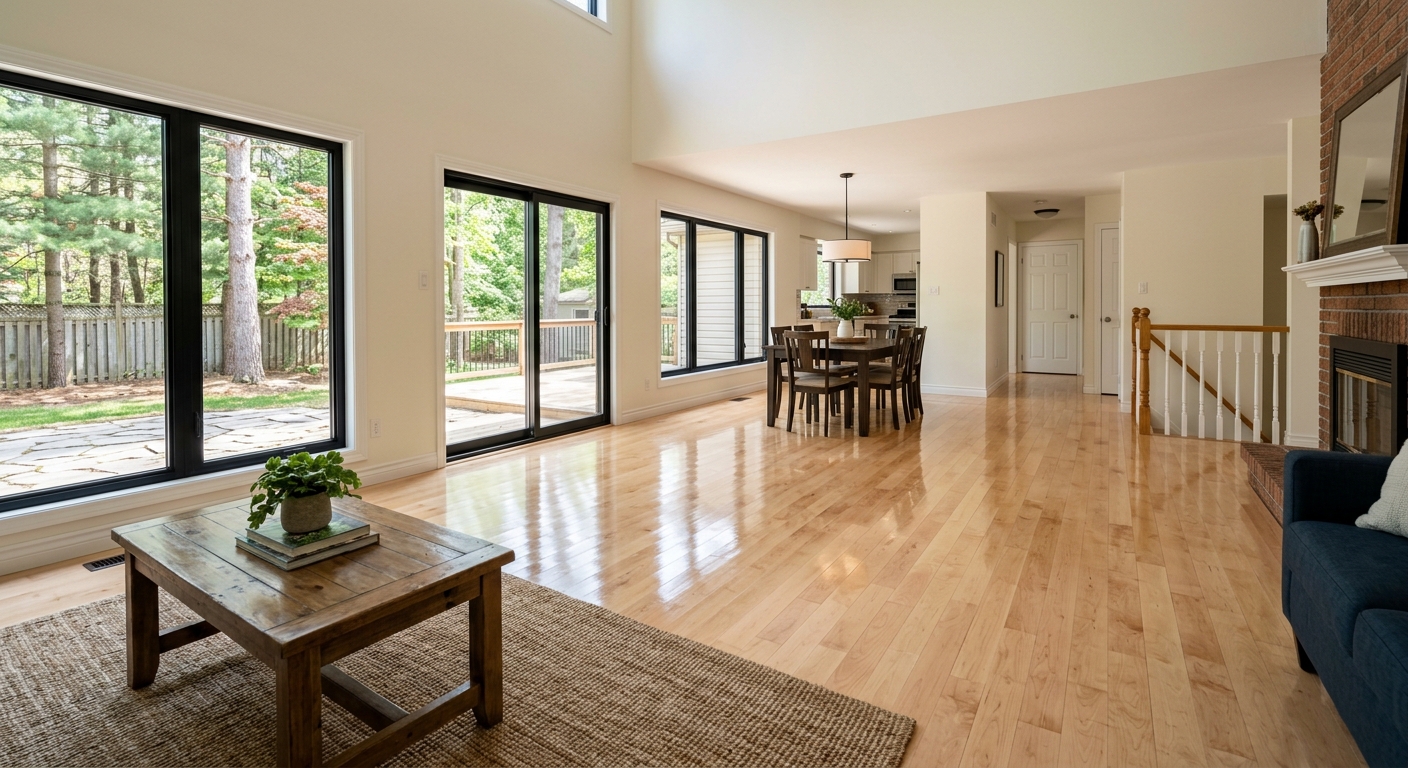
Flooring options and costs in Westmount
In Westmount, choosing the right flooring starts with matching the material to our Toronto-area humidity swings, typical renovation demands, and how your home was built. With a population of 4,010 (Statistics Canada, 2021 Census), Westmount is small enough that you’ll often see the same experienced crews repeatedly—so getting measurements and a detailed quote early helps. Just as importantly, many nearby homes were built in the 1960s–1990s era, meaning subfloor levelling, plywood replacement, or moisture mitigation is common before you can lay new flooring. That prep work can add roughly $1–$4 per sq ft, even when your finished surface is mid-range laminate or vinyl.
Toronto’s seasonal indoor humidity changes are the reason we steer many homeowners toward engineered hardwood or luxury vinyl plank (LVP). Solid hardwood looks premium, but it moves with moisture and is risky over concrete or in basements. For condos and newer infill builds, LVP often wins for durability and dimensional stability. In colder stretches of the region and in homes that add radiant floor heating, engineered wood, tile, and specific vinyl products are typically the better pairing—traditional solid hardwood is usually not our first recommendation over active heat circuits.
In Westmount, trades are especially busy around the central residential pockets and older housing corridors where owners frequently update multi-room layouts. Once you know the likely prep level, the next step is comparing real material tiers and installation expectations—see the table below for typical ranges.
| Type |
Best Room |
Moisture Resistance |
Lifespan |
Price per sq ft |
| Solid hardwood (nail-down, above grade only) |
Living / dining rooms (above grade) |
Low to moderate; avoid basements and concrete |
20–40 years |
$9,00 – $18,00 |
| Engineered hardwood (float or glue, above + on-grade) |
Living areas, bedrooms (above + on-grade) |
Moderate to high; better for humidity swings |
15–30 years |
$9,50 – $16,00 |
| Laminate (click-lock, above-grade) |
Bedrooms, living rooms (above grade) |
Low to moderate; seams can swell with standing water |
10–20 years |
$4,50 – $8,50 |
| Luxury vinyl plank / LVP (waterproof, any level) |
Kitchen, main level, finished basement |
High; handles moisture vapour and spills |
15–25 years |
$5,00 – $9,00 |
| Porcelain / ceramic tile |
Kitchen, bathrooms, entries |
Very high; accepts wet areas |
25–50 years |
$12,00 – $25,00 |
| Carpet (broadloom or modular tile) |
Bedrooms and stairs |
Low; moisture and vapour can damage subfloors |
8–15 years |
$5,00 – $11,00 |
Prices are estimates only and vary by project scope, site access and material selection.
What affects the price of flooring in Westmount
Across Toronto and Ontario, it’s common to see quotes for the “same” flooring come in 30–50% apart. The difference usually isn’t the product sticker—it’s the scope hidden inside the estimate: subfloor prep, moisture mitigation, underlay choices, removal/disposal, and how complex the installation is around trims, corners, and transitions. When a crew includes levelling, patching, and the right moisture barrier steps up front, you’ll often pay more on paper but avoid expensive callbacks.
In the Toronto-area climate, indoor humidity swings drive expansion and contraction. Solid hardwood expands and contracts with moisture and is designed for above-grade installs; it can’t be reliably glued or floated over concrete and it performs poorly in basements. Engineered hardwood is more dimensionally stable for humidity management and better tolerates common Ontario conditions. LVP is even more forgiving for high-humidity and below-grade applications, which is why we recommend it for finished basements. Colder-season radiant floor heating also affects options: many owners adding in-floor heat choose engineered wood, tile, or compatible vinyl, and those product selections can move the labour and material budget.
Local housing stock contributes too. In older Westmount and surrounding-area homes, subfloor levelling or repair commonly adds $1–$4 per sq ft. If your finished floor is mid-range, like laminate or vinyl in the $4,00 – $9,00 style band, prep can still shift your effective total closer to the next tier. A $2 per sq ft levelling line item sounds small until you price a 1,000 sq ft multi-room project.
Two practical examples we see often: (1) a main floor with mild concrete moisture risk can add extra steps that push you from a simple $5,00 – $9,00 vinyl plan to a fully vapour-managed basement-ready assembly; (2) a stair-and-transition-heavy layout increases labour hours, so tile or engineered can feel closer in cost than you’d expect.
| Price Factor |
Why It Matters |
Cost Impact |
| Room area in sq ft |
Material quantity and labour hours scale with coverage |
Direct—often the biggest driver |
| Subfloor condition |
Levelling and repairs determine whether the floor will stay flat |
Commonly adds $1–$4 per sq ft |
| Moisture / below-grade install |
Rules out solid hardwood and changes underlayment/barrier requirements |
May require vapour barrier and different floor system |
| Material choice |
Solid vs engineered vs LVP vs tile have different install complexity and tolerances |
Can move total cost 20–60% project-to-project |
| Removal and disposal of existing flooring |
Old adhesive, staples, and demolition time affect labour and dump fees |
Often a meaningful add-on for occupied homes |
| Stair nosing / transitions |
Stairs and transitions are high labour and demand better finishing |
Charged per step or linear foot |
| Radiant heat compatibility |
Limits which products can be used safely over active heat circuits |
May require engineered/tile/vinyl and specific underlay |
| Installation method |
Float vs glue-down vs nail-down affects prep, timing, and skill level |
Glue-down usually increases labour and prep cost |
Permits & regulations in Ontario
In Ontario, installing flooring itself typically does not require a building permit. You generally can replace surface finishes—like hardwood, engineered wood, laminate, LVP, carpet, or tile—without pulling a permit. However, associated work can trigger permits, especially when it overlaps with electrical or structural scope.
What often does require a permit: electrical work for radiant floor heating circuits (or any new/modified wiring), and sometimes work that goes beyond cosmetic changes—like structural subfloor repairs that involve altering load-bearing components. Moisture remediation that stays within standard floor prep is usually handled under normal contractor scope, but if it includes significant system changes, ask your contractor to explain whether any permits are required for the specific approach.
In condominiums, the bigger challenge is often not permits—it’s the building’s rules. Sound transmission requirements (STC/IIC) and underlay restrictions can limit what you can install on upper floors and may require specific underlayment under hard flooring.
For Westmount homeowners, a practical checklist is: step 1) request the contractor’s Ontario licence details and proof of liability insurance; step 2) confirm WSIB/WCB coverage (or the applicable clearance letter, if provided by the contractor); step 3) ask for product and system specs used for your floor type and subfloor; and step 4) for condos, request board approval in writing and provide the underlay/assembly details so you avoid rework.
When you’re comparing quotes, insist that each allowance for subfloor prep, underlayment, and removals is spelled out—regardless of whether a permit is required—so you’re not surprised mid-job.
Best flooring for each room in your Westmount home
Choosing the right material by room is what keeps your budget under control in Westmount’s Toronto climate, where humidity swings can be noticeable from season to season. For living and dining areas, engineered hardwood or a high-quality laminate are popular because they deliver a warm look without the same movement risk as solid wood. In bedrooms, carpet is still a comfortable win: it adds sound absorption for day-to-day living and can make colder months feel more inviting. For many homeowners, engineered hardwood also works well in bedrooms if the home is properly humidity-managed.
In kitchens, you’ll typically want luxury vinyl plank (LVP) or large-format porcelain tile. LVP is forgiving with spills and everyday moisture, and tile is ideal if you want maximum water resistance and easy cleaning. For basements, LVP is usually the clear winner for finished spaces because it’s waterproof and designed for below-grade moisture conditions; solid hardwood and most laminate systems are not reliable in these environments. Bathrooms should be porcelain or ceramic tile only—water and vapour handling are non-negotiable.
Radiant floor heating is increasingly common in new Ontario construction. If your rooms sit over in-floor heating, that compatibility can steer you away from traditional solid hardwood and toward engineered wood, tile, and certain vinyl products made for heat exposure.
Here’s a concrete budgeting example: if you’re deciding between laminate at about $4,50 – $8,50 and engineered hardwood at about $9,50 – $16,00, the higher material cost can be justified in living areas if you want better long-term stability through humidity swings. But in basements, that “savings” often disappears when moisture mitigation and rework are factored—LVP usually prevents that problem.
| Room |
Best Material |
Why |
Moisture Risk |
Price Band per sq ft |
| Living / dining room |
Engineered hardwood |
Stable with humidity swings; premium look without solid-wood movement risk |
Low to moderate |
$9,50 – $16,00 |
| Master bedroom |
Carpet or engineered hardwood |
Carpet adds comfort and quiet; engineered keeps a cleaner maintenance profile |
Low |
$5,00 – $11,00 |
| Secondary bedrooms |
Laminate or carpet |
Laminate is cost-efficient; carpet helps with sound and warmth |
Low |
$4,50 – $9,00 |
| Kitchen |
Luxury vinyl plank (LVP) |
Waterproof performance with everyday spills and splashes |
Moderate to high |
$5,00 – $9,00 |
| Basement (finished) |
Luxury vinyl plank (LVP) |
Best tolerance for below-grade moisture vapour; avoids solid/laminate failures |
High |
$5,00 – $9,00 |
| Bathroom |
Porcelain / ceramic tile |
Impervious surface; handles wet conditions and long service life |
Very high |
$12,00 – $25,00 |
How to choose a flooring contractor in Westmount
When you’re hiring in Westmount, your contractor choice matters as much as your material choice. Start by verifying Ontario licensing requirements where applicable and then confirm they carry the right protections: liability insurance and WSIB/WCB coverage (or a clearance letter where the contractor provides it). Ask for proof before any work begins—an updated certificate of insurance should match the company doing the install, and the WSIB/WCB clearance status should be current for the installation period. If you’re unsure what you’re looking at, ask the contractor to explain how their coverage applies to your job.
Next, get 2–3 itemised written quotes. You want line items that separate labour, materials, underlay/vapour barrier, subfloor work, removals, and transitions—rather than a single lump-sum number. Read the scope carefully: what’s included in removals and disposal, what patch/level/treat steps are assumed, whether permit steps (if any) are covered, and how stairs and thresholds are priced.
For warranty, confirm both workmanship and product coverage. A good contractor states the workmanship warranty length and how it works if there’s a failure. Also ask whether the product warranty is transferable to future owners and whether the installation method used matches the manufacturer requirements.
Payment schedule should be conservative. In most quality projects, never pay more than 10–15% upfront; hold back a portion until the job is complete and materials are installed to standard. Get a start date and completion estimate in writing so there’s a clear plan for Toronto-area scheduling pressures.
- Ask for liability insurance certificate (valid dates, correct legal name, jobsite listed if applicable).
- Confirm WSIB/WCB coverage or provide the clearance letter for the installing company.
- Request licence/registration information as applicable in Ontario for the contracting entity doing the work.
- Insist on an itemised quote (labour, materials, underlay/vapour barrier, removals, transitions).
- Verify exactly what’s included for subfloor levelling, plywood replacement, or moisture mitigation.
- Confirm what disposal is included (dump fees, hauling, and whether your home is protected during demo).
- Ask how stairs are handled and whether stair nosing is priced per step or per linear foot.
- Make sure underlay and subfloor prep products are listed by name (not “equivalent” only).
- Check moisture testing steps for basements or concrete-on-slab installs (and who does them).
- Ask about acclimation time for hardwood/engineered products before install.
- Clarify warranty: workmanship duration, product warranty terms, and whether it’s transferable.
- Set payment milestones: no large upfront deposits (generally 10–15%), holdback until completion.
Red flags in Westmount include: quotes that omit subfloor prep details but assume “it’ll be fine,” vague warranties without workmanship terms, refusal to provide insurance/WSIB/WCB proof, “lump sum only” pricing with no line items, and a schedule that won’t include written start/completion dates.
Frequently asked questions — flooring in Westmount
Can I install flooring over existing tile in Westmount?
Often, yes—if the tile is firmly bonded, level, and the floor assembly height and transitions can be managed. In Westmount homes, we sometimes see tile over old slab or earlier renovations; the main issue isn’t the tile surface itself, it’s what’s underneath and whether there’s any moisture pathway. For laminate or engineered products, we typically require a smooth, stable subfloor (so grout lines may need grinding/level patching). For LVP, the installation surface still must be flat and properly prepared—if tile is uneven, clicks can fail and joints can separate. Because Toronto-area humidity swings can expose minor subfloor issues over time, careful prep is key. If you’re comparing budgets, many homeowners choose LVP in the $5,00 – $9,00 range for easier maintenance, but a proper surface prep plan determines whether that savings holds up.
What is the best flooring for a high-traffic area in Westmount?
For high-traffic areas, durability and stability under humidity swings are the priorities. In most Westmount homes, that points to luxury vinyl plank or engineered hardwood—both handle daily wear better than laminate in real-life spill and scuff situations. If the traffic area is on the main level and stays dry, engineered hardwood is a strong choice. If there’s any chance of water exposure (entries, near kitchen), LVP is usually the safer bet because it’s waterproof and tolerates moisture vapour better, especially if you’re close to a basement stairwell. Solid hardwood can be beautiful, but the humidity-driven movement is why we’re more cautious in Toronto-area renovations. If you want a practical cost comparison: LVP often lands around $5,00 – $9,00 per sq ft, while engineered hardwood commonly costs about $9,50 – $16,00. The extra cost often makes sense when you want a longer service life and a more natural surface look.
How do I prepare my subfloor before new flooring?
Subfloor prep is where flooring jobs are won or lost, particularly in Ontario where humidity and older construction details can create surprises. The first step is assessing flatness and structural soundness: you can’t install a “perfect” floor on a wavy base. In many Toronto-area homes from the 1960s–1990s era, expect possible levelling compound use, plywood replacement, or localized patching before any finish flooring goes down. For basements and slabs, moisture mitigation and correct vapour barriers are critical—this is what makes engineered wood and LVP more forgiving than solid hardwood. Typical costs for this work can add about $1–$4 per sq ft, depending on what’s needed. If you’ve got an occupied home in Westmount, ask how dust control and protection will be handled during prep—good contractors treat prep as part of the finish-quality outcome, not an afterthought.
Is cork or bamboo flooring a good choice in Westmount?
Cork can be a nice option for comfort and sound control, but it’s still sensitive to moisture in ways that LVP isn’t. In Westmount and the Toronto area, the indoor humidity swings can be enough to cause edges and seams to react if the subfloor isn’t properly prepared or if vapour management isn’t right—especially on or below grade. Bamboo is typically offered as engineered or solid variations; as a category it’s often treated similarly to hardwood regarding stability and installation environment. If your goal is a moisture-tolerant system for a basement, cork and traditional bamboo are usually not our first pick; LVP or tile tends to be more reliable. Where cork or bamboo can make sense is a dry above-grade space with proper acclimation, correct underlay, and a flat subfloor. Before budgeting, request a system-specific recommendation because product construction and warranty requirements vary widely, and the wrong installation method can void coverage.
What is the difference between floating and glued-down flooring?
Floating flooring is installed over an underlay and allowed to “move” slightly with temperature and humidity; click-lock laminate and many floating LVP/engineered products use this approach. Because the planks are not rigidly bonded to the subfloor, the assembly can be more forgiving on surfaces that aren’t perfectly flat—but only to a point. Glued-down flooring is adhered directly to the subfloor, which provides strong stability and can reduce minor top-surface movement, but it requires stricter prep. In Toronto-area humidity swings, the right choice depends on your subfloor and room conditions. Over concrete or in basements, glued-down wood is often riskier because of moisture pathways; that’s why engineered wood systems with appropriate installation steps and LVP’s waterproof tolerance are commonly recommended. If you’re comparing budgets, glued-down work can increase labour and prep time, pushing totals closer to higher bands like engineered hardwood (about $9,50 – $16,00) rather than laminate/vinyl tiers.
What flooring holds up best to pets in a Westmount home?
For pets, the best flooring usually balances scratch resistance, moisture tolerance, and how easy it is to clean. In Westmount, where spills and seasonal humidity can happen fast, LVP is often the top recommendation because it’s waterproof and handles accidents without the same risk of swelling as many laminate products. Engineered hardwood can also work well for pets, especially with a tougher wear layer and proper surface protection, but it still demands correct installation and an above-grade environment for best long-term results. Carpet is comfortable and sound-dampening, but it can be challenging with urine and repeated wet cleanups; if you choose carpet, plan for fast stain response and consider moisture-safe subfloor prep. If you’re comparing typical costs, many pet-friendly projects land in the LVP range of $5,00 – $9,00 per sq ft, while tile (often best for messy areas) is commonly higher at $12,00 – $25,00. A good contractor will also help you choose the right underlay and transitions—those details matter when nails, claws, and door traffic hit the floor edges.