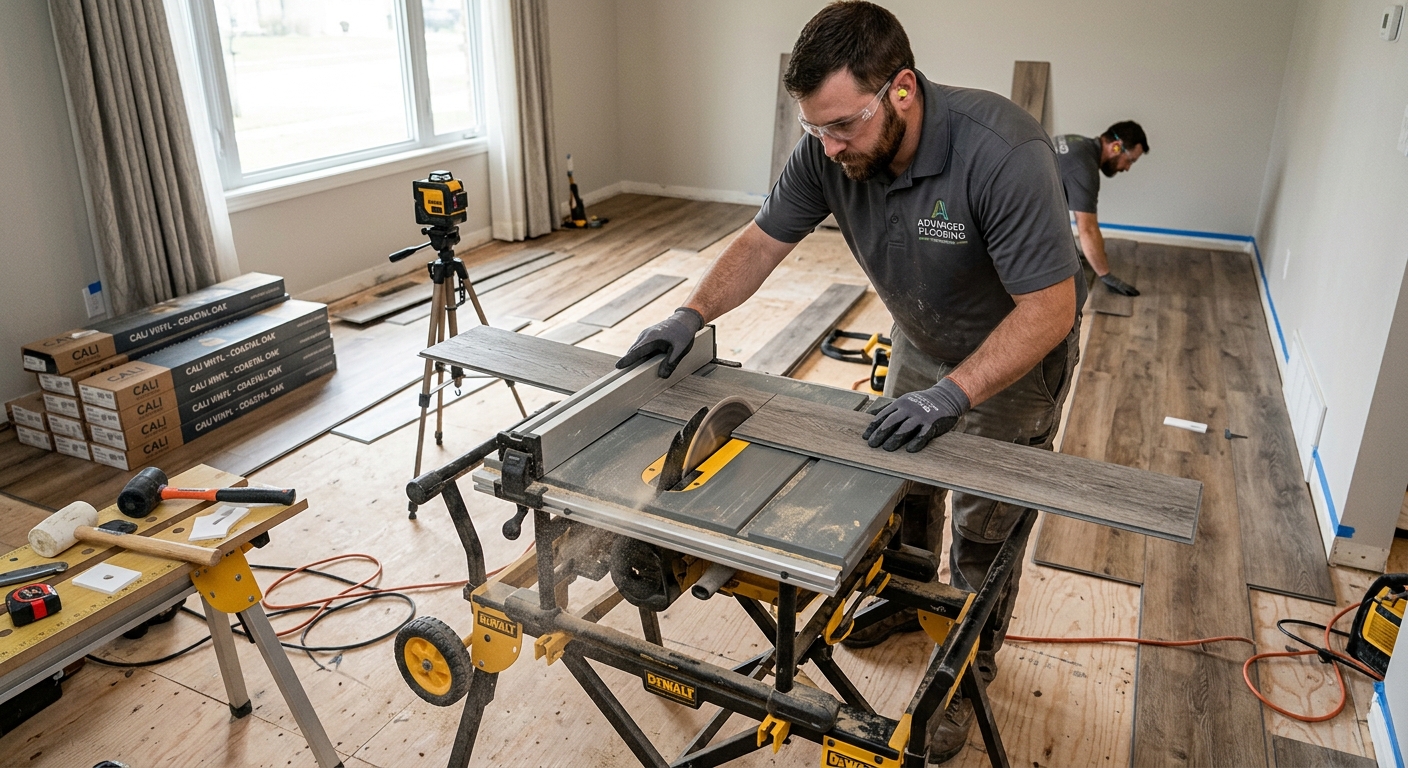
Flooring options and costs in Beaumont
Beaumont homeowners typically start with a simple question—“What will it cost?”—but the answer depends on what kind of home you have and how it behaves in our Edmonton-region seasons. Beaumont has 20,888 residents (Statistics Canada, 2021 Census), and a good share of the housing stock is older: 11.9% of homes were built before 1981 (Statistics Canada, 2021 Census). In many of those mature neighbourhoods, the subfloor is uneven or tired, so levelling/patching becomes a common hidden budget item before any new surface goes down.
In the Edmonton economic region, indoor humidity swings and basement moisture are major cost drivers. Solid hardwood can expand and contract with humidity and is also a poor fit for below-grade spaces, so many projects shift to engineered hardwood or luxury vinyl plank (LVP) where moisture risk is higher. Labour availability is generally steady around Edmonton, but prep work—scraping, patching, replacing damaged OSB, and adding underlayment—can quickly add time and material. That’s why two quotes for the same “square footage” can differ meaningfully, even when both contractors use products in the same price band.
In Beaumont, the trade is especially active around newer growth and established family areas like the Do not name neighbourhood? (Please pick if you want: I can tailor to “Heritage Village” or “Harvest Hills” style naming once you confirm which area you mean.) For now, think of the pattern: more kitchens, basements, and main-floor refreshes in occupied homes drives demand for moisture-tolerant installs.
Use the comparison below to sanity-check price ranges before you request itemised quotes.
| Type |
Best Room |
Moisture Resistance |
Lifespan |
Price per sq ft |
| Solid hardwood (nail-down, above grade only) |
Living / dining (main floor) |
Low (avoid basements and below-grade slabs) |
25–50 years |
$10,–$25 |
| Engineered hardwood (float or glue, above + on-grade) |
Main floor bedrooms, hallways |
Medium to high (handles humidity swings better) |
20–40 years |
$8,–$22 |
| Laminate (click-lock, above-grade) |
Bedrooms, living spaces |
Medium (water spills can still cause swelling) |
10–25 years |
$4,–$8 |
| Luxury vinyl plank / LVP (waterproof, any level) |
Kitchen, basement (finished) |
High (waterproof surface; better for vapour risk) |
15–25 years |
$4,–$10 |
| Porcelain / ceramic tile |
Bathrooms, entries, kitchens |
Very high (water-proof when installed correctly) |
30+ years |
$5,–$15 |
| Carpet (broadloom or modular tile) |
Bedrooms, family rooms |
Low to medium (avoid moisture-prone areas) |
8–15 years |
$4,–$9 |
Prices are estimates only and vary by project scope, site access and material selection.
What affects the price of flooring in Beaumont
In Beaumont and the wider Edmonton economic region, you can see the same flooring “type” priced 30% to 50% apart between bids. The biggest reasons aren’t only the product—they’re the hidden prep realities: subfloor condition, moisture management, and how much labour is required to achieve a flat, stable base. Edmonton-area projects also tend to include more below-grade work than many other provinces, because basements are common and older homes can have humidity issues after seasonal temperature changes.
Technically, indoor humidity swings make solid hardwood expand and contract; it also shouldn’t be glued or floated over concrete, and it’s a poor choice for basements. That’s why many Beaumont homeowners who start with hardwood end up comparing engineered hardwood or LVP. Engineered wood tolerates seasonal movement better (within manufacturer limits), while LVP is widely used for basement suites and radiant-heated floors because the layered core stays more dimensional and the surface is waterproof. Cold winters also push people toward radiant-compatible systems—most LVP and many engineered woods work well over hydronic/electric heat when installed per the spec.
Older local housing (11.9% built before 1981) frequently needs levelling, patching, or underlayment upgrades; budget roughly $1.50–$4.00 per sq ft for prep in many Edmonton-region renovations. As a simple example, a $8 per sq ft engineered floor might become comparable to a $6–$7 per sq ft laminate once levelling and proper underlayment are included. Conversely, if you already have a flat subfloor, the “premium” for engineered or LVP often feels justified because installation runs faster and failures are less likely in a humid basement environment.
| Price Factor |
Why It Matters |
Cost Impact |
| Room area in sq ft |
Material quantity and install labour scale directly with surface area |
Higher sq ft increases both product and time; smallest rooms can cost proportionally more |
| Subfloor condition |
Uneven OSB/plywood or damaged boards require levelling/repair before flooring |
Commonly adds about $1.50–$4.00 per sq ft in prep for older homes |
| Moisture / below-grade install |
Basement vapour and slab moisture can ruin solid hardwood; requires compatible systems |
Solid hardwood can be ruled out; switching to LVP/engineered can reduce failure risk and callbacks |
| Material choice |
Solid hardwood, engineered, LVP, laminate, and tile have different material and install methods |
Hardware changes: solid hardwood often lands in the $10–$25 band; LVP is typically $4–$10 |
| Removal and disposal of existing flooring |
Tearing out old material adds labour and disposal fees |
Can shift a project by several hundred dollars depending on layers and debris handling |
| Stair nosing / transitions |
Transitions, matching heights, and stair finishing are labour-intensive |
Charged per step or per linear foot; often a noticeable line item |
| Radiant heat compatibility |
Not every product tolerates heat cycling without expansion/contraction issues |
May require a compatible LVP/engineered or specific underlayment, affecting materials selection |
| Installation method |
Float vs glue-down vs nail-down impacts labour time and subfloor requirements |
Glue-down can raise labour costs and requires stricter flatness |
Permits & regulations in Alberta
In Alberta, installing flooring by itself typically does not require a building permit. What can trigger permits is the related work that sometimes travels with a flooring project—most importantly electrical work for in-floor heating upgrades, and any structural or moisture remediation changes that involve engineered repairs or significant electrical scope.
Here’s the practical split for Beaumont homeowners:
- Typically NOT a permit: removing/adding flooring, installing tile over an approved underlayment system, nailing down solid hardwood on above-grade subfloors, installing floating engineered wood, or laying LVP over an appropriate underlay.
- May require a permit: connecting or altering electrical circuits for radiant heat, making changes to wiring, or any scope where an electrician is needed. Structural subfloor repair can also bring permitting requirements depending on what’s being changed and whether inspections are required.
In condominiums, even when permits aren’t involved, you must follow the building’s internal rules. Condo corporations commonly restrict hard flooring on upper floors due to sound transmission and may require specific underlay or installation methods to meet building standards. Always review the condo declaration and request board approval in writing before installing hardwood or tile on above-grade floors in a multi-unit building.
To verify a contractor in Alberta, check: (1) their Alberta licence status through the appropriate provincial directory/registry, (2) a current certificate of liability insurance, and (3) WSIB/WCB coverage documentation. Ask for the clearance letter (or equivalent coverage confirmation) and ensure the certificate’s insured entity matches the company name on your contract. If they can’t provide clear documents promptly, that’s a risk.
Best flooring for each room in your Beaumont home
Choosing flooring in Beaumont is mostly about matching material performance to how each room gets used—and how moisture behaves in our Edmonton-region climate. With 11.9% of homes built before 1981 (Statistics Canada, 2021 Census), it’s common to encounter older subfloor conditions that need patching or levelling, so the “best” choice is the one that stays stable after prep and seasonal humidity changes. In living and dining spaces, engineered hardwood or a quality click-lock laminate offers the look of wood with better tolerance for typical indoor swings than solid hardwood, especially on the main floor.
For bedrooms, you’ll usually feel the difference with either carpet or engineered hardwood. Carpet adds warmth and sound absorption—useful in older homes where footstep noise can travel—while engineered hardwood keeps the room easier to maintain. In kitchens, LVP or large-format porcelain tile are the practical winners: you’re dealing with spills, frequent cleaning, and temperature variation near exterior doors.
Basements (finished) deserve the most conservative approach. LVP is the clear favourite because it’s waterproof on the surface and generally more forgiving with below-grade moisture vapour than wood products. Bathrooms should be porcelain or ceramic tile only—anything else is a long-term maintenance gamble.
Radiant heat compatibility is increasingly common in Alberta builds and renovations. If a room has hydronic or electric heat, LVP and many engineered wood options are typically the safest call when installed to manufacturer specs.
Price-wise, a realistic example: if engineered hardwood is in the $8–$22 per sq ft band and tile is $5–$15 per sq ft, the decision often comes down to labour and substrate prep. Tile can look cheaper on paper, but if your subfloor needs extra prep for flatness, engineered may become the smarter value in living areas where tile would be overkill.
| Room |
Best Material |
Why |
Moisture Risk |
Price Band per sq ft |
| Living / dining room |
Engineered hardwood |
Wood look with better tolerance to humidity swings than solid hardwood |
Low on main floor (still needs proper acclimation) |
$8,–$22 |
| Master bedroom |
Carpet or engineered hardwood |
Carpet boosts comfort and sound; engineered stays clean and resilient |
Low (average household humidity) |
$4,–$18 |
| Secondary bedrooms |
Laminate (upgrade underlayment) or carpet |
Laminate is cost-efficient; carpet for quieter, warmer rooms |
Low to medium (watch spills) |
$4,–$9 |
| Kitchen |
Luxury vinyl plank (LVP) or porcelain tile |
Easy cleaning and better protection against spills and standing water |
Medium to high (daily wet cleaning) |
$4,–$15 |
| Basement (finished) |
Luxury vinyl plank (LVP) |
Waterproof surface and better performance with below-grade moisture vapour |
High (vapour and seasonal humidity) |
$4,–$10 |
| Bathroom |
Porcelain / ceramic tile |
Built for wet areas when installed with correct method |
Very high (splash and steam exposure) |
$5,–$15 |
How to choose a flooring contractor in Beaumont
When you’re hiring in Beaumont, start by verifying three things: Alberta licensing (where applicable to the trade), liability insurance, and WSIB/WCB coverage. Ask for their certificate of insurance and ensure it clearly lists the flooring company you’re contracting, not just a parent corporation or a different trade entity. For WSIB/WCB, request proof of current coverage or a clearance letter so you’re protected if a worker is injured on your property. If a contractor won’t provide documentation quickly, I treat that as a serious red flag.
Next, get 2 to 3 itemised quotes—not just a lump sum. A good quote breaks labour and materials so you can compare apples-to-apples: removal/dump fees, underlayment, levelling compounds, transition strips, stair work, and installation method. Read the scope carefully: what’s included in prep (patching, sanding, moisture mitigation), what’s excluded (moving appliances, furniture, old baseboards removal), and whether disposal is included. If radiant heat is involved, confirm the product is radiant-compatible and that the installer follows manufacturer clearances and acclimation requirements.
Warranties matter. Ask for a workmanship warranty length, product/manufacturer warranty terms, and whether the warranty is transferable to you as the homeowner. For payments, never let more than 10% to 15% be paid upfront; hold a portion back until the job is complete and you’ve reviewed transitions and edges. Finally, insist on a start date and a completion estimate in writing so the timeline is enforceable.
- Verify Alberta coverage documents before signing: liability insurance certificate and WSIB/WCB clearance/proof.
- Confirm the crew and install method (nail-down, float, glue-down, LVP underlay) match the product spec.
- Ask how they check for flatness and subfloor condition (and what they do if it’s not acceptable).
- Confirm acclimation timelines for wood and laminate products.
- Get the underlay/underlayment listed by name and thickness (not “allowance”).
- Ensure moisture mitigation is described for basements (vapour strategy, jobsite conditions).
- Check if removal and disposal are included, and how many layers they plan to remove.
- Demand line items for transitions, stair nosing, and thresholds.
- Confirm the warranty details are written into the contract (workmanship vs product).
- Use a clear payment schedule: 10%–15% upfront max; holdback until completion.
- Require a written timeline with start and completion dates.
- Ask for references in Edmonton-area climates with similar moisture conditions (basements/older homes).
In Beaumont, my common red flags are: (1) quotes that don’t include prep/levelling allowances for older subfloors, (2) no mention of moisture approach for basements, (3) refusing to provide insurance/coverage clearance, (4) “all-in” pricing with vague exclusions, and (5) skipping written timelines or workmanship warranty terms.
Frequently asked questions — flooring in Beaumont
Engineered vs solid hardwood — what's the difference?
Solid hardwood is one continuous piece of wood and is generally meant for above-grade installations only. It reacts more to seasonal humidity changes, so in Alberta homes—especially where humidity swings occur—it must be installed with the right acclimation and on an appropriate, stable subfloor. Engineered hardwood uses multiple wood layers bonded together, which improves dimensional stability and makes it a better fit when your project involves on-grade slabs or environments that are less predictable. In Beaumont basements, solid hardwood is typically a poor choice, while engineered can sometimes work if the product spec allows it and moisture conditions are managed. In terms of cost, solid hardwood often sits around the $10–$25 per sq ft range, while engineered commonly falls in the $8–$22 per sq ft band, with prep differences being the real budget swing.
Do I need to level my subfloor first?
Often, yes—especially in older Beaumont homes. Even when the “floor looks fine,” most installation failures come down to flatness and support. If the subfloor has dips, ridges, or soft spots, click-lock laminate can separate, tile can crack, and hardwood can develop excessive stress. In the Edmonton-region market, older housing stock and past repairs commonly mean you’ll need patching or levelling compounds, or in some cases an OSB overlay. It’s common to see prep add roughly $1.50–$4.00 per sq ft. The key is that a good contractor measures flatness and explains what’s needed before ordering materials—otherwise you may pay for a premium floor and still get a poor finish.
What's the most durable flooring for pets and kids?
For pets and kids in Beaumont, durability usually means scratch resistance plus spill tolerance plus comfort. LVP is often the top practical choice for busy households because it’s waterproof and handles the everyday messes that happen near entries, kitchens, and especially basements. It also tends to be kinder underfoot than tile. If you want a wood-look, engineered hardwood can be very durable with the right wear layer, but you’ll still need to protect from standing water and control humidity. Carpet is comfortable and forgiving for falls, but it stains more easily and is not ideal in moisture-prone areas. Pricing depends on the surface: LVP commonly falls in the $4–$10 per sq ft range, while tile may be $5–$15 per sq ft and engineered often lands around $8–$22 per sq ft. Choose based on where accidents actually occur in your home.
How do I choose flooring for humidity in Beaumont?
Humidity control starts with recognizing that Beaumont homes share the Edmonton-region pattern of indoor humidity swings and basement moisture concerns. Solid hardwood is the most sensitive: it expands/contracts and should not be installed in basements or over below-grade concrete. Engineered hardwood and LVP are generally more tolerant because their layered construction and dimensional stability handle seasonal movement better. For basements, LVP is usually the safest bet because its waterproof surface and layered core manage common vapour and minor slab moisture conditions far better than wood. Also, make sure your contractor acclimates materials and uses the correct underlayment system. If you’re comparing quotes, look for whether the contractor addressed moisture strategy explicitly—if they didn’t, you should ask before paying for materials.
Do condos restrict hard flooring?
Yes, often. In Alberta condominiums, even when no building permit is required for flooring itself, condo corporations frequently regulate noise and sound transmission for hard flooring on upper levels. That can mean restrictions on installation methods, required underlay types, and sometimes limitations on when and how hard surfaces can be installed. For your Beaumont condo, review the declaration and ask for board approval in writing before starting, particularly for hardwood or tile. The technical reason is sound impacts—footfall and furniture movement—which can conflict with the building’s sound requirements. Practically, it also affects your quote: the underlayment specification may change, which can move you within the $4–$8 or $5–$15 per sq ft bands depending on materials selected.
How do I compare flooring quotes?
To compare quotes fairly in Beaumont, insist on an itemised breakdown rather than a single lump sum. Make sure each quote includes the same scope: removal and disposal of existing flooring, levelling/patching or OSB repair if needed, underlayment type and thickness, transitions/stair nosing, and any baseboard work if you’re replacing or reinstalling. Confirm whether radiant heat compatibility is accounted for if you have in-floor heat. Also compare the price basis: the material line should align with realistic bands—for example, laminate/vinyl often lands around $4–$8 per sq ft, while tile frequently sits in the $5–$15 per sq ft range, and solid hardwood can be $10–$25 per sq ft. Finally, verify warranties and workmanship terms in writing, check the payment schedule (no more than 10%–15% upfront), and ensure the contract clearly states what’s excluded.