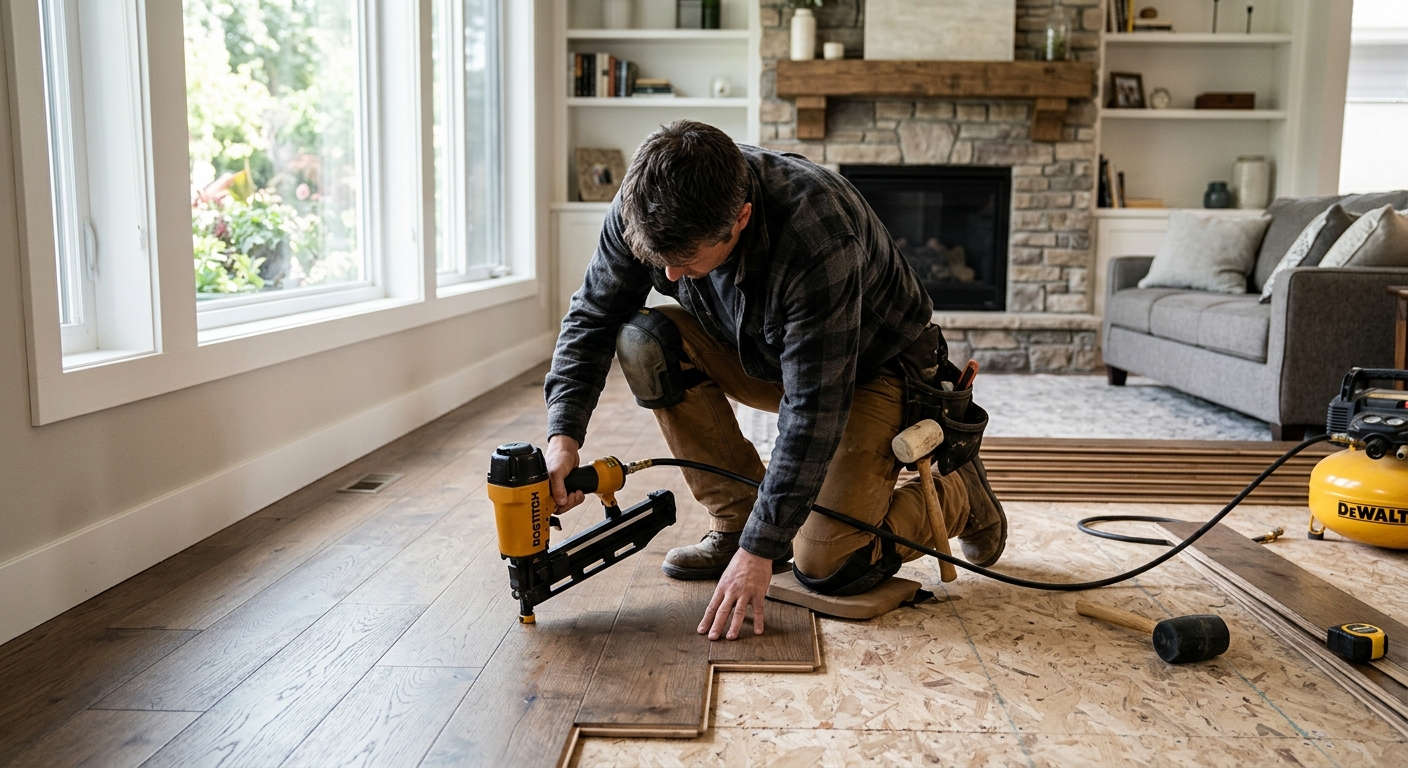
Flooring options and costs in Crossfield
Crossfield homeowners have plenty of flooring choices, but costs tend to land in predictable bands once you factor in local housing age and the dry, cold prairie swings around Calgary. In Crossfield’s housing stock, about 25.9% of homes were built before 1981 (Statistics Canada, 2021 Census), and older main floors or basements often need subfloor levelling or spot repairs before you can lay tile or glue-down products. That prep alone can add roughly 1–3 per sq ft when concrete is uneven or when aged plywood has dips, squeaks, or failed patches. With 1,105 owner households in the community (83.1% of households own) (Statistics Canada, 2021 Census), there’s strong demand for trades that can handle both occupied homes and older builds.
In the Calgary region, large seasonal humidity changes drive expansion and contraction—especially for solid hardwood. That’s why many quotes in Crossfield steer basements toward engineered wood, LVP (including SPC varieties), and sometimes tile with the right crack isolation setup. Also, colder-season scheduling and the need for accurate acclimation add labour time, but they reduce callbacks. If you’re near the busier school/amenity corridor on the east side of Crossfield, builders and flooring installers often get booked earlier for turn-key renovations that include stair work and trim reinstallation.
Below is a practical comparison of common material choices and what you can expect to budget per square foot, then we’ll break down what moves those numbers up or down.
| Type |
Best Room |
Moisture Resistance |
Lifespan |
Price per sq ft |
Price Range |
| Solid hardwood (nail-down, above grade only) |
Main floor living areas |
Low to moderate; sensitive to basement humidity |
25–50 years |
$8–$15 |
$8 – $15 |
| Engineered hardwood (float or glue, above + on-grade) |
Living/dining, bedrooms |
Moderate; generally safer across humidity swings |
15–30 years |
$8–$14 |
$8 – $14 |
| Laminate (click-lock, above-grade) |
Bedrooms, hallways |
Low to moderate; spills can damage core |
10–20 years |
$3–$7 |
$3 – $7 |
| Luxury vinyl plank / LVP (waterproof, any level) |
Kitchen, finished basements |
High; handles moisture vapour better than wood |
15–25 years |
$4–$9 |
$4 – $9 |
| Porcelain / ceramic tile |
Bathrooms, entries, wet zones |
Very high; depends on grout and proper prep |
25–50 years |
$6–$12 |
$6 – $12 |
| Carpet (broadloom or modular tile) |
Bedrooms |
Low; sensitive to chronic dampness |
7–15 years |
$3–$8 |
$3 – $8 |
Prices are estimates only and vary by project scope, site access and material selection.
What affects the price of flooring in Crossfield
In Crossfield and the broader Calgary area, it’s common to see quotes for the “same” flooring come back 30–50% apart—because the scope behind the scene isn’t the same. Labour pricing reflects how much prep is needed (levelling, patching, underlayment selection), how many transitions and stairs you have, and whether the installer must work around an occupied home schedule. Material costs can also swing based on thickness, wear layer, and warranty tier. The dry, cold prairie climate adds another layer: indoor humidity can drop in winter and rebound in spring, so solid hardwood can expand/contract and requires careful acclimation and stable indoor conditions. That’s why solid wood is typically restricted to above grade, while engineered hardwood and luxury vinyl plank (LVP) are often chosen for basements and main floors with broader humidity swings.
Below-grade moisture is the key technical driver. In many Calgary-region basement slabs, moisture migration through concrete affects dimensional stability—solid hardwood cannot be glued or floated directly over concrete, and it performs poorly where humidity is unpredictable. Engineered hardwood and LVP/SPC handle these conditions far better. Radiant heat compatibility also matters: colder regions using hydronic or in-floor systems frequently limit options, often steering budgets toward engineered products and certain laminate lines; most solid hardwood selections are constrained.
Two common Crossfield examples: (1) A 1,000 sq ft main-floor install over uneven plywood may require levelling and patching—often translating to about $1–$4 per sq ft added prep. (2) A kitchen-to-hall layout with 10–15 stair-step transitions and multiple doorways can add cost via stair nosing and transition strips. Even so, when you’re choosing between laminate at roughly $3 – $7 per sq ft and LVP at around $4 – $9 per sq ft, the extra dollar-per-square-foot can be justified by fewer callbacks in moisture-prone zones.
| Price Factor |
Why It Matters |
Cost Impact |
| Room area in sq ft |
Material quantity and labour time scale directly with square footage |
Often the largest driver; small spaces can have higher labour-per-sq-ft |
| Subfloor condition |
Levelling, patching, or repair is needed before most tile and for a smooth click/float |
Commonly adds about $1–$4 per sq ft in older Crossfield homes |
| Moisture / below-grade install |
Determines whether solid hardwood is ruled out and what vapour management is required |
May shift budget from $8 – $15 hardwood toward LVP/engineered |
| Material choice |
Solid vs engineered vs LVP vs tile changes both the product and underlayment systems |
Hardwood typically runs higher than laminate; tile tends to land mid-to-high |
| Removal and disposal of existing flooring |
Demolition time and waste hauling vary by thickness and substrate condition |
Can add a noticeable flat fee plus variable labour time |
| Stair nosing / transitions |
Stairs, thresholds, and reducers require extra measuring, cuts and hardware |
Charged per step or per linear foot; often a top “surprise” line item |
| Radiant heat compatibility |
Limits product selection and may require specific underlay and acclimation |
Can steer you toward engineered/LVP and away from most solid hardwood |
| Installation method |
Float vs glue-down vs nail-down affects labour steps and subfloor requirements |
Glue-down and tile are typically more labour-intensive than click-lock laminate |
Permits & regulations in Alberta
In Alberta, installing flooring itself usually does not require a building permit—you're typically dealing with finishes rather than changing a structure. However, associated work can trigger permit or regulatory requirements, depending on what’s being altered. For example, structural subfloor repairs that involve significant changes to supporting framing may require permits, and any work connected to electrical circuits for in-floor heating (including thermostat wiring and power supply modifications) can require electrical permitting. If your project includes moisture remediation strategies that involve engineered drainage or significant substrate replacement, that may also push the job into permit territory.
For condominiums in the Calgary region, the bigger practical “rule” isn’t usually a permit—it’s the corporation’s own by-laws and sound transmission requirements (often using STC/IIC expectations). That means you may need a specific approved underlay, limits on attaching hard flooring, and written board approval—especially for hardwood and tile on upper floors. Always check the declaration and request approval in writing before you buy product or schedule installation.
To verify your Crossfield contractor, ask for: (1) their Alberta licensing details (and confirm the correct trade where applicable), (2) liability insurance certificate naming you/your property as an additional insured if offered, and (3) WSIB/WCB coverage clearance. Start by checking any online contractor registry information they provide, then verify the certificate of insurance is current and matches the legal name on the quote. For WSIB/WCB, request a clearance letter rather than “we’re covered” and keep a copy with your contract documents.
Best flooring for each room in your Crossfield home
Choosing the right flooring in Crossfield is mostly about matching each room’s moisture exposure, foot traffic, and comfort needs to a material that tolerates Alberta’s climate. Living and dining spaces usually benefit from engineered hardwood or high-quality laminate: both offer a warm look, but engineered wood handles humidity fluctuations better than solid hardwood when seasonal indoor moisture swings are larger. For primary bedrooms, carpet is still one of the best comfort choices—especially in dry winter months when you want warmth underfoot and sound reduction for evening routines.
Kitchens in Crossfield see daily spills and wet cleaning, so luxury vinyl plank (LVP) or large-format porcelain tile is often the best fit. LVP gives waterproof flexibility over many subfloor types, while porcelain tile is extremely durable and easy to keep sanitary if the subfloor is properly levelled and cracks are managed. Basements are where decisions become climate-driven: LVP is the clear winner in finished basements because it’s fully waterproof and more forgiving over below-grade moisture vapour—solid wood and many laminates can fail when concrete moisture migrates. Bathrooms should be porcelain or ceramic tile only, with correct underlayment and grout/grain selection.
Radiant heat compatibility also matters. Many newer Alberta builds include hydronic radiant heat, which often rules out most traditional solid hardwood and limits laminate selections to those designed for in-floor heating. In a typical Crossfield comparison, it may cost more to go from laminate at about $3 – $7 per sq ft to engineered hardwood closer to $8 – $14 per sq ft—but the upgrade is justified if you want a longer service life, better feel, and reduced risk of seasonal movement.
| Room |
Best Material |
Why |
Moisture Risk |
Price Band per sq ft |
| Living / dining room |
Engineered hardwood |
Warm appearance with better humidity stability than solid wood |
Low to moderate (depends on air balance and entry humidity) |
$8 – $14 |
| Master bedroom |
Carpet or engineered hardwood |
Carpet adds comfort and sound control; engineered keeps a cleaner look |
Low (if basement and bathrooms aren’t leaking) |
$3 – $8 |
| Secondary bedrooms |
Carpet (broadloom or modular) |
Budget-friendly comfort and kid/pet cushioning |
Low to moderate (spot spills are the main issue) |
$3 – $7 |
| Kitchen |
LVP or porcelain tile |
Easy cleanup; handles day-to-day water and mopping better |
Moderate to high |
$4 – $12 |
| Basement (finished) |
LVP / SPC |
Waterproof surface and better tolerance for below-grade moisture vapour |
High (slab moisture migration is the common risk) |
$4 – $9 |
| Bathroom |
Porcelain / ceramic tile |
Durable wet-area performance when installed on a properly prepped base |
Very high |
$6 – $12 |
How to choose a flooring contractor in Crossfield
Hiring the right flooring contractor in Crossfield starts with proof, not promises. First, verify Alberta coverage: request their liability insurance certificate and confirm it’s current and matches the company name on your contract. Next, ask for WSIB/WCB coverage documentation (often a clearance letter). Third, confirm the contractor’s Alberta licensing information where applicable and make sure the quote is issued under the correct legal entity. Don’t rely on a photo of an insurance card—get the certificate details in writing and keep them.
Then, get 2–3 itemised written quotes. You want a breakdown that separates labour from materials, includes underlayment/vapour barrier items where needed, and lists prep scope such as levelling/patching and any crack isolation membranes for tile. Read the exclusions: ask if removal and disposal are included, whether stair nosing and transitions are quoted per step/linear foot, and if furniture move-back or debris hauling is part of the scope. For warranties, confirm both product and workmanship: what length applies to labour, what length applies to the manufacturer, and whether the warranty is transferable to subsequent owners.
Payment should be controlled. A standard approach is no more than 10–15% upfront; hold back the remainder until the work is complete, floors cleaned, and you’ve done your walkthrough. Finally, get a start date and completion estimate in writing so you can plan around Alberta weather and acclimation time for wood and rigid-core products.
- Provide a written scope that lists prep, underlayment, vapour management, and transition/stair details.
- Itemise labour and materials separately (not a single lump-sum line).
- Confirm disposal is included for existing flooring and underlay.
- Ask how they handle subfloor levelling and who measures flatness.
- Get radiant-heat compatibility confirmed in writing if you have in-floor heating.
- Request their workmanship warranty terms and how claims are handled.
- Check product warranty length and whether it’s voided by improper installation.
- Verify they provide current liability insurance and WSIB/WCB clearance.
- Ensure the quote includes acclimation requirements for wood/LVP and the timeline for delivery.
- Confirm payment schedule and keep a holdback until final inspection.
- Get a start/completion timeline and confirm coordination for stairs/trim reinstallation.
- Look for a contract with clear change-order pricing if you add rooms or stair work.
Red flags I see too often in Crossfield: quotes that don’t mention levelling/prep, “we’ll figure it out later” language on vapour barrier or tile membranes, no written workmanship warranty, vague insurance/coverage statements, and payment requests for large upfront deposits with no holdback plan.
Frequently asked questions — flooring in Crossfield
Can I install hardwood over concrete?
In most Crossfield projects, traditional solid hardwood isn’t the right choice directly over concrete. Solid hardwood is typically nail-down and intended for above-grade applications; it also reacts to humidity swings, which Alberta households can feel during winter dry periods and spring thaw. Engineered hardwood can sometimes work better than solid because it’s designed for more dimensional stability, but the success still depends on the concrete condition, flatness, and moisture/vapour management. If your home has an older slab or you suspect moisture migration (common in Calgary-area basements), contractors often steer homeowners to engineered wood above on-grade, or to LVP/SPC for below-grade areas. If you’re unsure, ask your installer to explain the underlayment/vapour system they plan to use and how they’ll confirm moisture conditions before installation.
How long does flooring installation take?
Timelines in Crossfield usually depend on room size, subfloor prep, and how many transitions and stairs are involved. A straightforward above-grade laminate install can move quickly, but older homes (about 25.9% built before 1981) often need levelling/patching, which adds time—commonly 1–3 extra prep days depending on how out-of-level the base is. Tile generally takes longer due to setting, grouting, and cure times, while LVP can be faster once prep is done. Also factor in acclimation for wood and rigid-core products, especially when materials arrive before winter humidity stabilises indoors. If you’re comparing budgets—say laminate at $3 – $7 per sq ft versus LVP around $4 – $9—the schedule can be similar, but the prep and cure steps are what usually change your total install time.
What flooring works with radiant heat?
Radiant heat compatibility is a product-specific requirement, not a one-size-fits-all rule. Many installers steer Crossfield homeowners away from most solid hardwood on hydronic in-floor systems because of movement and warranty limitations tied to surface temperature and humidity changes. Engineered hardwood is often a better fit when it’s specifically rated for radiant heat, with the correct installation method and moisture control. Laminate can sometimes work as well, but only if the manufacturer approves it for radiant heat and you use the specified underlay. LVP/SPC is frequently a solid choice too, because it tolerates temperature cycling better than solid wood when installed correctly. Before you buy, ask your contractor to provide the product’s radiant-heat rating and temperature guidelines in writing.
Engineered vs solid hardwood — what's the difference?
Solid hardwood is a single piece thickness (typically installed nail-down) and it’s more sensitive to humidity swings. In Alberta’s dry-cold prairie climate, that matters—especially for basements where slab moisture vapour can be unpredictable. Engineered hardwood is made in layers, usually with a real wood veneer on top, which helps it resist movement and makes it more suitable for on-grade installations and many situations where solid is too risky. In Crossfield, a lot of homeowners choose engineered when they want a hardwood look across the main floor without the same basement limitations. Price varies by selection: solid hardwood commonly sits in the $8 – $15 per sq ft band, while engineered often lands in the $8 – $14 per sq ft range depending on thickness and wear layer. Your contractor should also explain the exact installation method (float vs glue-down) and warranty conditions.
Do I need to level my subfloor first?
Most of the time, yes—subfloor flatness is the difference between a smooth floor and one that squeaks, shifts, or cracks tile. In Crossfield homes, especially those built before 1981 (about 25.9% in the local profile) (Statistics Canada, 2021 Census), it’s common to find uneven plywood or patchy concrete. Laminate and LVP want a flatter base for locking systems to perform reliably; tile is even more sensitive and typically requires proper levelling plus appropriate crack isolation or membranes where warranted. The dollar impact depends on how far out-of-level the surface is: levelling/repair is often budgeted around $1–$4 per sq ft in older regional basements and main floors. Ask your installer how they measure flatness and what they’ll do if they find dips, humps, or failed material.
What's the most durable flooring for pets and kids?
For pets and kids in Crossfield, durability usually means: scratch resistance, stain resistance, and how well the floor handles accidents and routine cleaning. Luxury vinyl plank (LVP) or SPC is often the top practical choice because it’s waterproof and handles spills better than laminate and most carpets. If you’re comparing price bands, LVP typically sits around $4 – $9 per sq ft, which is a realistic middle-ground against laminate at about $3 – $7 per sq ft—while tile can be $6 – $12 per sq ft in wet-prone areas. Carpet can be comfortable, but it stains more easily and isn’t ideal in basements or near entryways where moisture can migrate. The best recommendation depends on where your “kid/pet zones” are—if you have frequent tracking from winter boots, LVP in the main areas plus carpet in bedrooms is a common winning combo.