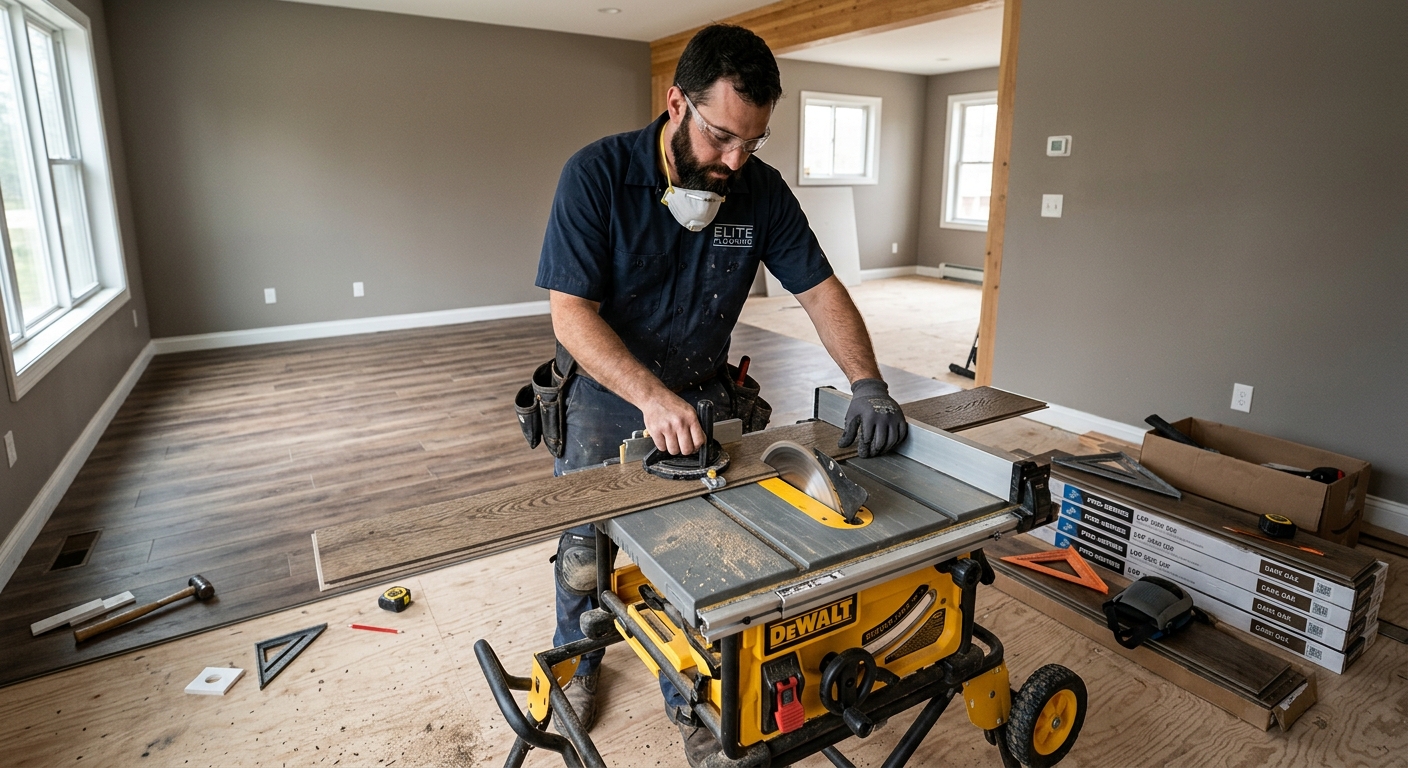
Flooring options and costs in Leger
Leger, Alberta is small by population, but it sits inside the Calgary market, where flooring demand stays steady because homeowners are balancing comfort, durability, and cold-weather maintenance. In the 2021 Census, Leger had a population of 2,559 (Statistics Canada, 2021 Census), and that matters for you: local quotes often reflect a tight pool of installers who regularly serve nearby Calgary and surrounding communities. Another cost driver is the age of the housing stock in the region—older homes commonly need subfloor levelling before the new surface goes down. When plywood is uneven or concrete has waves, flatness prep can add real labour and material, typically pushing overall budgets upward.
Calgary-area winters are cold and dry, while shoulder seasons swing indoor humidity. That cycling is hard on traditional solid wood because it expands and contracts as the relative humidity changes. Basements and in-slab spaces also face moisture migration through concrete, so below-grade installs typically favour engineered wood, luxury vinyl plank (LVP), or SPC. Those products are more dimensionally stable and tend to perform better when humidity conditions aren’t perfect. Finally, where radiant heat is installed (common in newer Alberta builds), some materials are simply better compatible than others, which can change total cost from job to job. In Leger, tradespeople often see higher demand for installs in older core areas and family neighbourhoods where renovation cycles line up with basement finishing.
Below is a practical comparison table for common flooring choices in Leger, with realistic price bands to help you compare quotes apples-to-apples.
| Type |
Best Room |
Moisture Resistance |
Lifespan |
Price per sq ft |
| Solid hardwood (nail-down, above grade only) |
Living / dining (main floor) |
Low–moderate (humidity sensitive) |
25–60 years |
$8,00 – $15,00 |
| Engineered hardwood (float or glue, above + on-grade) |
Living areas & hallways |
Moderate–good (better stability) |
20–35 years |
$6,50 – $12,50 |
| Laminate (click-lock, above-grade) |
Living areas & bedrooms |
Low–moderate (edges can swell) |
10–25 years |
$3,00 – $7,00 |
| Luxury vinyl plank / LVP (waterproof, any level) |
Kitchen & basements |
High (waterproof surface) |
15–25 years |
$5,50 – $10,50 |
| Porcelain / ceramic tile |
Bathrooms & kitchens |
Very high (but grout maintenance) |
25–50 years |
$7,00 – $12,00 |
| Carpet (broadloom or modular tile) |
Bedrooms |
Moderate (sensitive to spills) |
7–15 years |
$4,50 – $9,00 |
Prices are estimates only and vary by project scope, site access and material selection.
What affects the price of flooring in Leger
In Leger, homeowners can see the same flooring type come in at meaningfully different numbers across Calgary and Alberta—often a 30–50% spread—because quotes aren’t just “material + a crew.” They’re also driven by prep, subfloor flatness, moisture risk, waste, and how much labour is required to remove/replace trim and handle stairs and transitions. In practice, the biggest swings usually come from whether your subfloor needs levelling and whether the install is on grade or in a basement. Cold, dry prairie weather also means indoor humidity can change quickly, so solid hardwood may require more attention to acclimation and proper conditions, and it’s usually not chosen for below-grade spaces.
Technically, Calgary’s dryness plus below-grade moisture migration through concrete pushes many basements toward engineered hardwood, LVP, or SPC, which handle humidity changes better. Solid hardwood expands and contracts with indoor humidity and cannot be glued or floated over concrete; it also performs poorly when moisture vapour is present in basements. That’s why “solid hardwood” pricing can be deceptively low in showrooms, then rises once the realities of levelling, transitions, and correct installation method are added.
Older regional housing often needs subfloor repair or levelling—commonly adding about $1–$4 per sq ft depending on how out-of-level the surface is. For example, a main-floor laminate project in the $3–$7 per sq ft band can jump when tile-like flatness is required at doorways or when stair work is included. Similarly, engineered hardwood in the mid range ($6–$12.50 per sq ft) may be well worth it if you need stability for on-grade hall areas, while a solid hardwood basement plan can add costs because it’s not the right system for moisture conditions. In Leger’s climate, that $2–$4 per sq ft prep difference can be the line between a smooth install and a call-back situation.
| Price Factor |
Why It Matters |
Cost Impact |
| Room area in sq ft |
Material quantities, waste factor, and labour time scale with floor area |
Often direct: larger jobs may price per sq ft slightly lower |
| Subfloor condition |
Levelling or repairs are required for flatness and to prevent squeaks/telegraphing |
Commonly +$1 to $4 per sq ft depending on extent |
| Moisture / below-grade install |
Moisture vapour through concrete can damage solid hardwood and edge-sensitive products |
Can add membrane/prep; often shifts material choice to engineered/LVP |
| Material choice |
Solid vs engineered vs LVP vs tile affects both material and install method complexity |
Wide: hardwood $8–$15 vs laminate/vinyl $3–$7 baseline bands |
| Removal and disposal of existing flooring |
Labour for demo, hauling, and disposal fees vary by what’s already there |
May add a noticeable fixed component to the quote |
| Stair nosing / transitions |
Stairs and transitions are labour-intensive and require precise matching and materials |
Often charged per step or per linear foot; can materially raise total cost |
| Radiant heat compatibility |
Some products handle in-floor heat better than others to avoid gapping/cupping |
May restrict options and change underlayment requirements |
| Installation method |
Float vs glue-down vs nail-down changes labour, underlayment, and subfloor tolerance |
Can swing cost depending on prep level and product system |
Permits & regulations in Alberta
In Alberta, installing flooring itself usually does not require a building permit. However, associated work can trigger permit requirements—so the key is to separate “surface installation” from any electrical or structural changes your contractor may propose. Flooring upgrades that typically do not require permits include: removing existing floor coverings, installing new flooring (engineered hardwood, LVP/SPC, laminate, carpet), setting tile where there’s no structural modification, and installing standard subfloor underlayments.
Work that may require a permit depends on the scope, but common examples include: electrical work for in-floor heating circuits, modifications to an electrical panel, or any change that involves wiring/thermostats handled by a licensed electrician. If the job involves moisture remediation that requires specialized repairs to building components, or any structural subfloor correction (for example, substantial framing adjustments), you should ask the contractor to clarify whether permits or inspections are needed before work begins.
For Leger homeowners, verifying a contractor the right way is crucial. Step-by-step: (1) confirm the contractor’s Alberta licence/registration status using the appropriate provincial listings (based on their trade/role) and ensure the business name matches the quote; (2) request a current certificate of insurance and check that liability coverage is active for your project; and (3) ask for proof of WSIB/WCB coverage—either clearance documentation or confirmation of account status. Get these documents in writing (email or PDF) before signing, not after the first day on site. In condominium-style situations, also review the corporation’s rules on sound transmission (STC/IIC) and underlay requirements for hard flooring.
Best flooring for each room in your Leger home
Choosing the right flooring for each room in your Leger home is mostly about matching the material to moisture exposure, traffic, and the comfort you want—under Leger’s cold, dry prairie climate and Calgary’s seasonal humidity swings. In living and dining areas, engineered hardwood or high-quality laminate is a common sweet spot: warm underfoot, durable for everyday use, and less sensitive than solid hardwood when humidity levels move around. For many master bedrooms, carpet is popular because it adds comfort and sound absorption, especially in multi-level layouts.
For kitchens, go with luxury vinyl plank (LVP) or large-format porcelain tile. Spills, snowmelt, and frequent cleaning are normal realities in Alberta homes, and LVP’s waterproof construction handles water better than laminate. In basements, LVP is usually the clear winner—fully waterproof surfaces plus better performance against moisture vapour migration through concrete than solid wood or edge-sensitive laminate systems. Bathrooms should be porcelain or ceramic tile only, because tile’s water resistance is reliable and easier to maintain in wet conditions.
If you have (or plan) radiant heat, confirm compatibility before ordering. Many contractors steer you away from traditional solid hardwood in radiant applications because of expansion behaviour, especially in a region where indoor humidity changes can be dramatic. As a cost example, if you’re comparing carpet in a bedroom (often within the $3–$5 carpet installation band) to LVP in the adjacent hall at $5.50–$10.50 per sq ft, the higher hall cost is usually justified because that area sees wet footwear, mopping, and higher moisture exposure.
| Room |
Best Material |
Why |
Moisture Risk |
Price Band per sq ft |
| Living / dining room |
Engineered hardwood |
Warm look, stable for humidity swings, easier to install than solid over questionable subfloors |
Low (main floor) |
$6,50 – $12,50 |
| Master bedroom |
Carpet |
Comfort and sound control; reduces cold-floor feel in winter |
Low |
$4,50 – $9,00 |
| Secondary bedrooms |
High-quality laminate |
Budget-friendly durability; easier maintenance than carpet for many families |
Low–moderate (spills can affect edges) |
$3,00 – $7,00 |
| Kitchen |
LVP or porcelain tile |
LVP resists splashes and mopping; tile handles heavy cleaning and water well |
Moderate (daily spills and wet cleaning) |
$5,50 – $12,00 |
| Basement (finished) |
LVP (waterproof) |
Best stability over on-grade/below-grade conditions; safer where moisture migration is a concern |
High (vapour and seasonal swings) |
$5,50 – $10,50 |
| Bathroom |
Porcelain / ceramic tile |
Water-resistant and long-lived; supports proper wet-area detailing |
Very high |
$7,00 – $12,00 |
How to choose a flooring contractor in Leger
Start by verifying the basics for Alberta work. Ask for their current Alberta trade registration/licence where applicable, and confirm liability insurance is active for your project. Then request proof of WSIB/WCB coverage (or clearance documentation) so you’re not indirectly exposed if a worker is injured on your site. In Leger, I recommend you request these documents by email before work starts—contractors who do this routinely can usually provide them immediately.
Next, get 2–3 itemised written quotes. You want a line-by-line breakdown that separates materials, underlayment, any levelling/repair, removal and disposal, stair labour, transitions, and any disposal fees. Avoid lump-sum only quotes, because the scope can quietly expand (for example, additional levelling boards needed after the contractor sees the real subfloor flatness). Clarify what’s excluded: permit pull (if any), window/door trim modifications, moving furniture, replacing damaged subfloor components, and whether adhesives or membranes are included when required by your flooring type.
Warranty matters too. Ask for the workmanship warranty length and whether it’s backed by the installer company (and for how long). Also get the product/manufacturer warranty details in writing and confirm whether the warranty is transferable if you sell the home. For payment schedule, never pay more than 10–15% upfront; hold back until the job is complete and cleaned. Finally, request a written start date and completion estimate.
- Confirm Alberta registration/licence for the contractor/business name shown on your quote.
- Request a current certificate of liability insurance before any materials are ordered.
- Get proof of WSIB/WCB coverage (clearance letter or equivalent) in writing.
- Ask for 2–3 itemised quotes with labour and materials separated (not lump sum).
- Verify levelling/repair scope: how much flatness is guaranteed and what triggers extra charges.
- Confirm removal and disposal is included (and whether it’s per room or per load).
- Check stair work and transitions pricing (charged per step/linear foot) in the proposal.
- Request underlayment details: type, thickness, and who supplies it.
- Ask about acclimation for hardwood/engineered products in Calgary humidity swings.
- Get warranty terms for workmanship and products (including transferability).
- Set payment milestones: maximum 10–15% upfront; holdback until punch list completion.
- Get an installation schedule in writing with a realistic completion target.
Red flags I commonly see in the Leger area include: quotes that omit levelling even after they haven’t measured flatness, refusal to provide insurance/WSIB proof, “free upgrade” claims that later turn into change orders, no written scope for stairs/transitions, and warranty promises made verbally with no paperwork.
Frequently asked questions — flooring in Leger
What is luxury vinyl plank and is it worth it in Leger?
Luxury vinyl plank (LVP) is a layered flooring that’s designed to look like wood while remaining highly water-resistant. In Leger and across the Calgary region, it’s often worth it because the climate brings strong humidity swings and winter dryness, while basements and on-grade concrete can still have moisture vapour migration. Unlike laminate, LVP’s waterproof surface is far less likely to suffer permanent swelling from small spills or damp mopping. It’s also a good choice if you want continuity between main floors and lower levels without changing materials midstream. Pricing depends on wear layer and construction, but you’ll commonly see LVP projects land around the $5,50–$10,50 per sq ft range depending on prep and stair/transition complexity.
How much does flooring cost in Leger?
In Leger, flooring cost is usually best thought of as a range plus a few “scope variables” (prep, levelling, stairs, and disposal). For budgeting, the common regional starter bands are: hardwood $8–$15 per sq ft, laminate/vinyl plank $3–$7 per sq ft, tile $6–$12 per sq ft, and carpet installation $3–$5 per sq ft. Your final number can move up when subfloor levelling or repair is needed—older houses in the Calgary area frequently show uneven plywood or concrete waves, and levelling can add roughly $1–$4 per sq ft. For example, switching from laminate at around $3–$7 per sq ft to engineered hardwood may increase material cost, but it can reduce risk in areas where humidity stability matters more. Always compare quotes that itemise labour, materials, and levelling rather than relying on a single lump sum.
Hardwood vs laminate vs vinyl plank — which is best?
“Best” depends on room moisture and how much humidity movement your home experiences in Alberta. Solid hardwood looks great and can last a long time, but it’s humidity sensitive and is not the right system for most basement/below-grade conditions. Laminate is usually more affordable (often within the $3–$7 per sq ft band), but it’s vulnerable at seams and edges if water gets underneath. Vinyl plank (especially waterproof LVP) tends to be the most forgiving choice in a place like Leger where you may have damp footwear traffic, wet-cleaning routines, and basement moisture vapour concerns. Many homeowners choose engineered hardwood on main floors for the look, and LVP in kitchens/basements for reliability. If radiant heat is involved, confirm compatibility with the product system because not all underlayments and materials respond the same way to in-floor temperatures.
What flooring is best for a Leger basement?
For most Leger basements, LVP is the safest, most common recommendation. Calgary-area basements often face moisture migration through concrete and seasonal humidity swings, and solid hardwood generally performs poorly below grade because it expands/contracts with humidity and is not designed for direct contact with basement moisture conditions. Many homeowners also avoid laminate in basements due to swelling risk along seams and edges. LVP is waterproof on the surface, and it’s typically easier to keep performing well when there are small moisture vapour changes. The price difference can be meaningful: engineered hardwood may look similar, but it usually requires more careful subfloor conditions and installation expectations. As a practical budgeting point, many LVP installs land around the $5,50–$10,50 per sq ft range, while higher-end hardwood options often climb into the $8–$15 per sq ft band once correct prep and proper system requirements are included.
Can I install hardwood over concrete?
Usually, solid hardwood is not installed directly over concrete. Solid hardwood is typically nail-down over an appropriate above-grade subfloor system and it’s sensitive to humidity swings. Over concrete, you’ll often need to use an engineered hardwood approach instead, because engineered products are more dimensionally stable and can handle on-grade installations better when the system is set up correctly (including proper underlayments and moisture considerations). In a Leger home, concrete moisture vapour is the big issue, especially in basements. If your contractor proposes solid hardwood over concrete, ask how they’re addressing moisture and flatness and whether they’re following the manufacturer’s installation method exactly. For many projects, the safer value is engineered hardwood on grade and LVP in basements.
How long does flooring installation take?
Timelines vary with room count, room size, and prep, but in Leger you can generally expect a faster install when floors are relatively level and you’re working with click-lock products (like laminate or many floating engineered systems). The schedule usually expands when subfloor levelling/repair is needed, when stairs require custom stair nose work, and when removal/disposal is involved. For example, a straightforward single-level install might be completed in a few working days by a two-person crew, while a multi-room job including levelling, transitions, and trim work can take closer to a week or more depending on scope. If any in-floor heating compatibility checks or moisture remediation steps are part of the plan, add time. Ask for a written start date and completion estimate so you can plan around deliveries, acclimation, and the full scope.