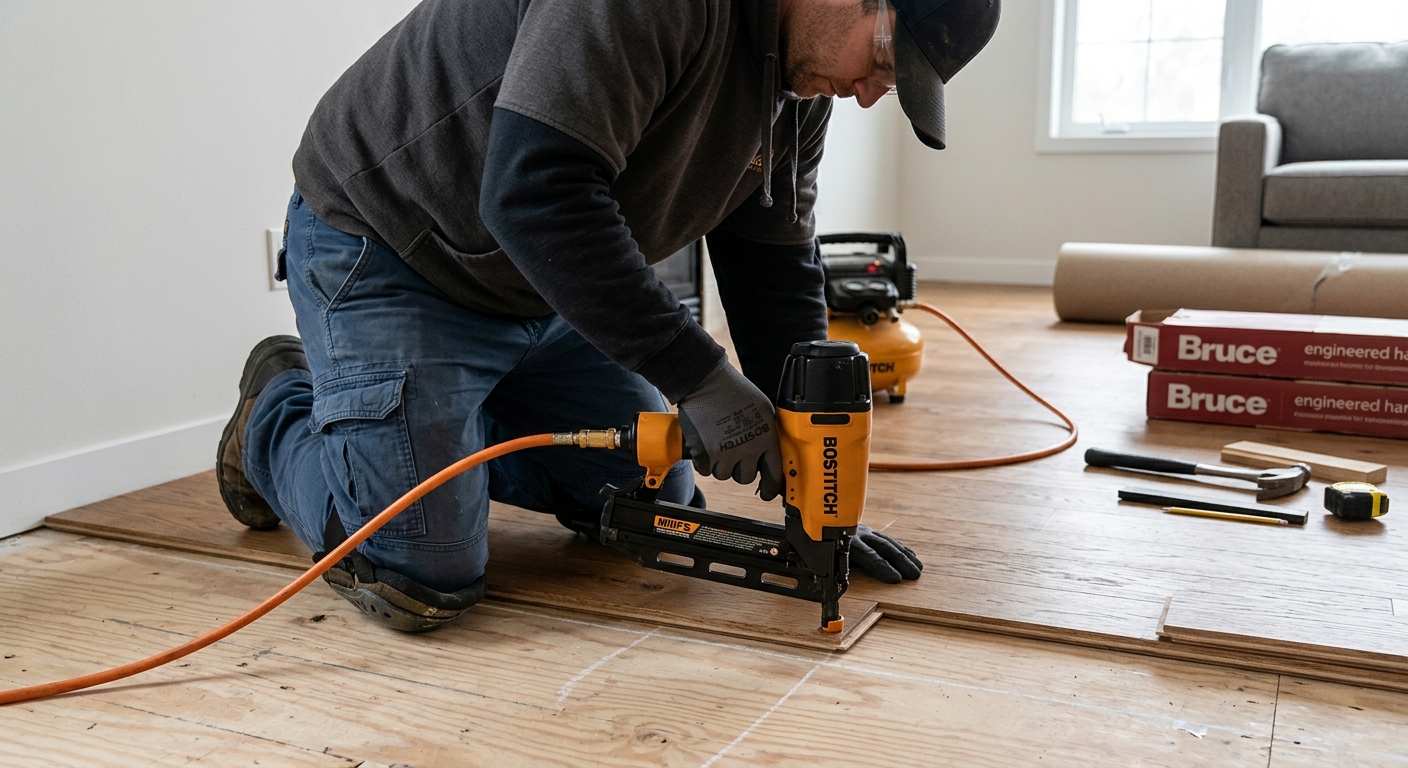
Flooring options and costs in Mayfield
Mayfield, Alberta is a small community (2021 population: 1,973) in the Calgary economic region, and that size shows up in how flooring contractors schedule projects. In practice, you’ll usually book through a wider Calgary pool for crews, materials, and stair/trim trades. You also tend to see more “make-ready” work than in brand-new subdivisions because older homes across the region often arrive with uneven plywood, aging subfloor layers, or dated transitions that need correction before new flooring can perform. In other parts of Calgary, older housing stock is commonly associated with added prep; in Mayfield you should expect that kind of reality—subfloor levelling and repair can add roughly $1–$3 per sq ft (sometimes more on very uneven basement slabs). Calgary’s dry, cold prairie climate brings large indoor humidity swings, and that matters because solid hardwood expands and contracts with moisture. For below-grade areas, solid wood also can’t be installed over concrete in the way homeowners often assume. That’s why engineered wood and waterproof LVP/SPC are such frequent choices in basements and main floors exposed to seasonal humidity changes.
In areas near the active retail corridors and newer infill zones of Mayfield, you’ll see stronger demand for “all-in” replacements—especially living/dining upgrades with matching stair treads—because homeowners want one consistent look that holds up to winter dryness. With that in mind, use the table below to compare typical material performance and pricing, then we’ll break down what actually drives your quote.
| Type |
Best Room |
Moisture Resistance |
Lifespan |
Price per sq ft |
| Solid hardwood (nail-down, above grade only) |
Living / dining (dry seasons, stable humidity) |
Low to moderate (humidity sensitive; not for basements) |
25–60 years |
$8,–$15 |
| Engineered hardwood (float or glue, above + on-grade) |
Living / dining, hallways, main floor bedrooms |
Moderate (better dimensional stability) |
20–35 years |
$7,–$12 |
| Laminate (click-lock, above-grade) |
Bedrooms, hallways (not wet areas) |
Low to moderate (water can damage edges) |
10–25 years |
$3,–$7 |
| Luxury vinyl plank / LVP (waterproof, any level) |
Basements, kitchens, main floors |
High (waterproof core; still follow subfloor requirements) |
15–25 years |
$4,–$10 |
| Porcelain / ceramic tile |
Bathrooms, kitchens (high-traffic wet zones) |
Very high (with correct underlayment and grout) |
30+ years |
$6,–$12 |
| Carpet (broadloom or modular tile) |
Master and secondary bedrooms |
Moderate (avoid prolonged moisture) |
8–15 years |
$4,–$8 |
Prices are estimates only and vary by project scope, site access and material selection.
What affects the price of flooring in Mayfield
It’s normal to see big quote differences for what looks like the “same” flooring in Calgary and across Alberta—often 30–50% once you break down preparation, subfloor repair, and layout complexity. The main technical drivers are Calgary’s dry, cold prairie climate (large humidity swings) and moisture behaviour around basements. Solid hardwood expands and contracts with indoor humidity, so it’s restricted to above-grade installs and is usually a poor choice where seasonal moisture migration affects concrete slabs. Engineered hardwood and luxury vinyl plank (LVP) are much more dimensionally stable and are the safer match for above/on-grade and below-grade applications. If your home has in-floor heating, colder-region compatibility can also limit options—most solid hardwood installs over radiant require specific products and moisture controls, while many laminate selections are more limited than LVP/SPC.
Older housing stock in the region frequently needs subfloor levelling or repair, adding about $1–$4 per sq ft depending on how out-of-level the surface is and whether transitions need rebuilding. For example, a main floor with aged plywood that’s “wavy” can push levelling higher than a newer slab. Another common Mayfield scenario is an in-slab basement where moisture migration through concrete means homeowners prefer LVP/SPC; that decision can prevent expensive failures later. Finally, tile is sensitive to flatness—if your concrete is uneven, you may see crack isolation membranes and additional prep included, which shifts tile from “mid-range” to “fully loaded” in a hurry. In practical terms, homeowners who compare laminate/LVP at roughly the $3–$7 and $4–$10 material-price bands often find the gap narrows when levelling and disposal are similar; the biggest cost changes usually come from moisture-related prep and stair/transition work.
| Price Factor |
Why It Matters |
Cost Impact |
| Room area in sq ft |
More surface area increases material consumption and crew hours. |
Low to high (directly scales) |
| Subfloor condition — levelling or repair needed before install |
Uneven floors require grinding/patching or underlayment/overlay to meet flatness. |
Commonly +$1 to +$4 per sq ft |
| Moisture / below-grade install — rules out solid hardwood |
Concrete moisture migration increases risk for solid wood and some laminates. |
Often +$2 to +$6 per sq ft (vapour control/appropriate materials) |
| Material choice — solid vs. engineered vs. LVP vs. tile |
Higher-end products cost more and may require different install methods. |
Varies widely by selection (often the biggest line item) |
| Removal and disposal of existing flooring |
Labour, haul-off, and possible underlayment removal add time and costs. |
Typically +$1 to +$5 per sq ft |
| Stair nosing / transitions — charged per step or per linear foot |
Stairs are labour-intensive and transitions need precise matching. |
Often +$150 to +$600 total (varies by count) |
| Radiant heat compatibility — limits material options |
Not all materials and underlays tolerate radiant or temperature cycling. |
May add +$0.50 to +$3 per sq ft (selecting compatible system) |
| Installation method — float vs. glue-down vs. nail-down |
Different methods require different labour time, adhesives, and prep. |
Can shift costs by +$1 to +$4 per sq ft |
Permits & regulations in Alberta
In Alberta, installing flooring by itself usually does not require a building permit. Flooring work is typically treated as finish work. Where permits can come up is when flooring replacement is tied to electrical, structural, or system changes. For example, if the project includes moisture remediation that involves modifying drainage pathways, structural subfloor repair beyond normal patching/levelling, or any work on in-floor heating circuits (especially electrical components), you may be pulled into permit territory depending on what’s being altered. If you’re in a condo, separate from permits, you must follow the corporation’s rules around sound transmission—STC/IIC expectations often affect what underlay you can use and whether hard flooring is permitted above certain units.
For Mayfield homeowners, the practical step-by-step approach is simple. First, ask the contractor for their Alberta business/contracting information and proof of liability insurance before work starts; confirm the certificate shows coverage for the type of flooring installation being quoted. Second, request proof of WSIB/WCB coverage (or the relevant coverage status if they’re exempt). Third, verify the insurance and coverage by reviewing the certificate of insurance and looking for active dates and correct business name. If applicable, request a clearance letter or coverage confirmation from the relevant system. Finally, in condos, get written approval from the board/corporation before installing tile or engineered/solid hardwood on upper floors—underlay choices and installation details often need to match their sound requirements.
Best flooring for each room in your Mayfield home
Choosing flooring in Mayfield is about matching the material to real day-to-day conditions: traffic, comfort underfoot, and moisture exposure through Calgary’s big seasonal humidity swings. For living and dining areas, homeowners usually want a warm look without the risk of seasonal movement—engineered hardwood or a higher-quality laminate can deliver that balance. In master bedrooms, comfort and sound matter; carpet is a strong option, or you can go with engineered hardwood if you prefer a hard surface with a softer underlay. Kitchens should be waterproof-capable: luxury vinyl plank (LVP) is a frequent win for easy cleanup, and large-format porcelain tile is excellent if you want the most resilient surface to spills.
Basements are where the region’s climate rules show up most. In Calgary-area basements, moisture migration through concrete is common, so LVP/SPC is typically the clear winner because the core is waterproof and the system is designed to handle below-grade conditions better than solid wood or most laminate. Bathrooms should be porcelain or ceramic tile only—no compromise—using proper substrate prep and grout/caulk details. If you have radiant heat, confirm compatibility: radiant-friendly options maintain performance better over temperature cycling, and some solid hardwood installations require strict product selection and moisture controls.
To see the cost logic, consider a common upgrade path: replacing basement flooring with LVP often costs less than tile once you include levelling complexity, and it avoids the higher risk premium you’d otherwise pay if you tried solid hardwood in a basement. Meanwhile, switching from laminate at the $3–$7 band to engineered at the $7–$12 band can be justified when the look matters and you want improved dimensional stability through Alberta winters.
| Room |
Best Material |
Why |
Moisture Risk |
Price Band per sq ft |
| Living / dining room |
Engineered hardwood |
Warm underfoot, stable through humidity swings, realistic for main-floor installs. |
Low (manage indoor humidity seasonally) |
$7,–$12 |
| Master bedroom |
Carpet |
Comfort, quieter steps, and better heat retention in cold prairie winters. |
Low (avoid spills; keep ventilation consistent) |
$4,–$8 |
| Secondary bedrooms |
Laminate (high-quality click-lock) or engineered |
Good balance of durability and value for everyday wear. |
Low to moderate (protect edges from standing water) |
$3,–$10 |
| Kitchen |
Luxury vinyl plank (LVP) or porcelain tile |
Water/soils resistant, easier cleaning, and better tolerance to splashes. |
Moderate to high (spills are common) |
$4,–$12 |
| Basement (finished) |
LVP / SPC |
Waterproof core and better stability over in-slab moisture conditions. |
High (below-grade moisture vapour and seasonal effects) |
$4,–$10 |
| Bathroom |
Porcelain / ceramic tile |
Best long-term moisture performance and easiest to maintain. |
Very high (water exposure by design) |
$6,–$12 |
How to choose a flooring contractor in Mayfield
Start by verifying Alberta coverage and legitimacy, then move to the quote details. For licensing, ask the contractor to confirm what Alberta registration applies to their business and provide documentation for their operations. For insurance, request a liability insurance certificate and check that it lists the correct business name, includes active dates, and covers flooring installation work. For workers, ask for proof of WSIB/WCB coverage or clearance status; you should be able to see confirmation that their employees are covered for workplace injury. If a contractor can’t produce these items quickly, that’s your first warning sign.
Next, get 2–3 itemised written quotes that clearly separate labour, materials, subfloor prep, and any optional upgrades. Don’t accept a lump-sum number without scope—ask what’s included for removal and disposal, whether levelling/patching is counted, and how stair work and transitions are priced (per step or per linear foot). Clarify timeline: request a start date and estimated completion in writing, along with what happens if materials are delayed. For warranty, confirm both workmanship (how many years, what’s covered) and the manufacturer product warranty, including whether it’s transferable if you sell your home. Payment schedule matters too: never pay more than about 10–15% upfront, and hold back the balance until the job is complete and walk-through items are corrected.
- Provide proof of liability insurance (certificate) before you sign.
- Provide WSIB/WCB clearance or coverage documentation.
- Use an itemised quote: labour vs materials vs subfloor prep vs disposal.
- Confirm flatness/levelling plan, especially for tile installs.
- Ask how they handle transitions (doorways, stair nosing) and the unit rate.
- Ask whether underlayment/vapour control is included and which brand/type.
- Get radiant heat compatibility confirmed in writing if applicable.
- Confirm warranty terms for workmanship and product (and transferability).
- Request start date and completion estimate in the contract.
- Limit deposits to 10–15% and keep holdback for completion/cleanup.
- Confirm disposal/haul-away is included (or priced separately).
- Ask for a jobsite plan for dust control and floor protection.
Red flags in Mayfield include: (1) quotes that don’t mention subfloor flatness targets or levelling scope; (2) a contractor who won’t provide insurance/WSIB/WCB proof; (3) vague “luxury vinyl included” wording without specifying underlay/vapour control and prep; (4) refusing to put timeline, warranty, and exclusions in writing; and (5) pushing large deposits early or delaying a written scope review.
Frequently asked questions — flooring in Mayfield
Do I need to level my subfloor first?
Often, yes—especially in older Mayfield and Calgary-area homes where plywood layers can develop dips or waves over time. If you’re installing tile, flatness is critical: even minor unevenness can translate into grout cracking or premature failure, so contractors typically include levelling/patching and may add crack isolation membranes. For engineered hardwood and LVP, levelling still matters, but the tolerance is usually higher than tile. A contractor who plans to install “over whatever is there” without measuring flatness with a straightedge is a concern. In the Calgary climate, seasonal humidity can also exaggerate movement, making good prep even more important. If your quote shows added prep in the $1–$4 per sq ft range, it usually means they’re correcting measurable issues rather than guessing.
What's the most durable flooring for pets and kids?
For Mayfield homes with pets and kids, LVP/SPC is commonly the most durable practical choice because it’s waterproof and handles everyday mess better than laminate or carpet. It resists spills and cleanup is fast, which matters when accidents happen. If you prefer a warmer feel, engineered hardwood can work well too, but you’ll want to manage humidity and avoid prolonged standing water. Tile is also extremely durable, though it’s harder underfoot and can be colder in winter unless you pair it with radiant heat. In real Calgary-area budgets, you’ll often see LVP material pricing around the $4–$10 per sq ft band, which can be cost-effective compared with engineered in busy family areas. Choose the right wear layer and thickness for LVP, and ensure subfloor prep is done—durability isn’t just the top surface.
How do I choose flooring for humidity in Mayfield?
Start with the room and the moisture path. Mayfield sits in a dry-cold prairie climate with large indoor humidity swings, so solid hardwood can expand and contract as seasons change. That’s why solid hardwood is generally limited to above-grade installs and typically should not be used in basements where concrete moisture vapour can affect conditions. For Alberta humidity management, engineered hardwood and waterproof LVP/SPC handle changes far better and are more reliable where your home experiences seasonal drying and rehydration. If you have radiant heat, confirm product compatibility so your flooring and underlay can deal with temperature cycling. A good contractor will discuss relative humidity control (and whether a vapour barrier is needed for below-grade), then match the product accordingly.
Do condos restrict hard flooring?
Yes, often. In Alberta condominiums, the corporation commonly restricts or requires specific underlayment and installation details to meet sound transmission goals (STC/IIC). That can affect whether you install engineered hardwood or tile on upper floors, and which underlay you’re allowed to use. Before you buy materials, check the condo declaration and request board approval in writing—this is especially important for hard flooring in suites below you. A helpful contractor will ask about your unit location (above/below), confirm underlay requirements, and provide proof of the underlay system. If you ignore the rules, you can end up with forced changes or disputes. While flooring often doesn’t require a permit by itself, condo board approval is a separate requirement you shouldn’t skip in Mayfield.
How do I compare flooring quotes?
Compare quotes line-by-line, not just the total. Ask each contractor for an itemised breakdown: labour, materials, removal/disposal, subfloor levelling/repair, underlayment/vapour control (if applicable), and stair/transition work. Clarify exclusions in writing—dust control, subfloor flattening measurement, disposal of underlayment, and whether transitions include matching trim. Also compare material grades: two “LVP” products can have different wear layers and thickness, which impacts lifespan and warranty. If one quote mentions levelling prep and the other doesn’t, your difference may be several dollars per sq ft and could explain 30–50% variation across Calgary projects. For reference, laminate/vinyl can sit around the $3–$7 (laminate/vinyl plank band) or $4–$10 (LVP band) range, while tile and engineered tend to be higher—so make sure you’re comparing like with like.
Can I install flooring over existing tile in Mayfield?
Sometimes, but it depends on flatness, height transitions, and the type of tile/adhesive. Over existing tile, many installers prefer to remove tile to avoid repeating problems (lippage, hollow spots, or uneven surfaces). For LVP/SPC, installation over tile can be acceptable if the tile is properly bonded, fully level, and meets flatness requirements—otherwise you’ll need grinding or an underlayment/patch system to correct unevenness. For laminate or engineered, similar flatness rules apply. Also consider moisture: if the tile is failing due to moisture migration, flooring on top won’t fix the root issue. In Mayfield’s below-grade climate conditions, concrete moisture is a common reason for change—so contractors may recommend addressing the source first. If you’re considering keeping tile, ask for their measurement plan and an explanation of transition heights at doorways.