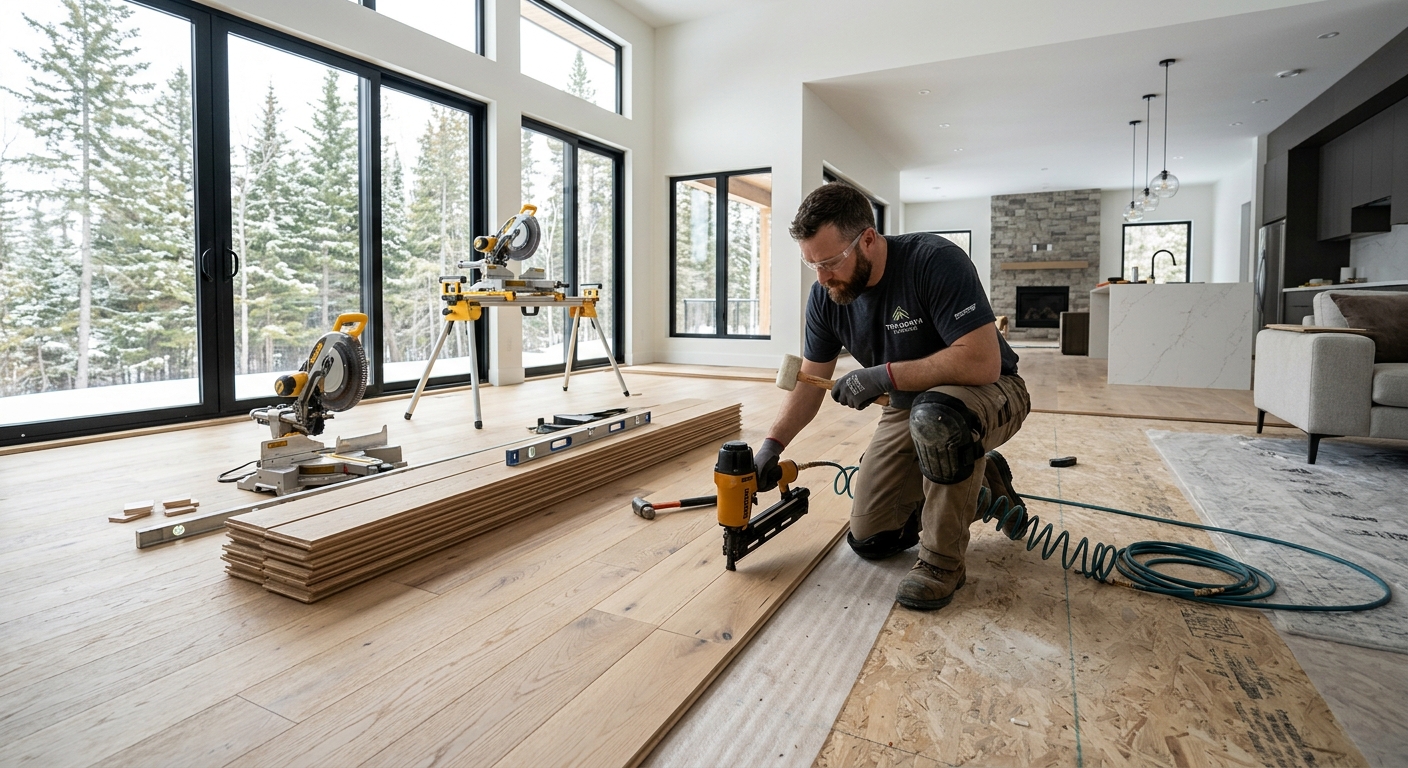
Flooring options and costs in Nanton
Nanton homeowners usually want flooring that looks great in the main living areas, but also performs reliably through Alberta’s seasonal swings. With a population of 2,167 and about 80.1% of households owning (Statistics Canada, 2021 Census), it’s common to see renovation projects where we’re upgrading both appearance and performance. One reason pricing varies early in the conversation is housing age: 52.9% of homes were built before 1981 (Statistics Canada, 2021 Census). Older subfloors often need levelling compound, repairs, or sometimes an OSB/plywood overlay before install, which can add a meaningful labour and material premium.
In the Lethbridge–Medicine Hat economic region, indoor humidity can swing widely, and basements and concrete slabs often run cool and slightly damp. That’s why moisture management is a core cost driver—especially on below-grade installs. In Nanton, trades are often busy around established residential pockets such as downtown Nanton / Main Street where many homes are staged for sales and fast refreshes. If your project includes radiant heat (common in newer or renovated houses), material compatibility also affects cost and product selection.
Below are typical flooring price bands for this region, so you can compare options quickly. Use the table as a starting point, then we’ll tighten the estimate once we’ve confirmed subfloor condition, moisture testing results, and whether stair transitions and removal are included.
| Type |
Best Room |
Moisture Resistance |
Lifespan |
Price per sq ft |
| Solid hardwood (nail-down, above grade only) |
Living / dining (above grade) |
Low to moderate (needs stable humidity; not for basements) |
25–50 years |
$10–$18 |
| Engineered hardwood (float or glue, above + on-grade) |
Living / dining / bedrooms |
Moderate to good (handles seasonal swings better) |
20–35 years |
$11–$17 |
| Laminate (click-lock, above-grade) |
Bedrooms / living (dry areas) |
Moderate (sensitive to standing water) |
10–20 years |
$4–$9 |
| Luxury vinyl plank / LVP (waterproof, any level) |
Kitchen / basement / main floor |
High (waterproof; tolerant of humidity changes) |
15–25 years |
$6–$11 |
| Porcelain / ceramic tile |
Kitchen / bathroom (and entry) |
Very high (excellent for wet areas) |
25–50 years |
$12–$22 |
| Carpet (broadloom or modular tile) |
Bedrooms / stairs |
Low to moderate (avoid below-grade without proper moisture control) |
8–15 years |
$5–$14 |
Prices are estimates only and vary by project scope, site access and material selection.
What affects the price of flooring in Nanton
In Nanton and across Alberta, two quotes for the “same floor” can differ by 30–50% because the hidden work (prep, moisture management, transitions, and subfloor corrections) is rarely identical. In Lethbridge–Medicine Hat-area basements and slab-on-grade situations, moisture and temperature conditions often demand testing and additional prep. That matters even before you choose a finish: older regional housing stock is more likely to have uneven or aging subfloors, so levelling compound, new plywood/OSB, or moisture barriers can add a noticeable labour and material premium before the finish goes down.
Indoor humidity swings also affect what materials we can install and how carefully we must prep. Solid hardwood expands and contracts with humidity, so it can’t be glued or floated over concrete and it performs poorly in basements. Engineered hardwood and luxury vinyl plank (LVP) tolerate seasonal humidity changes far better, so they’re frequently recommended for below-grade or cool slab areas. Colder winters in Alberta make radiant heat compatibility a major decision point: most LVP, many tiles, and quality engineered hardwood work with radiant heat, while solid hardwood has stricter requirements.
For concrete examples in Nanton: if your living floor is above grade but the subfloor has dips, levelling may move you from the lower laminate band (around $4–$9/sq ft) to the higher prep-inclusive range. If you’re converting a basement from old carpet to LVP, waterproof performance may keep you near the $6–$11/sq ft material pricing, while adding moisture testing and a smoother slab can push total costs upward. In contrast, a solid hardwood plan above grade might start in the $10–$18 band, but if humidity control isn’t realistic, the “lower-looking” initial quote can become a poor-fit expense.
| Price Factor |
Why It Matters |
Cost Impact |
| Room area in sq ft |
Material and labour scale directly with square footage |
Large rooms can reduce per-sq-ft waste but increase overall project cost |
| Subfloor condition |
Levelling/repair is essential for a flat, stable finish |
Repairs/levelling often add roughly $1–$4 per sq ft depending on scope |
| Moisture / below-grade install |
Rules out solid hardwood; requires testing and barriers on slabs |
Can add testing and prep labour; switches you to engineered hardwood/LVP |
| Material choice |
Solid vs engineered vs LVP vs tile changes stability and install complexity |
Tile typically runs higher; LVP usually sits mid-range; solid hardwood is often the most expensive per sq ft |
| Removal and disposal of existing flooring |
Old flooring adds labour and tipping/disposal costs |
Often a major portion of the “quote gap” between contractors |
| Stair nosing / transitions |
Transitions at doorways and stair components are detail-intensive |
Charged per step or per linear foot; can add a noticeable premium |
| Radiant heat compatibility |
Not every product/underlay combination is rated for radiant systems |
May increase material cost or limit your options |
| Installation method |
Float vs glue-down vs nail-down affects prep and labour time |
Glue-down and tile setting can raise labour; nail-down solid hardwood needs stricter conditions |
Permits & regulations in Alberta
In Alberta, installing flooring by itself generally does not require a building permit. For most Nanton homeowners, the “flooring permit” question only becomes relevant when the project includes associated work that touches electrical, structural components, or in-floor heating systems. For example, if you’re altering or adding circuits for radiant heat, that electrical work may require an electrical permit and qualified inspection. Similarly, significant subfloor reconstruction (for instance, structural repairs) can change the scope into work that may need permitting depending on what’s being replaced and how it’s tied into the structure.
In condos or multi-unit buildings, the building’s rules can be as important as provincial requirements. Sound transmission is commonly addressed through underlay and floor build-up to meet the building’s STC/IIC expectations. Before installing hardwood or tile on an upper-level unit, review the condo declaration and ask for written board approval if required—especially if you’re planning a hard surface over existing underlay or a change to the floor assembly.
To verify your contractor in Nanton, start by asking for proof of:
- Valid Alberta licence/registration information (where applicable to their trade category)
- Liability insurance certificate (request the COI naming you as an additional insured if possible)
- WSIB/WCB coverage (clearance letter or proof of coverage number)
- Warranty paperwork for workmanship and the product warranty term
Then confirm details by checking the insurer clearance (for WCB), reviewing the certificate expiry dates, and matching the coverage to the contractor’s legal business name.
Best flooring for each room in your Nanton home
In Nanton, the “best” flooring usually comes down to moisture exposure, foot traffic, comfort needs, and how the basement or slab behaves during Alberta temperature swings. With many homes having older construction (52.9% built before 1981) and a common finished-basement reality, moisture management is often the deciding factor. For living and dining areas, engineered hardwood or high-quality laminate balances warmth with durability and is typically easier to live with during humidity changes than solid hardwood.
For the master bedroom, carpet is hard to beat for comfort and sound dampening, especially on colder mornings; it also works well if the bedroom is above grade and stays dry. In the kitchen, choose luxury vinyl plank (LVP) or large-format porcelain tile—both handle spills and frequent cleanups. For the basement (finished), LVP is often the clear winner: it’s waterproof and generally performs better over cool, potentially damp concrete and vapour conditions than solid wood and most laminate. Bathrooms should be porcelain or ceramic tile only due to water exposure.
Radiant heat compatibility matters too. If your living area or basement uses in-floor heating, most LVP, many tile systems, and quality engineered hardwood can be installed with appropriate underlays and adhesives. Solid hardwood is more demanding: without strict temperature and humidity control, it’s more likely to gap.
Cost-wise, the “right choice” can still be cost-effective. For instance, if you compare LVP at roughly $6–$11/sq ft to tile at $12–$22/sq ft, tile in a bathroom can be worth it because it stays serviceable for decades under wet conditions, while LVP in the basement avoids the riskier behaviour of solid hardwood in cool, humid spaces.
| Room |
Best Material |
Why |
Moisture Risk |
Price Band per sq ft |
| Living / dining room |
Engineered hardwood |
Comfortable warmth, good stability for humidity swings, and cleaner radiant compatibility than solid |
Low (above grade), but varies with household humidity |
$11–$17 |
| Master bedroom |
Carpet or engineered hardwood |
Carpet adds softness and noise reduction; engineered keeps a cleaner, hypoallergenic option |
Low if above grade and well ventilated |
$5–$14 |
| Secondary bedrooms |
Laminate or carpet |
Laminate offers an easy-clean surface; carpet helps with comfort and sound in kids’ rooms |
Low (above grade) when spills are handled quickly |
$4–$9 |
| Kitchen |
Luxury vinyl plank (LVP) or porcelain tile |
LVP is forgiving for dropped items; tile is ideal if you want maximum moisture and scratch resistance |
Medium (spills, humidity near cooking) |
$6–$22 |
| Basement (finished) |
Luxury vinyl plank (LVP) |
Waterproof performance and better tolerance for below-grade humidity and cool slabs |
High (compared with above grade; requires moisture-aware installation) |
$6–$11 |
| Bathroom |
Porcelain / ceramic tile |
Built for wet areas; durable grout and long service life when installed correctly |
Very high (direct water exposure) |
$12–$22 |
How to choose a flooring contractor in Nanton
Choosing a flooring contractor in Nanton is mostly about verifying three things: legal coverage, job clarity, and workmanship accountability. First, confirm Alberta liability insurance is current—ask for a certificate of insurance showing the policy holder name matches the contractor you’re hiring. Next, verify WSIB/WCB coverage by requesting proof/clearance information, so you know the installer’s workforce is covered if injuries happen on site. Finally, ask whether the contractor is operating under the correct licensing/registration for the work being done, and request the licence/registration details before scheduling.
Then get 2–3 itemised written quotes. You want a line-by-line breakdown for labour and materials: floor prep/levelling, moisture testing, underlay (if applicable), adhesive (if glue-down), stair nosing, transitions, and removal/disposal. Avoid “lump sum only” quotes that don’t specify what’s included. Read the scope carefully for exclusions such as subfloor replacement, electrical or plumbing adjustments (if any), and whether permits are included where radiant electrical work is involved.
Warranty also matters. Ask for the workmanship warranty length, who provides it, and whether it’s transferable if you sell your home. Confirm the manufacturer product warranty terms too. Payment schedule should be conservative: never pay more than 10–15% upfront, and use a holdback until the job is complete and cleaned. Get a start date and estimated completion timeline in writing.
- Ask for proof of insurance (liability COI) and confirm it’s not expired.
- Request WSIB/WCB clearance information before work starts.
- Verify licence/registration for the type of flooring and any related work they perform.
- Require an itemised quote with labour + materials (no vague “allowance” sections).
- Confirm whether moisture testing and subfloor prep are included.
- Ask what happens if the subfloor is worse than expected (change order rules).
- Check if removal and disposal of old flooring is included.
- Clarify stair nosing, thresholds, and moulding—priced per step or linear foot.
- For radiant heat, ask which products are rated and which underlay/adhesive is used.
- Get exact start date and completion estimate in writing, with weather/day-off assumptions.
- Confirm warranty: workmanship duration, manufacturer warranty, and transferability.
- Agree on payment milestones (10–15% max deposit; holdback until completion).
Concrete red flags I see in the Nanton area: contractors who won’t show insurance/coverage documents; quotes that skip moisture testing or subfloor prep but assume “solid hardwood everywhere”; unusually low pricing that doesn’t include removal/disposal or stair work; vague scopes that don’t list transitions and underlay; and contractors who ask for large deposits early (beyond 10–15%) without a signed, detailed agreement.
Frequently asked questions — flooring in Nanton
What flooring works with radiant heat?
In Nanton and across Alberta, radiant heat compatibility depends on the flooring build-up and the product’s installation requirements. Most LVP is typically considered compatible when it uses the manufacturer-approved underlay or none (as specified), and many porcelain/ceramic tile assemblies are also radiant-friendly when installed with the correct thinset and flatness requirements. Quality engineered hardwood often works with radiant systems because it’s more dimensionally stable than solid hardwood.
Solid hardwood is the most restrictive option: it requires tighter temperature and humidity control to avoid gapping or cupping, and it’s not usually recommended for basements on slab. If you’re looking at a budget plan, LVP in the roughly $6–$11/sq ft band can be a practical match for radiant areas, while tile (often $12–$22/sq ft) can be ideal where you want long-term durability.
Engineered vs solid hardwood — what's the difference?
Solid hardwood is one piece of hardwood cut from a single species, usually installed nail-down (above grade only in most sensible radiant/moisture scenarios). It reacts more to humidity swings and isn’t a good fit over concrete slabs or in basements where conditions can be cool and damp—so it’s not what I’d recommend if you’re targeting below-grade performance in the Lethbridge–Medicine Hat region.
Engineered hardwood uses multiple layers (often a plywood core with a hardwood wear layer). That construction makes it more dimensionally stable through seasonal humidity changes, which is why engineered is commonly chosen for above-grade living spaces and sometimes for on-grade installs. In Nanton homes built before 1981, where subfloors may be uneven, engineered can also be easier to manage because the installation method (floating or glue-down) and prep options are more forgiving. Typical pricing often overlaps with the $10–$18 hardwood range, depending on brand and wear layer.
Do I need to level my subfloor first?
Almost always, yes—at least enough to bring the subfloor to the flatness tolerance required by the flooring system. In Nanton, older housing stock is common (52.9% built before 1981), and it frequently includes dips, old patches, and uneven joist/subfloor conditions. When that happens, the finish flooring can telegraph imperfections, joints can separate (laminate), or tile can crack if the base isn’t solid and flat.
Levelling or repair can raise the job cost, and it’s one reason quotes can differ by 30–50% across the region. As a practical planning figure, subfloor levelling or repair commonly adds about $1–$4 per sq ft depending on how much rebuild is needed. If moisture testing indicates slab dampness, you may also need a moisture barrier system, which is separate from levelling but often priced alongside prep.
What's the most durable flooring for pets and kids?
For pets and kids in Nanton, durability is mainly about scratch resistance, dent resistance, and how the floor handles spills and quick cleanups. LVP is usually the top “all-around” choice because it’s waterproof, tolerates humidity swings better than solid wood, and is generally forgiving under impact. That’s especially valuable if you’re installing over basement concrete where conditions can be cool and slightly damp.
Porcelain tile is also extremely durable and handles water well, but it can be harder/colder underfoot and is more prone to cracked tiles if the substrate isn’t properly levelled and supported. If your home includes radiant heat, LVP remains a common choice, while tile is also radiant-friendly. In terms of budget, you might see LVP plans around $6–$11/sq ft versus carpet at $5–$14/sq ft (with carpet being comfortable but more stain-prone if spills aren’t managed quickly).
How do I choose flooring for humidity in Nanton?
Start with the location of the install: above grade versus below grade. In the Lethbridge–Medicine Hat region, indoor humidity can swing, and below-grade areas are often cooler and more prone to dampness. For that reason, solid hardwood is usually limited to above-grade rooms where you can maintain stable indoor humidity. Engineered hardwood and LVP handle seasonal changes far better, which reduces the risk of gapping or warping.
If you’re planning a basement finish, think “moisture first.” That generally means waterproof LVP, proper moisture testing on concrete, and correct installation details. For above-grade living areas, engineered hardwood is a strong balance of warmth and stability, often aligning with the $10–$18 hardwood price band depending on the product. The key is matching product selection to your actual moisture conditions—because in Nanton’s housing stock (with many homes built before 1981), subfloor issues are common and affect how flooring performs.
Do condos restrict hard flooring?
Yes, often they do—at least in practice—because many condo corporations manage sound transmission (STC/IIC) requirements through building rules and approved floor assemblies. In Alberta, the provincial permitting isn’t the typical hurdle for flooring itself, but the condo declaration and board approval process can restrict hard flooring on upper floors without the right underlay system.
Before you buy engineered hardwood or tile, review your condo documents and ask the board or property manager what underlay is approved and whether they require written approval. Even within allowed materials, the floor build-up matters: insufficient underlay can lead to noise complaints and a requirement to modify. If you’re considering an install near the $10–$18 hardwood band or higher, build in time for approval and documentation, because delays can affect your schedule. When radiant heat isn’t involved, the most common condo issue is sound—so don’t skip the underlay specification.