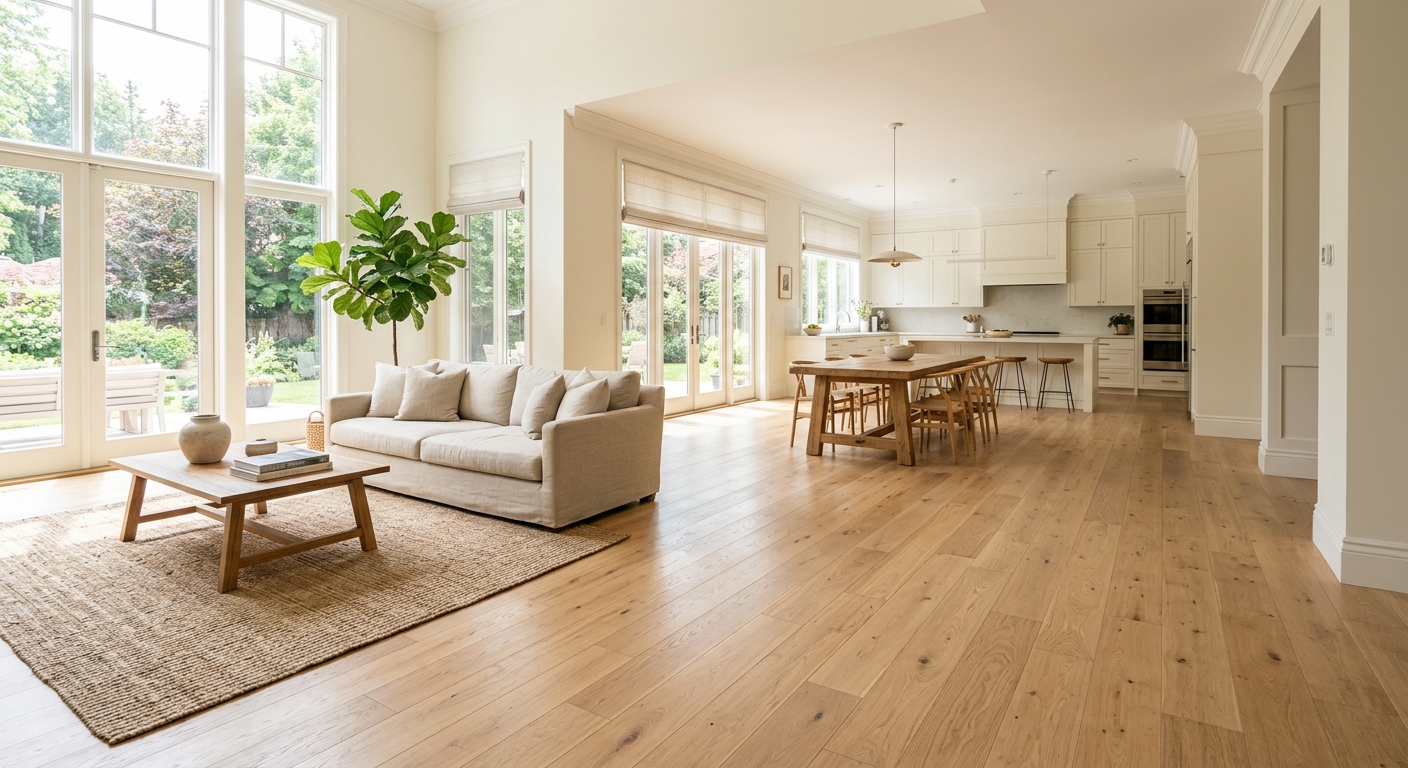
Flooring options and costs in Ogden
Ogden, Alberta homeowners usually price-check flooring the same way: they want something that looks great, feels comfortable underfoot, and survives the region’s dry-cold prairie swings. With Ogden’s population at 8,315 (Statistics Canada, 2021 Census), trades availability is steady, but pricing still reflects the full project scope—especially in older Calgary-area homes where subfloor surfaces aren’t perfectly flat. In practice, that often means levelling or patching before install. When concrete is uneven or plywood is worn down, contractors commonly add prep work, typically in the order of $1–$4 per sq ft depending on how far out-of-level the surface is.
Calgary’s climate is a cost driver because indoor humidity can swing a lot through heating season and spring shoulder months. Solid hardwood expands and contracts with those changes, so it’s typically limited to above-grade installs; it’s not the right choice for basements or over slab without a suitable system. Engineered hardwood and waterproof LVP/SPC usually handle moisture vapour better and are often the safer bet for below-grade areas. If you’re considering radiant heat, colder-region compatibility matters too—most quotes will steer you toward materials that tolerate cycling temperatures.
In Ogden’s established residential pockets—especially around the older sections near 50 Street and the surrounding homes closer to main service corridors—there’s strong demand for engineered hardwood, LVP, and tile because many houses need at least some subfloor repair and careful transition detailing. Use the table below as your quick baseline, then we’ll break down what moves the final number up or down.
| Type |
Best Room |
Moisture Resistance |
Lifespan |
Price per sq ft |
| Solid hardwood (nail-down, above grade only) |
Living rooms, hallways (no basement) |
Low to moderate (above grade only) |
20–35 years |
$8 – $15 |
| Engineered hardwood (float or glue, above + on-grade) |
Main floors, bedrooms |
Moderate to good (with proper underlay and acclimation) |
15–30 years |
$9 – $14 |
| Laminate (click-lock, above-grade) |
Living rooms, bedrooms (avoid long wet exposure) |
Low to moderate (water can swell edges if not wiped) |
10–20 years |
$3 – $7 |
| Luxury vinyl plank / LVP (waterproof, any level) |
Kitchen, main floor, finished basements |
High (waterproof core) |
15–25 years |
$4 – $9 |
| Porcelain / ceramic tile |
Kitchen, bathrooms, entries |
Very high (proper grout and sealing as required) |
25–40 years |
$6 – $12 |
| Carpet (broadloom or modular tile) |
Bedrooms, stairs for comfort |
Moderate (needs quick drying; avoid wet zones) |
8–15 years |
$4 – $8 |
Prices are estimates only and vary by project scope, site access and material selection.
What affects the price of flooring in Ogden
Even when homeowners in Ogden pick the same flooring product line, quotes can still come in 30–50% apart across Calgary and surrounding Alberta communities because labour scope and subfloor preparation aren’t “included by default.” Contractors price based on how much corrective work is required, how many transitions and stair details your layout includes, and how well your existing surface can be made flat and ready for the chosen installation method. In the Calgary area’s dry-cold prairie climate, humidity swings also influence how contractors protect the job—especially for engineered vs. solid hardwood and for moisture-vulnerable below-grade spaces.
Technically, solid hardwood expands and contracts with indoor humidity, so it can’t be installed over concrete basements and isn’t typically the first choice for slab-related moisture migration. That limitation often pushes projects toward engineered hardwood or waterproof LVP/SPC. On the cost side, levelling and repair matter: older regional housing stock frequently needs subfloor levelling or patch repair, and that prep often adds roughly $1–$4 per sq ft. Cold-season radiant heat compatibility can also rule out some solid hardwood and some laminate systems, which forces an upcharge to an approved product.
Concrete examples we see in Ogden: (1) A main floor with aged plywood that’s “wavy” can require flattening and additional labour before tile—tile installs are sensitive to flatness, so levelling and crack-isolation steps can increase total cost. (2) A finished basement with in-slab moisture exposure usually costs more at the start but saves money over the long term when you choose LVP/SPC that tolerates moisture vapour instead of risking solid wood failure. For budgeting, you’ll often see materials land near the laminate/vinyl band of $3–$7 per sq ft or the tile band of $6–$12 per sq ft, but the prep and transitions can be what widen the gap between “cheap” and “done right.”
| Price Factor |
Why It Matters |
Cost Impact |
| Room area in sq ft |
Directly affects material quantity, waste, and labour time |
Scales proportionally; larger jobs reduce per-sq-ft overhead |
| Subfloor condition |
Levelling, patching, or replacement is required for a stable finish |
Commonly adds $1–$4 per sq ft for repair/levelling |
| Moisture / below-grade install |
Rules out solid hardwood and influences underlayment and system build-up |
Can shift material choice to LVP/SPC; adds prep and vapour management |
| Material choice |
Solid vs. engineered vs. LVP vs. tile changes both cost and installation method |
Typically drives the biggest variation; e.g., laminate $3–$7 vs tile $6–$12 |
| Removal and disposal of existing flooring |
Labour and dump fees depend on what’s there (tile, glue residue, underlay) |
Often adds a noticeable line item, especially with tile and stapled subfloors |
| Stair nosing / transitions |
Stairs require extra labour and specific transition details |
Charged per step or per linear foot; can add materially to total |
| Radiant heat compatibility |
Some products/installs can’t handle heating cycles reliably |
May add approved underlay or more suitable material selection |
| Installation method |
Float vs. glue-down vs. nail-down affects prep and labour time |
Glue-down often costs more due to surface prep and adhesives |
Permits & regulations in Alberta
In Alberta, flooring installation itself generally does not require a building permit. That means replacing carpet, laminate, engineered hardwood, LVP, or tile on an existing non-structural floor surface typically doesn’t trigger permitting. However, associated work can require permits—especially when it touches electrical systems or structural/moisture remediation beyond surface patching. For example, if your project includes electrical modifications for radiant heat (new circuits, thermostat wiring changes, or electrical rework), an electrical permit and inspection are commonly required. If your plan includes significant subfloor structural repair or moisture remediation that involves cutting out and rebuilding portions of floor assemblies, permits may come into play depending on how the work is classified.
For condos in the Calgary region (including Ogden-area multi-unit buildings), the corporation’s rules on sound transmission are a big practical constraint. Even when a permit isn’t required, you should review the condo declaration and ask for written board approval if you’re planning hard surfaces on upper floors. Many corporations restrict or require specific underlay systems to protect STC/IIC performance.
Step-by-step to verify your contractor in Ogden: first, ask for their Alberta business number and confirm they’re operating legally. Next, request a certificate of insurance (general liability) and verify it’s current. Then confirm WSIB/WCB coverage—ask for the clearance letter or proof of account status. Finally, don’t rely on a verbal promise: keep copies of the insurance and clearance documents in your file, and make sure they match the scope in the signed contract.
Best flooring for each room in your Ogden home
The best flooring in an Ogden home is the one that matches your room’s moisture exposure, traffic level, and comfort needs—while also respecting Alberta’s indoor humidity swings and the realities of older housing stock. In living and dining areas, homeowners often choose engineered hardwood or high-quality laminate to balance warmth, appearance, and durability. For bedrooms, carpet remains popular because it cushions footsteps and reduces sound transfer—especially valuable on multi-level layouts.
Kitchens and entryways take more abuse: grit, occasional water tracking, and spills. That’s where luxury vinyl plank (LVP) or large-format porcelain tile shines. LVP is waterproof and more forgiving over minor subfloor imperfections, while tile offers maximum moisture resistance and a long service life. In basements (when finished), waterproof LVP is usually the clear winner in the Calgary region. Solid hardwood is typically limited to above-grade, and most laminate struggles if moisture vapour migrates through concrete.
Bathrooms should be porcelain or ceramic tile only, with proper substrate prep and installation details. If your home has radiant heat, confirm compatibility before you buy—some solid hardwood and laminate systems aren’t suitable for heating-cycle temperature changes. For example, upgrading from a laminate band ($3–$7 per sq ft) to LVP or engineered in targeted areas can be justified: you pay more upfront, but you reduce the risk of edge swelling or cupping during seasonal humidity changes.
| Room |
Best Material |
Why |
Moisture Risk |
Price Band per sq ft |
| Living / dining room |
Engineered hardwood |
Warm look with improved stability for Alberta humidity swings |
Low to moderate (manage indoor RH) |
$9 – $14 |
| Master bedroom |
Carpet or engineered hardwood |
Comfort and sound control; engineered handles daily humidity better than solid |
Low |
$4 – $14 |
| Secondary bedrooms |
Carpet or laminate |
Good value, easy maintenance, and comfortable for kids’ play areas |
Low |
$3 – $8 |
| Kitchen |
LVP or porcelain tile |
Handles spills and frequent cleanings; LVP is faster to install over imperfect floors |
Moderate to high (spills and wet cleanup) |
$4 – $12 |
| Basement (finished) |
Waterproof LVP (or SPC) |
Best match for below-grade moisture vapour and seasonal swings |
High |
$4 – $9 |
| Bathroom |
Porcelain / ceramic tile |
Maximum water tolerance and longevity |
Very high |
$6 – $12 |
How to choose a flooring contractor in Ogden
Choosing a contractor is where you protect your budget in Ogden. Start with Alberta compliance: ask for proof of current general liability insurance and verify the certificate shows the correct legal name and address. Next, confirm WSIB/WCB coverage—request the clearance letter or proof of account status rather than accepting a photo of a policy alone. If the quote includes work that involves electrical modifications for radiant heat controls, make sure electrical permits and appropriate licensed electrical work are handled.
Then, get 2–3 itemised written quotes. Each quote should list labour and materials separately, including underlay/vapour barriers, patch/levelling supplies, transition pieces, stair nosing details, and adhesive systems (if applicable). Read the scope line-by-line: is removal and disposal included, are trim re-installs included, and are furniture moving and door undercutting included? Ask whether a permit is required for any associated work and whether the contractor will manage it.
Warranty matters too. Confirm the workmanship warranty length, whether it covers subfloor prep issues, and whether it’s transferable if you sell your home. For payment, never pay more than about 10–15% upfront; hold back funds until the job is complete and you’ve inspected key areas. Finally, require a written start date and completion estimate so you can plan your move-in and finish trades.
- Request Alberta insurance certificate (general liability) and confirm coverage dates.
- Ask for WSIB/WCB clearance letter or proof of account status for the installing crew.
- Get 2–3 quotes with labour and materials separated (no “lump sum” only).
- Confirm levelling/repair scope: what’s included and what’s “extra”?
- Verify moisture plan: vapour barrier/underlay details for LVP/SPC or engineered.
- Check stair pricing: per step or per linear foot, and what trim/nosing is used.
- Ensure transitions are specified (T-mouldings, reducers, stair transitions).
- Ask how waste and offcuts are handled (waste factor and measurement method).
- Confirm trim handling: remove/reinstall baseboards, quarter-round, and thresholds.
- Ask whether subfloor flatness requirements are measured before installation.
- Review warranty terms in writing (labour only vs labour + materials exclusions).
- Agree on payment schedule: 10–15% upfront max; holdback at substantial completion.
In Ogden, a few red flags show up repeatedly: (1) a quote that won’t specify underlay/vapour barrier for LVP/SPC or doesn’t mention moisture conditions, (2) promises of “solid hardwood anywhere in the house” for basements, (3) no itemized breakdown for levelling, transitions, and disposal, (4) warranty terms that are vague or only offered verbally, and (5) refusing to provide insurance/WSIB/WCB documentation before starting.
Frequently asked questions — flooring in Ogden
What's the most durable flooring for pets and kids?
If you’re choosing for pets and kids in Ogden, the top durability picks are usually waterproof LVP/SPC and porcelain/ceramic tile. LVP is forgiving—if a spill happens, it’s far less likely to swell than laminate, and it cleans up quickly. Tile is even tougher against claws and accidents, though it can be harder and colder underfoot. Carpet can work in bedrooms because it’s comfortable, but it’s typically the least durable if you expect frequent wet messes. For a realistic budget anchor, homeowners often see LVP in the $4–$9 per sq ft band and tile in the $6–$12 per sq ft band, depending on product quality and prep needs.
How do I choose flooring for humidity in Ogden?
Humidity is where Ogden and the wider Calgary area really matters. Winters are dry and indoor heating can reduce relative humidity, while spring and shoulder seasons can bring swings that affect materials. Solid hardwood expands and contracts, so it’s generally restricted to above-grade installs and requires good acclimation and indoor climate control. Engineered hardwood is more stable and often performs better on main floors when installed correctly with the right system. For basements, LVP/SPC is typically the safest choice because it’s waterproof and better tolerates below-grade moisture vapour migration through concrete. If your home has a history of musty odours or damp patches, build the moisture plan into your quote.
Do condos restrict hard flooring?
Often, yes—hard flooring in condo buildings frequently comes with sound-transmission requirements even when a building permit isn’t required. Many condo boards regulate what underlay you can use under hardwood, tile, or LVP on upper floors to meet STC/IIC expectations. In Ogden-area condos, you should request written approval before installing hard surfaces, especially if the building has had complaints about impact noise. Your contractor should be able to recommend an underlay that matches the condo’s specifications. This is also why quotes can vary: a “cheap” hard-floor install without the approved underlay or proper underlayment system can lead to rework and extra cost.
How do I compare flooring quotes?
To compare quotes fairly in Alberta, treat them like apples-to-apples scopes. Ask each contractor for an itemized breakdown: material, labour, underlay/vapour barrier, levelling/patching, removal and disposal, stair work, and trim reinstallation. A quote can look lower but hide costs like floor prep—especially in older housing stock where levelling can add around $1–$4 per sq ft. Confirm whether the price assumes level subfloors, and whether tile includes crack isolation membranes and flatness corrections. Also compare warranties and payment terms. If one proposal lists laminate at $3–$7 per sq ft but another includes heavy levelling and proper underlayment, the “higher” quote may actually be more cost-effective.
Can I install flooring over existing tile in Ogden?
Sometimes, but it depends on flatness, height transitions, and the condition of the tile and grout. LVP can often be installed over properly prepared tile if the surface is stable, well-bonded, and flat enough for the system, with the right underlayment (or no underlayment if the product calls for it). However, tile-to-tile bumps, cracked grout, or hollow sections can telegraph through the new floor. Laminate and engineered flooring also require careful evaluation because the subfloor must meet flatness and stability standards. In many Ogden projects, contractors will either prep the tile (grind and level high spots) or remove it to avoid future movement and to control total floor height—especially where stairs and door clearances are involved.
What is the best flooring for a high-traffic area in Ogden?
For high-traffic areas—entries, hallways, and open living spaces—durability and cleanability are key in Ogden’s climate. Waterproof LVP/SPC is a strong choice because it handles tracked-in moisture and quick cleanups, and it’s typically more forgiving over minor subfloor irregularities. Porcelain or ceramic tile is the toughest option and works especially well where you expect frequent wet cleanup. Engineered hardwood can perform well if it’s installed with the correct system and kept away from long-term moisture exposure. As a price reality check, tile is often in the $6–$12 per sq ft band, while LVP commonly lands in the $4–$9 per sq ft band, and the final cost will still depend on prep, transitions, and stair work.