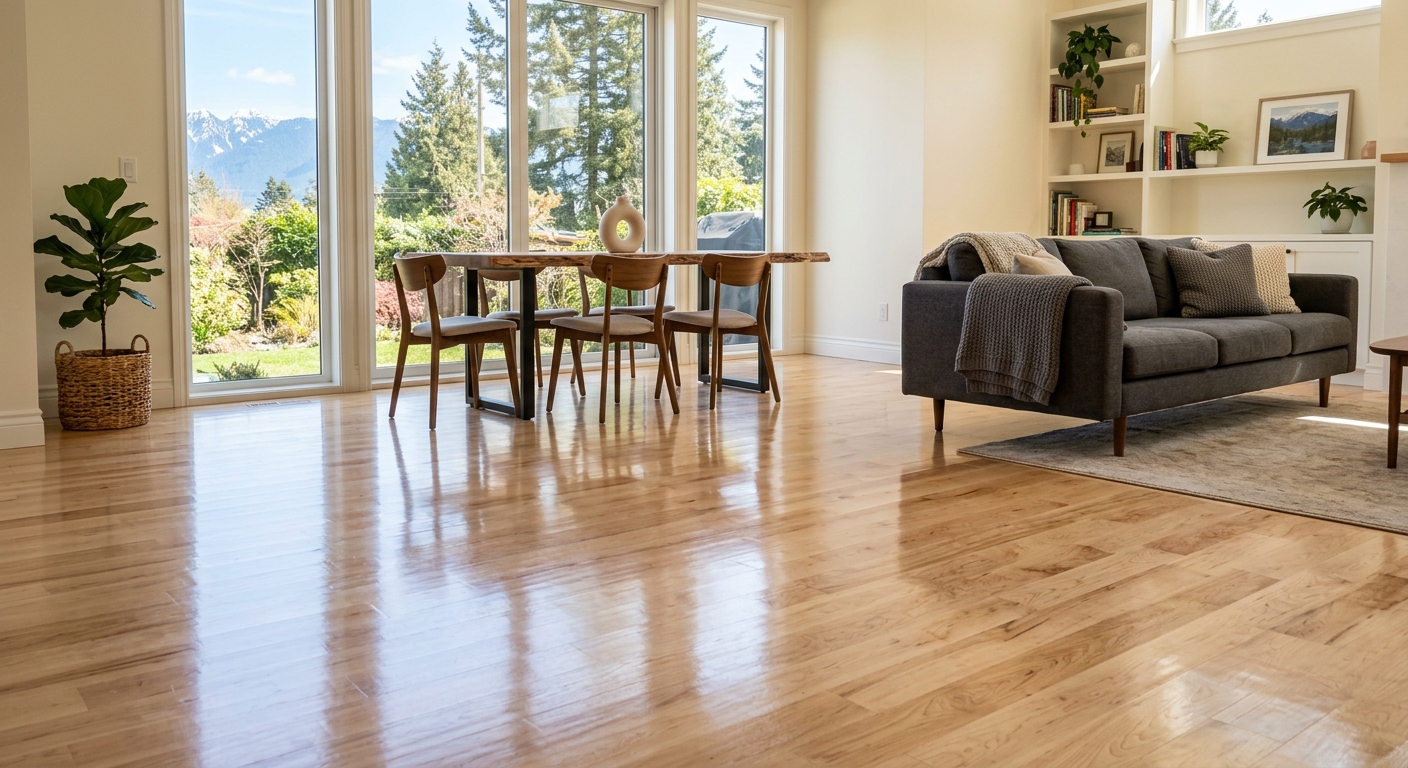
Flooring options and costs in Redcliff
Redcliff homeowners usually have two big flooring realities: most homes are owned (77.1% of households), and a lot of the housing stock is older (54.7% built before 1981). That combination matters because many renovations start with subfloor upgrades—levelling compounds, patching, or adding plywood/OSB to bring the surface up to spec before finish flooring goes down. In the Lethbridge–Medicine Hat economic region, that prep work can be as important as the finish itself, and it’s one reason the same “hardwood” quote can swing noticeably between contractors.
Climate also drives the line-item costs. Lethbridge–Medicine Hat homes see wide indoor humidity swings, plus cool, damp basement conditions in many properties. Solid hardwood expands and contracts with humidity, and it can’t be installed over concrete or below grade in the way engineered hardwood and LVP can. Contractors in Redcliff also deal with radiant heat compatibility: most engineered hardwood and most LVP systems are commonly used over in-floor heating, while solid hardwood typically needs stricter controls to avoid gapping or cupping.
Where this shows up in day-to-day estimating: in older neighbourhood pockets such as the Redcliff East area, finished basements are common and moisture testing/vapour control is frequently added to the scope. Once those technical pieces are accounted for, the remaining price difference usually comes down to product thickness, wear layer (for engineered/LVP), and whether installation is nail-down, float, or glue-down. Use the table below as a practical cost baseline for your comparison.
| Type |
Best Room |
Moisture Resistance |
Lifespan |
Price per sq ft |
| Solid hardwood (nail-down, above grade only) |
Living / dining (above-grade) |
Low to moderate (not for basements/slabs) |
25–50 years |
$10–$18 |
| Engineered hardwood (float or glue, above + on-grade) |
Living areas, bedrooms (above-grade; some systems for on-grade) |
Moderate to high with proper underlayment/moisture control |
20–35 years |
$10–$17 |
| Laminate (click-lock, above-grade) |
Bedrooms, living areas (above-grade) |
Moderate (avoid long-standing moisture) |
10–25 years |
$4–$9 |
| Luxury vinyl plank / LVP (waterproof, any level) |
Kitchen, basement (finished), main-floor zones with spills |
High (waterproof designs) |
15–25 years |
$4–$9 |
| Porcelain / ceramic tile |
Kitchen, bathroom, entryways |
Very high (good for wet areas) |
25–50 years |
$12–$22 |
| Carpet (broadloom or modular tile) |
Bedrooms, basement living spaces (with vapour-aware prep) |
Low to moderate (needs clean, dry subfloor) |
8–15 years |
$4–$10 |
Prices are estimates only and vary by project scope, site access and material selection.
What affects the price of flooring in Redcliff
In Redcliff and across the Lethbridge–Medicine Hat region, two quotes for the same square footage can differ by 30% to 50% because the “hidden scope” is often different—especially around moisture management and subfloor correction. Even when the finish looks similar, contractors may be pricing different preparation levels (patching vs. full levelling), different underlayments (standard vs. vapour-barrier systems), and different installation methods (floating vs. glue-down vs. nail-down). On top of that, older local homes built before 1981 are common (54.7% of dwellings in the area), and those surfaces frequently aren’t flat enough or may need repairs before new flooring can perform as intended (Statistics Canada, 2021 Census).
Technically, indoor humidity swings are a key cost driver in this region. Solid hardwood expands and contracts with humidity, so it can’t go over concrete slabs and performs poorly in basements; that limitation alone changes both product choice and prep. Engineered hardwood and LVP handle humidity and below-grade conditions far better when the moisture testing and underlayment/vapour plan are followed. Colder winters also affect radiant heat compatibility: many engineered hardwoods and quality LVP are commonly rated for in-floor heating, while solid hardwood typically requires stricter temperature and humidity control, which can push customers toward engineered or LVP.
Concrete examples: (1) If your basement slab tests high or uneven, you may need additional moisture barriers and more levelling compound—commonly adding a noticeable premium before LVP goes down. (2) If your subfloor has dips or squeaks, labour to remove old coverings and repair the substrate can make a “$10 per sq ft” look more like the upper band; tile can stay in budget when the floor is already flat, but the same tile job grows expensive quickly when the prep is extensive. In short, regional prep and compatibility decisions often decide whether you land closer to the laminate/LVP band (roughly $4 to $9 per sq ft) or whether your scope pushes you toward hardwood/tile mid-to-upper costs.
| Price Factor |
Why It Matters |
Cost Impact |
| Room area in sq ft |
Material is sold per square foot (plus waste). Labour scales with total footage. |
Direct—bigger areas typically reduce cost per sq ft after fixed mobilization. |
| Subfloor condition |
Old homes often need levelling, patching, or new underlayment. |
Can add about $1 to $4 per sq ft in prep in many renovation cases. |
| Moisture / below-grade install |
Basements and slabs require vapour control and sometimes moisture testing. |
Rules out solid hardwood and often increases prep and materials. |
| Material choice |
Solid vs. engineered vs. LVP vs. tile have different install systems and requirements. |
Changes finish price level substantially (e.g., hardwood $10–$18; LVP/laminate $4–$9; tile $12–$22). |
| Removal and disposal of existing flooring |
Disposal fees, haul-away, and time to remove glued/nailed materials. |
Higher if demo is extensive or involves underlayment/adhesives. |
| Stair nosing / transitions |
Work around steps and transitions is labour-intensive and priced per step/linear foot. |
Can add a meaningful line item even with small square footage. |
| Radiant heat compatibility |
Not all products are rated for in-floor heating performance. |
May limit options or require specific underlayments; reduces risk of callbacks. |
| Installation method |
Float, glue-down, and nail-down each require different prep and tooling. |
Glue-down and nail-down typically increase labour vs. simple floating installs. |
Permits & regulations in Alberta
In Alberta, installing new floor coverings typically does not require a building permit by itself. The project is usually treated as interior finishing. However, permits can become relevant when the flooring project includes associated work that affects electrical systems, structural elements, or in-floor heating components.
Work that may require a permit can include changes to in-floor heating circuits (electrical work), rewiring, or any adjustments tied to electrical components powering radiant systems. If your flooring plan includes electrical alterations, you should confirm permit requirements with a qualified electrician before installation. Work that typically does not require a permit includes ripping up and replacing flooring, installing LVP/laminate over an approved underlay, tile installation over properly prepared surfaces, or redoing baseboards/trim—so long as you’re not altering structural elements or electrical wiring.
In condominiums, there’s another layer: even if permits aren’t required, the condo corporation often restricts sound transmission. For hard flooring on upper floors, you may need specific underlay that targets STC/IIC performance, and you should request board approval in writing before installing hardwood or tile.
To verify your contractor in Redcliff: (1) confirm their Alberta registration/licensing information from the appropriate online registry, (2) request a certificate of insurance showing liability coverage, (3) confirm WSIB/WCB coverage status (or the applicable proof your contractor should provide), and (4) ask for a clearance letter where applicable for your specific scope.
Best flooring for each room in your Redcliff home
Picking the right material in Redcliff comes down to matching moisture exposure, foot traffic, and comfort—then respecting how this region’s humidity and basement conditions affect performance. In living and dining rooms, engineered hardwood or high-quality laminate tends to be a strong balance of warmth and durability. For bedrooms, carpet is a comfortable option and helps with sound absorption; engineered hardwood is also popular where homeowners want a harder feel and easier sweeping.
In kitchens, choose luxury vinyl plank (LVP) or large-format porcelain tile. LVP is forgiving during spills and quick cleanups, and porcelain/ceramic tile handles wet mopping well. For basements (finished), LVP is usually the clearest winner because many slabs run cool and can be damp, and LVP is waterproof and more dimensionally stable through seasonal humidity changes—unlike solid hardwood and most laminate, which are more sensitive to moisture and subfloor conditions.
Bathrooms should be porcelain or ceramic tile only, paired with the correct underlayments and waterproofing system where required. Also consider radiant heat compatibility: in-floor heating is increasingly common in Alberta renovations, and many engineered hardwoods and many LVP products are rated for radiant systems, while solid hardwood often requires stricter controls.
Where price differences make sense: if you’re comparing basement finishes, it’s common for tile (roughly $12–$22 per sq ft) to cost notably more than LVP (roughly $4–$9 per sq ft). In a basement where moisture risk is the primary issue, spending for tile only “buys” aesthetics and longevity if you’re prepared for the added labour and substrate requirements—otherwise, LVP often gives better value for the conditions.
| Room |
Best Material |
Why |
Moisture Risk |
Price Band per sq ft |
| Living / dining room |
Engineered hardwood |
Warm look, better stability than solid wood when humidity swings occur. |
Low to moderate (normal interior conditions) |
$10–$17 |
| Master bedroom |
Carpet or engineered hardwood |
Carpet adds comfort and sound damping; engineered keeps maintenance simple. |
Low (manage indoor humidity) |
$4–$10 |
| Secondary bedrooms |
Laminate (click-lock) or carpet |
Laminate is cost-effective for day-to-day use; carpet is easier on knees and footsteps. |
Low |
$4–$9 |
| Kitchen |
Luxury vinyl plank (LVP) or porcelain tile |
LVP tolerates spills; tile resists wet cleaning and stains. |
Moderate (spills and frequent mopping) |
$4–$22 |
| Basement (finished) |
LVP (waterproof) |
Works better with cool, damp slabs and wide humidity swings; reduces callback risk. |
High (below-grade moisture/vapour) |
$4–$9 |
| Bathroom |
Porcelain / ceramic tile |
Best-in-class moisture tolerance for wet zones. |
Very high |
$12–$22 |
How to choose a flooring contractor in Redcliff
When choosing a flooring contractor in Redcliff, start with proof you’re protected. Ask for their Alberta licensing/registration details (as applicable to their trade), then request a current certificate of liability insurance. For workplace coverage, confirm they have appropriate WSIB/WCB coverage for their installers and request proof (or a clearance letter where required). Don’t accept “we’re covered” without documentation—this is what protects you if there’s an accident on site.
Next, get 2–3 written, itemised quotes with a labour-and-materials breakdown. Avoid vague lump sums where it’s unclear how prep is handled, what underlay is included, and whether moisture testing or levelling is part of the price. Read the scope line-by-line: what’s excluded (old flooring removal, subfloor repairs, transitions on stairs), is permit pulling required (usually only if electrical work is added), and is disposal included?
Warranty matters in flooring. Confirm workmanship warranty length (for installation issues like gapping, edges, or loose tiles), product/manufacturer warranty coverage, and whether warranties are transferable if you sell your home. For payment, never let the schedule climb above 10% to 15% upfront. Hold back until the job is complete and you’ve confirmed measurements, transitions, and baseboard/trim touch-ups.
Finally, insist on a written timeline: start date, estimated duration, and completion target. In this region, a slower schedule sometimes reflects better prep and moisture management—not just more time.
- Provide their Alberta licence/registration details (and reference numbers).
- Show an active certificate of liability insurance.
- Confirm WSIB/WCB coverage with proof/clearance as applicable.
- Quote includes moisture testing where basements/slabs are involved.
- Subfloor prep scope is explicit (levelling compound, patching, plywood/OSB overlays).
- Underlay/vapour-barrier product is named (not “or equivalent” only).
- Labour and materials are itemised separately.
- Removal and disposal of existing flooring is clearly included or excluded.
- Stair nosing and transitions are priced per step or per linear foot with quantities.
- Confirm radiant heat compatibility for your specific product (written confirmation preferred).
- Warranty terms are in writing (labour vs. manufacturer coverage).
- Payment schedule caps upfront deposit at 10% to 15% with a holdback after completion.
Red flags I watch for in Redcliff: they won’t talk about moisture testing or vapour control for basements; they quote solid hardwood for slab installs; they use generic “carpet underlay/foam” wording without specifying the underlay; they won’t list what’s included in subfloor levelling and repairs; or they ask for a large upfront payment (well beyond 10% to 15%) before any prep work starts.
Frequently asked questions — flooring in Redcliff
How do I compare flooring quotes?
To compare flooring quotes in Redcliff (and the Lethbridge–Medicine Hat region), you need to compare the scope, not just the final number. Ask each contractor for an itemised breakdown: material unit price, labour for prep and installation, and line items for removal/disposal, transitions, and stair nosing. Confirm what underlay or vapour barrier is included—especially for basements, where moisture management is a core cost driver. Also verify whether moisture testing and levelling are included; older homes built before 1981 (54.7% locally) often need more prep. For a quick sanity check on finish-only pricing, hardwood often lands around $10–$18 per sq ft, while LVP/laminate typically sits closer to $4–$9 per sq ft. The best quote usually balances prep realism with the right product for humidity and subfloor conditions (Statistics Canada, 2021 Census).
Can I install flooring over existing tile in Redcliff?
You can sometimes install over existing tile in Redcliff, but it depends on tile condition and whether the surface is sound, flat, and properly prepared. If the tile is well-bonded, stable, and within acceptable flatness, some systems (like LVP with the correct underlayment plan, or laminate over a suitable underlay) may be possible. For tile over tile, you typically need a patch/levelling approach and the right substrate prep; for example, high points must be abraded and loose grout/tile must be addressed. If you’re planning engineered hardwood, confirm the manufacturer’s guidance on direct installation over tile and whether an underlayment system is allowed. In older homes, unevenness is common, and that prep can push costs upward even if the finish price looks reasonable.
What is the best flooring for a high-traffic area in Redcliff?
For high-traffic areas in Redcliff, homeowners usually get the best mix of durability and maintenance with engineered hardwood (with a quality wear layer) or waterproof LVP, especially if spills and humidity swings are a concern. Carpet is comfortable but wears faster in heavy traffic and can trap odours if the subfloor ever gets damp. In basements or near entries where moisture can be higher, LVP is often the safest practical choice because it tolerates seasonal humidity changes better than solid hardwood and most laminate. Price-wise, LVP typically falls in the $4–$9 per sq ft band, while higher-end tile can be around $12–$22 per sq ft. If you want a premium hard surface with the lowest moisture risk, tile performs extremely well—just be prepared for the extra prep and labour if the substrate isn’t perfectly flat.
How do I prepare my subfloor before new flooring?
Subfloor prep is where successful Redcliff installs are won or lost. First, measure flatness and address dips—if your surface is uneven, many floors will show gaps, click-lock issues, or cracked grout lines. Second, check for moisture: below-grade slabs and basements in the Lethbridge–Medicine Hat region can run cool and damp, so moisture testing and a vapour barrier plan are common requirements for waterproof flooring systems. Third, repair damaged areas: loose boards, squeaks, and deteriorated OSB/plywood must be corrected before finish flooring goes down. For older homes (54.7% built before 1981 in the local profile), expect that levelling and/or patching is frequently part of the scope. Finally, ensure proper installation conditions—room temperature and humidity must be within the flooring manufacturer’s limits, especially if you’re considering engineered hardwood over radiant heat.
Is cork or bamboo flooring a good choice in Redcliff?
Cork and bamboo can be attractive, but in Redcliff you have to be selective because moisture and humidity swings are real—especially in basements. Cork is resilient and comfortable, yet many cork products are still sensitive to prolonged moisture exposure, so it’s not the best choice for below-grade areas unless you’re using a system designed for those conditions with proper vapour control. Bamboo behaves like hardwood in many respects; solid bamboo generally has the same humidity/installation limitations as solid hardwood, so it’s usually not recommended for slabs or basements. If you love the look, engineered variants are often more workable than solid forms. Practically, most homeowners seeking “moisture-proof and stable” performance in Redcliff gravitate toward engineered hardwood (where allowed) or LVP in the $4–$9 per sq ft band, and keep cork/bamboo for above-grade rooms with stable humidity.
What is the difference between floating and glued-down flooring?
Floating flooring isn’t mechanically fixed to the subfloor; it “floats” on top of an underlayment, usually using click-lock edges for laminate and many engineered products. Glued-down flooring is adhered to the subfloor with a proper adhesive system, which can improve stability on certain substrates—but it also makes prep more critical (flatness, dryness, and substrate suitability). In Redcliff, floating installs are common for laminate and many click-lock products, provided moisture is controlled. Glued-down methods are often used for specific engineered hardwood systems or when a contractor needs extra stability, but they typically require careful subfloor prep and correct adhesive selection. If you’re installing over radiant heat, confirm the product’s installation method and compatibility in writing to avoid performance issues during Alberta’s seasonal humidity and temperature swings.