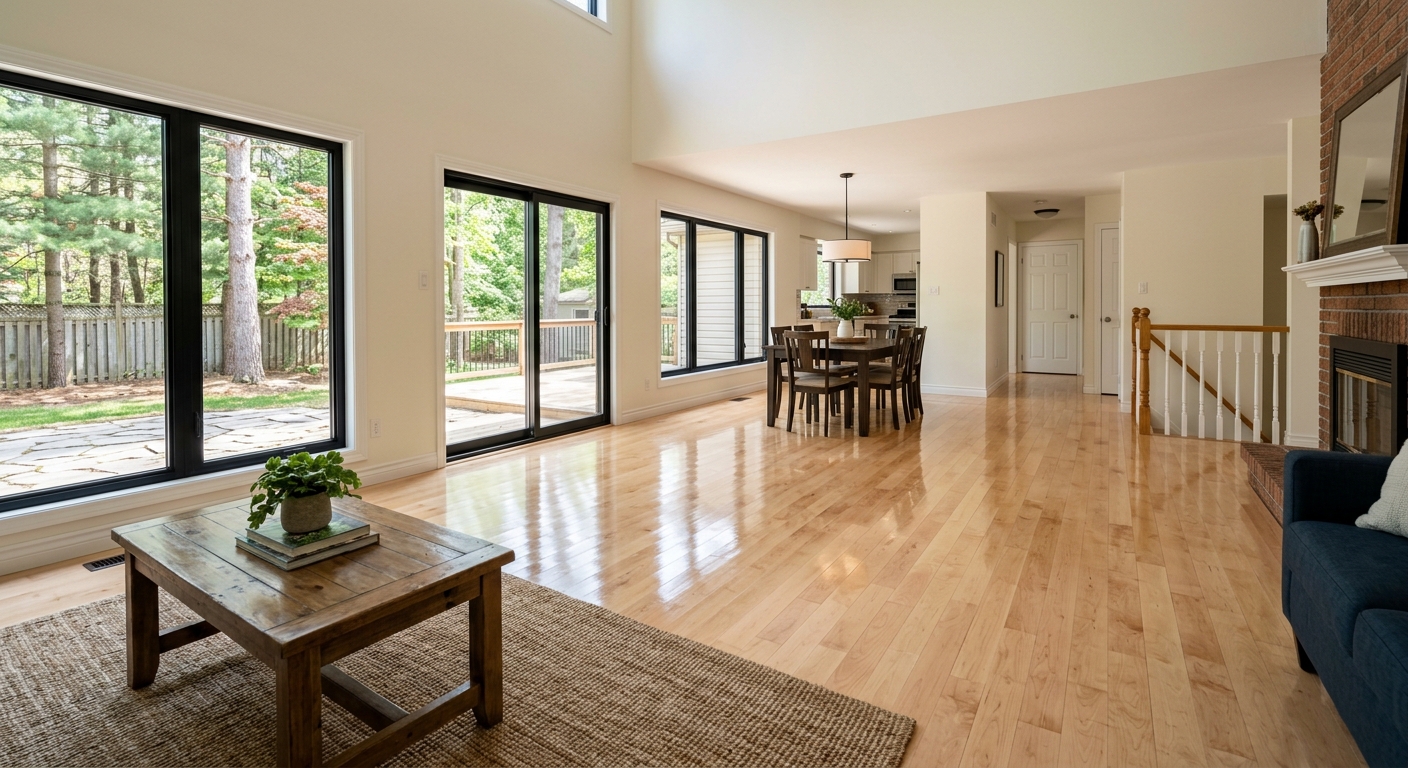
Flooring options and costs in Summerside
Summerside homeowners have a lot of choices, but the right cost and product depend on how Alberta’s prairie climate behaves inside your rooms. With a population of 7,976 (Statistics Canada, 2021 Census), the local market is steady, and that affects scheduling—most flooring crews in the Calgary region book out based on seasonal install demand. Another cost reality in this area is housing age: older homes commonly need subfloor levelling or patching before new flooring can be laid flat, which can add roughly $1–$3 per sq ft depending on how out-of-level the existing base is.
Calgary and surrounding communities see large seasonal humidity swings, and that’s a major driver of flooring expansion/contraction and callback issues. In particular, basements in the Calgary region often experience moisture migration through concrete slabs; that’s why contractors typically steer homeowners toward engineered wood, luxury vinyl plank (LVP) or SPC instead of ¾-inch solid hardwood. Tile can perform exceptionally well, but it’s highly sensitive to surface flatness—if your slab or plywood is uneven, levelling and crack isolation membranes may be budgeted. The same job can also vary by access and labour demands (stair work, removals, and trim reinstallation are common add-ons).
In Summerside specifically, installs are especially in demand around the North-end and older-core streets where many renovations are tied to main-floor updates. Once you pick your material direction, you can compare realistic per-square-foot ranges in the table below.
| Type |
Best Room |
Moisture Resistance |
Lifespan |
Price per sq ft |
| Solid hardwood (nail-down, above grade only) |
Living areas on upper floors |
Low to moderate (humidity-sensitive; avoid basements) |
25–50 years |
$8 – $15 |
| Engineered hardwood (float or glue, above + on-grade) |
Main floors, hallways |
Moderate to high (better with humidity swings) |
20–40 years |
$9 – $14 |
| Laminate (click-lock, above-grade) |
Living rooms, bedrooms |
Low to moderate (water-resistant top, edges can swell) |
12–25 years |
$3 – $7 |
| Luxury vinyl plank / LVP (waterproof, any level) |
Kitchens and finished basements |
High (waterproof core; handles vapour better) |
15–25 years |
$4 – $10 |
| Porcelain / ceramic tile |
Bathrooms and wet zones |
High (properly set with the right membrane) |
25–50 years |
$6 – $12 |
| Carpet (broadloom or modular tile) |
Bedrooms |
Low (needs protection from spills/possible vapour) |
8–15 years |
$3 – $5 |
Prices are estimates only and vary by project scope, site access and material selection.
What affects the price of flooring in Summerside
In Summerside and across the Calgary economic region, quotes for the same-looking job can swing by 30–50% because the “hidden scope” changes: subfloor prep, moisture management, removal/disposal, stair and transition work, and the installation method required for the product. The biggest technical cost drivers are indoor humidity swings and below-grade moisture. In our dry, cold prairie climate, solid hardwood expands and contracts with indoor relative humidity; it’s also not meant to be glued or floated over concrete, so it’s a poor match for basements where vapour can migrate upward. Engineered hardwood and LVP/SPC are more dimensionally stable and are generally safer for on-grade and below-grade applications.
For colder regions like ours, radiant heat compatibility matters too. Many homeowners add or already have in-floor systems, and that can limit solid hardwood choices and some laminate underlay setups. Older housing stock in the region frequently needs levelling—especially basements with inconsistent concrete or main floors that transition between aged plywood sections—so levelling and repair commonly add about $1–$4 per sq ft. If you compare the typical bands, choosing LVP at roughly $4–$10 per sq ft can still be cost-effective versus tile at $6–$12 per sq ft when you factor in how much levelling is required for flatness.
Concrete examples: if your basement slab has minor cracks or moisture-related speckling, some crews budget a crack isolation membrane to protect the floor system (often increasing prep and materials). If you have multiple stair landings or angled stair nosings, stair work can add meaningful labour compared with a straightforward single-level room. And if you’re installing porcelain tile, the tile installer may require a stricter flatness prep than LVP, which can raise the per-square-foot total even when tile material looks similar.
| Price Factor |
Why It Matters |
Cost Impact |
| Room area in sq ft |
Material quantities and labour time scale directly with coverage |
Major driver; small rooms cost more per sq ft |
| Subfloor condition — levelling or repair needed before install |
Uneven surfaces cause gaps, movement, and failures (especially for tile) |
Often adds about $1–$3 per sq ft in older homes |
| Moisture / below-grade install — rules out solid hardwood |
Vapour migration and slab moisture can ruin humidity-sensitive products |
Can add membrane/underlayment prep; increases total by 10–30% |
| Material choice — solid vs. engineered vs. LVP vs. tile |
Different products require different underlay, prep, and install methods |
Shifts you between approximate bands (e.g., $3–$7 vs. $8–$15) |
| Removal and disposal of existing flooring |
Subfloor exposure and hauling affects labour and time |
Often adds a noticeable flat charge plus disposal fees |
| Stair nosing / transitions — charged per step or per linear foot |
Stairs and transitions require custom cutting and extra labour |
Can add several hundred to over $1,000 depending on count |
| Radiant heat compatibility — limits material options |
Heat cycles can affect adhesives, underlay, and dimensional stability |
Sometimes increases costs by selecting compatible products/underlays |
| Installation method — float vs. glue-down vs. nail-down |
Method changes labour intensity and materials (adhesives, moisture barriers) |
Often shifts labour cost by 5–20% for the same floor type |
Permits & regulations in Alberta
In Alberta, flooring installation itself usually does not require a building permit. Replacing floors, installing hardwood/engineered wood, laying LVP/SPC, or setting ceramic/porcelain tile are typically considered a finishing trade activity and fall under the normal scope of residential renovations. However, associated work can trigger permit requirements—this is where homeowners need to be careful. If your project includes structural subfloor repair (e.g., joist repair/replacement or significant framing changes), moisture remediation that changes building systems, or electrical work connected to in-floor heating (thermostat wiring, dedicated circuits, or changing electrical components), permits may be required.
For condos in the Calgary region, the corporation’s rules on sound transmission (often discussed as STC/IIC considerations) may restrict underlay choices for hard-surface flooring on upper floors. Always review your condo declaration and request board approval in writing before installing hardwood or tile above-grade in a multi-unit building—especially when you’ll be using hard flooring without the required underlayment system.
To verify your contractor before signing, follow a practical checklist: (1) confirm their Alberta licence/registration (using the relevant public registry tools available online), (2) request a certificate of insurance and confirm you’re listed for the job, and (3) confirm WSIB/WCB coverage status through proof documentation (ask for the clearance letter if applicable). A reputable Summerside contractor will provide these without hesitation and will match the coverage to your address and scope of work.
Best flooring for each room in your Summerside home
Choosing the right flooring for each space matters in Summerside because our climate cycles can move your flooring system more than in milder regions. Living and dining areas see daily traffic and wide temperature swings from heating season; engineered hardwood (or high-quality laminate where appropriate) is a common balance of warmth, appearance, and durability. For master bedrooms, carpet remains a strong choice because it improves comfort and sound absorption, and it’s typically less exposed to moisture events. If you prefer hard floors, engineered hardwood again performs better than solid oak in Alberta’s humidity swings.
Kitchens take the hardest hits from spills and cleaning. LVP is often the best value because it’s fully waterproof and handles quick wipe-downs without swelling, and it usually comes at a mid-range cost (commonly in the $4–$10 per sq ft band). For bathrooms, porcelain or ceramic tile is the safer long-term pick; but tile requires properly prepped flatness to avoid cracked grout lines, and your quote should address membrane/flatness prep if needed. Basements are where Calgary-area best practices really stand out: LVP is the clear winner for finished basements because it’s more forgiving over slab conditions and better equipped for below-grade moisture vapour. Traditional ¾-inch solid hardwood is not a good fit for basements in our region.
Radiant heat is increasingly common in Alberta new construction. If a room is over in-floor heating, confirm the flooring product is specifically rated for that use and that the underlayment/installation method is compatible.
Example: if your bedroom is $3–$7 per sq ft for laminate versus $8–$15 for solid hardwood, you may not get the performance bump in a bedroom like you would in a main-floor living area—so choosing laminate for the bedroom and investing in engineered hardwood for the main floor can be a smarter budget split.
| Room |
Best Material |
Why |
Moisture Risk |
Price Band per sq ft |
| Living / dining room |
Engineered hardwood |
Warm look with better tolerance for indoor humidity swings than solid wood |
Low to moderate (control humidity and protect from leaks) |
$9 – $14 |
| Master bedroom |
Carpet or engineered hardwood |
Carpet adds comfort and sound control; engineered keeps a harder-wear surface if desired |
Low |
$3 – $5 |
| Secondary bedrooms |
Carpet or laminate |
Cost-effective under typical family traffic; easy to maintain |
Low |
$3 – $7 |
| Kitchen |
Luxury vinyl plank (LVP) |
Waterproof core for spills and everyday cleaning; comfortable underfoot |
Moderate (spills are common) |
$4 – $10 |
| Basement (finished) |
Luxury vinyl plank (LVP) / SPC |
More stable and moisture-tolerant for below-grade conditions than solid hardwood and most laminate |
High (vapour and slab moisture migration) |
$4 – $10 |
| Bathroom |
Porcelain / ceramic tile |
Durable, water-resistant, and repairable long-term when set with the right prep system |
Very high |
$6 – $12 |
How to choose a flooring contractor in Summerside
Start by verifying coverage and credentials. In Alberta, ask for a copy of the contractor’s Alberta licence/registration where applicable, and confirm their liability insurance includes your address and the scope of work. For worker protection, request proof of WSIB/WCB coverage (commonly provided as a clearance letter or coverage documentation). A valid clearance letter and a current insurance certificate should match the timeframe of your project.
Next, get 2–3 itemised written quotes. You want the breakdown separated into labour and materials (including underlayment, levelling/patching, adhesives, membranes, and transitions), not a single lump sum. Read the scope carefully: is furniture moving included? Is removal and disposal included? Is stair labour included or priced per step? If you’re doing tile, ask who is responsible for flatness testing and whether a crack isolation or appropriate membrane is included. Also clarify whether permits (if any associated electrical/structural work is needed) are the contractor’s responsibility.
Warranty matters in Alberta’s dry, cold swings. Confirm workmanship warranty length and whether it’s transferable to you as the homeowner. Then review the product warranty coverage for installation issues (not just manufacturing defects). Finally, payment schedule: never pay more than 10–15% upfront. Use a holdback until the job is complete and clean (final measurements and walk-through done).
- Request itemised labour/material quotes with line items for prep, underlay, and transitions.
- Ask for proof of liability insurance and ensure it names your project/address.
- Confirm WSIB/WCB clearance or coverage letter before work begins.
- Get a written start date and completion timeline with weather/access contingencies.
- Verify disposal is included (especially if old underlay/adhesive must be removed).
- For basements, ask how they manage below-grade moisture (vapour barrier/membranes).
- For tile, confirm flatness requirements and what happens if the slab is out of spec.
- Confirm stair nosing and transitions are priced transparently (per step/linear foot).
- Ask whether they acclimatize products to indoor conditions before installation.
- Review the warranty in writing: workmanship + manufacturer terms, and transferability.
- Agree on a cleanup standard and protection for adjacent floors, doors, and trim.
- Keep holdback until punch list items are corrected and the area is final-clean.
Red flags in Summerside include: quotes that exclude levelling while promising a “perfect finish,” refusing to provide insurance/WSIB proof, adding change orders because prep wasn’t described, vague warranty language (“covers defects” with no duration), and a payment request that exceeds 10–15% upfront without a signed schedule.
Frequently asked questions — flooring in Summerside
What is the best flooring for a high-traffic area in Summerside?
For high-traffic areas in Summerside (entryways, main halls, and busy living rooms), the best mix of durability and cost usually comes down to engineered hardwood or LVP/SPC. Engineered hardwood handles Alberta’s indoor humidity swings better than ¾-inch solid hardwood, while LVP’s waterproof core is tough against tracked-in moisture from boots and everyday spills. In the common contractor bands, LVP often lands around $4 – $10 per sq ft, while engineered hardwood is frequently in the $9 – $14 per sq ft range—so you can choose based on whether you want the most authentic wood look or the most moisture-tolerant surface. If the traffic area includes a basement entry or transitions over concrete, prioritize a moisture-stable system and ensure your installer addresses prep and underlayment compatibility.
How do I prepare my subfloor before new flooring?
Subfloor prep is what separates a long-lasting floor from a costly callback in Alberta. First, measure flatness—tile and most plank systems need the base to be even, and older Summerside homes often have sections of plywood or patched subfloor that aren’t level. Contractors typically remove loose materials, scrape off remnants of old adhesive, and repair soft spots. If the surface is out of level, levelling compounds or underlayment corrections may be required; in the Calgary region, this is commonly budgeted at about $1–$4 per sq ft depending on severity. For below-grade work, address moisture: confirm whether a vapour barrier or the correct underlayment/membrane system is included, since slab moisture migration can ruin humidity-sensitive materials. Always ask your contractor what they do (and what they don’t) for the first 1–2 steps before flooring arrives.
Is cork or bamboo flooring a good choice in Summerside?
Cork and bamboo can look great, but they’re not always the safest choice for Summerside basements or rooms with potential vapour. In Alberta’s dry, cold prairie climate, both materials can respond to indoor humidity changes; bamboo is a form of wood composite, and cork is plant-based, so both can be affected if relative humidity swings are large. Cork is also softer than LVP, meaning it can dent more easily in high-traffic areas and from rolling furniture. For moisture sensitivity, LVP/SPC or tile remains a more predictable option where below-grade moisture migration is possible. If you love cork or bamboo for an upper-floor living area, choose a product designed for your installation method (often floating with appropriate underlay) and confirm it meets manufacturer humidity guidance. For basements, most local crews recommend LVP/SPC instead.
What is the difference between floating and glued-down flooring?
Floating flooring is installed as a system that “locks” together and does not bond to the subfloor. You’ll typically see click-lock laminate and many engineered/rigid core products installed this way, often over an underlayment layer. The benefit is it can handle minor movement and is usually faster to install. Glued-down flooring is bonded directly to the subfloor (common with certain engineered hardwoods and some solid/engineered install specifications). Glue-down can improve stability and reduce some types of movement, but it requires a properly prepared, compatible surface—moisture conditions must be right. In Summerside/Calgary, glued-down methods over concrete demand careful moisture assessment; below-grade installs frequently rule out solid hardwood regardless. If your home has radiant heating, confirm the product allows your method.
What flooring holds up best to pets in a Summerside home?
For pet homes in Summerside, LVP/SPC is often the most forgiving because it’s waterproof and resistant to everyday accidents. A waterproof core helps with spills and quick cleanups without swelling at seams, which can be an issue in laminate. Pair that with a tougher wear layer and a good underlay for comfort, and you’ll usually get better long-term results than carpet or humidity-sensitive hardwood in areas where pets track moisture. If you want a natural look, engineered hardwood can work well on main floors, but it still needs protection from prolonged water exposure and consistent humidity. Carpet is comfortable for pets and quieter underfoot, but it can stain and hold odours if cleaning isn’t immediate. From a budgeting standpoint, many homeowners compare LVP around $4 – $10 per sq ft versus tile around $6 – $12 when they want maximum cleanability.
How do I fix squeaky floors in my Summerside home?
Squeaks are usually a subfloor-to-joist movement issue, not a flooring problem itself. In Summerside and the wider Calgary region, older subfloors can have gaps, loose fasteners, or slight deflection that shows up over time—especially after seasonal humidity changes. The first step is to locate the squeak points and determine whether it’s from the joists, the subfloor panels, or transitions between rooms. Sometimes adding screws through the subfloor into joists from above solves it; other times the fix is from underneath (if accessible), using shims or additional fasteners. If you plan to replace flooring, don’t cover squeaks without correcting the cause—ask your contractor to investigate before installing new material. If the squeak is localized, repairing subfloor movement may be cheaper than re-installing later after the new floor starts showing gaps.