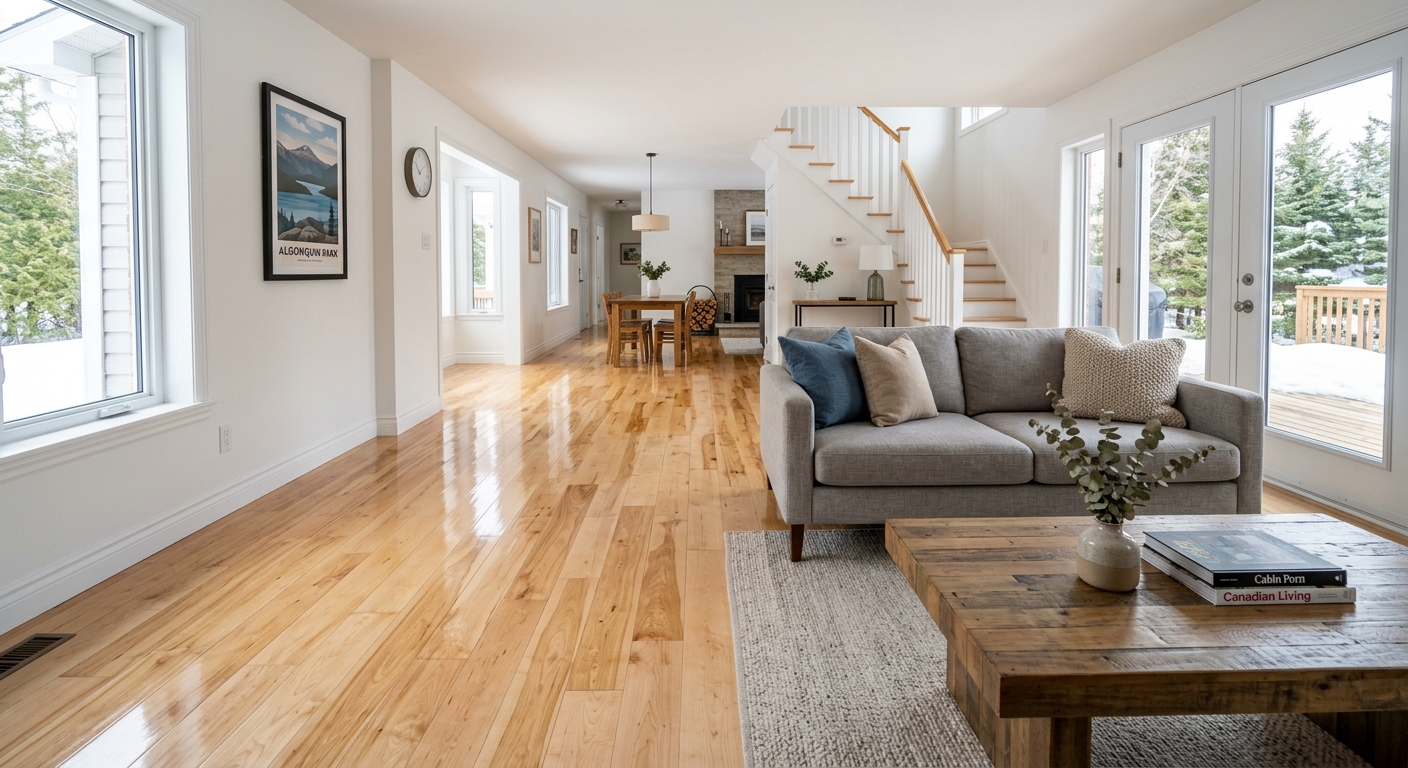
Flooring options and costs in Chetwynd
Chetwynd homeowners have plenty of style choices, but the real cost drivers are usually climate exposure and the condition of older subfloors. In Chetwynd (population 2,302, Statistics Canada, 2021 Census), many homes sit within the typical Northeast B.C. reality: the Peace River area has a large share of housing stock built before 1981 (56.1%), which often means uneven boards, aged underlayment, or a need for patching and levelling before you can install new flooring. Even when the finished look is similar, that prep work can move a project materially.
Northeast winters and the humidity swings inside homes are hard on dimensional products. Solid hardwood can expand and contract with seasonal moisture changes, and it also isn’t the go-to choice for basements or below-grade concrete. That’s why, across Dawson Creek and Fort St. John–style projects in the region, engineered wood and luxury vinyl plank (LVP) are often the most practical value picks: they tolerate moisture fluctuations better and perform better over on-grade or below-grade slab with the right underlayment and prep. Contractors are also more available for LVP and laminate because these systems are straightforward to install and forgiving of minor subfloor irregularities.
In Chetwynd, demand for moisture-tolerant installs is especially noticeable around the residential areas near major road corridors where homes commonly have basements and older concrete sections. From there, it’s a straight comparison of common materials and realistic per-square-foot ranges—see the table below.
| Type |
Best Room |
Moisture Resistance |
Lifespan |
Price per sq ft |
| Solid hardwood (nail-down, above grade only) |
Main floor living areas (dry, controlled humidity) |
Poor in basements; sensitive to humidity swings |
30–60 years |
$11,–$18 |
| Engineered hardwood (float or glue, above + on-grade) |
Main floor; some above-grade hallways/bedrooms |
Good for humidity changes; usually not for wet basements |
20–40 years |
$9,–$16 |
| Laminate (click-lock, above-grade) |
Living/dining, secondary bedrooms |
Moderate—protect from standing water |
10–25 years |
$4,–$10 |
| Luxury vinyl plank / LVP (waterproof, any level) |
Kitchen, basement (finished), entryways |
Excellent—waterproof with proper edge detailing |
15–25 years |
$5,–$12 |
| Porcelain / ceramic tile |
Bathrooms, kitchens, entryways (where you want permanence) |
Excellent—tolerates moisture well |
30+ years |
$12,–$22 |
| Carpet (broadloom or modular tile) |
Bedrooms; basements only if moisture is controlled |
Low to moderate—avoid where dampness occurs |
8–15 years |
$3,–$8 |
Prices are estimates only and vary by project scope, site access and material selection.
What affects the price of flooring in Chetwynd
In the Northeast B.C. market, two quotes for the same room can differ by about 30–50% once you factor prep, moisture management, and how cold-season installation affects schedule and product handling. The technical drivers are indoor humidity swings and below-grade moisture—solid hardwood reacts the most. Solid hardwood expands and contracts with humidity, and it can’t be glued or floated over concrete in the way many homeowners assume; it’s typically limited to above-grade nail-down conditions with tighter moisture control. Engineered hardwood and LVP handle humidity changes far better and are commonly selected for on-grade and basement floors.
Cold regions also change what’s practical. Radiant heat compatibility is a must for many Chetwynd projects where in-floor systems exist or are being added, and that can eliminate some solid hardwood options and portions of laminate if they’re not rated for the required temperature profiles. Older regional housing stock built before 1981 frequently needs levelling or repair; in practice, that’s often a $1–$4 per square foot swing in total installed cost, depending on how much patching and smoothing compound is required.
Concrete examples from similar Chetwynd and Peace River area installs: (1) a basement with “level-looking” but actually uneven slab often requires more self-levelling and crack patching—easy to budget for, but it’s labour-heavy; (2) removing existing carpet plus worn underlay and disposing of debris adds time and tipping fees; (3) choosing tile can feel like a premium jump compared with LVP because the prep and setting work are more labour-intensive, even when both are in the same room.
Those realities help explain why hardwood projects typically land in the $11–$18 per square foot range, while laminate and vinyl are commonly priced in the $4–$10 per square foot bands for value-oriented jobs—prep and moisture conditions are what decide which range you actually end up paying.
| Price Factor |
Why It Matters |
Cost Impact |
| Room area in sq ft |
Larger areas increase both materials and labour time, including waste allowance |
Direct—often the biggest single driver |
| Subfloor condition — levelling or repair needed before install |
Uneven floors require patching/levelling to prevent “bounce,” gaps, and joint failure |
Typically +$1 to +$4/sq ft in older homes |
| Moisture / below-grade install — rules out solid hardwood |
Moisture management dictates product choice and the underlayment system |
Can shift you from solid hardwood pricing to engineered/LVP |
| Material choice — solid vs. engineered vs. LVP vs. tile |
Different systems have different install methods and labour intensity |
Ranges can change by several dollars per sq ft |
| Removal and disposal of existing flooring |
Takes time, may require hauling and handling of old adhesives/underlayment |
Often +$0.50 to +$3/sq ft depending on what’s there |
| Stair nosing / transitions — charged per step or per linear foot |
Special trims and transition pieces aren’t “free” in hard surface conversions |
Can add noticeable project totals, especially on multi-level homes |
| Radiant heat compatibility — limits material options |
Only certain engineered products, LVP, and rated laminates meet temperature requirements |
May increase material cost to stay within manufacturer specs |
| Installation method — float vs. glue-down vs. nail-down |
Method affects labour hours, adhesives, and attention to subfloor tolerances |
Glue-down and tile typically cost more in labour |
Permits & regulations in British Columbia
In British Columbia, installing flooring itself typically does not require a building permit. However, associated work can trigger permits. For example, if the project includes in-floor heating circuit work (electrical connections, thermostat wiring, or changes to the heating controls), that electrical scope can require an electrical permit and must be completed/verified appropriately. If your job involves structural subfloor repair that affects framing or major load-bearing components, that may require permitting depending on the extent and professional involvement.
For condominiums, the building’s rules can matter even when permits don’t. Sound transmission requirements (STC/IIC ratings) often restrict underlay thickness and hard-floor installation details on upper floors. Always review the condo declaration and request board approval in writing before installing hardwood or tile on above-grade floors in a multi-unit building.
To verify a flooring contractor’s credentials in Chetwynd (and anywhere in B.C.), take these steps: (1) Check the provincial licensing/registry information online for the trade and business status; (2) Ask for a certificate of insurance and confirm it covers general liability appropriate to your project; (3) Request proof of coverage for workers (WSIB/WCB coverage) to reduce your risk if there’s an onsite injury; and (4) Ask for a clearance letter where applicable and keep a copy in your records for the contract file.
Best flooring for each room in your Chetwynd home
Choosing the right floor in Chetwynd comes down to traffic, comfort, and how your home handles moisture. In living and dining areas, many households want warmth underfoot without the risk of basement-style moisture swings—engineered hardwood or a high-quality laminate (properly installed with the right underlay) is often a strong balance. For master bedrooms, carpet is still popular because it’s comfortable and helps with sound absorption in older homes, while engineered hardwood remains a good option if you prefer a harder finish and you keep humidity consistent.
Kitchens need easy clean-up and resilience to spills. Luxury vinyl plank (LVP) is usually the best value because it’s waterproof and handles everyday accidents without swelling at seams; large-format porcelain tile is the premium alternative where you want maximum wear resistance and a “forever” finish. Basements are where Northeast B.C. conditions most often dictate a winner: fully waterproof LVP is typically the clear choice for finished basements because it tolerates moisture vapour and below-grade installs far better than solid wood and most laminate systems. Bathrooms should be porcelain or ceramic tile only, with correct waterproofing details at transitions.
Radiant heat compatibility is increasingly common in B.C. new construction and upgrades. If your room is over in-floor heating, prioritize products that are explicitly rated for radiant installations to avoid performance issues and to keep the heating system efficient in colder months.
For example, if you’re comparing LVP versus porcelain tile in a kitchen, LVP commonly lands closer to the $5–$12 per square foot band, while tile is often $12–$22 per square foot. That difference is usually justified when you want tile’s long-term durability and moisture tolerance—not just the appearance.
| Room |
Best Material |
Why |
Moisture Risk |
Price Band per sq ft |
| Living / dining room |
Engineered hardwood |
Warm look, better tolerance than solid wood in real humidity swings |
Low to moderate (above-grade if you control indoor moisture) |
$9,–$16 |
| Master bedroom |
Carpet (or engineered hardwood if you prefer hard surface) |
Comfort and sound reduction; engineered adds easy cleaning |
Low if humidity is managed; avoid if you have persistent dampness |
$3,–$10 |
| Secondary bedrooms |
Laminate (above-grade) or carpet |
Value-focused durability with quicker installation than tile |
Low if above-grade; moderate if basement rooms run humid |
$4,–$8 |
| Kitchen |
Luxury vinyl plank (LVP) |
Waterproof and easy to maintain around spills and frequent cleaning |
Moderate (spills and wet mops are common; LVP handles it well) |
$5,–$12 |
| Basement (finished) |
LVP |
Designed for below-grade moisture conditions and vapour tolerance |
High without waterproofing—LVP reduces risk compared with wood/laminate |
$5,–$12 |
| Bathroom |
Porcelain / ceramic tile |
Best long-term choice where water exposure is routine |
High by definition; tile is the correct surface type |
$12,–$22 |
How to choose a flooring contractor in Chetwynd
When you’re hiring a flooring contractor in Chetwynd, start with proof and process—not just a quote. In British Columbia, verify the contractor’s business/licensing information online and confirm they carry liability insurance that fits your project. Ask for documentation for workers coverage (WSIB/WCB clearance or proof of coverage) so you’re not left holding the cost if there’s an onsite injury.
Next, get 2–3 itemised written quotes that separate labour and materials. You want line items for subfloor preparation (levelling/patching), underlayment, transitions/stair nosing, removal and disposal, and the specific installation method (float vs. glue-down vs. nail-down). A lump-sum quote without detail can hide where the real cost changes happen—especially in older Northeast homes that need prep work before anything new goes down.
Read exclusions carefully: is dust control included? Is permit pull included if electrical work is part of radiant heating updates? Is disposal of old flooring included, or charged separately by weight/truck? Confirm warranty coverage too: a workmanship warranty (often limited in years but clearly stated), the manufacturer warranty on the product, and whether the product warranty transfers if you sell your home. For payment, never pay more than about 10–15% upfront; keep a holdback until the job is complete and you’ve confirmed the floor is installed to spec. Finally, ask for a written start date and a completion estimate.
- Provide B.C. licensing/business verification details and show them before you sign.
- Include a certificate of insurance (liability) naming your address/project.
- Confirm WSIB/WCB clearance or worker coverage documentation.
- Get 2–3 itemised quotes with labour and materials separated.
- Ask exactly what subfloor prep is included (levelling/patching, moisture checks).
- Confirm underlayment/vapour barrier requirements for your specific product.
- Make sure stair nosing and transitions are listed per step or per linear foot.
- Clarify removal and disposal: what’s included and what’s billed separately.
- Verify radiant heat compatibility claims are specific to your product model.
- Ask for start date, expected duration, and rescheduling terms in writing.
- Review warranty terms for workmanship and product (and transferability).
- Use a payment schedule with a 10–15% maximum upfront deposit and a holdback.
Red flags we see too often in the Peace River area: “lump-sum only” quotes with no line items for prep or underlayment; no proof of insurance or workers coverage; promises that solid hardwood will be installed over concrete/basements “no problem”; vague moisture statements like “we’ll just lay it down” without subfloor checks; and rushing timelines without an inspection of flatness/levelness first.
Frequently asked questions — flooring in Chetwynd
Can I install hardwood over concrete?
In Chetwynd and across Northeast B.C., the answer depends on what kind of concrete and what kind of hardwood. Solid hardwood (nail-down) is generally intended for above-grade conditions and doesn’t perform well when moisture conditions are unpredictable. It also can’t be glued or floated over slab the way homeowners sometimes expect. If you have concrete floors, many contractors recommend engineered hardwood instead, because it’s more tolerant of humidity fluctuations when installed according to manufacturer requirements and with correct prep. If your slab is in a basement or below-grade area, the moisture risk goes up, and LVP is often the safer choice.
How long does flooring installation take?
Timelines in British Columbia depend on room size, subfloor prep, and how much removal is needed. For a straightforward above-grade install (flat subfloor, no surprises), LVP or laminate can often be completed in a few working days per typical residence scope. Hardwood and tile usually take longer because prep tolerances are tighter and tile setting plus cure time can extend the schedule. In Chetwynd, older housing stock built before 1981 (56.1% of dwellings, Statistics Canada, 2021 Census) means levelling and patching are common, which can add time even when the finished area looks ready. If radiant heat is involved, product suitability and setting/temperature rules can also affect scheduling.
What flooring works with radiant heat?
Radiant heat compatibility is key in colder parts of B.C., and Chetwynd homeowners often run into this when upgrading main floors or adding a heated bathroom. In general, choose products that are explicitly rated for radiant heating and installed with the manufacturer’s temperature guidelines. Many engineered hardwood products are designed to work with radiant systems when installed within specs, and LVP is commonly used because it tolerates temperature changes better than solid hardwood. Laminate can work only if the manufacturer rates it for radiant heat. Solid hardwood is often limited in radiant setups because of moisture/temperature movement and the stricter install requirements. Your contractor should confirm model-level compatibility, not just “category-level” claims.
Engineered vs solid hardwood — what's the difference?
Solid hardwood is typically one species with a uniform thickness designed for nail-down installation, usually above grade. Because it reacts more strongly to seasonal humidity swings, it’s not a great match for basements or below-grade concrete. Engineered hardwood uses layered construction (a stable core with a hardwood wear layer), making it more tolerant of humidity changes common in Northeast B.C. homes. In practical pricing, solid hardwood commonly falls around the $11–$18 per square foot band, while engineered often comes in around $9–$16 depending on grade and installation method. In a Chetwynd basement, even engineered can be approached cautiously—LVP is usually the more moisture-proof option when below-grade conditions are present.
Do I need to level my subfloor first?
Often, yes—especially in older Northeast B.C. homes like many in Chetwynd where pre-1981 builds are common (56.1% of dwellings, Statistics Canada, 2021 Census). If you install flooring over an uneven subfloor without correction, you can get joint separation (laminate/LVP), soft spots that damage planks, or cracked grout in tile. Levelling doesn’t always mean tearing everything up; it can be patching and smoothing compound, but it needs to be assessed before installation. In quotes, this work is where cost differences show up: subfloor levelling/repair commonly adds around $1–$4 per square foot depending on what’s wrong and how much patching is needed. A good contractor will check flatness/levelness before committing to an install plan.
What's the most durable flooring for pets and kids?
For families in Chetwynd dealing with pets and kids, the most durable choice is usually luxury vinyl plank (LVP) if you need moisture tolerance and easy cleanup. LVP is waterproof and better at handling everyday spills than laminate or solid wood, which is important in homes with basements or humidity swings typical of the Northeast B.C. climate. If you’re cost-sensitive, laminate can be a good option above grade, but it’s not as forgiving of standing water. Tile is extremely durable for wear, but installation is more labour-intensive and harder underfoot. In pricing terms, LVP commonly sits around the $5–$12 per square foot band, while laminate often aligns with the $4–$10 band. For households with frequent accidents or muddy paws, that small cost difference can be worth it.