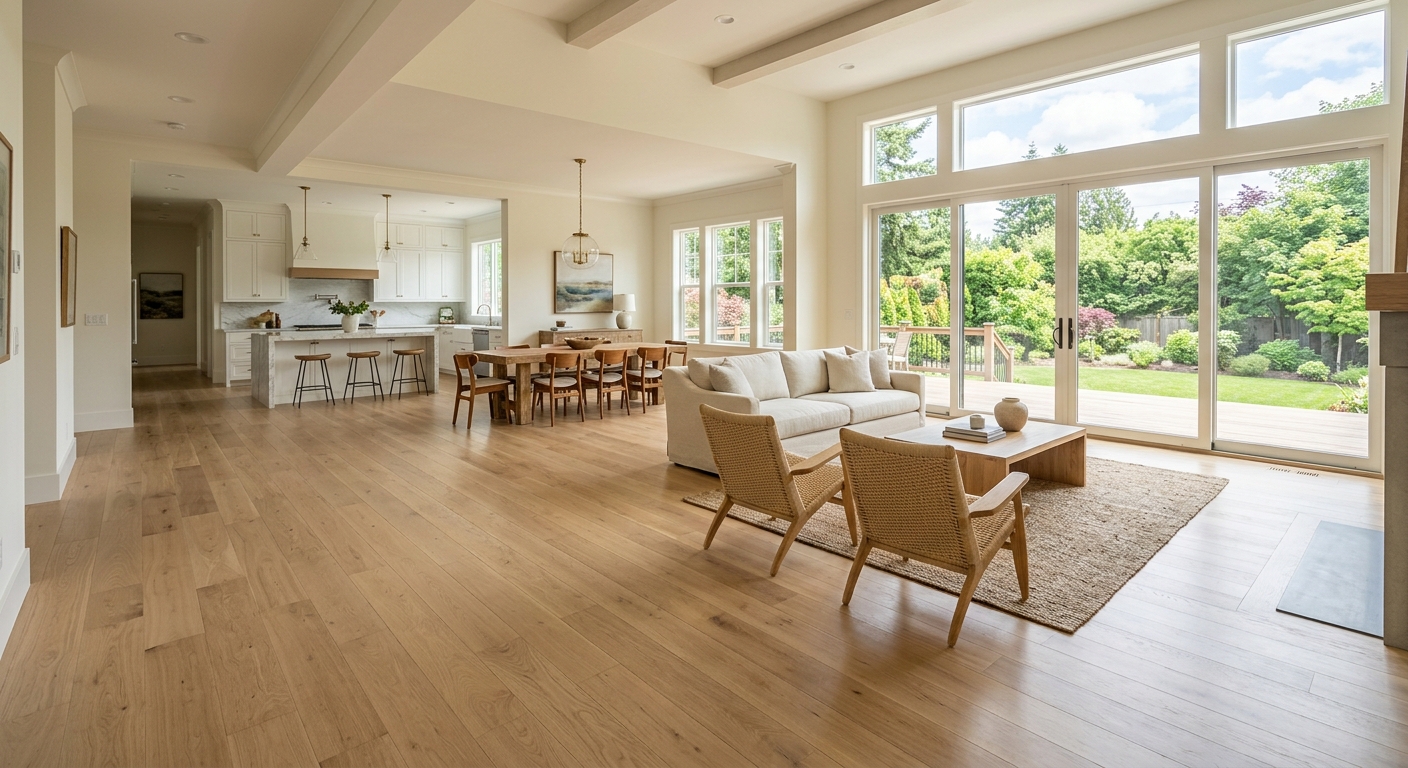
Flooring options and costs in Cameron
Cameron flooring projects tend to start with a simple question—solid hardwood, engineered wood, laminate, tile, or LVP—but the right answer depends on the house you’re working with. With Cameron’s population at 11,844 (Statistics Canada, 2021 Census), local demand supports steady contractor availability, especially in established residential pockets. In the Lower Mainland–Southwest, the wet, marine climate and indoor humidity swings are a constant cost factor: in winter and shoulder seasons, moisture can wick through slab-on-grade and concrete, so below-grade installs need moisture-tolerant products. That’s why we typically avoid solid hardwood below grade and recommend engineered wood or luxury vinyl plank (LVP) where moisture is a concern. Budget also gets shaped by the area’s older housing stock, which often has uneven plywood or concrete subfloors; levelling, moisture barriers, and resurfacing can add roughly $1–$3 per sq ft to many quotes. This is especially noticeable in older streets close to downtown Cameron and the more mature residential corridors where renovations are common.
Contractor pricing in the Lower Mainland–Southwest is also influenced by high labour demand, meaning preparation work (demo, floor flattening, underlayment) can be a big portion of the total. For main living areas above grade, solid hardwood remains popular for its feel and longevity, as long as you leave proper expansion gaps and manage indoor humidity. For basements and any on-grade areas with past dampness, layered flooring systems perform better and reduce callbacks.
Use the table below as a practical starting point before you compare itemised quotes.
| Type |
Best Room |
Moisture Resistance |
Lifespan |
Price per sq ft |
| Solid hardwood (nail-down, above grade only) |
Main living areas |
Low to moderate (humidity sensitive) |
25–50 years |
$9 – $18 |
| Engineered hardwood (float or glue, above + on-grade) |
Main floor & bedrooms |
Moderate (better with humidity swings) |
20–40 years |
$8 – $16 |
| Laminate (click-lock, above-grade) |
Living areas, bedrooms |
Low to moderate (not for wet basements) |
10–25 years |
$4 – $10 |
| Luxury vinyl plank / LVP (waterproof, any level) |
Kitchen, entry, basements |
High (waterproof core) |
15–25 years |
$5 – $12 |
| Porcelain / ceramic tile |
Kitchen, bathrooms |
Very high (water resistant) |
30–50 years |
$10 – $20 |
| Carpet (broadloom or modular tile) |
Bedrooms, stairs (comfort) |
Low to moderate (avoid chronic dampness) |
7–15 years |
$4 – $10 |
Prices are estimates only and vary by project scope, site access and material selection.
What affects the price of flooring in Cameron
Two homeowners can get quotes for the “same” flooring type in Cameron and still see differences of 30% to 50%—and it usually isn’t the product. In the Lower Mainland–Southwest and across British Columbia, labour demand is high, and prep work is what drives variability: levelling an uneven subfloor, handling moisture, removing existing materials, and building proper transitions. Indoor humidity swings are a key technical driver. Solid hardwood expands and contracts with humidity, and it can’t be glued or floated over concrete in the way engineered products can; it performs poorly in basements and other below-grade situations where moisture vapour is more likely. Engineered hardwood and LVP handle humidity and minor temperature changes far better, so they’re often the cost-effective choice when the home has moisture-prone areas.
Colder inland pockets and homes with radiant heating also influence pricing decisions. Radiant heat compatibility rules out most solid hardwood and some laminate products, which can shift your quote to engineered wood, LVP, or tile—often at the upper end of the band. In Cameron, older housing stock can add levelling or repair time; a realistic add-on is about $1–$4 per sq ft depending on how far the subfloor is out of flat and whether patching becomes resurfacing. For example, switching from laminate at roughly $4 – $10 per sq ft to LVP at about $5 – $12 per sq ft may feel like a jump, but in a basement it can be justified because it avoids moisture-related failures that lead to early replacement. Conversely, in a dry main floor, laminate can be the budget win if your subfloor is flat enough for a click-lock install without excessive underlayment build-up.
In practice, we see cost swing based on whether moisture barriers are required, how many stairs need stair nosing, and how much time is spent flattening. Next, the factors below show where your quote is most likely to change between contractors.
| Price Factor |
Why It Matters |
Cost Impact |
| Room area in sq ft |
Material usage and labour hours scale with square footage |
Lower/upper band differences across the same product line |
| Subfloor condition — levelling or repair needed before install |
Concrete and plywood unevenness affects click-lock, underlayment, and adhesive performance |
Typically adds about $1–$4 per sq ft in older homes |
| Moisture / below-grade install — rules out solid hardwood |
Humidity swings can cause cupping/gapping in solid wood |
Shifts you toward engineered wood or LVP; may change your total by 10–25% |
| Material choice — solid vs. engineered vs. LVP vs. tile |
Different systems require different prep, underlay, and installation methods |
Hardwood/Tile often land higher than laminate/LVP |
| Removal and disposal of existing flooring |
Demo time and hauling costs vary with adhesives, nails, and subfloor damage |
Can add a noticeable flat labour fee plus disposal |
| Stair nosing / transitions — charged per step or per linear foot |
Transitions around doorways, closets, and stairs are labour-heavy |
Often increases total cost even when floor area is modest |
| Radiant heat compatibility — limits material options |
Some products can be damaged by temperature changes |
May require engineered/LVP/tile rated for radiant systems |
| Installation method — float vs. glue-down vs. nail-down |
Labour time and materials (adhesives, membranes) differ by method |
Typically changes cost by several dollars per sq ft |
Permits & regulations in British Columbia
In British Columbia, most flooring installation itself does not require a building permit. Installing carpet, laminate, LVP (including waterproof plank systems), and typical above-grade hardwood installs generally fall under “finish work.” However, permits and professional requirements can come into play when the job includes work that touches electrical systems, structural changes, or moisture remediation that goes beyond simple underlay. For example, if you’re installing or altering in-floor heating circuits (radiant systems), that work can require electrical permits depending on the scope. If the subfloor needs structural repair, major remediation, or involves a dryer/venting strategy for chronic moisture, the project may also trigger additional reviews or trades beyond standard flooring.
In condominiums, the building’s bylaws and sound-transmission requirements become the real rule-set. Even when a permit isn’t required for the flooring surface, the strata may require specific underlay thickness, impact-sound control (STC/IIC targets), and board approval—especially for hard flooring on upper floors. Always check the condo declaration and request approval in writing before installing hardwood or tile on multi-unit floors.
To verify your contractor in Cameron and across B.C., check three things in order: (1) licensing status/registration where applicable through official B.C. resources and business listings; (2) liability insurance—ask for a current certificate of insurance that matches the work address; and (3) WCB/WSIB coverage evidence (workers’ compensation coverage). For each, look for dates, policy numbers, and that the certificate includes the right entity and project location. Finally, request clearance letters or proof of coverage as applicable before work begins—don’t wait until the end.
Best flooring for each room in your Cameron home
Choosing flooring in Cameron is mostly about matching material performance to moisture, traffic, and comfort in a home where the Lower Mainland–Southwest climate can create indoor humidity swings year-round. In living and dining areas, engineered hardwood or high-quality laminate is usually the sweet spot: it gives a warmer feel than tile and handles normal humidity changes better than solid wood. For a master bedroom, carpet is often the most comfortable option and helps with sound absorption; if you prefer hard surfaces, engineered hardwood is a strong alternative, particularly if your humidity is stable and the subfloor is flat.
In the kitchen, water exposure is predictable. Luxury vinyl plank (LVP) is a practical choice because it’s waterproof and forgiving around spills and sink leaks. Large-format porcelain tile is also excellent when you want maximum durability and a wipe-clean surface, but expect higher labour due to layout and grout work. Basements are where the climate and local building styles really matter: fully waterproof LVP is the clear winner because it tolerates moisture vapour and below-grade conditions far better than solid hardwood and most laminate. For bathrooms, stick to porcelain or ceramic tile only.
If your home uses radiant heating (increasing in newer builds across B.C.), pick products rated for higher temperatures and proper installation methods. For example, spending the extra dollars on engineered wood or radiant-compatible tile can be justified because callbacks are expensive—repairing a warped floor is never cheaper than selecting the right system up front.
As a dollar sanity check, upgrading from laminate around $4 – $10 per sq ft to LVP around $5 – $12 per sq ft is often only a modest increase on paper, but it can protect your basement investment for the long term.
| Room |
Best Material |
Why |
Moisture Risk |
Price Band per sq ft |
| Living / dining room |
Engineered hardwood |
Warm look with better humidity tolerance than solid |
Low (above-grade) |
$8 – $16 |
| Master bedroom |
Carpet or engineered hardwood |
Comfort and quieter steps; engineered option still looks premium |
Low to moderate (depends on humidity control) |
$4 – $10 |
| Secondary bedrooms |
Laminate (high-quality) or LVP |
Good durability per dollar; LVP gives spill resistance if kids live here |
Low |
$4 – $10 |
| Kitchen |
Luxury vinyl plank (LVP) or porcelain tile |
Easy cleaning; strong performance around wet zones |
Moderate to high (spills, sink area) |
$5 – $20 |
| Basement (finished) |
Luxury vinyl plank (waterproof) |
Designed for moisture vapour and below-grade conditions |
High |
$5 – $12 |
| Bathroom |
Porcelain / ceramic tile |
Water resistant and long lasting |
Very high |
$10 – $20 |
How to choose a flooring contractor in Cameron
When you hire a flooring contractor in Cameron, your goal is to confirm they’re set up for B.C.-style conditions: wet air, humidity swings, and the realities of older subfloors. Start with B.C. coverage checks. Ask for a copy of their liability insurance certificate—make sure it lists the correct business name and covers the work at your address. Confirm workers’ compensation coverage by requesting proof of WSIB/WCB coverage as applicable; a clearance letter or current coverage documentation is typically provided. If the contractor is also doing any related trade work that affects permits (for example, radiant heating electrical hookups), ensure those trades are properly covered and permitted.
Next, require 2–3 itemised written quotes instead of one lump sum. A good estimate breaks out labour and materials (including underlay, adhesives, fasteners, membranes, and transition pieces), plus the cost to remove and dispose of existing flooring. Read the scope carefully: what’s excluded (baseboards, subfloor prep, leveling compound, patch repairs, trim carpentry), is site protection included, and is there a moisture testing or visual inspection step?
Warranty matters for both product and workmanship. Look for the workmanship warranty length, whether it’s in writing, and whether it’s transferable if you sell the home. For payment, never pay more than 10–15% upfront—hold back the balance until the job is complete and inspected. Get your timeline in writing: a start date, milestones (demo/subfloor work/material delivery), and an end date estimate.
- Ask for 2–3 references from similar Lower Mainland–Southwest installs (including at least one moisture-sensitive area like a basement).
- Confirm liability insurance with your address listed on the certificate and verify coverage is current.
- Request proof of WSIB/WCB coverage (and clearance letter if provided) before work begins.
- Get an itemised quote with line-by-line labour, materials, underlay/membranes, and transitions.
- Ensure the quote specifies subfloor prep (flattening/levelling) and how they measure “flat.”
- Ask whether moisture testing is included for below-grade areas and what happens if moisture is detected.
- Clarify removal and disposal: is the haul-away included, and are disposal fees included or separate?
- Confirm who handles baseboards, door trimming, and undercutting (or that those costs are excluded).
- Check that transitions and stair nosing are priced per step or per linear foot when applicable.
- Review warranty details: workmanship duration, product warranty terms, and whether it’s transferable.
- Set a payment schedule in writing with no large upfront deposits (10–15% maximum upfront).
- Require a written start date and completion estimate, plus a process for material delays.
In Cameron, red flags I’ve seen include: (1) quotes that don’t include subfloor levelling or moisture provisions in a basement scenario; (2) insisting on solid hardwood below grade “because we’ve always done it that way”; (3) refusing to provide insurance or proof of workers’ compensation coverage; (4) using only verbal change orders; and (5) charging a large upfront deposit with no written scope or timeline.
Frequently asked questions — flooring in Cameron
How do I fix squeaky floors in my Cameron home?
Squeaks in Cameron are usually caused by movement between joists and subfloor panels, or by loose fasteners in older framing. The first step is to walk the area and identify exactly where the noise happens—then determine whether it’s above a joist, near a seam, or around a stair opening. In many Lower Mainland–Southwest homes, older plywood subfloors flex, especially after humidity swings or seasonal changes. Fixes can include re-screwing subfloor panels into joists (from above if possible), adding blocking, or in some cases using specialized fasteners under flooring. If you’re planning new flooring, don’t just “cover the squeak”—have the contractor stop the movement first. If the squeak is widespread, ask for a short inspection before choosing between laminate, carpet, or LVP, since prep affects lifespan.
What is luxury vinyl plank and is it worth it in Cameron?
Luxury vinyl plank (LVP) is a layered flooring system with a wear layer on top and a vinyl core that can be waterproof, depending on the product line. In Cameron and the Lower Mainland–Southwest, LVP is often worth it because humidity swings and below-grade moisture can cause failures in solid hardwood and many laminate installs. LVP’s waterproof core also helps with everyday spill risk in kitchens and entryways. Typical installed pricing often lands in the $5 – $12 per sq ft range, which can be comparable to or slightly above laminate at $4 – $10 per sq ft—but the real value is moisture tolerance and fewer callbacks in basements. If you’re on a slab-on-grade or you’ve had dampness before, LVP can cost less than redoing a floor that cupped or separated.
How much does flooring cost in Cameron?
In Cameron, flooring costs vary by product type, room size, and how much subfloor prep is needed. As a rough guide, hardwood projects commonly price within the $9 – $18 per sq ft band depending on whether you select solid or engineered wood and how complex the install is. Laminate and vinyl plank commonly fall into the $4 – $10 or $5 – $12 ranges respectively, while tile is often $10 – $20 per sq ft for porcelain/ceramic. Carpet installation is commonly $4 – $8 per sq ft for labour, with total carpet jobs depending on the material you choose. In the Lower Mainland–Southwest, levelling uneven subfloors in older homes can add about $1–$3 per sq ft (sometimes more). That’s why two quotes can differ significantly even when the material price seems similar.
Hardwood vs laminate vs vinyl plank — which is best?
“Best” depends on where you’re installing and how your home handles humidity. Solid hardwood is great above grade in living areas when the indoor environment is stable, but it’s not the right choice for basements or any area with moisture vapour risk. Engineered hardwood is typically the safer hardwood option in Cameron because it handles humidity swings better. Laminate is a budget-friendly choice at about $4 – $10 per sq ft, but it isn’t the best match for wet environments or below-grade installs if moisture is a concern. Luxury vinyl plank (LVP) is often the most forgiving choice in damp-prone areas because many products are waterproof, commonly ranging around $5 – $12 per sq ft. If you tell your contractor whether your area is basement/above grade and whether you have moisture history, the recommendation becomes much clearer.
What flooring is best for a Cameron basement?
For a Cameron basement, LVP is usually the clear winner because it’s designed to handle moisture vapour and below-grade conditions better than solid hardwood and most laminate systems. In the Lower Mainland–Southwest’s wet, marine climate, moisture can wick through concrete in slab-on-grade and similar setups, especially in winter and shoulder seasons. Carpet is also risky because it can trap moisture and lead to odours or damage if the space is chronically damp. If you want a hard-surface look with warmth, engineered wood can work only when the subfloor is properly prepared and the moisture conditions are addressed. But in most practical renovations, waterproof LVP reduces risk the most. Expect pricing often around $5 – $12 per sq ft for LVP installs, plus potential levelling costs if the slab or subfloor isn’t flat.
Can I install hardwood over concrete?
You can install “wood-look” over concrete, but solid hardwood is the tricky one. In British Columbia homes, solid hardwood is typically specified for above-grade only and is sensitive to humidity changes—so it’s usually not recommended directly over concrete slabs or in basements where moisture vapour is present. Engineered hardwood is the more common choice over concrete because many systems can be installed in ways that tolerate humidity better, and you can use the appropriate underlayment/membrane system recommended by the manufacturer. If you have radiant heating, you must follow the product’s temperature limits as well. If your contractor suggests solid hardwood over slab-on-grade, ask how they’ll address moisture testing, vapour control, and the required expansion gap strategy. In Cameron, this question often decides whether your project stays in the $9 – $18 hardwood band for a safe above-grade install or shifts to engineered wood/LVP for moisture-resilient performance.