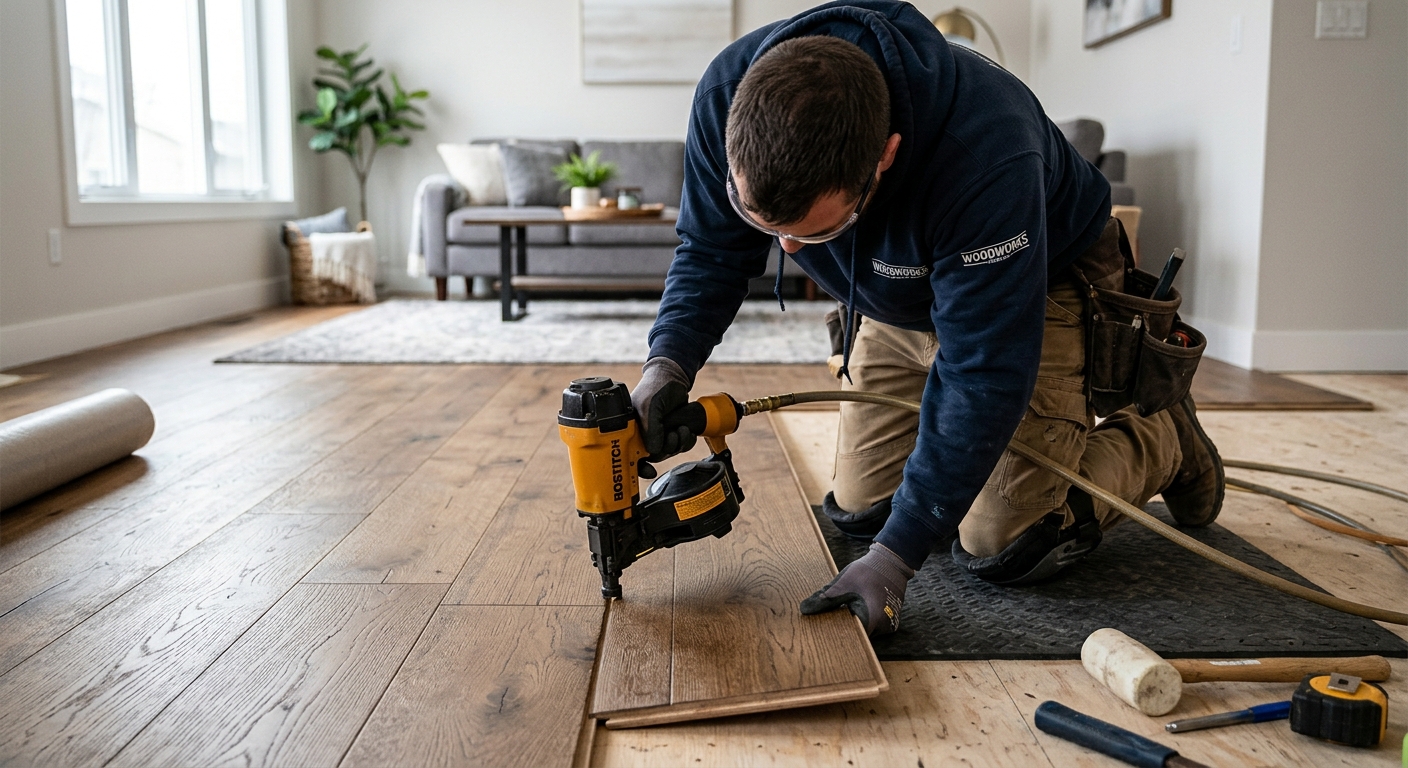
Flooring options and costs in Westridge
In Westridge, your flooring choice has to make sense for both the home you live in and the Lower Mainland–Southwest weather outside. Westridge is a small community with a population of 2,521 (Statistics Canada, 2021 Census), and that matters because fewer trades are available on short notice—so scheduling and installer capacity can affect pricing. It also means many homeowners are working with older housing stock, and that often translates into extra subfloor prep before “new floor” can start: where plywood is uneven, you may be looking at levelling and repair that commonly adds roughly $1–$3 per sq ft to the overall project in our region.
The big technical driver here is the wet, marine climate. In winter and shoulder seasons, indoor humidity can swing noticeably, and basements or slab-on-grade areas can experience moisture wicking through concrete. That’s why we typically avoid solid hardwood below grade and recommend engineered wood or luxury vinyl plank (LVP) instead—layered cores and (in the case of LVP) waterproof constructions handle humidity and minor temperature changes far better. For the main living areas, solid hardwood remains popular, but successful installs depend on leaving proper expansion gaps and maintaining indoor humidity. If your home has in-floor radiant heat—common in newer builds in and around the Lower Mainland—then the product spec matters, and some options are better suited than others.
In Westridge, trades are especially busy around the busier residential pockets where turnarounds are tight and homes change hands—so getting your measurements and moisture plan nailed down early can protect your budget. Below is a practical comparison table to help you line up material expectations with realistic local ranges.
| Type |
Best Room |
Moisture Resistance |
Lifespan |
Price per sq ft |
| Solid hardwood (nail-down, above grade only) |
Main living areas (above grade) |
Low to moderate (needs controlled indoor humidity) |
25–50 years |
$9–$18 |
| Engineered hardwood (float or glue, above + on-grade) |
Living/dining, bedrooms (including on-grade) |
Moderate to high (better humidity stability) |
20–40 years |
$9–$16 |
| Laminate (click-lock, above-grade) |
Bedrooms, hallways |
Moderate (not for standing-water risks) |
10–25 years |
$4–$10 |
| Luxury vinyl plank / LVP (waterproof, any level) |
Kitchen, entry, basement (finished) |
High (waterproof, tolerant of humidity swings) |
15–25 years |
$5–$12 |
| Porcelain / ceramic tile |
Kitchen, baths, mudrooms |
Very high (excellent for wet areas) |
25–50 years |
$10–$20 |
| Carpet (broadloom or modular tile) |
Bedrooms, stairs |
Low to moderate (avoid below grade unless well-managed) |
7–15 years |
$4–$10 |
Prices are estimates only and vary by project scope, site access and material selection.
What affects the price of flooring in Westridge
Two homeowners in Westridge can receive very different quotes for the “same” floor, sometimes by 30–50%, because the Lower Mainland–Southwest market has high labour demand and because technical site conditions change the prep work. In addition, product pricing shifts by brand, wear layer, thickness, and installation system. When you compare across British Columbia, the same category (for example laminate or LVP) can cost differently due to transport logistics, installer availability, and how much subfloor work is required to hit a flat, consistent installation surface.
Technically, humidity swings and below-grade moisture are the key drivers in this region. Solid hardwood expands and contracts with moisture—it can’t be glued or floated over concrete in typical below-grade situations, and it performs poorly if moisture vapour is wicking up from slabs. Engineered hardwood and luxury vinyl plank handle humidity far better and are the go-to choices when basements or on-grade concrete are part of the plan. If your rooms are over radiant heat, that can rule out most solid hardwood and some laminate products unless they’re specifically rated for higher operating temperatures.
Older regional housing stock also shows up in the numbers: uneven plywood, patchy concrete, or crumbling edges often require levelling compounds or repair. That frequently adds about $1–$4 per sq ft—depending on whether we’re doing spot repairs or full resurfacing. For example, a basic LVP install in a basement may still land near the laminate/vinyl band of $4–$10 per sq ft for materials, but once you include moisture barrier work and levelling, the project can move toward the high end. Conversely, a solid hardwood quote might start in the $9–$18 band, but the total can jump if we have to correct subfloor flatness and manage transitions carefully.
In Westridge, you’ll commonly see costs rise for three reasons: tight stair landings that require more finishing time, older subfloors that need correction before any “click” product can lay flat, and basement installs where a moisture plan is mandatory. On the flip side, cost can be lower when you’re staying above grade on a newer, flatter substrate and using straightforward install methods.
| Price Factor |
Why It Matters |
Cost Impact |
| Room area in sq ft |
Material usage and installer time scale directly with square footage. |
Can change labour and waste allowances significantly on small vs large jobs. |
| Subfloor condition — levelling or repair needed |
Flatness and soundness are required for best results and warranty acceptance. |
Often adds about $1–$4 per sq ft in our region. |
| Moisture / below-grade install — rules out solid hardwood |
Concrete moisture vapour affects solid wood; engineered and LVP tolerate it better. |
May require moisture mitigation or switching materials mid-quote. |
| Material choice — solid vs. engineered vs. LVP vs. tile |
Product price, wear layer, thickness, and underlayment requirements differ widely. |
Ranges typically follow local bands (e.g., hardwood $9–$18; tile $10–$20). |
| Removal and disposal of existing flooring |
Tear-out time, disposal fees, and patching after removal drive labour. |
Can add noticeable cost, especially with glued-down materials. |
| Stair nosing / transitions — charged per step or per linear foot |
Trim, mouldings and transitions are labour-intensive and often measured separately. |
Frequently a hidden line item on multi-level homes. |
| Radiant heat compatibility — limits material options |
Some products need special underlay or temperature ratings to avoid gapping/damage. |
May increase material cost or require different spec (usually raises quote). |
| Installation method — float vs. glue-down vs. nail-down |
Each method has different prep, adhesives/fasteners, and labour demands. |
Nail-down over above-grade is often efficient; glue-down and tile are labour-heavier. |
Permits & regulations in British Columbia
In British Columbia, flooring installation itself typically does not require a building permit. You generally do not need a permit to remove and replace flooring, install underlay, lay floating floors, or set most tile surfaces—provided you’re not altering load-bearing structural elements or changing plumbing/electrical systems. Where permits can come into play is when flooring work is paired with other trades.
For example, if the project includes electrical work related to in-floor radiant heating (such as new circuits, thermostat wiring, or modifications to an existing electrical setup), that can trigger electrical permitting requirements and needs an electrician. If you’re doing structural subfloor repair or remediation beyond cosmetic patching (for instance, replacing compromised materials tied to moisture damage and structural integrity), that may also require additional approvals depending on scope and documentation. And for condominiums, the building’s own rules matter: sound transmission requirements (often discussed as STC/IIC targets) may dictate which underlay and flooring thickness you can use.
Step-by-step, a Westridge homeowner should verify a contractor’s credentials before signing: (1) confirm the contractor’s licence status through the appropriate online registry listings, (2) request a current certificate of insurance showing liability coverage and ask whether it includes the work at your address, and (3) verify workers’ coverage paperwork (WSIB/WCB clearance letter or equivalent documentation) to reduce risk on the job. If you’re in a multi-unit building, request written board approval before installing hard surfaces like hardwood or tile on upper floors.
Best flooring for each room in your Westridge home
In Westridge, the best flooring choice is less about trends and more about matching material to moisture exposure, day-to-day traffic, and comfort under a Lower Mainland–Southwest climate. Living and dining areas usually do well with engineered hardwood or a high-quality laminate: both can give you the look of wood while tolerating indoor humidity changes better than solid hardwood. In a master bedroom, comfort and sound matter—so either carpet (for softness and warmth) or engineered hardwood (for an easier-clean, quieter feel than laminate) is a strong fit.
Kitchens are where waterproofing really pays off. LVP or large-format porcelain tile handle spills and frequent cleaning, and they’re more forgiving if humidity rises during rainy-season cooking and dishwasher use. For basements (finished), LVP is the clear winner in this region because it’s waterproof and can handle the reality of moisture vapour that may move through concrete. Solid wood and most laminate are not a smart match below grade in Westridge without very stringent moisture conditions and product-specific allowances. Bathrooms should be porcelain or ceramic tile only, since wet conditions and frequent water contact are non-negotiable.
If your home has radiant heating, favour products rated for temperature changes and follow the manufacturer’s installation instructions closely. A practical way to justify cost is to compare options: if switching from laminate to LVP in a basement moves you from roughly $4–$10 per sq ft to a higher $5–$12 range, you may avoid moisture-related callbacks and reduce the risk of premature gapping/edge lift that can happen with less moisture-tolerant materials.
Below is a room-by-room guide tailored to Westridge’s typical moisture profile and the Lower Mainland’s busy contractor market.
| Room |
Best Material |
Why |
Moisture Risk |
Price Band per sq ft |
| Living / dining room |
Engineered hardwood |
Wood look with better stability through indoor humidity swings. |
Low to moderate (above grade, humidity-managed) |
$9–$16 |
| Master bedroom |
Carpet or engineered hardwood |
Carpet boosts comfort; engineered hardwood offers easy cleaning. |
Low (avoid if you’ve had basement moisture issues migrating upward) |
$4–$10 |
| Secondary bedrooms |
Laminate (click-lock) or LVP |
Durable for daily use; LVP is a backup if humidity fluctuates more. |
Low to moderate |
$4–$10 |
| Kitchen |
Luxury vinyl plank (LVP) or large-format porcelain tile |
Easy cleanup and strong performance under frequent water exposure. |
Moderate to high (spills and humidity from cooking) |
$5–$20 |
| Basement (finished) |
Luxury vinyl plank (waterproof) |
Handles moisture vapour and below-grade conditions better than wood. |
High (concrete moisture and indoor humidity swings) |
$5–$12 |
| Bathroom |
Porcelain / ceramic tile |
Best-in-class wet-area performance and long-term durability. |
Very high (direct water exposure) |
$10–$20 |
How to choose a flooring contractor in Westridge
Choosing a contractor well matters in Westridge because the Lower Mainland’s labour demand can be tight, and the “difference between quotes” is often in the scope and risk management—not just the product price. First, verify British Columbia licence details (as applicable to the work they’re doing) and insist on insurance proof. Ask for a current certificate of liability insurance that clearly covers your project. Next, confirm they have workers’ compensation coverage—commonly handled through WCB/WSIB documentation and clearance letters—so you’re not exposed if an installer is injured on your property.
Then, request 2–3 itemised, written quotes rather than lump sums. You want a clear breakdown of material line items (underlay, moisture barrier, reducers/transitions, trim) plus labour. Make sure the quote specifies what’s included in removal and disposal, whether levelling is included or treated as an allowance, and whether permit-related steps (like electrical permitting for radiant heat circuitry changes) are handled by the right trade. For warranties, separate the two: the manufacturer warranty on the floor product and the contractor workmanship warranty. Confirm whether workmanship coverage is transferable if you sell your home, and get the warranty terms in writing.
Payment schedule matters: never pay more than about 10–15% upfront. Use a practical holdback (often until completion and final cleanup) and ensure the timeline is written with a start date and completion estimate.
- Ask for their insurance certificate before any work begins, and confirm it matches your address/project scope.
- Request WCB/WSIB clearance letter or equivalent proof of coverage for their workers.
- Get 2–3 itemised quotes with labour and materials separated (not one big number).
- Confirm whether subfloor levelling/patching is included or treated as an allowance.
- For basements, require a moisture plan (vapour barrier/appropriate underlayment) in writing.
- Specify the transition method for doorways and stairs (reducers, stair nosing, linear-foot pricing).
- Ask how they verify flatness (straightedge measurement) before installation.
- Confirm installation method by product type (nail-down, glue-down, or float) and included underlay.
- Read exclusions: what happens if additional levelling is needed once removal is complete?
- Ensure disposal/recycling is included, including nail plates/trim debris.
- Confirm warranty duration, what it covers, and whether it remains valid after occupancy.
- Set a clear start date, completion estimate, and what “final completion” means for payment.
In Westridge, red flags I see often include: a contractor who quotes hardwood for a basement without discussing moisture vapour; a quote that lumps labour and materials with no underlay/moisture barrier listed; refusing to provide insurance or coverage paperwork; promising radiant-heat compatibility without confirming product ratings; and asking for a large upfront payment beyond 10–15% without a written contract and schedule.
Frequently asked questions — flooring in Westridge
How long does flooring installation take?
In Westridge and the wider Lower Mainland–Southwest area, timelines depend mainly on square footage, subfloor prep, and how many areas are being finished at once. For a straightforward above-grade installation with a reasonably flat plywood subfloor, you can often expect a typical room to be completed in a few working days. The clock changes quickly when the contractor must level or repair the subfloor—common in older housing stock—because prep and curing time add days. Basements can take longer if moisture mitigation steps are required before installing LVP. If your project includes tile, expect extra time for setting, grouting, and curing. If you’re budgeting, plan around the reality that installation is sometimes constrained by installer availability in the Greater Vancouver market, not just the floor type.
What flooring works with radiant heat?
For British Columbia homes with in-floor radiant heat, you want products that are rated for temperature changes and that can be installed using the manufacturer’s system. In practice, engineered hardwood and many LVP products are the most reliable choices, because their layered construction tolerates temperature swings far better than solid hardwood. Solid hardwood over radiant heat can be done only with careful specification and strict humidity/temperature controls, and many installs choose engineered instead to reduce risk. Laminate may work if it’s explicitly rated for radiant heat and installed with the correct underlay, but not all laminates are suitable. The safest route is to ask your contractor to confirm product ratings in writing and to follow the prescribed start-up/temperature ramp schedule. If your radiant heat work involves electrical circuit changes, that’s separate from flooring and may require permit handling by the appropriate trade.
Engineered vs solid hardwood — what's the difference?
Solid hardwood is a single piece of wood throughout its thickness and relies heavily on stable indoor humidity to prevent cupping and gapping. That’s why, in Westridge’s marine climate, solid hardwood is typically recommended above grade only, and it’s not a good fit for below-grade moisture conditions. Engineered hardwood uses multiple layers (often a real wood veneer on top with stable inner layers), which makes it more tolerant of humidity swings and allows for more installation situations, including on-grade and—depending on conditions—some basement applications. Both can look similar, but performance differences show up during seasonal changes. Pricing also differs in the local ranges: hardwood products generally land in the $9–$18 per sq ft band, and your final quote depends on thickness, wear layer, installation method, and whether any $1–$3 per sq ft subfloor levelling is needed.
Do I need to level my subfloor first?
Often, yes. In Westridge and across the Lower Mainland–Southwest, older plywood subfloors can be uneven, and concrete slabs can have irregularities that affect clicks, seams, and long-term performance. Even if your floor doesn’t “look” uneven, most flooring manufacturers require a flatness tolerance, and installers typically measure with a straightedge before proceeding. If the contractor finds low spots or high ridges, levelling compound or patching may be necessary before any floating click-lock product, and it’s essential for a tile substrate. Subfloor levelling and repair is one of the most common quote variables, frequently adding about $1–$4 per sq ft depending on how extensive the correction is. If you’re considering solid hardwood, subfloor prep is even more critical because moisture and flatness issues can become visible over time. Ask your contractor how they’ll verify flatness and whether levelling is included in the quote or handled as an allowance.
What's the most durable flooring for pets and kids?
For pets and kids in British Columbia, durability means scratch resistance, moisture tolerance, and ease of cleaning—especially during rainy-season mud and indoor humidity swings. Luxury vinyl plank (LVP) is often the best balance because it’s waterproof and more forgiving if accidents happen or if humidity fluctuates in a basement or on-grade area. Look for thicker wear layers rather than the cheapest LVP, and make sure the underlayment system is correct for your subfloor. High-quality laminate can also handle everyday traffic well, but it’s less forgiving when standing water is involved. Solid hardwood can be durable when maintained, but it’s more sensitive to moisture exposure and indoor humidity control, so it’s best kept to above-grade areas. If you want a “set it and forget it” wet-area option for kitchen/mud zones, porcelain tile is extremely durable, though it’s harder underfoot. In local price terms, you’re commonly choosing within the laminate/vinyl $4–$10 or $5–$12 bands for LVP, and the best value typically comes from getting the right wear layer and proper prep, not just the lowest material cost.
How do I choose flooring for humidity in Westridge?
Humidity is a daily reality in Westridge. The Lower Mainland–Southwest climate brings indoor humidity swings, and basements or slab-on-grade areas may experience moisture vapour migration. The practical approach is to match material to moisture risk by room: avoid installing solid hardwood in below-grade locations, and don’t assume laminate will tolerate moisture the way waterproof LVP can. For main living areas above grade, engineered hardwood or a quality laminate often performs well when your indoor humidity is kept within the manufacturer’s recommended range. For basements, LVP is usually the safest choice because it’s waterproof and resilient to vapour-related issues that can cause gapping in wood products. Bathrooms should be tile only due to direct water exposure. Cost-wise, you may pay a bit more to use LVP instead of lower-end options, but it can protect against expensive redo work—especially if your home needs levelling or moisture barrier work (often $1–$4 per sq ft in our region). If your home is older, budget time for moisture assessment and subfloor prep before you pick the final material.