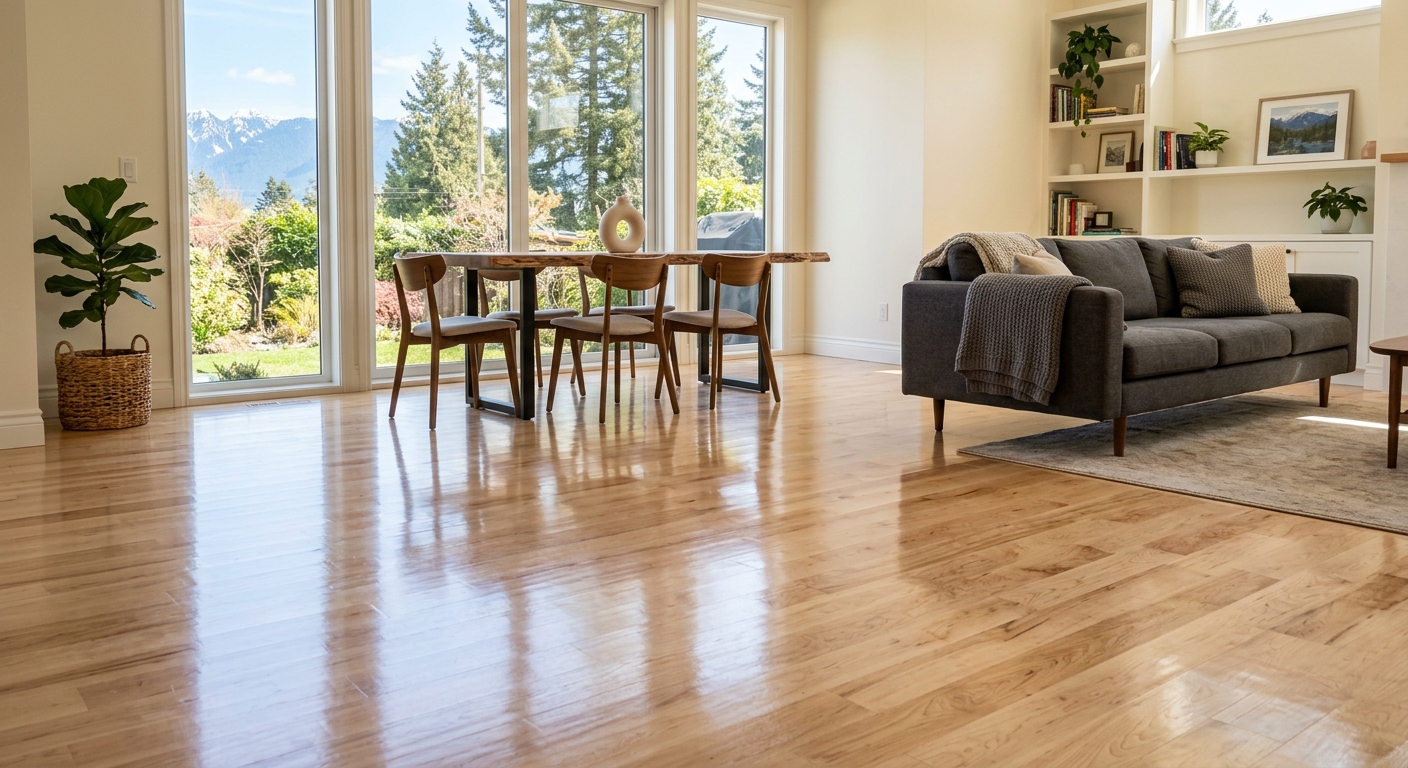
Flooring options and costs in Pitt Meadows
Pitt Meadows homeowners have a clear range of flooring choices, but the “best fit” depends on where in the home you’re installing and how your subfloor is performing. With 19,146 residents and 79.5% of households owning (Statistics Canada, 2021 Census), many properties are lived-in for decades—so replacement jobs often start around older areas that were built before 1981 (25.9% of homes). In Pitt Meadows, that age factor matters because older plywood and concrete can be uneven or have patchy moisture performance, which commonly adds levelling and prep time (often in the $1–$3 per sq ft range).
In the Lower Mainland–Southwest, we also see wet, marine weather and indoor humidity swings—especially through winter and shoulder seasons. That’s why contractor quotes can swing even for the “same” room: solid hardwood is sensitive to humidity and typically should be limited to above-grade installs, while engineered wood and luxury vinyl plank (LVP) are more forgiving over minor movement and can handle below-grade conditions far better. Labour availability is good in the Lower Mainland, but pricing reflects the region’s higher labour costs, so subfloor prep and removal/disposal often become the deciding line items.
In Pitt Meadows, flooring installs are especially busy in the Maple Crescent and Harris Road corridor areas where many homes have basements and older finish updates. Next, use the comparison table to align options with performance and typical price bands before you request your itemised quote.
| Type |
Best Room |
Moisture Resistance |
Lifespan |
Price per sq ft |
| Solid hardwood (nail-down, above grade only) |
Main living areas |
Low to moderate (avoid basements and slab-on-grade) |
25–60 years (with proper humidity control) |
$9,XXX–$18,XXX |
| Engineered hardwood (float or glue, above + on-grade) |
Main living areas, hallways |
Moderate to high (layered construction resists swings) |
20–40 years |
$10,XXX–$16,XXX |
| Laminate (click-lock, above-grade) |
Bedrooms, living rooms (not wet areas) |
Low to moderate (core can swell if exposed) |
10–25 years |
$4,XXX–$10,XXX |
| Luxury vinyl plank / LVP (waterproof, any level) |
Kitchen, entry, basement (finished) |
High to waterproof |
15–25 years |
$7,XXX–$12,XXX |
| Porcelain / ceramic tile |
Kitchen, bathrooms, mud rooms |
Very high (with correct installation) |
30–50+ years |
$10,XXX–$20,XXX |
| Carpet (broadloom or modular tile) |
Bedrooms, stairs with comfort needs |
Moderate (risk increases in humid basements) |
7–15 years |
$4,XXX–$8,XXX |
Prices are estimates only and vary by project scope, site access and material selection.
What affects the price of flooring in Pitt Meadows
In Pitt Meadows and across the Lower Mainland–Southwest, two quotes for the same room can easily differ by 30–50% because the “visible floor” depends on what your contractor finds underneath. The big difference is usually subfloor prep: older homes often have uneven plywood, patchy spots on concrete, or areas where underlay has failed. In a region where 25.9% of homes were built before 1981 (Statistics Canada, 2021 Census), levelling and repair work isn’t rare, and it can add roughly $1–$4 per sq ft to get the surface flat and stable before install.
Technically, Lower Mainland’s wet marine climate drives moisture management. Indoor humidity swings cause solid hardwood to expand and contract—so it can’t be installed over concrete and performs poorly in basements. That’s why engineered hardwood and LVP are more commonly recommended for slab-on-grade and below-grade spaces: their layered cores (or PVC-based waterproof construction) tolerate humidity better. If your home uses radiant heating (increasing in newer builds), that can also steer choices—many solid hardwood options need very careful specification, while engineered wood, tile, and many LVP systems handle radiant heat more predictably.
Concrete examples we see often in Pitt Meadows: (1) a 500 sq ft main-floor job where the subfloor needs levelling can climb from a mid-band laminate/LVP install into the higher end of the hardwood price bracket due to prep time; (2) a basement change from carpet to LVP usually costs more up front than simple laminate, but it avoids moisture-related callbacks that can be far more expensive. Material choice aligns with the regional price bands—hardwood typically lands around $9–$18, while LVP/laminate often sit lower, frequently within $4–$10—once prep is accounted for.
| Price Factor |
Why It Matters |
Cost Impact |
| Room area in sq ft |
Material quantities and labour hours scale directly with square footage |
Higher total project cost; per-sq-ft pricing may drop slightly on larger areas |
| Subfloor condition — levelling or repair needed before install |
Uneven plywood or damaged concrete requires patching, flattening, or resurfacing |
Often adds about $1–$4 per sq ft depending on the severity |
| Moisture / below-grade install — rules out solid hardwood |
Basements and slab-on-grade spaces need moisture-tolerant systems |
May increase material cost (engineered/LVP instead of solid) and add moisture barriers |
| Material choice — solid vs. engineered vs. LVP vs. tile |
Different assemblies and layers tolerate humidity differently |
Hardwood commonly runs $9–$18; tile often $10–$20; laminate/vinyl $4–$10 |
| Removal and disposal of existing flooring |
Disassembly, haul-away fees, and time on older adhesives or underlay |
Can add significant labour; sometimes a mid-project “surprise” if not itemised |
| Stair nosing / transitions — charged per step or per linear foot |
Transitions and nosings are precision work and use specialty trim pieces |
Often adds a noticeable line-item beyond the floor area |
| Radiant heat compatibility — limits material options |
Not every product handles heat cycling without excessive movement or gapping |
May require higher-rated engineered wood/LVP or specific underlay, raising material cost |
| Installation method — float vs. glue-down vs. nail-down |
Method affects labour time, adhesives, and subfloor flatness requirements |
Glue-down can add labour/adhesive cost; nail-down needs stable, above-grade subfloors |
Permits & regulations in British Columbia
In British Columbia, installing flooring itself usually does not require a building permit. The work typically considered “finish installation” (like nail-down hardwood on an above-grade subfloor, LVP floating installs, laminate click-lock, or tile flooring over an approved underlayment) is generally handled without permits. However, permits can be required when flooring projects connect to other regulated work—most commonly electrical or structural elements.
For example, if you’re modifying radiant heat wiring or making changes to in-floor heating circuits, electrical permits can be triggered. If a project includes subfloor structural repair that affects load-bearing performance (not just cosmetic patching), that’s another scenario where permits and inspections may be involved. In condos and strata buildings in Pitt Meadows and the broader Lower Mainland, the corporation’s rules often matter more than permits: sound transmission requirements (STC/IIC) can restrict which underlay you can use and may require board approval in writing before installing hard flooring on upper floors.
Step-by-step, verify your contractor’s status before any work starts: (1) confirm the installer’s licence and standing via the appropriate online BC registry resources; (2) request a current certificate of liability insurance and make sure it lists the correct business name and coverage dates; (3) ask for proof of WSIB/WCB coverage (or an equivalent clearance document where applicable) and review that it’s current; and (4) get everything—scope, exclusions, and warranty details—written into the contract.
Best flooring for each room in your Pitt Meadows home
Choosing the right flooring in Pitt Meadows means matching the material to the room’s moisture exposure, foot traffic, and comfort needs—especially in a Lower Mainland home where humidity swings are common and basements can be sensitive to moisture wicking through concrete. For living and dining areas, homeowners usually want warmth and quiet underfoot, so engineered hardwood or a high-quality laminate balances comfort with stability. In a master bedroom, carpet is still a strong choice for sound absorption and coziness, but above-grade engineered wood is also a good option if you prefer easier cleaning.
In kitchens, LVP is often the “set-and-forget” option because it’s waterproof and handles drips, mopping, and occasional standing water better than wood or laminate. For bathrooms, porcelain or ceramic tile is the correct surface—water resistance depends on both the tile and the installation details (membranes, proper setting materials, and grout/caulk transitions).
Basements are where most mistakes happen. Solid hardwood should be avoided over slab-on-grade or below-grade areas, and many laminate products struggle if moisture vapour migrates upward. LVP is the clear winner for finished basements because its waterproof construction tolerates the marine climate better. If your home has radiant heat (common in newer BC builds and increasingly in renovations), tile and properly rated engineered wood/LVP typically pair well, but solid hardwood needs careful specification and humidity control.
Budget-wise, the difference is often justified. For instance, if a kitchen is a 200 sq ft area, moving from an $4–$10 laminate/vinyl band into a higher-end LVP selection may cost more per sq ft, but it reduces long-term risk from spills and moisture—so you’re not paying twice.
| Room |
Best Material |
Why |
Moisture Risk |
Price Band per sq ft |
| Living / dining room |
Engineered hardwood |
Warm look with better stability in Lower Mainland humidity swings |
Low to moderate (above-grade) |
$10,XXX–$16,XXX |
| Master bedroom |
Carpet or engineered hardwood |
Comfort and sound control; engineered wood still handles daily temperature changes |
Low (above-grade) |
$4,XXX–$16,XXX |
| Secondary bedrooms |
Laminate or engineered hardwood |
Durable under kids’ traffic; laminate can be cost-effective on dry subfloors |
Low (above-grade) |
$4,XXX–$14,XXX |
| Kitchen |
Luxury vinyl plank (LVP) or large-format porcelain tile |
LVP handles spills and mopping; tile offers the most stain and water resistance |
Moderate to high (spills, cleaning water) |
$7,XXX–$20,XXX |
| Basement (finished) |
Luxury vinyl plank (LVP) |
Waterproof performance over concrete; better tolerance for moisture vapour |
High (below-grade / slab-on-grade risk) |
$7,XXX–$12,XXX |
| Bathroom |
Porcelain / ceramic tile |
Correct surface for wet-room conditions when installed with proper membranes and sealing |
Very high |
$10,XXX–$20,XXX |
How to choose a flooring contractor in Pitt Meadows
Picking the right flooring contractor in Pitt Meadows is less about flashy ads and more about paperwork, process, and how they handle surprises. First, verify British Columbia licensing (where applicable for your contractor’s trade category), then request proof of liability insurance and ensure coverage is current. Ask for their WSIB/WCB clearance documentation (or equivalent proof of coverage that applies to your contractor’s situation) and confirm it’s not expired. If a contractor can’t provide these documents promptly, it’s a sign to pause.
Next, get 2–3 itemised written quotes. You want labour and materials broken down line-by-line (demo/removal, levelling or underlayment, adhesives, transitions, and disposal). Avoid a “lump sum only” quote because Pitt Meadows projects often hinge on prep: older subfloors may need flattening, patching, or moisture mitigation. Your scope should also clearly state what’s excluded—baseboards (do they remove and reinstall?), furniture moving, patch thickness limits, and whether disposal and tipping fees are included.
For warranty, confirm workmanship coverage length (how long the installer stands behind the job), product warranty terms, and whether it’s transferable to you as the homeowner. Payment schedules should be conservative: never pay more than 10–15% upfront, and use a holdback until completion and cleanup are done. Finally, insist on a written timeline: start date, milestones, and a completion estimate.
- Provide their current business name and contact details exactly as they appear on insurance documents.
- Show proof of liability insurance with coverage dates and limits.
- Provide WSIB/WCB coverage clearance documentation (or equivalent) before work begins.
- Include an itemised quote: removal, levelling, underlayment/moisture barrier, installation, trim/transitions.
- Specify whether baseboards are removed and who handles reinstallation/caulking.
- Clarify disposal/tipping fees and what debris they haul away.
- Confirm transition materials: stair nosings, reducers, and threshold profiles.
- Detail underlay and moisture barriers (especially for basements and slab-on-grade).
- State the installation method for your chosen product (float, nail-down, or glue-down) and why.
- Write the warranty: workmanship term, what voids warranty, and product warranty coverage.
- Set payment milestones: deposit at 10–15%, progress draws if needed, and holdback at completion.
- Get a start date and completion estimate in writing, not just “sometime next week.”
In Pitt Meadows, watch for red flags: quotes that don’t mention subfloor moisture testing or levelling allowances, missing insurance/coverage paperwork, unclear disposal responsibilities, warranties that only cover “materials” (not workmanship), and crews that start without a written scope—especially on basements where moisture vapour is a real risk.
Frequently asked questions — flooring in Pitt Meadows
What flooring is best for a Pitt Meadows basement?
For most Pitt Meadows basements, LVP is the safest default choice because it’s waterproof and tolerates moisture vapour and minor slab movement far better than solid hardwood or typical laminate. The Lower Mainland–Southwest climate is wet and marine, and older homes (25.9% built before 1981) often have subfloors that aren’t perfectly flat or consistently dry. A basement LVP project usually lands in the regional vinyl range—commonly around $7,XXX–$12,XXX per sq ft depending on product grade, underlayment, and how much levelling is needed. If you also have radiant heat or plan future bathroom plumbing changes, tell your contractor early so the system is installed correctly from day one.
Can I install hardwood over concrete?
In most Pitt Meadows situations, solid hardwood should not be installed directly over concrete slabs. Solid wood expands and contracts with humidity, and it generally requires a nail-down setup on a suitable above-grade subfloor. For concrete, engineered hardwood is the more practical option because its layered construction handles humidity swings better, and it can be installed float or glue-down only when the system and flatness requirements are met. If your concrete is below grade (typical in basements), solid hardwood is especially risky due to moisture wicking and vapour migration. If you’re comparing quotes, ask specifically what product is proposed and how they’ll address moisture and flatness; that’s where Lower Mainland costs often change.
How long does flooring installation take?
Timelines in Pitt Meadows depend on prep, not just the install day count. A simple above-grade room with good subfloor flatness and no complicated transitions might move quickly, but many projects include removal, levelling, and acclimation time (particularly with engineered wood and LVP). For a typical 500–800 sq ft job, homeowners often see installation days plus prep time that can add up to about 2–5 working days in total. Basements usually take longer because moisture barriers, patching, and additional flatness work are common. Get a written schedule from your contractor and confirm when materials are delivered, because delays in levelling compound curing or product acclimation can shift the plan.
What flooring works with radiant heat?
Radiant heat compatibility is a product-by-product requirement, but in British Columbia homes (including the Lower Mainland–Southwest), engineered hardwood, tile, and many LVP systems are typically the easiest pairings. Solid hardwood can work only if it’s specifically rated for radiant heat and installed with strict humidity control and the right underlay/spacing—many solid products are not ideal over radiant systems. Laminate can also be compatible if the manufacturer allows heat cycling and the installation method matches their instructions. When you get quotes, ask your contractor to reference the manufacturer’s radiant heat guidelines for the exact SKU. That small step helps avoid future gapping or cupping that can happen if the product isn’t meant for the heat profile.
Engineered vs solid hardwood — what's the difference?
Solid hardwood is one uniform piece of wood and is usually nailed down over an appropriate above-grade subfloor; it’s more sensitive to humidity swings. Engineered hardwood uses multiple layers (often a real wood veneer on top with plywood/core layers beneath), which gives it better dimensional stability—important in the Lower Mainland’s wet marine conditions and indoor humidity changes. That stability is why engineered wood is commonly recommended for on-grade installs and certain concrete contexts where flatness and moisture control are addressed. Price-wise, both can be premium: solid hardwood frequently falls within the $9,XXX–$18,XXX band, while engineered often sits slightly lower to mid-high depending on grade and installation method.
Do I need to level my subfloor first?
Often, yes—especially in older Pitt Meadows homes where the base layer may be uneven. Even minor low/high spots can cause click-lock joints to fail early, create gaps in hardwood, or lead to tile cracking if the surface isn’t within the installer’s tolerance. A levelling step may also be paired with repairs and moisture mitigation, which is why quotes can vary significantly. As a rough planning note, older housing stock frequently needs prep that adds around $1–$4 per sq ft to project costs when levelling or resurfacing is required. When you receive a quote, ask how they measure flatness, what compounds or underlay they plan to use, and whether they include disposal and feather-finish prep in the scope.