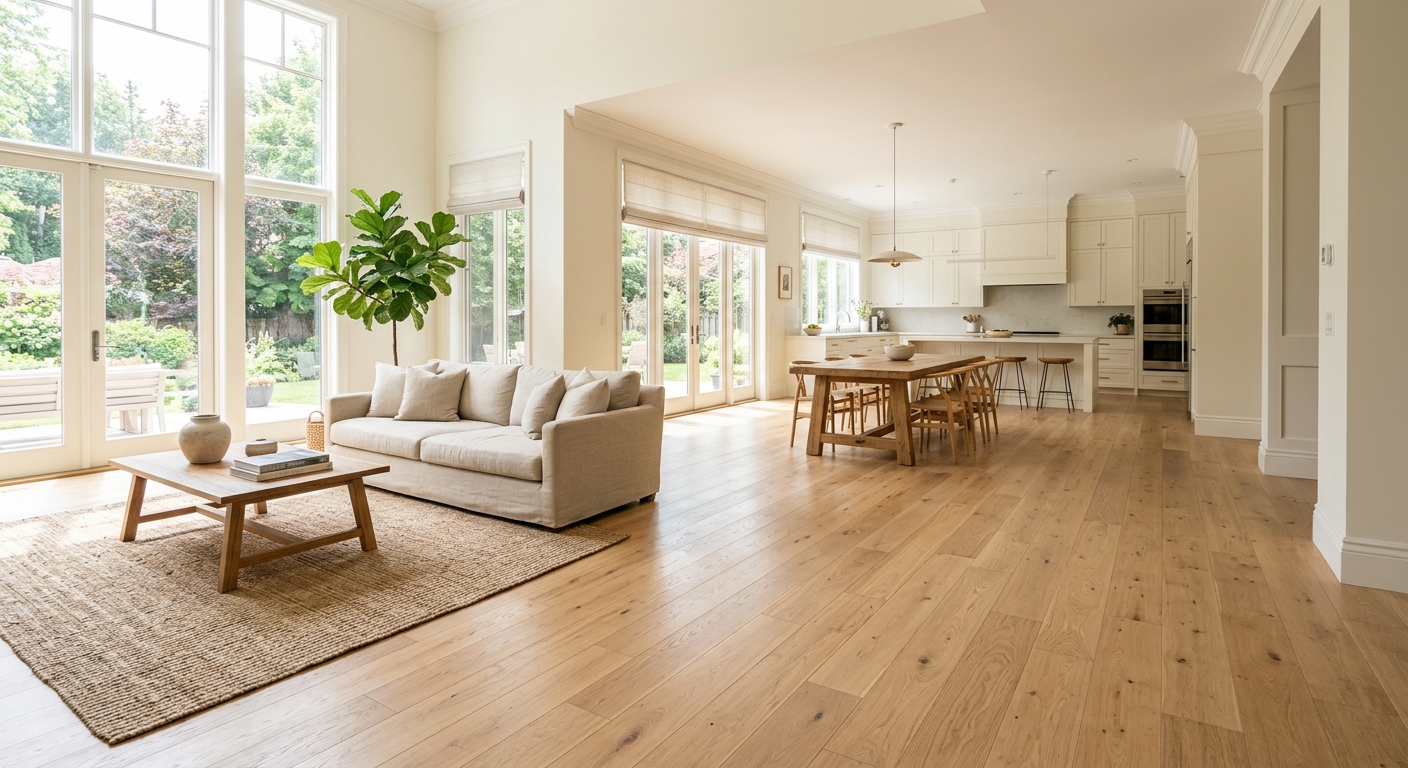
Flooring options and costs in Mission
In Mission, British Columbia, homeowners typically start by comparing three “big” categories—hardwood look, vinyl plank, and tile—then fine-tune based on how damp the home gets in winter. With 42.4% of Mission homes built before 1981, many properties have older plywood or uneven concrete that needs levelling, patching, or a moisture-aware underlayment strategy before any new flooring goes down. That prep work is a common reason you’ll see small rooms jump in cost, and it can add roughly $1–$3 per sq ft depending on how much correction is required.
Lower Mainland–Southwest conditions also shape pricing. The region’s wet, marine climate creates indoor humidity swings, and basements or slab-on-grade areas can wick moisture through concrete. Because of that, we generally avoid solid hardwood below grade and recommend engineered hardwood or luxury vinyl plank (LVP) in those areas, since layered wood and PVC/PVC-core products handle seasonal changes more reliably. In main living spaces above grade, solid hardwood is still popular, but we specify expansion gaps and manage indoor humidity to reduce cupping and gapping. Labour availability and installation demand are strong around Mission’s older neighbourhoods and the fast-changing pockets near the downtown and Riverside/Belmont areas, where renovations are frequent.
Below are typical cost bands for each option in Mission, followed by a quick guide to how to interpret your quote line-by-line.
| Type |
Best Room |
Moisture Resistance |
Lifespan |
Price per sq ft |
| Solid hardwood (nail-down, above grade only) |
Main living areas (above grade) |
Low to moderate; expands/contracts with humidity |
20–50 years |
$9–$18 |
| Engineered hardwood (float or glue, above + on-grade) |
Living areas, bedrooms (above/on grade) |
Good; more stable in humidity swings |
15–30 years |
$10–$16 |
| Laminate (click-lock, above-grade) |
Secondary rooms above grade |
Moderate; avoid wet mopping at seams |
10–25 years |
$4–$10 |
| Luxury vinyl plank / LVP (waterproof, any level) |
Kitchens, basements, hallways |
Very good; waterproof core handling |
15–25 years |
$5–$12 |
| Porcelain / ceramic tile |
Bathrooms, kitchens, entries |
Excellent; tolerates spills and routine cleaning |
20–50 years (with grout care) |
$10–$20 |
| Carpet (broadloom or modular tile) |
Bedrooms, stairs comfort zones |
Low; sensitive to chronic dampness |
8–15 years |
$6–$12 |
Prices are estimates only and vary by project scope, site access and material selection.
What affects the price of flooring in Mission
In Mission and across the Lower Mainland–Southwest, it’s common to see the “same” flooring project land 30–50% apart between bids. A big reason is that some quotes include the hard parts (subfloor levelling, moisture mitigation, underlay choices, transitions, and proper underlayment) while others treat them as optional add-ons. Labour and scheduling also swing because Greater Vancouver trades often run busy—so a weekend install with full subfloor prep can price very differently than a straightforward, above-grade job.
Technically, indoor humidity swings and below-grade moisture are the key drivers for this region. Solid hardwood expands and contracts with humidity, and it cannot be glued or floated over concrete the way engineered products can. That’s why solid wood performs poorly in basements and other below-grade spaces in Mission, where moisture can wick through slab and create a slow, unseen problem. Engineered hardwood and luxury vinyl plank handle humidity and minor temperature changes far better. If you’re working in colder pockets or installing over radiant heating (increasing in BC new builds), that can further narrow material choices; many homes end up with engineered wood, LVP, tile, and some higher-spec laminates rated for temperature movement. Finally, older housing stock frequently needs levelling or repair—often adding about $1–$4 per sq ft once patching, grinding, or plywood resurfacing is included.
Here are two practical Mission examples contractors use to price fairly: (1) A 600 sq ft living space on a reasonably flat subfloor might price near the $9–$18 hardwood band, but if the subfloor needs levelling, the total often shifts upward into the higher end of the range. (2) A 400 sq ft basement that would normally be a cheap vinyl job becomes costlier if a moisture barrier and floor prep are required—but the alternative (solid wood) typically fails, which is far more expensive over time.
| Price Factor |
Why It Matters |
Cost Impact |
| Room area in sq ft |
Material quantity and labour hours scale with square footage |
Direct; small rooms still carry fixed demo and setup costs |
| Subfloor condition — levelling or repair needed |
Uneven plywood or concrete requires patching, grinding, or overlay |
Often adds about $1–$4 per sq ft |
| Moisture / below-grade install — rules out solid hardwood |
Humidity and wicking require proper barriers and stable products |
Switching to engineered/LVP can reduce failure risk and rework |
| Material choice — solid vs. engineered vs. LVP vs. tile |
Different materials have different tolerances and install methods |
Can move the project by several dollars per sq ft (e.g., $9–$18 vs. $5–$12 vs. $10–$20) |
| Removal and disposal of existing flooring |
Demo, hauling, and debris protection are time-intensive |
Typically a meaningful add-on in older homes |
| Stair nosing / transitions — charged per step or per linear foot |
Transitions and trim are rarely “free” in real installs |
Can add hundreds of dollars on busy layouts |
| Radiant heat compatibility — limits material options |
Temperature movement changes the install spec and product selection |
May require specific underlay and allowances (extra labour/material) |
| Installation method — float vs. glue-down vs. nail-down |
Method dictates prep, adhesives, and tolerances |
Glue-down and nail-down often cost more than click-lock/LVP floating |
Permits & regulations in British Columbia
In British Columbia, flooring installation itself generally does not require a building permit. That said, associated work can trigger permits—especially when you’re modifying electrical circuits or doing structural moisture remediation. For example, if you’re installing or modifying in-floor heating circuits, the electrical side may require an electrical permit and inspection. If subfloor repairs involve significant structural changes, removal of compromised framing, or substantial reconstruction, permits can come into play depending on the scope. Moisture remediation that is limited to surface treatments and proper vapour management for a flooring assembly typically stays permit-free, but deeper remediation (for instance, major breakdown of contaminated assemblies) is worth clarifying in writing before work starts.
In condominiums, the bigger constraint is usually the building’s rules on sound transmission. Many condo corporations set requirements for underlay and flooring type to meet sound criteria (commonly expressed as STC/IIC ratings). Even if the install doesn’t require a municipal permit, you should review the declaration and request board approval in writing when installing hard flooring (engineered hardwood, laminate, tile) on upper floors. Get that approval before ordering materials so you don’t end up swapping underlay systems at the last minute.
To verify your contractor in Mission/BC: confirm they’re licensed/registered where applicable for their trade, request a clearance letter/proof of status if they provide one, and check liability insurance. For coverage, ask for certificates of insurance showing liability limits and confirm workers’ compensation (WSIB/WCB coverage) information through their documentation. Always keep copies of the insurance certificate and any written approvals for condo work.
Best flooring for each room in your Mission home
Choosing flooring in Mission means matching the material to the room’s moisture exposure, daily traffic, and comfort needs—while respecting this region’s wet winters and humidity swings. Living and dining areas usually do best with engineered hardwood or high-quality laminate: they give warmth underfoot and can better handle seasonal movement than solid wood. In master bedrooms, you’ll often get the best comfort and sound reduction with carpet (especially if you prefer a quieter feel in winter), or choose engineered hardwood if you want easy maintenance.
For kitchens, we see the most satisfaction with luxury vinyl plank (LVP) or large-format porcelain tile. LVP tolerates splash and day-to-day cleaning and is far more forgiving in a home that experiences winter humidity. Tile is a strong choice where you expect water exposure and want a surface that wipes clean immediately. Basements (finished) are a clear “go-with-LVP” zone: in Mission, below-grade assemblies can experience moisture vapour movement, and LVP’s waterproof core is designed for that reality. Bathrooms should be porcelain or ceramic tile only, because the grout and surface are engineered for moisture and routine cleaning.
Radiant heat compatibility is increasingly common in BC. If your system is active in certain rooms, the safer approach is to choose engineered wood, LVP, or tile with manufacturer guidance for temperature cycling. Solid hardwood over radiant needs very careful specification and acclimation, so many homeowners choose engineered or tile instead.
Example: if you’re comparing laminate at roughly $4,XXX – $10 per sq ft versus engineered hardwood closer to the $9,XXX – $18 band (material + typical installation range), the price jump is usually justified when you want better stability in humidity, a more “real wood” appearance, and longer service life in Mission’s older housing stock.
| Room |
Best Material |
Why |
Moisture Risk |
Price Band per sq ft |
| Living / dining room |
Engineered hardwood |
Warm look with better stability during seasonal humidity swings |
Low to moderate (manage indoor RH) |
$9–$16 |
| Master bedroom |
Carpet or engineered hardwood |
Comfort and quiet for mornings; engineered option keeps it easy to maintain |
Low |
$6–$14 |
| Secondary bedrooms |
Laminate or carpet |
Laminate is durable for family life; carpet adds warmth and sound absorption |
Low |
$4–$10 |
| Kitchen |
Luxury vinyl plank or porcelain tile |
Handles spills and frequent cleaning; good under winter humidity |
Moderate (spills happen) |
$10–$20 |
| Basement (finished) |
Luxury vinyl plank (waterproof) |
Best tolerance for below-grade vapour and concrete moisture wicking |
High if not addressed (use waterproof assembly) |
$5–$12 |
| Bathroom |
Porcelain / ceramic tile |
Moisture-ready surface for showers, spills, and cleaning |
High |
$10–$20 |
How to choose a flooring contractor in Mission
Start by verifying British Columbia contractor responsibility the practical way: ask for proof of liability insurance and workers’ compensation coverage, and confirm they can legally perform the type of work they’re proposing. For licensing, check the relevant provincial registry for their business/individual status (and ask for the licence/registration number they’re operating under). Then request a current certificate of insurance (liability) naming the correct business entity and address, and ask about WSIB/WCB coverage documents for their workers. In a home with 41,519 residents and a large share of homeowner households (76.9% of households own, Statistics Canada, 2021 Census), you’ll find many long-established contractors—so it’s reasonable to expect clear paperwork.
Next, get 2–3 itemised written quotes. The best quotes break down labour and materials separately: removal/demo, subfloor prep, underlayment/vapour barrier, baseboards/trim, transitions, and the specific installation method (float vs. glue-down vs. nail-down). Avoid “lump sum with vague exclusions.” Read the scope carefully: what’s included for disposal, who moves furniture, whether levelling compounds are included if needed, and whether permits or condo board documentation fees are covered if applicable.
For warranty, ask for both workmanship and product terms, and confirm whether the workmanship warranty is transferable to future owners (some aren’t). Payment should stay conservative: never pay more than 10–15% upfront; hold back the remainder until the job is complete and cleaned. Also insist on a start date and an estimated completion timeline in writing.
- Verify current liability insurance (request a certificate) and confirm workers’ compensation coverage documentation.
- Confirm the legal business name on the quote matches the insurance certificate and contract.
- Get 2–3 quotes with itemised labour/material lines, not just one total figure.
- Ask whether subfloor moisture testing is included if the basement/slab is part of the scope.
- Ensure levelling/patching inclusions are defined (not “as needed” without pricing).
- Clarify underlay/vapour barrier products and whether they match the flooring manufacturer requirements.
- Confirm transition and stair nosing pricing (per step or per linear foot) is listed.
- Check who handles furniture moving, protection, and clean-up after each phase.
- Make sure demo and disposal are explicit: included or extra, and where debris goes.
- Confirm the warranty: workmanship duration, product brand warranty, and transferability.
- Use a payment schedule that holds back most funds until completion and punch-list items.
- Require a written schedule with start date, milestones, and estimated completion date.
Red flags in Mission to watch for: (1) they won’t put moisture/subfloor prep in writing, (2) they dismiss humidity concerns for basements as “no big deal,” (3) they offer unusually low pricing without an itemised scope, (4) they ask for large upfront payments, and (5) they can’t provide insurance/coverage documentation or a written timeline.
Frequently asked questions — flooring in Mission
What's the most durable flooring for pets and kids?
For Mission homes with pets and kids, the most durable option is typically waterproof luxury vinyl plank (LVP) or porcelain tile, depending on how hard you want to go on comfort. LVP is resilient against daily messes, and because it’s waterproof it’s easier to manage when humidity and occasional spills happen in winter routines. If you want the toughest surface possible, tile handles scratches and stains extremely well, but it’s harder on your feet. Carpet can be comfortable, but it’s usually the highest maintenance choice if accidents or dampness risk exists—especially in lower-level spaces where moisture vapour can move. In practical budget terms, LVP often lands around the $5–$12 per sq ft range, while tile commonly sits nearer the $10–$20 per sq ft band.
How do I choose flooring for humidity in Mission?
Mission’s wet, marine climate means indoor humidity swings, and basements or slab-on-grade areas can experience moisture wicking through concrete. That’s why we steer homeowners toward engineered hardwood or LVP for areas that see higher humidity risk. Solid hardwood works best above grade with careful expansion-gap specification and proper indoor humidity control; it should not be installed in basements where moisture vapour can reach the wood. For humidity-sensitive homes, the best “low drama” strategy is to pick stable materials (engineered or LVP) and ensure the assembly is correct—vapour barrier, underlayment, and subfloor prep. If your home is older (Mission has a large pre-1981 housing share), subfloor levelling and patching are often needed, which can change the final budget by about $1–$4 per sq ft.
Do condos restrict hard flooring?
Yes—often, in British Columbia condominiums the restriction isn’t municipal permitting, it’s the building rules on sound transmission. Many condo corporations require hard flooring to meet specific sound performance targets (commonly described using STC/IIC language) and to be installed with approved underlay. That means your engineered hardwood, laminate, or tile may require a particular underlayment system and installation method to comply. Before you buy materials, review the condo declaration and request board approval in writing where required—especially for upper floors. Your contractor should be willing to list the exact underlay and thickness they plan to use, plus details like underlayment type and edge transitions, so the board can review it.
How do I compare flooring quotes?
To compare quotes fairly in Mission, insist on itemised pricing. Separate labour from materials, and make sure both quotes include the same scope: demo/disposal, subfloor prep, underlayment/vapour barrier, transitions, stair nosing, and any levelling compounds. Don’t compare only the “per sq ft” number—two bids can land in the same range but differ by whether they address moisture. For example, engineered hardwood might be quoted in the $10–$16 range, while a “cheaper” number could skip necessary levelling. Also ask who supplies trims/baseboards, whether removal is included, and whether the installation method is clearly stated (float vs. glue-down vs. nail-down). A good quote references manufacturer requirements and includes a timeline and warranty details.
Can I install flooring over existing tile in Mission?
Sometimes, but it depends on the tile surface condition and what type of new flooring you’re installing. For LVP or laminate, tile can be a suitable substrate if it’s solid (not loose), flat enough for the click-lock tolerance, and properly prepped (typically cleaning and checking for high spots). If tile is cracked, uneven, or has height variation, levelling may be required—often adding labour and material cost. For engineered hardwood, glue-down or float systems can work over tile in some cases, but the flatness and moisture conditions still matter, and you’ll need the correct underlayment strategy and manufacturer approval. The key is to inspect and measure before starting. In older Mission homes, inconsistent subfloors are common, so skipping the prep step is a frequent cause of later problems.
What is the best flooring for a high-traffic area in Mission?
For high-traffic areas like entries, hallways, and main living zones, the best choices in Mission are usually porcelain/ceramic tile or high-quality LVP, because they handle abrasion, frequent cleaning, and wet-season tracking better than carpet. LVP is also forgiving around minor subfloor movement and moisture vapour risks typical of the Lower Mainland–Southwest, making it a smart option when basements or slab areas influence humidity behaviour in the home. If you prefer the warmth and look of wood, engineered hardwood can work well above grade and provides better stability than solid hardwood during humidity swings. Price-wise, homeowners often choose tile at roughly $10–$20 per sq ft for durability, or LVP around $5–$12 per sq ft for a balance of performance and cost.