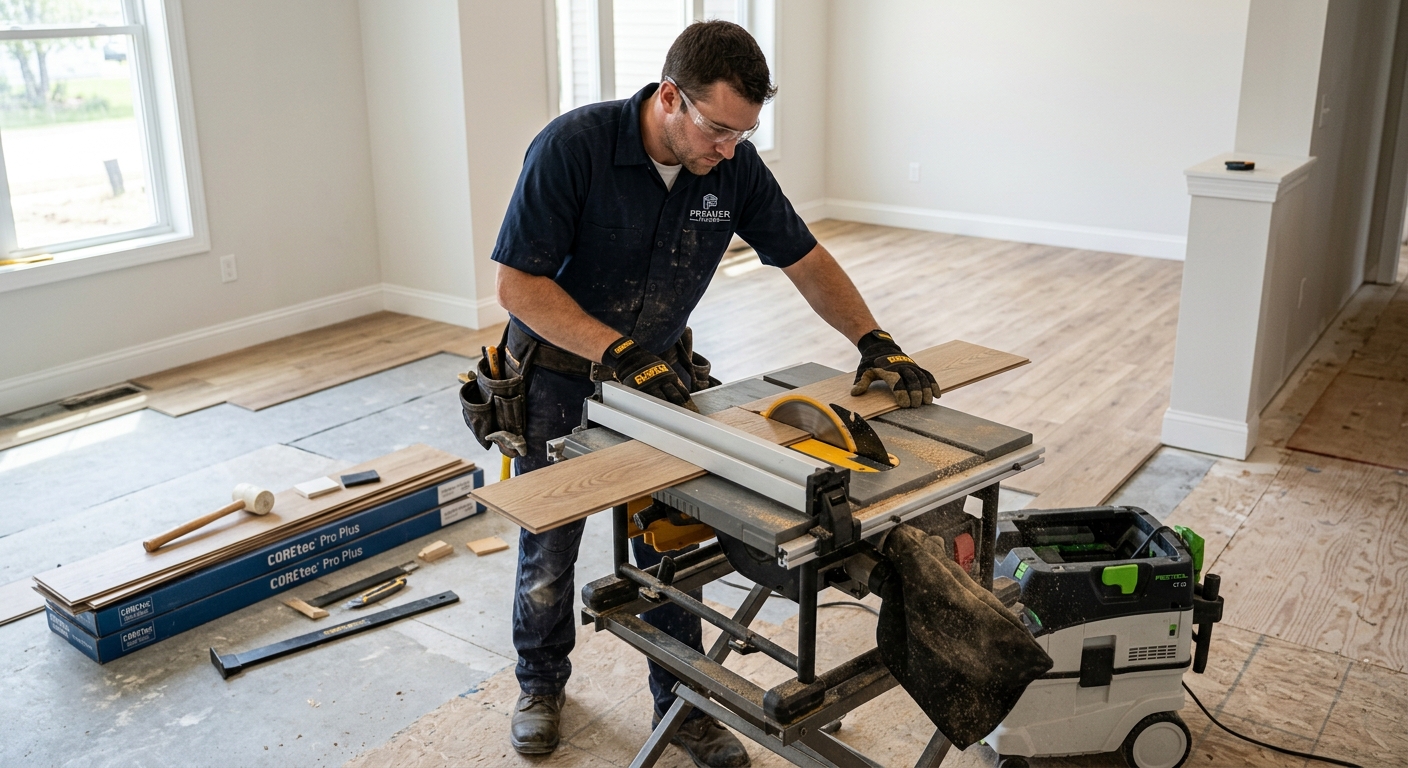
Flooring options and costs in Qualicum Beach
Qualicum Beach homeowners usually ask for “the best value,” but the right floor depends on how your house handles coastal moisture and day-to-day humidity swings. With 27.3% of homes built before 1981, it’s common to see older subfloors (wavy plywood or uneven concrete) that need levelling or repair before any new finish goes down. That prep work can add roughly $1 to $4 per sq ft in labour and materials, even before you choose hardwood versus vinyl or tile.
On Vancouver Island and the Coast, pricing reflects more than material cost. Contractors typically build in allowances for moisture management (vapor barrier/underlayment, acclimation time, and careful fastening) and for extra site labour—especially in older basements and below-grade bedrooms where humidity is harder to control. Availability can also affect turnaround: popular install periods near late spring and summer can stretch scheduling and increase labour demand for sanding, floor prep, and stair work.
In Qualicum Beach, the trade is especially active around the Englishman River area and the neighbourhoods near the village core, where many upgrades are happening in older single-detached homes (79.3% of dwellings are single-detached). If you’re planning a renovation this year, the fastest way to budget is to compare typical all-in installed per-square-foot ranges by flooring type—then adjust for your prep scope and any transitions or stair nosing. See the comparison table below.
| Type |
Best Room |
Moisture Resistance |
Lifespan |
Price per sq ft |
| Solid hardwood (nail-down, above grade only) |
Living rooms, hallways |
Low (avoid below grade; needs stable indoor humidity) |
25–50 years |
$10 – $18 |
| Engineered hardwood (float or glue, above + on-grade) |
Living rooms, main bedrooms |
Medium–high (better dimensional stability) |
20–35 years |
$9 – $16 |
| Laminate (click-lock, above-grade) |
Living rooms, bedrooms |
Low–medium (water still needs prompt cleanup) |
10–25 years |
$5 – $10 |
| Luxury vinyl plank / LVP (waterproof, any level) |
Kitchen, basements, main floors |
High (waterproof core; strong for coastal moisture) |
15–25 years |
$7 – $12 |
| Porcelain / ceramic tile |
Bathrooms, kitchens |
High (tile is stable; grout needs care) |
30–60 years |
$12 – $25 |
| Carpet (broadloom or modular tile) |
Bedrooms, stairs |
Low–medium (needs dry subfloor and good underpad) |
8–15 years |
$4 – $9 |
Prices are estimates only and vary by project scope, site access and material selection.
What affects the price of flooring in Qualicum Beach
In Qualicum Beach (and across Vancouver Island and the Coast), it’s normal to see quotes for the same room land 30–50% apart. The biggest reasons aren’t usually the “flooring brand”—they’re the prep scope, the moisture solution, and how your install method is engineered around your house. British Columbia projects also fluctuate based on timing, crew availability, and how much subfloor work is needed before any product can be installed properly.
Technically, indoor humidity swings and below-grade moisture drive the cost. Solid hardwood expands and contracts with humidity; that’s why we generally don’t install it over concrete or in basements. Engineered hardwood and luxury vinyl plank (LVP) handle expansion and contraction far better, and they’re the safer choice when you’re managing moisture with vapor barriers and underlayment systems. In colder pockets of the region, electrically heated homes increasingly favour radiant-compatible flooring—LVP, many laminates, tile, and most engineered woods—so you may see different material pricing depending on whether the system is radiant-ready.
Older regional housing stock matters: with 27.3% of homes built before 1981, it’s common to budget for levelling or repair. If your plywood is wavy, we may add $1 to $3 per sq ft for labour plus patch/underlayment materials before installation. For example, a $9–$16 per sq ft engineered hardwood job can effectively move closer to the upper end when we add subfloor correction. Likewise, a “simple” LVP project that starts around $7–$12 per sq ft can climb if stair transitions, heavy removal, or detailed floor prep are included.
Two practical examples from this area: (1) a basement with chronic dampness often adds cost through moisture testing, underlayment selection, and careful adhesive/lock handling—making LVP the budget-smart option; (2) a main-floor upgrade in an older single-detached home frequently needs patching or skim-coating, which narrows the price gap between laminate at $5–$10 and engineered at the higher band.
| Price Factor |
Why It Matters |
Cost Impact |
| Room area in sq ft |
Material quantity and labour time scale directly with floor area. |
Larger areas spread fixed costs; small rooms can cost more per sq ft. |
| Subfloor condition — levelling or repair |
Uneven plywood or flatness issues can break click-lock performance and cause squeaks. |
Often adds about $1–$4 per sq ft in labour/materials in older homes. |
| Moisture / below-grade install — rules out solid hardwood |
Coastal humidity and damp basements require moisture-managed systems. |
May shift you to engineered hardwood or waterproof LVP; typically increases prep items. |
| Material choice — solid vs. engineered vs. LVP vs. tile |
Different product construction tolerates humidity differently and has different install systems. |
Can move you across bands (e.g., carpet $4–$9 vs. tile $12–$25). |
| Removal and disposal of existing flooring |
Demo time, haul-away fees, and patching after removal vary widely. |
Commonly increases labour; can be a major driver in renovations. |
| Stair nosing / transitions |
Stairs, landings, and floor height changes are labour-intensive. |
Charged per step or per linear foot; can add noticeable total cost. |
| Radiant heat compatibility |
Some floors over radiant need specific underlayment and temperature-control setpoints. |
May require specific product selection and extra floor testing/temperature pacing. |
| Installation method — float vs. glue-down vs. nail-down |
Method affects subfloor prep, labour hours, and material usage. |
Glue-down and nail-down often cost more if prep and bonding requirements are strict. |
Permits & regulations in British Columbia
In British Columbia, the flooring installation itself typically does not require a building permit. Where homeowners run into permitting is with related work—especially anything that changes the structure, addresses moisture remediation in a way that impacts assemblies, or touches electrical systems. For example, installing or modifying in-floor heating wiring/circuits generally requires the appropriate electrical permitting and qualified work. Structural subfloor repair that goes beyond simple patching may also require involvement from qualified trades and, depending on scope, can trigger permits.
In condominiums, rules are often the real constraint rather than municipal permits. Corporation policies on sound transmission (STC/IIC ratings) can restrict hard-surface flooring on upper floors and can require specific underlays. Before you order material, review your condo declaration and request board approval in writing if the plan involves hardwood, engineered hardwood, LVP, or tile above-grade in multi-unit buildings.
To verify your contractor in Qualicum Beach, do it step-by-step: (1) ask for their business licence/registration information and confirm they’re legitimate; (2) request a certificate of insurance showing general liability (and, where applicable for the job scope, coverage for subcontractors); (3) request evidence of workers’ compensation coverage (WSIB/WCB) for their employees/subcontractors—this matters if you’re hiring someone to work in occupied homes or access crawl spaces; (4) if you’re dealing with older homes, ask how they test and manage moisture before installation. Then store copies of the insurance certificate and any clearance/letters provided, not just the quote.
Best flooring for each room in your Qualicum Beach home
Choosing flooring by room is how you avoid costly callbacks in Qualicum Beach. Living and dining areas typically suit engineered hardwood or high-quality laminate: both offer warmth underfoot and good day-to-day durability while tolerating humidity better than solid hardwood. For master bedrooms, carpet is often the comfort winner because it reduces sound and stays warmer in cooler months—just make sure the subfloor is properly dry before installation.
Kitchens are where water events are most common (spills, wet shoes, frequent cleaning). Luxury vinyl plank (LVP) is a strong choice because it’s waterproof and handles the coastal moisture realities better than many laminates. If you want the most water-tough finish, large-format porcelain tile is also excellent for cleaning and long-term stability. For basements (especially finished ones), LVP is usually the clear winner: its waterproof core and layered construction make it more forgiving in below-grade humidity environments where solid wood and many laminate floors can suffer gapping or edge swelling.
Bathrooms should be porcelain or ceramic tile on the right substrate and with proper sealing/underlayment practices. And if you’re installing over in-floor heating—which is increasingly common—choose radiant-compatible flooring and follow manufacturer temperature limits. This is one reason many Qualicum Beach homeowners end up in the $7–$12 per sq ft LVP band or tile at $12–$25 instead of solid hardwood, which is generally better limited to above-grade main floors.
Example: if your living room area is 300 sq ft and engineered hardwood is priced in the $9–$16 per sq ft range, that could total roughly $2,700–$4,800 before adding subfloor correction. If the subfloor needs levelling, it may bring you closer to the upper end—yet it’s still often less hassle than managing solid hardwood’s humidity sensitivity above concrete or in a basement-adjacent space.
| Room |
Best Material |
Why |
Moisture Risk |
Price Band per sq ft |
| Living / dining room |
Engineered hardwood |
Warm look, strong dimensional stability for coastal humidity |
Low–medium (manage indoor humidity; keep RH stable) |
$9 – $16 |
| Master bedroom |
Carpet (or engineered hardwood if pets are minimal) |
Comfort and quieter rooms; carpet helps with sound absorption |
Low (dry subfloor is key) |
$4 – $9 |
| Secondary bedrooms |
Carpet or high-quality laminate |
Good value for day-to-day traffic; easy maintenance vs carpet in some cases |
Low (typically) |
$5 – $10 |
| Kitchen |
Luxury vinyl plank (LVP) or porcelain tile |
Waterproof practicality for spills and regular cleaning |
Medium–high (spills are frequent) |
$7 – $12 |
| Basement (finished) |
LVP (waterproof) |
Handles below-grade humidity better; safer over moisture-managed systems |
High (coastal moisture + older basements) |
$7 – $12 |
| Bathroom |
Porcelain / ceramic tile |
Best-in-class water resistance and long-term durability |
High (routine wet areas) |
$12 – $25 |
How to choose a flooring contractor in Qualicum Beach
Start with verification. In British Columbia, you should ask the contractor for proof of general liability insurance and workers’ compensation coverage (WSIB/WCB) for their crew and subcontractors. A legitimate flooring contractor will provide a certificate of insurance on request, and their WCB documentation should match the legal business name on your quote. If they can’t produce it, pause and request it again in writing before work begins.
Next, get 2–3 itemised written quotes. Ideally, the quote includes labour and materials separately (not a single lump sum), plus line items for prep, underlayment/vapor barrier, adhesive or fasteners, removal and disposal, and transitions/stair work. Read the scope for what’s excluded: for instance, moisture testing, subfloor patching, floor levelling/skim-coating, and any required permits for in-floor heating electrical circuits (where applicable). Confirm whether disposal is included and whether they haul away the underlay, old baseboards, and packaging.
For warranty, separate product warranty from workmanship warranty. Ask the typical workmanship coverage length and whether it’s transferable if you sell your home. Clarify the payment schedule: never let the job start with a large upfront payment—generally keep deposits around 10–15% and hold back the remainder until key completion items are done and defects (if any) are addressed. Finally, require a start date and completion estimate in writing.
- Confirm insurance certificate (general liability) matches their business name.
- Request proof of WSIB/WCB coverage for employees/subcontractors.
- Ask for prior-project photos from Qualicum Beach and nearby Vancouver Island sites.
- Get an itemised quote: materials vs labour, and prep/underlayment listed line-by-line.
- Ensure the subfloor flatness/repair scope is explicitly stated (levelling/patching included or not).
- Clarify moisture management steps: vapor barrier/underlayment and acclimation time.
- Confirm removal and disposal costs (and what is hauled away).
- Ask how transitions and stair nosing are priced (per step or per linear foot).
- Require a written timeline with start date and estimated completion.
- Review warranty terms: workmanship duration, product warranty terms, and transferability.
- Keep upfront payment to 10–15% and schedule the rest to milestones.
- Get the scope in writing for changes: what happens if additional subfloor repair is discovered?
Common red flags in Qualicum Beach: (1) refusing to provide insurance/WSIB details; (2) quoting a “flat rate” without stating subfloor prep or moisture handling; (3) dismissing humidity concerns for engineered/LVP vs solid hardwood; (4) missing stair/transition pricing until the end; and (5) only offering vague warranties or no written workmanship coverage.
Frequently asked questions — flooring in Qualicum Beach
Engineered vs solid hardwood — what's the difference?
Solid hardwood is a single piece of wood installed nail-down (typically only suitable for above-grade main floors). Engineered hardwood uses a plywood or high-density core with a hardwood veneer on top; that layered structure makes it far more dimensionally stable in British Columbia’s humidity swings. In Qualicum Beach, that stability matters because indoor relative humidity can drift outside the ideal range, especially in older single-detached homes where air systems and basements behave differently. That’s why we commonly steer homeowners toward engineered hardwood for main floors, and we generally avoid solid hardwood in basements or over concrete. Pricing often reflects this: engineered is frequently in the $9–$16 per sq ft band, while solid hardwood commonly lands higher in the $10–$18 per sq ft range due to stricter install requirements.
Do I need to level my subfloor first?
Often, yes—especially in homes built before 1981 in Qualicum Beach, where older plywood or concrete can be out of plane. Leveling doesn’t always mean total replacement; it can be patching, feather-filling, or adding an appropriate underlayment system to reach the flatness needed for a quality installation. If the subfloor is uneven, click-lock laminate can shift at seams, LVP can telegraph high spots, and hardwood floors may squeak or fail prematurely. It also affects how well transitions align with door jambs and stair heights. If your contractor finds flatness issues, expect an added allowance often around $1–$4 per sq ft for labour and materials, before the actual floor is installed.
What's the most durable flooring for pets and kids?
For pets and kids in Qualicum Beach, LVP is usually the most forgiving choice because it’s waterproof and handles daily accidents better than hardwood or laminate. It also tends to be more resistant to minor spills and easier to clean after muddy paws—important in coastal weather when wet footwear comes in. Carpet can work in bedrooms if you’re careful with spills, but it’s not the best in basements or high-moisture areas. Tile is durable too, but it can be harder on dropped items and requires more precise installation. Cost-wise, many families compare LVP in the $7–$12 per sq ft band versus carpet at $4–$9; if your lifestyle includes frequent messes, the extra cost of LVP can be justified by fewer stain-related replacements.
How do I choose flooring for humidity in Qualicum Beach?
Start with the location in your home and the moisture risk: above-grade main floors are one scenario; basements and any below-grade areas are another. In Qualicum Beach and across Vancouver Island and the Coast, humidity swings can move outside the ideal 35–55% range, and older basements can hold dampness. Solid hardwood expands and contracts with humidity, and it performs poorly where moisture is chronic—so we generally avoid it for basements and concrete. Engineered hardwood handles humidity far better, and LVP is the most reliable option when moisture is a concern because it’s waterproof. For bathrooms, tile is the practical solution. If your home has radiant heat, confirm radiant compatibility before choosing any product.
Do condos restrict hard flooring?
Yes, often. In British Columbia condominiums, the restriction usually comes from the building corporation’s rules on sound transmission (STC/IIC ratings), not from a general “hard flooring ban.” Many condos require specific underlay under hard flooring on upper floors, and some may restrict installation types unless you get written board approval. Before ordering, review your condo declaration and ask the corporation what product and underlay combinations are acceptable. This matters with engineered hardwood, LVP, and tile because those can transmit impact noise. Your installer should be able to advise on sound-rated underlay options, but approval must come from the corporation first.
How do I compare flooring quotes?
Compare quotes the same way you’d compare car repairs: line-by-line, not just by the final total. Ask for an itemised breakdown of labour and materials, and confirm what’s included for removal and disposal, subfloor levelling/repair, underlayment/vapor barrier, stair nosing, and transitions. Clarify whether moisture testing or extra prep is included if issues are discovered. In older Qualicum Beach homes, prep can shift the final cost significantly, so scope clarity prevents surprises. Also check timelines, warranty terms (workmanship vs product), and the payment schedule—avoid proposals asking for more than about 10–15% upfront. Finally, confirm realism against the typical bands for this region: tile often lands around $12–$25 per sq ft installed, while LVP commonly sits around $7–$12, and carpet around $4–$9.