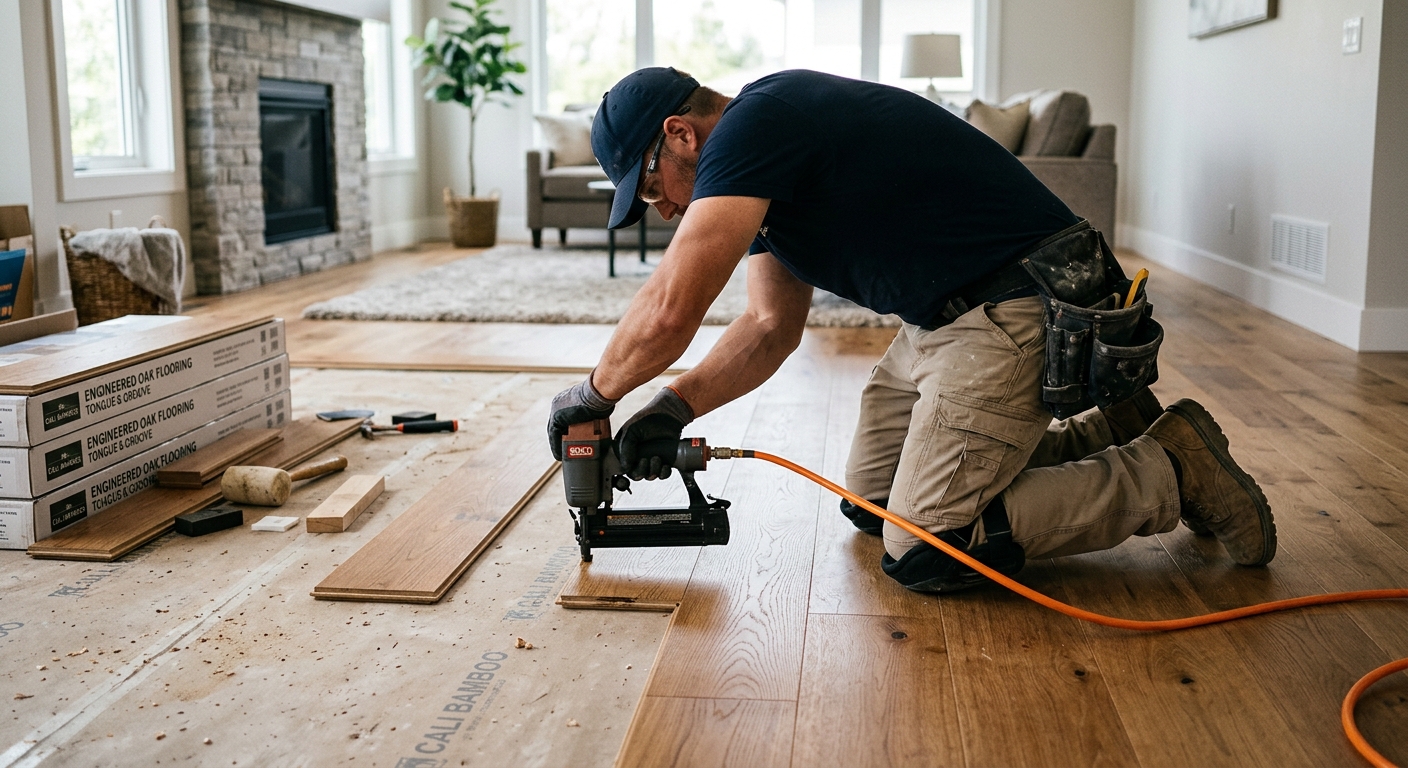
Flooring options and costs in Austin Heights
Austin Heights is a small, established community in the Lower Mainland–Southwest, with a population of 3,340 (Statistics Canada, 2021 Census). That size matters: you’ll often get faster scheduling than bigger metros, but the same regional supply and demand pressures still affect pricing. Just as important, many local properties are older—older housing stock in the Lower Mainland–Southwest frequently has uneven plywood or concrete, which can mean levelling, patching, and sometimes an added moisture barrier layer before a new floor goes down. In practice, that subfloor prep commonly adds about $1–$3 per sq ft, and it’s one reason quotes for “the same-looking” flooring can differ.
The wet, marine climate is a daily reality here. Indoor humidity swings—especially in winter and the shoulder seasons—can push solid hardwood to cup or separate if the home isn’t managed for humidity. Basements and slab-on-grade areas also see moisture wicking through concrete, which is why we typically avoid solid hardwood below grade and recommend engineered wood or luxury vinyl plank (LVP) instead. If your home has radiant heating (more common in newer builds inland and in updated Lower Mainland homes), that also influences which materials perform best. Contractor availability is strongest in the busier corridor and around amenities, so trades often prioritize jobs in the most trafficked streets and older neighbourhood pockets where moisture prep is frequently needed.
Below is a practical side-by-side of the main flooring types we install in Austin Heights, including realistic pricing for this market. Use it to compare material choices before you request itemised quotes.
| Type |
Best Room |
Moisture Resistance |
Lifespan |
Price per sq ft |
| Solid hardwood (nail-down, above grade only) |
Main living areas (not below grade) |
Low to moderate (sensitive to humidity swings) |
25–60 years |
$9,00–$18,00 |
| Engineered hardwood (float or glue, above + on-grade) |
Living areas, bedrooms |
Moderate to high (built for stability) |
20–35 years |
$9,50–$16,50 |
| Laminate (click-lock, above-grade) |
Bedrooms, hallways |
Low to moderate (water can damage edges) |
10–25 years |
$4,50–$10,00 |
| Luxury vinyl plank / LVP (waterproof, any level) |
Kitchen, entry, basement (finished) |
High (PVC core handles moisture better) |
15–30 years |
$5,00–$12,00 |
| Porcelain / ceramic tile |
Bathrooms, kitchens, foyers |
Very high (waterproof surface) |
25–50 years |
$10,00–$20,00 |
| Carpet (broadloom or modular tile) |
Bedrooms, stairs (comfort-first) |
Moderate (avoid long-term damp areas) |
7–15 years |
$6,00–$12,00 |
Prices are estimates only and vary by project scope, site access and material selection.
What affects the price of flooring in Austin Heights
In Austin Heights, it’s common to see the same floor type land anywhere from 30% to 50% apart across the Lower Mainland–Southwest and British Columbia. The biggest reason isn’t the sticker price of the flooring—it’s what happens underneath it. Our regional climate is wet and marine, which means humidity swings can change how subfloors behave through the year. Below grade, moisture wicking through concrete can require extra prep and a moisture-rated system, and that rules out solid hardwood. Solid hardwood expands and contracts with humidity; it generally can’t be installed over concrete in the way engineered wood and LVP can, and it performs poorly in basements unless you’re using a very specific above-grade build-up.
Cold-room and radiant heating considerations also change material selection. When radiant heat is in play, most homeowners end up choosing engineered wood, LVP, tile, or some higher-rated laminate. Meanwhile, older regional housing stock frequently needs subfloor levelling or repair, commonly adding roughly $1–$4 per sq ft. That’s a real driver of total cost because levelling products, grinding, additional underlayment, and extra labour all stack up quickly in Greater Vancouver-area scheduling.
Here are concrete examples we see often in Austin Heights: (1) A 400 sq ft living area with cupping risk—solid hardwood that otherwise “should” be $9–$18 per sq ft—often becomes an engineered job once humidity stability is specified; the material difference is usually justified by fewer callbacks. (2) A finished basement that looks dry can still have concrete moisture—switching from solid wood to waterproof LVP can add cost up front but avoids expensive remediation and floor replacement later. (3) Uneven plywood under vinyl or laminate can increase labour for levelling before install, even when the finish is “budget” at $4–$10 per sq ft.
| Price Factor |
Why It Matters |
Cost Impact |
| Room area in sq ft |
Material quantity and labour time scale directly with area |
Typically the baseline of most total quotes (often 40%+ of scope) |
| Subfloor condition — levelling or repair needed before install |
Unlevel floors require patching, grinding, or re-laying surfaces |
Commonly adds about $1–$3 per sq ft |
| Moisture / below-grade install — rules out solid hardwood |
Moisture wicking through concrete requires moisture-rated systems |
Can add $2–$4 per sq ft in prep for basements |
| Material choice — solid vs. engineered vs. LVP vs. tile |
Different products have different install requirements and materials cost |
Solid hardwood usually lands higher than laminate or LVP |
| Removal and disposal of existing flooring |
Demo time and landfill fees vary by product and layers |
Often adds a noticeable lump to total labour cost |
| Stair nosing / transitions — charged per step or per linear foot |
Transitions and stair components are priced separately |
Can add hundreds to the total depending on stair count |
| Radiant heat compatibility — limits material options |
Not every floor supports radiant heat safely |
May shift you from solid hardwood to engineered or LVP |
| Installation method — float vs. glue-down vs. nail-down |
Labour steps and tolerances differ by method |
Can swing labour cost by 10%–25% on similar materials |
Permits & regulations in British Columbia
In British Columbia, a typical flooring replacement doesn’t require a building permit by itself. Most installs—floating engineered wood, click-lock laminate, LVP, carpet, and setting tile over an approved underlayment—generally fall under “finishing work” that homeowners handle without permits. However, associated work can trigger requirements. For example, if the project includes structural subfloor repair that changes load-bearing components, moisture remediation that involves specialized remediation steps, or in-floor heating circuit work, you may need electrical permits depending on what’s being altered. If you’re adding or modifying radiant heating components, that’s the part to verify early with your contractor and the relevant authorities.
Condominiums add another layer. Many buildings restrict hard flooring due to sound transmission, often referencing STC/IIC performance and requiring specific underlay. Always review your condo declaration and request board approval in writing before installing hardwood or tile on upper floors. Even when a product is “approved,” the underlay thickness and installation method can make or break compliance.
Step-by-step, an Austin Heights homeowner can verify a contractor in B.C.: (1) confirm the contractor’s licensing status through the appropriate provincial licensing registry for the trade, (2) request a certificate of liability insurance that clearly lists the contractor and your project address if applicable, and (3) verify coverage for workplace injury via WSIB/WCB documentation. Ask for clearance letters or coverage proof and keep copies in your project file. If a contractor can’t produce documents quickly, that’s usually a red flag.
Best flooring for each room in your Austin Heights home
Choosing the right floor for each room in Austin Heights comes down to moisture behaviour, traffic, and comfort. The Lower Mainland–Southwest’s marine climate brings humidity swings that can stress wood and laminate edges. In main living and dining spaces, engineered hardwood or a high-quality laminate can be a good balance of warmth and durability, especially when installed with proper underlayment and expansion gaps. In the master bedroom, many homeowners prefer carpet for comfort and sound absorption, while others choose engineered hardwood for a more continuous, easy-to-clean look.
For kitchens, go with luxury vinyl plank (LVP) or large-format porcelain tile. LVP’s waterproof core handles everyday spills and minor standing water better than laminate, and tile is ideal if you want the lowest long-term moisture risk. Basements are where the climate and housing realities really show: finished basements in Austin Heights often sit on slab-on-grade or have moisture dynamics that make solid hardwood a gamble. LVP is the clear winner there—fully waterproof, tolerant of humidity and moisture vapour movement, and typically easier to keep stable in a damp environment than wood products. Bathrooms should be porcelain or ceramic tile only, with proper grout and waterproofing assemblies.
If you have radiant heating, choose materials designed to work with heat cycles—engineered wood, LVP, and tile are the usual safe options. Solid hardwood over radiant requires careful product specification and monitoring.
Price-wise, the “best value” depends on where you’re spending. For example, switching a basement from solid hardwood (or a moisture-risk laminate) to LVP often costs more than a basic laminate install, but it can save you from costly replacement if humidity pushes the edges—especially in a wet-marine climate like ours.
| Room |
Best Material |
Why |
Moisture Risk |
Price Band per sq ft |
| Living / dining room |
Engineered hardwood |
Warm look with better humidity stability than solid |
Low to moderate (manage indoor humidity) |
$9,50–$16,50 |
| Master bedroom |
Carpet or engineered hardwood |
Carpet adds comfort; engineered keeps a cleaner, quieter feel |
Low (avoid if condensation is common) |
$6,00–$14,00 |
| Secondary bedrooms |
Laminate (quality click-lock) or engineered |
Good durability per dollar in bedrooms with controlled moisture |
Low (keep away from wet mops and spills) |
$4,50–$12,50 |
| Kitchen |
LVP or porcelain tile |
Spill tolerance and easy cleaning for everyday use |
Moderate to high (sinks, leaks, cleaning) |
$5,00–$20,00 |
| Basement (finished) |
Luxury vinyl plank (waterproof) |
Handles moisture vapour and slab-on-grade conditions far better |
High (moisture wicking is common) |
$5,00–$12,00 |
| Bathroom |
Porcelain / ceramic tile |
Lowest moisture risk with a properly built waterproof system |
Very high (wet areas) |
$10,00–$20,00 |
How to choose a flooring contractor in Austin Heights
When you’re hiring a flooring contractor in Austin Heights, verify credentials first—then match the scope to the climate realities. In British Columbia, flooring work itself is usually straightforward, but subcontracting and related prep often involve trade skills that affect quality. Ask for liability insurance and proof of workplace injury coverage (WSIB/WCB) and make sure the certificate is active. For licensing, confirm the contractor’s registration status through the relevant B.C. trade registry/credentials pathway for the work they’re performing, and don’t rely on verbal confirmation.
Next, get 2–3 itemised written quotes. You want a breakdown that separates labour and materials, and clearly lists underlay, moisture barriers, levelling products, transitions, and stair work. A lump sum can hide the real cost drivers, like whether removal and disposal of existing flooring are included, and whether levelling is “included only if needed” or actually budgeted. In this region, moisture prep can change everything—especially on slabs and in basements—so insist the quote specifies the moisture plan and installation requirements.
Warranty matters too: ask for the workmanship warranty length, the manufacturer’s product warranty terms (including what voids coverage), and whether the warranty is transferable to you as the homeowner. For payment, never pay more than 10–15% upfront; hold back part of the total until the job is complete and you’ve inspected key areas. Require a start date and a completion estimate in writing so delays don’t become “extra costs” conversations later.
- Verify B.C. licensing/registration status relevant to the scope
- Confirm liability insurance is current and request a certificate copy
- Provide WSIB/WCB clearance or coverage proof (ask to see it)
- Ask for 2–3 references from Lower Mainland projects with similar floors
- Require quotes that itemise labour, materials, underlay/moisture barrier, and levelling
- Confirm removal and disposal are included (and how many floors/layers)
- List all transitions and stair nosing costs per step/linear foot if applicable
- Make sure the scope includes room-by-room measurements and waste factor
- Ask how they handle humidity control recommendations for hardwood
- Confirm radiant heating compatibility if installed or present
- Get a written workmanship warranty and understand what’s excluded
- Set payment milestones tied to completion milestones, not just dates
Red flags I commonly see in the Austin Heights market: (1) contractors who won’t put moisture-prep and underlayment details in writing; (2) “solid hardwood everywhere” promises without asking about basement/slab conditions; (3) vague warranties (no workmanship term or unclear exclusions); (4) requiring large upfront payments beyond 10–15%; and (5) quotes that don’t specify removal/disposal, stair transitions, or levelling scope but assume the floor will “just fit.”
Frequently asked questions — flooring in Austin Heights
What is the difference between floating and glued-down flooring?
Floating flooring (common with click-lock laminate and many engineered options) is installed so planks “float” over an underlay rather than being bonded to the subfloor. It relies on an expansion gap around the perimeter and proper underlayment to absorb minor movement—important in Austin Heights due to indoor humidity swings in the Lower Mainland–Southwest. Glued-down flooring is bonded directly to the subfloor, which can provide a more rigid feel and sometimes better sound control, but it requires a very stable, properly prepared surface and the right adhesive system. For below-grade or on concrete, installers often prefer methods and products designed for moisture—engineered systems and waterproof LVP—because solid hardwood is sensitive to humidity and generally not the right choice over slab.
What flooring holds up best to pets in a Austin Heights home?
For pets in Austin Heights, luxury vinyl plank (LVP) is often the most forgiving option. Its waterproof core handles accidents and easier cleanup, and it tends to resist denting better than softer carpets—though no flooring is dent-proof. Choose a quality wear layer and thicker core if you have active pets, and make sure the subfloor is properly level so the floor doesn’t flex at seams. If you prefer a wood look, engineered hardwood can work well above grade, but you still need to manage indoor humidity and address spills quickly to protect the top veneer. Carpet can be comfortable for pets, but in a wet-marine climate where dampness can occur in certain areas, you’ll want to keep it strictly dry and consider stain protection. Price-wise, compare typical LVP ranges (often around $5,00–$12,00 per sq ft) versus carpet installation bands ($4,00–$8,00 installation component, depending on total system).
How do I fix squeaky floors in my Austin Heights home?
Squeaks usually come from movement between subfloor layers, fasteners that have loosened, or insufficient support under plywood over time—issues that are common in older housing stock across the Lower Mainland–Southwest. The first step is to identify where the sound originates: press and walk in small areas, then check for gaps, loose boards, or movements near joists. If squeaks are localized, subfloor fastening repairs (adding screws or addressing a loose layer) are often the correct fix before installing new floors, because flooring replacements won’t reliably “solve” a structural squeak. If you’re planning new flooring, ask the contractor to inspect for subfloor deflection and confirm levelling/repair plans. If the squeak is tied to the underlayment or a floating system, sometimes it’s underlay selection or installation tension issues, but most true squeaks need subfloor attention first.
What is luxury vinyl plank and is it worth it in Austin Heights?
Luxury vinyl plank (LVP) is a waterproof, multi-layer floor with a PVC core and a wear layer on top that can mimic wood grain. In Austin Heights, it’s often worth it because it performs well through wet, marine humidity cycles and is tolerant of moisture vapour movement, which matters for basements and slab-on-grade areas. Solid hardwood is usually a poor fit below grade because it expands and contracts with humidity, and laminate can be vulnerable at edges if water gets in. With LVP, everyday spills in kitchens and bathrooms-adjacent areas are generally less risky, and it’s easier to maintain. Cost-wise, LVP typically sits in a mid band around $5,00–$12,00 per sq ft, which can compare favourably to tile (often $10,00–$20,00) if you want a warmer, softer feel. The “worth it” decision is really about avoiding moisture-driven callbacks.
How much does flooring cost in Austin Heights?
Flooring cost in Austin Heights depends on the material, room size, and how much prep your subfloor needs. As a guide, laminate and vinyl plank projects often fall around the $4–$10 per sq ft band for typical material pricing, while tile commonly trends higher, roughly $10–$20 per sq ft depending on tile size and finish. Hardwood (solid) usually sits at the higher end—often $9–$18 per sq ft—especially once you factor in levelling and humidity-conscious installation details. Carpet installation is commonly budgeted around $4–$8 for installation, with total cost varying by carpet grade. In this region’s older housing stock, subfloor levelling or repair commonly adds about $1–$3 per sq ft, and basement moisture prep can push higher. The best way to get a realistic number is an itemised quote that includes removal/disposal and whether moisture barriers or levelling are fully budgeted.
Hardwood vs laminate vs vinyl plank — which is best?
In British Columbia’s Lower Mainland–Southwest climate, “best” depends on the room and the moisture story. Hardwood (especially solid hardwood) looks premium and can last decades above grade, but it’s sensitive to humidity swings and is generally not the right choice for basements or on concrete without a very careful system. Engineered hardwood is the better wood alternative because it handles stability better in the same climate. Laminate is often a good budget pick and can work well in bedrooms and hallways, but it’s more vulnerable to water at seams and edges. Vinyl plank (especially waterproof LVP) is usually the most practical choice for kitchens and basements because it tolerates moisture vapour movement and spills far better.
So for an Austin Heights home: living rooms—engineered hardwood; bedrooms—laminate or engineered; basements—LVP; bathrooms—tile. If you’re comparing dollars, remember hardwood is typically $9–$18 per sq ft, while LVP commonly lands around $5,00–$12,00 per sq ft. Choose the option that fits your moisture risk rather than chasing the lowest initial line item.