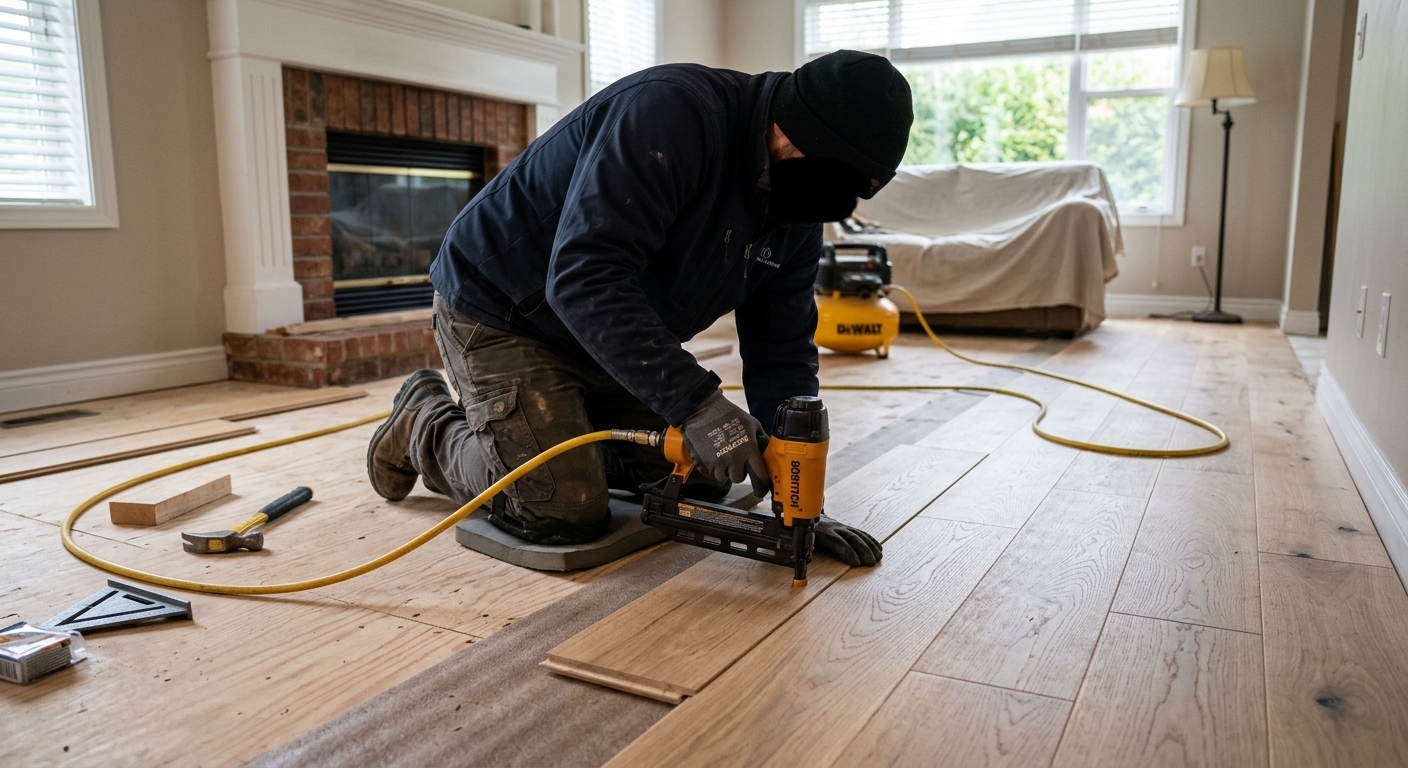
Flooring options and costs in Essondale
In Essondale, British Columbia, the right flooring choice comes down to balancing comfort with moisture performance. With a population of 1,116 (Statistics Canada, 2021 Census), the local market is smaller than Vancouver, so high-quality installers for tile and hardwood tend to book quickly—especially during spring and early summer. Cost is also affected by the kind of housing you’ll find in the area: older Lower Mainland–Southwest homes often have uneven plywood or dated concrete prep, and that means many projects include levelling, patching, or resurfacing before any new finish goes down. In practical terms, that subfloor work commonly adds about $1–$3 per sq ft to the overall job, on top of the flooring itself.
The wet, marine climate is a major driver of pricing in this region. Indoor humidity swings in winter and shoulder seasons can cause cupping and gapping in solid hardwood unless you manage indoor moisture and leave proper expansion gaps. Below grade is where things get even trickier: in basements and slab-on-grade areas, moisture can wick through concrete, so we generally avoid solid hardwood and steer homeowners toward engineered wood or luxury vinyl plank (LVP). If your home has radiant heating in colder new builds, it further narrows material choices—engineered wood, LVP, tile, and selected laminates are the typical best-fit.
Trades are especially busy around the busier residential pockets near the community’s older cores, where home renovations are frequent and subfloor repairs are commonly required. With that in mind, here’s how the main flooring types typically compare for Essondale projects.
| Type |
Best Room |
Moisture Resistance |
Lifespan |
Price per sq ft |
| Solid hardwood (nail-down, above grade only) |
Living / dining rooms |
Low to moderate (humidity sensitive; not for basements) |
25–50 years |
$9–$18 |
| Engineered hardwood (float or glue, above + on-grade) |
Living areas, bedrooms |
Moderate to high (handles indoor swings better) |
20–40 years |
$10–$16 |
| Laminate (click-lock, above-grade) |
Bedrooms, hallways |
Moderate (fine above grade; poor for active moisture) |
10–25 years |
$4–$10 |
| Luxury vinyl plank / LVP (waterproof, any level) |
Kitchen, finished basements |
High (PVC core; good for moisture vapour) |
15–25 years |
$5–$12 |
| Porcelain / ceramic tile |
Kitchen, bathrooms, entries |
Very high (impervious finish; relies on correct underlayment) |
25–50 years |
$10–$20 |
| Carpet (broadloom or modular tile) |
Bedrooms |
Low (not ideal for below grade unless moisture controlled) |
7–15 years |
$5–$11 |
Prices are estimates only and vary by project scope, site access and material selection.
What affects the price of flooring in Essondale
In the Lower Mainland–Southwest region, it’s common to see quotes for the same general flooring job vary by 30–50% across British Columbia. The usual reason isn’t “just different pricing”—it’s differences in subfloor preparation, moisture mitigation, and how the contractor handles labour risk. In Essondale, indoor humidity swings and occasional below-grade moisture are the key technical drivers. Solid hardwood expands and contracts with humidity, and it can’t be installed over concrete in most cases because glue-down or floating methods aren’t appropriate the same way as engineered products. Basements and slab-on-grade areas therefore push many homeowners toward engineered hardwood or LVP, which tolerate minor movement and manage moisture better.
Material choice also interacts with radiant heating. In colder pockets and newer builds, radiant heat compatibility rules out most solid hardwood and can limit some laminate products, while engineered wood, LVP, and tile are typically more forgiving. Older regional housing stock adds to the budget because many floors require levelling, patching, or even a moisture barrier, with local prep commonly adding about $1–$4 per sq ft. At the same time, layout complexity can move labour costs: a smaller room with fewer cuts is cheaper to install than an open-concept area with lots of transitions.
Two concrete Essondale examples: (1) switching from carpet to tile often costs more upfront—tile commonly lands in the $10–$20 per sq ft band—but the value is in wet-area durability and cleaning. (2) upgrading from laminate at roughly $4–$10 per sq ft to engineered hardwood at the $9–$18 hardwood pricing neighbourhood can be worth it if you have any on-grade moisture history, because engineered construction is more stable than solid wood. For basements, LVP usually protects your budget better than trying to “make” solid hardwood work over moisture.
| Price Factor |
Why It Matters |
Cost Impact |
| Room area in sq ft |
Material quantities and labour hours scale directly with area |
Higher area typically reduces per-sq-ft labour efficiency losses |
| Subfloor condition — levelling or repair needed before install |
Uneven plywood and old patching cause hollow spots and premature failure |
Commonly adds about $1–$4 per sq ft |
| Moisture / below-grade install — rules out solid hardwood |
Concrete moisture vapour can telegraph through finishes and damage adhesives |
Often increases cost if barrier/mitigation is required |
| Material choice — solid vs. engineered vs. LVP vs. tile |
Different products need different underlayments, prep, and installation systems |
Can shift the project across $4–$18+ per sq ft bands |
| Removal and disposal of existing flooring |
Demo time, hauling, and special handling for older materials add labour |
Typically a meaningful add-on for tile and old glued-down floors |
| Stair nosing / transitions — charged per step or per linear foot |
Trim, nosing systems, and reducer strips are time-consuming details |
Can add hundreds of dollars depending on layout |
| Radiant heat compatibility — limits material options |
Some floors warp or fail under heat cycling without correct spec |
May increase costs by choosing more compatible products |
| Installation method — float vs. glue-down vs. nail-down |
Prep, labour steps, and moisture management differ by method |
Glue-down and tile typically cost more than straightforward floating |
Permits & regulations in British Columbia
In British Columbia, installing new flooring typically does not require a building permit. That said, associated work can trigger permit requirements—especially when you touch systems that aren’t “just flooring.” For example, if you’re doing electrical updates tied to in-floor heating (or moving/adding components), you may require electrical permits. If your project includes structural subfloor repair beyond simple patching—such as replacing compromised joists or significant framing modifications—check with the relevant authorities. In condominiums, even when a permit isn’t required, the corporation’s rules for sound transmission are often the gating item: hardwood and other hard floors may require approved underlay and sometimes specific STC/IIC requirements.
Here’s a practical step-by-step verification for an Essondale homeowner. First, ask the contractor for their current Business licence and to provide their insurance certificates—and confirm coverage is active for the project dates. Second, request proof that they carry liability insurance and WSIB/WCB coverage (the exact form varies by coverage type, but the intent is to confirm workers’ protection). Third, verify the contractor’s credentials through the appropriate online registry listings and cross-check the company name on the certificate of insurance. Finally, in condo buildings, request board approval in writing before install—especially for hardwood or tile on upper levels where sound control rules apply.
Taking these steps avoids delays, liability gaps, and warranty disputes later.
Best flooring for each room in your Essondale home
In Essondale, British Columbia’s wet, marine climate means your best flooring choices depend on moisture exposure and how much your home’s humidity fluctuates season to season. For living and dining areas, engineered hardwood or a high-quality laminate is usually the sweet spot: they offer warmth underfoot while being far more stable than solid hardwood when humidity changes. In bedrooms, many homeowners choose carpet for comfort and sound absorption, but if your home has a history of dampness, selecting a basement-safe option is important—carpet is generally less forgiving.
In kitchens, choose luxury vinyl plank (LVP) or large-format porcelain tile. LVP handles splashes and minor vapour issues far better than solid wood and many laminates, while porcelain tile stands up to spills and cleaning routines. For basements (finished), LVP is the clear winner: fully waterproof products with the right underlayment approach protect against below-grade moisture movement that can wick through concrete. Bathrooms should be porcelain or ceramic tile only.
If you have radiant heating, pay close attention to compatibility. Engineered wood, LVP, and tile are typically better matches, while solid hardwood and some laminate products can fail if the heat cycle is too aggressive or the product isn’t rated for it. As a cost reality check: upgrading from laminate at roughly $4–$10 per sq ft to LVP in the $5–$12 range is often justified for kitchens and basements because it reduces the risk of moisture-related callbacks—especially in Lower Mainland–Southwest homes where older construction and concrete moisture dynamics are common.
| Room |
Best Material |
Why |
Moisture Risk |
Price Band per sq ft |
| Living / dining room |
Engineered hardwood |
Stable with humidity swings; warm feel without solid-wood limitations |
Low to moderate (manage indoor humidity) |
$10–$16 |
| Master bedroom |
Carpet or engineered hardwood |
Carpet improves comfort and sound; engineered keeps a cleaner maintenance profile |
Low |
$5–$15 |
| Secondary bedrooms |
Carpet |
Budget-friendly comfort and quieter footsteps for upstairs rooms |
Low |
$5–$11 |
| Kitchen |
Luxury vinyl plank (LVP) or porcelain tile |
Easy cleaning and spill tolerance; LVP reduces risk from minor moisture |
Moderate |
$5–$20 |
| Basement (finished) |
Luxury vinyl plank (waterproof) |
Best defence against concrete moisture vapour and uneven subfloor conditions |
High |
$5–$12 |
| Bathroom |
Porcelain / ceramic tile |
Impervious finish; requires correct underlayment and proper waterproofing details |
Very high |
$10–$20 |
How to choose a flooring contractor in Essondale
Choosing the right flooring contractor in Essondale comes down to verification, clarity in the quote, and realistic scheduling. Start with credentials. In British Columbia, confirm the contractor’s licensing status where applicable and ask for their liability insurance certificate—then confirm the policy is active and matches the legal name on the quote. Next, request proof of WSIB/WCB coverage so you’re not exposed if a worker is injured on-site. If they do sub-contracting, ask who the actual installers are and whether those parties are covered too. You should also be able to verify information through appropriate online registry listings and a clearly dated certificate.
Next, get 2–3 itemised written quotes rather than a single lump sum. A good quote separates labour, material, underlayment, prep (like levelling compounds or moisture barriers), removal and disposal, and any transitions. Read the exclusions carefully: is permit handling included where needed, is there a moisture testing allowance, and are there assumptions about subfloor flatness? Confirm warranty terms in writing: workmanship warranty length and what product warranty covers (and whether the warranty is transferable to subsequent owners).
For payment, use a conservative schedule. Don’t pay more than about 10–15% upfront, and hold back a portion until completion. Finally, insist on a start date and completion estimate in writing so you can plan around holidays and school schedules.
- Ask whether they’ve installed the same product on similar subfloors (especially for on-grade and basements).
- Confirm who does demo and disposal and whether it’s included.
- Require an underlay/moisture-barrier specification in the quote—no “allowance” language.
- Check how they handle subfloor flatness and what threshold triggers levelling.
- Ensure transition details (stair nosing, reducers, door jamb trims) are itemised.
- Verify product lot numbers and include delivery timelines.
- Confirm waste factor assumptions (cutting/offsets) to avoid shortfalls.
- Ask about acclimation for wood products (typically several days on-site).
- Confirm the cleaning and final walkthrough steps.
- Get all warranty terms and exclusions in writing.
- Review payment terms and avoid large upfront deposits.
- Ask who to contact if there’s a moisture issue after install.
Red flags I commonly see in Essondale: vague quotes that don’t list levelling/prep line-by-line, contractors who dismiss basement moisture concerns with “just put it down,” refusing to provide proof of insurance/coverage, offering only cash-style payments with no signed contract, and starting without confirming condo sound requirements where applicable.
Frequently asked questions — flooring in Essondale
What is the best flooring for a high-traffic area in Essondale?
For high-traffic areas in Essondale, LVP and tile usually outperform softer options because they resist wear, spills, and daily scuffs in a marine climate. Luxury vinyl plank is a strong choice where humidity swings are noticeable, since waterproof PVC cores handle minor moisture and everyday wet mopping better than solid hardwood. If you prefer a wood look, engineered hardwood is also durable, but it depends on having proper acclimation and correct installation over the right subfloor—especially in older Lower Mainland–Southwest homes. Budget-wise, you’ll typically see LVP around $5–$12 per sq ft, while tile often lands in the $10–$20 per sq ft band. If your high-traffic zone includes an entry or kitchen path with tracked-in moisture, LVP or tile is the safer long-term move.
How do I prepare my subfloor before new flooring?
Subfloor preparation is the difference between a floor that looks good at install and one that lasts in Essondale’s wet conditions. First, evaluate flatness and structural integrity: old plywood can dip, and concrete may show moisture vapour. A reputable contractor will check flatness and plan levelling—often using a patch or self-levelling compound—because unevenness can cause clicking noise in laminate or stress joints in LVP. Second, address moisture: for basements or on-grade areas, an appropriate moisture-control system may be required. Solid hardwood is especially sensitive—generally not recommended over below-grade concrete—while engineered wood and LVP are designed to better manage humidity swings. Finally, ensure the subfloor is clean and properly under-laid (for example, the correct underlay under laminate/LVP). In this region, subfloor work commonly adds about $1–$4 per sq ft when levelling or repairs are needed.
Is cork or bamboo flooring a good choice in Essondale?
Cork can be comfortable and quiet, but in British Columbia’s Lower Mainland–Southwest humidity swings, it needs careful selection. Many cork floors are less forgiving in areas with active moisture or where below-grade moisture vapour is possible. If you’re looking at cork, choose products specifically rated for your installation method and climate, and avoid basements unless the system is designed for it. Bamboo can work as a “hard surface” option, but you still need to treat it like wood: humidity management matters, and installation above grade with proper acclimation is key. For many Essondale homeowners, the practical comparison comes down to stability and risk. Engineered hardwood and LVP usually provide more predictable results when moisture is a concern—particularly over concrete. If you love the look, ask your installer for a moisture plan, and request written warranty terms that clearly cover Essondale-style humidity conditions.
What is the difference between floating and glued-down flooring?
Floating flooring “locks” together—either with click-lock laminate, click-lock LVP, or some engineered systems—then the whole surface rests over an underlay without being directly bonded to the subfloor. Glued-down flooring is installed with adhesive and is physically bonded to the substrate, which can help with some stability characteristics but demands more rigorous subfloor condition and moisture control. In Essondale, floating LVP often has an advantage in basements because the waterproof construction handles moisture better, while a glued-down wood system can be more sensitive to moisture vapour and adhesive performance. For radiant heating, both methods can be acceptable depending on product ratings, but you must follow the manufacturer’s spec closely. The best method depends on the product type, subfloor flatness, and whether moisture is present in the slab or plywood.
What flooring holds up best to pets in a Essondale home?
For pets in Essondale, LVP is commonly the most practical choice because it’s waterproof, easy to clean, and less vulnerable to everyday accidents than carpet. It also tends to resist moisture-related issues that can show up in older Lower Mainland–Southwest homes, particularly if you have any on-grade or basement areas in the path of your routine. If you prefer something softer, carpet can work in bedrooms but needs careful spot-cleaning and may not be ideal for basements where humidity can be higher. Engineered hardwood can be pet-friendly with the right finish, but it’s not the first pick for basements and it’s more sensitive to moisture than LVP. For budgets, LVP typically sits around $5–$12 per sq ft, while tile can be a durable pet option in kitchens and entries at $10–$20 per sq ft. Choose a realistic thickness/wear layer and ensure underlayment won’t compromise performance.
How do I fix squeaky floors in my Essondale home?
Squeaks usually come from movement between subfloor layers or joists—not from the finish flooring itself. In most Essondale homes, the fix depends on where the squeak originates. Start by locating the spot with someone walking while you listen from underneath (if you have a crawlspace) or by tapping gently and checking for loose fasteners in the area if accessible. Common solutions include re-screwing subfloor boards into joists, adding blocking to reduce movement, or correcting gaps that let boards rub. Once the structural squeak issue is corrected, your flooring can be reinstalled or covered, but it’s important not to “mask” squeaks with new flooring alone. If you have installed carpet or floating floors, squeaks may worsen as the underlay compresses. For a flooring contractor, the key is a quick assessment before replacing materials—especially if the home’s older construction contributes to movement.