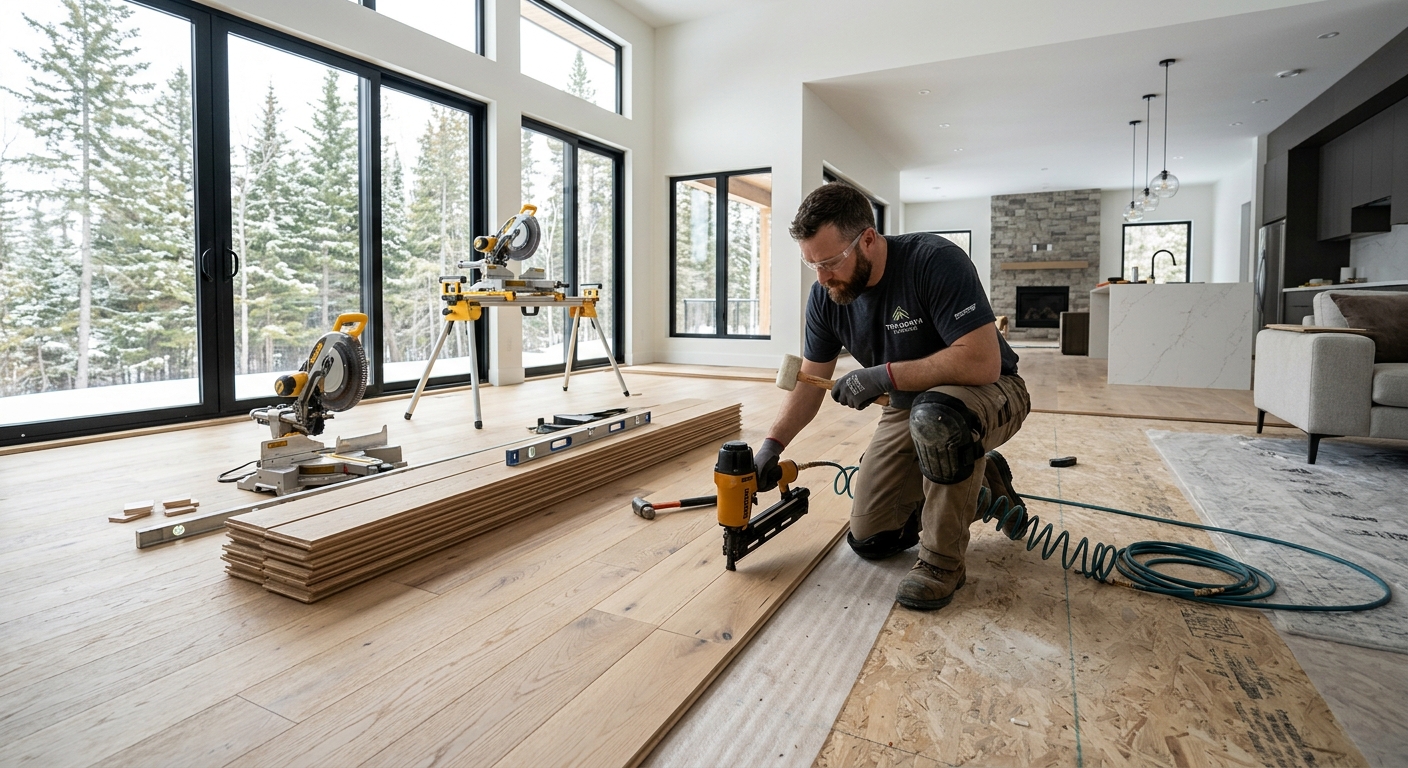
Flooring options and costs in Williams Lake
Flooring in Williams Lake has to perform through big seasonal swings—winter indoor air can get quite dry, then summer swings back to higher humidity. That matters because Williams Lake’s housing stock is older: 62.8% of homes were built before 1981 (Statistics Canada, 2021 Census). In these homes, uneven subfloors and patched sections are common, so the quote often starts with levelling/repair work before any finish flooring is installed. Depending on the floor system, it’s also typical to budget additional labour for patching or adding plywood/OSB where the base isn’t flat; that prep can easily run a few dollars per square foot before you ever lay the new surface.
On top of that, the Cariboo market is shaped by cold winters and humidity at shoulder seasons. Solid hardwood is especially sensitive: it expands and contracts with indoor humidity and isn’t a good choice for basements or any below-grade concrete. In contrast, engineered hardwood and luxury vinyl plank (LVP) handle moisture better when installed with the right vapour barrier, underlay, and expansion spacing. Because many installers are booked around the few stable-weather install windows, projects that require significant subfloor prep—common in older neighbourhoods—tend to price higher and schedule longer.
Trades are particularly busy around South Lakeside, where many homeowners tackle main-floor refreshes in late spring and summer. With those factors in mind, here’s how the main flooring types typically stack up on cost and performance for Williams Lake homes.
| Type |
Best Room |
Moisture Resistance |
Lifespan |
Price per sq ft |
| Solid hardwood (nail-down, above grade only) |
Living / dining (main floor) |
Low (avoid basements and concrete) |
25–40 years |
$12–$22 |
| Engineered hardwood (float or glue, above + on-grade) |
Living / dining, bedrooms |
Medium to high (with correct underlayment) |
20–35 years |
$12–$20 |
| Laminate (click-lock, above-grade) |
Bedrooms, hallways (dry zones) |
Low to medium (water at seams is the risk) |
10–20 years |
$6–$12 |
| Luxury vinyl plank / LVP (waterproof, any level) |
Kitchen, entry, finished basement |
High to very high (proper prep still matters) |
15–25 years |
$8–$14 |
| Porcelain / ceramic tile |
Kitchen, bathrooms |
High (grout still needs care) |
25–50 years |
$15–$30 |
| Carpet (broadloom or modular tile) |
Bedrooms, stairs (comfort-focused) |
Low (not ideal for damp basements) |
8–15 years |
$6–$12 |
Prices are estimates only and vary by project scope, site access and material selection.
What affects the price of flooring in Williams Lake
In Williams Lake and the wider Cariboo (including Prince George and Quesnel), the same “square-foot” project can land 30–50% apart when contractors quote different prep scope, product grade, or installation method. That gap is even wider across British Columbia because shipping distances, seasonal scheduling, and the amount of subfloor correction you need can vary by site. The big technical driver is moisture: cold winters often bring dry indoor air, while summer humidity can rise quickly. Solid hardwood responds by expanding and contracting; it’s not meant to be glued or floated over concrete and performs poorly in basements. Engineered hardwood and LVP handle humidity and below-grade applications far better when installed with correct vapour barriers and flatness requirements.
Radiant heat compatibility also changes costs. In colder regions, homeowners increasingly want in-floor heating under new surfaces. That typically rules out most solid hardwood and some laminate products, steering projects toward engineered wood, many LVP lines, or tile systems. Finally, older housing stock is the reason many Cariboo quotes include a “subfloor levelling/repair” line item; even a modest repair can add $1–$4 per sq ft depending on how out-of-flat the base is.
Two practical examples from Williams Lake: (1) A finished-basement refresh usually costs more at the start because contractors may need vapour barrier and flattened plywood before LVP goes down; you’ll often pay less over time than replacing a failing laminate later. (2) Main-floor engineered hardwood may look expensive compared with laminate’s $6–$12 band, but the stability benefits can be worth it in humidity swings—especially in homes built before 1981 where the floor system isn’t always perfectly even (Statistics Canada, 2021 Census). From there, labour availability and product grade usually determine whether you land closer to the low or high end of each band.
| Price Factor |
Why It Matters |
Cost Impact |
| Room area in sq ft |
Direct driver of material usage and labour hours |
Lower rates on bigger areas; waste allowance applies |
| Subfloor condition |
Older homes often need levelling, patching, or new plywood |
Can add $1–$4/sq ft in many Cariboo basements |
| Moisture / below-grade install |
Rules out solid hardwood; vapour barriers and prep become critical |
Typically increases prep labour and underlay materials |
| Material choice |
Solid vs. engineered vs. LVP vs. tile changes product price and install method |
Broadly shifts total spend across the $6–$30/sq ft range |
| Removal and disposal of existing flooring |
Old glue, underlay, and nails can take significant time |
Often adds a noticeable labour line item |
| Stair nosing / transitions |
Complex edges and matching thresholds cost labour and trim material |
Charged per step or per linear foot |
| Radiant heat compatibility |
Limits options to specific engineered, LVP, or tile systems |
May raise material cost but reduce warranty risk |
| Installation method |
Float vs. glue-down vs. nail-down affects subfloor prep and labour pace |
Glue-down and tile usually cost more than simple click installs |
Permits & regulations in British Columbia
In British Columbia, the act of installing most floor coverings typically does not require a building permit. However, associated work can trigger permits—this is where many quotes need clarity. For example, if your project includes electrical work for in-floor heating circuits, that portion usually requires an electrical permit. If you’re doing significant structural subfloor repair (not just replacing a few damaged panels) or addressing moisture remediation that ties into other building envelope issues, you may need additional approvals depending on what’s being altered.
In condominiums, regulations are more about building rules than public permits. Many building corporations restrict or require specific underlay for noise/sound transmission, and they may require product/underlay combinations to meet STC/IIC targets. Before you install any hardwood or tile on upper floors, review the declaration and request written board approval.
If you’re a homeowner in Williams Lake, verify your contractor the practical way:
- Check British Columbia licensing/registration status through the appropriate provincial online registry (search the contractor’s business name).
- Ask for a current certificate of liability insurance before work starts.
- Confirm WSIB/WCB coverage (Workers’ compensation coverage) and request proof.
- Require a written scope that states whether permits (if needed) are handled by the contractor or by you.
- Keep copies of all certificates and approvals for your records and any future resale disclosure.
Best flooring for each room in your Williams Lake home
Choosing the right flooring for each room in your Williams Lake home is mostly about matching performance to moisture exposure, traffic, and comfort—while respecting the Cariboo climate’s humidity swings and cold winters. In living and dining areas, engineered hardwood or high-quality laminate can deliver warmth and style without the same expansion/contraction risk as solid wood. For a master bedroom, many homeowners pick carpet for comfort and sound absorption, but engineered hardwood is also a strong choice if you want easier cleaning and a more uniform look.
Kitchen flooring needs real water-resistance. That’s where LVP shines: it’s easy to maintain, tolerates splashes, and handles the humidity conditions better than laminate. For bathrooms, go with porcelain or ceramic tile—water resistance and durability are the priority, and tile systems are built to manage wet areas. Basements are the big decision point in Williams Lake: because moisture vapour and occasional seepage can occur in older homes, LVP is usually the clear winner for finished basements. Most solid hardwood and many laminate products are poor fits below grade and can cup or swell if moisture is present.
Radiant heat compatibility is increasingly requested in British Columbia, and it matters for comfort during long winters. If you have or plan in-floor heating, engineered wood (that’s rated for radiant heat) and many LVP lines are often safer than traditional solid hardwood.
Price-wise, a quick example: if laminate is in the $6–$12/sq ft band, but your basement needs proper vapour control and a water-resistant surface, upgrading to LVP can cost more per sq ft while reducing the risk of future replacement. That’s often the difference between “a good demo and redo later” and “done once.”
| Room |
Best Material |
Why |
Moisture Risk |
Price Band per sq ft |
| Living / dining room |
Engineered hardwood |
Warm look with better dimensional stability than solid |
Low to medium (main-floor exposure) |
$12–$20 |
| Master bedroom |
Carpet or engineered hardwood |
Comfort and sound control, or easy-clean stability |
Low |
$6–$18 |
| Secondary bedrooms |
Laminate or engineered hardwood |
Good value; engineered lasts longer with humidity swings |
Low |
$6–$16 |
| Kitchen |
Luxury vinyl plank (LVP) |
Handles spills and frequent cleaning without swelling |
Medium (routine splash exposure) |
$8–$14 |
| Basement (finished) |
LVP (waterproof system) |
Best balance of below-grade tolerance and practical maintenance |
Medium to high (vapour/possible dampness) |
$8–$14 |
| Bathroom |
Porcelain / ceramic tile |
Designed for wet areas; long service life |
High |
$15–$30 |
How to choose a flooring contractor in Williams Lake
Picking the right flooring contractor in Williams Lake is mostly about avoiding surprises: moisture problems, poor subfloor prep, or unclear exclusions in your quote. Start by verifying British Columbia contractor licensing/registration status (if applicable for their scope) and ask for a certificate of liability insurance. You should also confirm Workers’ compensation coverage—ask for proof of WSIB/WCB coverage and check it’s current. A reputable installer will provide these documents without pushing back.
Next, get 2–3 itemised written quotes. You want a breakdown that separates labour from materials and lists prep requirements (levelling/patching, vapour barrier, underlay, adhesive type, and transition pieces). Avoid quotes that only state a single lump sum without explaining what’s included. Ask if disposal is included, whether subfloor flattening is part of the price, and whether any permits are required for electrical work related to radiant heat.
Warranty terms matter too. Confirm the workmanship warranty length, the manufacturer warranty terms, and whether the warranty is transferable if you sell the home. For payment, never pay more than 10–15% upfront; hold back a balance until the job is complete and inspected. Finally, insist on a written timeline with start date and a realistic completion estimate—Cariboo projects often depend on seasonal install windows.
- Request proof of insurance (liability) before signing.
- Confirm WSIB/WCB coverage with a current clearance letter or proof of coverage.
- Verify their British Columbia registration/licensing status through the online registry.
- Get an itemised quote: materials, labour, underlay/vapour barrier, adhesives, trim.
- Ask what’s excluded (moving appliances, baseboards, patching beyond X sq ft).
- Confirm removal and disposal costs and whether they include hauling.
- Get a written plan for subfloor flattening and the acceptable height variation.
- For basements, require vapour barrier details and underlayment specification.
- Ask whether moulding/baseboard undercutting is included.
- Confirm stair nosing and transitions pricing per step or per linear foot.
- Review warranty details in writing: workmanship + product, transferability, exclusions.
- Set a payment schedule with a holdback until final walkthrough and punch list completion.
Red flags in the Williams Lake market: contractors who won’t show insurance/coverage documents, quotes that ignore subfloor flattening needs in older homes, “too-good-to-be-true” pricing with no line items for underlay/vapour barrier, unclear warranty terms, or plans that treat basements like standard above-grade installs.
Frequently asked questions — flooring in Williams Lake
Can I install flooring over existing tile in Williams Lake?
Yes, it can be possible in British Columbia, but it depends on the tile surface and your floor build-up. If the existing tile is well-bonded, flat, and firmly fixed (no hollow spots or rocking), some contractors will prep and install over it—especially for LVP with proper underlay and for engineered systems that meet flatness requirements. The catch in Williams Lake is unevenness: older homes can have dips, cracked grout, or minor lippage that will telegraph through new flooring. Also, if moisture has been an issue in the area, you still need to address vapour pathways before laying a new finish. In many cases, removing tile is the cleaner, longer-lasting option.
What is the best flooring for a high-traffic area in Williams Lake?
For high-traffic areas in Williams Lake, LVP and tile are usually the safest bets. LVP (when installed as a proper waterproof system) handles frequent foot traffic, occasional spills, and humidity swings better than laminate, and it’s practical for entryways and kitchens. Tile is excellent where you want maximum durability and easy cleaning, but it can feel colder unless paired with radiant heat or a warmer subfloor strategy. If you’re balancing budget, LVP typically falls in the $8–$14/sq ft range, while tile often lands in the $15–$30/sq ft band. In homes built before 1981, ensure your subfloor is level first—high traffic will expose imperfections faster.
How do I prepare my subfloor before new flooring?
Subfloor prep is where Williams Lake projects are won or lost, especially in older homes (Statistics Canada, 2021 Census). Generally, you’ll need the subfloor to be flat, solid, clean, and dry enough for the chosen flooring. Contractors typically check for movement, squeaks, and soft spots, then either patch low areas or add new plywood/OSB where needed. For basement or below-grade areas, vapour control becomes critical—so the prep scope may include moisture testing, vapour barrier placement, and choosing an underlayment system that matches the flooring type. Don’t rush this stage: even the best LVP or engineered hardwood can fail early if the base is uneven. Confirm the prep steps are spelled out in your written quote.
Is cork or bamboo flooring a good choice in Williams Lake?
In most Williams Lake basements and moisture-prone zones, cork and bamboo are usually a risky fit because they can react to humidity changes and they don’t behave like fully waterproof systems. Bamboo can be dimensionally sensitive depending on the product construction, and cork can also be affected by moisture and temperature swings over time. If you’re considering these materials, keep them for dry, above-grade rooms with stable indoor humidity, and confirm the manufacturer’s installation instructions for vapour barriers and subfloor requirements. In contrast, engineered hardwood and LVP are more forgiving under Cariboo climate conditions. If your intent is to install in a basement, LVP typically outperforms cork/bamboo for long-term stability.
What is the difference between floating and glued-down flooring?
Floating flooring is installed with a locking system (common with click-lock laminate and some engineered products). It “floats” over a prepared subfloor with an underlay, relying on the click joints and expansion gaps around the perimeter. Glued-down flooring uses adhesive to bond planks directly to the subfloor, which can improve stability on harder bases and sometimes helps reduce movement. In Williams Lake, the key is what your subfloor is like: if it’s older and uneven, both methods require prep to achieve the right flatness tolerance. For below-grade or any moisture-sensitive areas, glued-down doesn’t automatically solve moisture problems—vapour barriers and correct system selection matter more. Always confirm whether the product is rated for your installation method and the room’s moisture conditions.
What flooring holds up best to pets in a Williams Lake home?
For pets, LVP and tile are often the top choices in British Columbia because they’re resilient, easy to clean, and less vulnerable to humidity swings than many wood-based surfaces. LVP is particularly popular in homes that see muddy paws or regular water exposure near exterior doors; when installed with a proper waterproof system, it’s far more forgiving than laminate. Tile is durable and scratch-resistant, though it can be harder underfoot unless paired with radiant heat or rugs. If you’re comparing costs, LVP generally sits around $8–$14/sq ft, while tile typically ranges from $15–$30/sq ft. If you choose carpet, use quality underpad and keep basements and damp areas off-limits for carpet to avoid odours or damage.