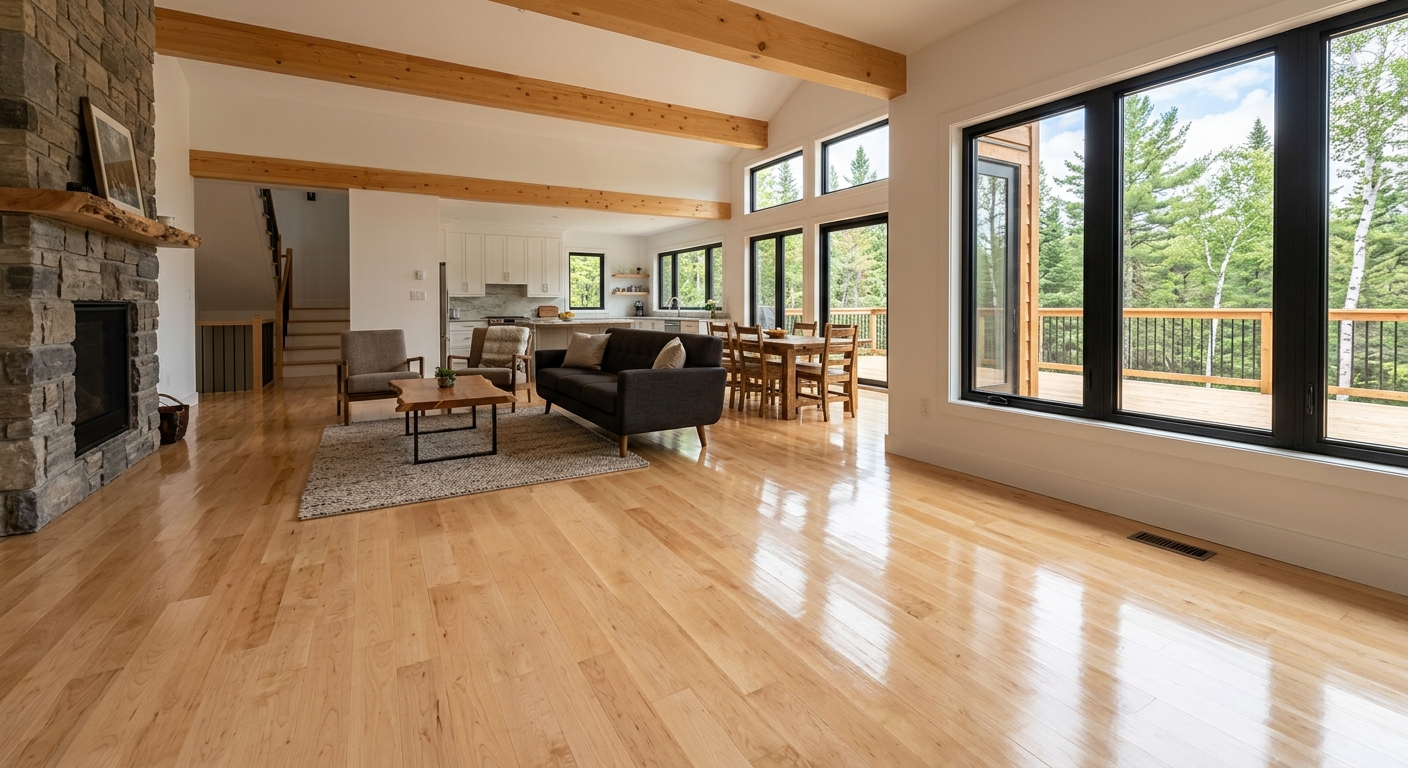
Flooring options and costs in Cariboo
Cariboo homeowners typically balance comfort, resale value, and moisture risk when choosing flooring—because the region’s Greater Vancouver-area pricing and trade availability ripple outward, even as you’re dealing with local concrete slabs, older subfloors, and humidity swings. With a population of 22,780 (Statistics Canada, 2021 Census), Cariboo demand supports steady contractor scheduling, but you’ll still see variation in labour costs and lead times depending on the month and the crew size.
One reason quotes can feel inconsistent is that many older homes in the area have uneven plywood or dated subfloor layers that need levelling, patching, or sometimes a full resurfacing before new flooring can be installed. In practice, that adds roughly $1–$3 per sq ft to many projects. In the Lower Mainland–Southwest market, moisture management is also central: basements and slab-on-grade areas can experience moisture wicking through concrete, especially during winter and shoulder season. For those below-grade areas, we generally avoid solid hardwood and recommend engineered hardwood or luxury vinyl plank (LVP) because their layered construction (and LVP’s waterproof build) tolerates humidity and minor temperature changes far better.
In main living spaces, solid hardwood remains popular for appearance and longevity, but you’ll want the right product, expansion gap details, and indoor humidity control to prevent cupping or gapping. Radiant heating is increasingly common in newer builds, which further narrows the “safe over heat” choices—often pushing homeowners toward engineered wood, LVP, tile, and some higher-rated laminates.
In Cariboo, this trade is especially in demand around the Williams Lake and 100 Mile House corridors, where renovations hit both older housing stock and active family traffic. Below is a practical cost and performance comparison to help you translate your estimate into like-for-like scope before you talk to installers.
| Type |
Best Room |
Moisture Resistance |
Lifespan |
Price per sq ft |
| Solid hardwood (nail-down, above grade only) |
Main living areas |
Low (humidity-sensitive; avoid below grade) |
25–50 years |
$9–$18 |
| Engineered hardwood (float or glue, above + on-grade) |
Main living + bedrooms |
Medium to high (layered core handles swings) |
20–35 years |
$9–$17 |
| Laminate (click-lock, above-grade) |
Living areas, bedrooms |
Medium (depends on core + underlay; avoid wet basements) |
10–20 years |
$4–$10 |
| Luxury vinyl plank / LVP (waterproof, any level) |
Kitchen, entry, basement (finished) |
High (waterproof with correct prep) |
15–25 years |
$4–$10 |
| Porcelain / ceramic tile |
Kitchen, bathrooms |
Very high (surface water resistance) |
30–50 years |
$10–$20 |
| Carpet (broadloom or modular tile) |
Bedrooms, stairs (comfort) |
Low to medium (needs stain protection) |
7–15 years |
$4–$10 |
Prices are estimates only and vary by project scope, site access and material selection.
What affects the price of flooring in Cariboo
In Cariboo and the wider Lower Mainland–Southwest region, two quotes for the “same” flooring type can differ by 30–50% because the quote is really a bundle of materials, subfloor preparation, labour complexity, and risk. For example, in one home the slab is flat enough for LVP; in another, you’ll need levelling compound, skim coating, or more extensive moisture management before any finish floor goes down. Labour availability also matters—Greater Vancouver-area pricing pulls on installation costs, and scheduling can tighten when multiple renovations are underway across nearby communities.
The biggest technical driver is indoor humidity swings and below-grade moisture. Solid hardwood expands and contracts with moisture, so it can’t be glued or floated over concrete and generally performs poorly in basements. Engineered hardwood and luxury vinyl plank (LVP) handle humidity far better, which is why they’re the practical choice for many on-grade and basement installs. For colder-inland pockets using radiant heat, most solid hardwood and some laminate products aren’t ideal—specification matters and can affect what product brands your contractor can responsibly install.
Older regional housing stock adds another cost layer: if the subfloor needs levelling or repair, homeowners often see an additional $1–$4 per sq ft. In real projects, that can be the difference between a mid-range carpet install and a higher priced engineered-wood job. A second example: stairs and transitions are frequently priced per step or per linear foot, so an open-concept living area with minimal doorways can cost notably less than a similar total square footage with many tight corners.
Finally, material band selection changes the “base” quickly. If you start at laminate/LVP territory (often $4–$10 per sq ft), then add $1–$3 per sq ft for levelling and a heavier underlay for sound control, your finished total can still land well below hardwood. Tile and porcelain, often $10–$20 per sq ft, can look expensive at first, but it’s typically justified in wet rooms where replacement cycles are less frequent.
| Price Factor |
Why It Matters |
Cost Impact |
| Room area in sq ft |
Directly drives material quantity, waste factor, and labour time |
Usually ±10% depending on layout complexity |
| Subfloor condition — levelling or repair needed before install |
Uneven plywood/OSB or damaged spots must be addressed for warranty and performance |
Commonly +$1–$4 per sq ft |
| Moisture / below-grade install — rules out solid hardwood |
Moisture vapour needs vapour barriers, patching, or waterproof systems |
Can add +$1–$3 per sq ft |
| Material choice — solid vs. engineered vs. LVP vs. tile |
Different products carry different material and installation requirements |
Ranges from about $4–$20 per sq ft depending on type |
| Removal and disposal of existing flooring |
Old flooring, underlay, and staples create extra labour and dump fees |
Often +$1–$3 per sq ft for tear-out-intensive jobs |
| Stair nosing / transitions — charged per step or per linear foot |
Profiles and labour add up quickly on staircases and doorways |
Can shift total by several thousand dollars on bigger homes |
| Radiant heat compatibility — limits material options |
Only certain products are warrantied/approved for heat cycles |
May add +$1–$5 per sq ft depending on product selection |
| Installation method — float vs. glue-down vs. nail-down |
Method changes labour time, prep, and sometimes required adhesives/underlay |
Typically ±10% to ±25% on labour component |
Permits & regulations in British Columbia
In British Columbia, installing new flooring by itself usually does not require a building permit. That said, “associated work” can trigger permits depending on what else you’re changing. For example, if your project includes electrical work for in-floor heating circuits (wiring, thermostats, new runs), you may need an electrical permit handled by a licensed electrician. If you’re doing structural subfloor repair—like replacing major portions of subfloor framing or correcting unsafe conditions—permits may come into play depending on how extensive and structural the changes are.
In condominiums, regulations and building rules are often the bigger constraint than provincial permitting. Sound transmission requirements (STC/IIC) can restrict underlay choices, and some strata councils have specific approved underlays or installation methods for hard surface floors on upper levels.
For a homeowner in Cariboo verifying a contractor, use a three-step check. First, confirm the contractor’s licensing status and trades credentials through the appropriate provincial registry for the company/individual doing the work. Second, request a certificate of insurance (liability) that shows active coverage for your project period and confirm it matches the contractor’s legal name. Third, ask for proof of WSIB/WCB coverage (as applicable) or a clearance letter—then verify the document is current, not just a generic attachment. If they can’t provide clear documentation promptly, that’s a red flag before you sign anything.
Best flooring for each room in your Cariboo home
Choosing the right flooring in Cariboo comes down to matching the material to moisture exposure, daily traffic, and how your home handles humidity. In living and dining areas, engineered hardwood is a strong balance: it keeps the look of real wood while tolerating the indoor humidity swings common in the Lower Mainland–Southwest market. If you’d rather start with a lower-cost option, high-quality laminate (rated for stable conditions) can work, but you still need correct underlay and careful acclimation.
For kitchens, go with luxury vinyl plank (LVP) or large-format porcelain tile. LVP is waterproof and forgiving for spills, and it’s also an easier upgrade path over uneven subfloors than tile. Tile wins where you expect regular water contact; it’s also a long-term choice, often justifying its higher cost (commonly $10–$20 per sq ft) compared with laminate/LVP (often $4–$10 per sq ft) because it typically lasts longer in wet zones.
Basements (when finished) are where local climate and construction realities matter most. Moisture wicking through concrete is common, so LVP is usually the clear winner: it handles below-grade conditions far better than solid wood or many laminates. Bathrooms should be porcelain/ceramic tile only. Solid hardwood is best kept above grade, and on homes with radiant heating, engineered wood, LVP, and tile are usually the safer pairings—many solid hardwood installs over radiant require very careful product selection and humidity control.
As a real-world cost example: if you’re comparing LVP at roughly $4–$10 per sq ft versus tile at $10–$20 per sq ft for a kitchen, the price jump is justified when spills are frequent and you want a surface that doesn’t degrade from water exposure or frequent cleaning. Otherwise, LVP gives you most of the practical benefits at a more budget-friendly band.
| Room |
Best Material |
Why |
Moisture Risk |
Price Band per sq ft |
| Living / dining room |
Engineered hardwood |
Warm look with better humidity tolerance than solid |
Low to medium (manageable with indoor humidity) |
$9–$17 |
| Master bedroom |
Carpet or engineered hardwood |
Comfort and sound control from carpet; stability from engineered wood |
Low (avoid major moisture sources) |
$4–$17 |
| Secondary bedrooms |
High-quality laminate or LVP |
Good durability for kids/pets; simpler maintenance |
Low (spill risk is usually the main issue) |
$4–$10 |
| Kitchen |
Luxury vinyl plank (LVP) or porcelain tile |
Water resistance and easy cleaning; tile for maximum wet-zone durability |
Medium to high (spills, sink splash, wet mops) |
$4–$20 |
| Basement (finished) |
LVP (waterproof) |
Designed for below-grade moisture conditions |
High (concrete vapour/moisture wicking) |
$4–$10 |
| Bathroom |
Porcelain / ceramic tile |
Best protection against water; long service life |
Very high |
$10–$20 |
How to choose a flooring contractor in Cariboo
Start by verifying the contractor’s credentials before you compare “cheap” versus “premium.” In British Columbia, ask for three things in writing: (1) their current licensing/trade credentials for the scope they’re claiming, (2) liability insurance (certificate of insurance showing active coverage), and (3) WSIB/WCB coverage or an applicable clearance letter. If you’re not sure what coverage is required for their roles, ask directly—reputable contractors will explain what applies to their crew and provide documents without hesitation.
Next, request 2–3 itemised written quotes, not lump sums. You want a breakdown that separates labour (subfloor prep, installation, transitions/stairs) and materials (underlay, adhesives, vapour barrier where needed, trim). Flooring jobs often change when subfloor levelling is discovered late; an itemised quote makes it clearer what your “unknowns” are. Also read the exclusions: is demo and disposal included, is moving furniture included, and is vapour barrier/moisture testing included for below-grade areas?
Warranty matters twice: workmanship warranty length and product warranty terms. Confirm whether the workmanship warranty is transferable if you sell the home, and ask if the product warranty requires specific installation steps (acclimation, underlay type, approved adhesives). Then get the payment schedule right—never pay more than 10–15% upfront, and hold back a portion until the job is fully complete and cleaned.
Finally, lock in timing. Get a start date and completion estimate in writing so you’re not guessing around material availability and crew scheduling in the Cariboo area.
- Check they can show licence/trade credential details matching the work scope.
- Request a current certificate of liability insurance with your project dates.
- Verify WSIB/WCB coverage or provide a current clearance letter.
- Get 2–3 itemised quotes: labour, materials, underlay/vapour barrier, transitions.
- Ask if removal and disposal are included (dump fees can surprise you).
- Confirm subfloor prep requirements and who supplies levelling compound/patch.
- For basements, ask how they manage moisture vapour (barrier and prep steps).
- Request that stair nosing and door transitions are quoted per step/linear foot.
- Confirm underlay details for laminate/LVP and any sound requirements.
- Verify acclimation and installation conditions (temperature/humidity requirements).
- Review warranty: workmanship term, product term, and whether coverage is transferable.
- Use a payment schedule with ≤10–15% upfront and a holdback until completion.
Red flags we see in Cariboo include: contractors who won’t provide insurance/coverage documents, quotes that omit subfloor levelling or moisture prep scope, “one-price” lump sums with no breakdown for stairs/transitions, unclear warranty terms (especially workmanship), and requests for large upfront payments beyond 10–15%.
Frequently asked questions — flooring in Cariboo
How do I compare flooring quotes?
To compare quotes in Cariboo and across British Columbia, insist on like-for-like scope. Ask each contractor to itemise labour and materials separately, including underlay, vapour barrier (for basements/slabs), adhesives (if glue-down), trims, and transition pieces. Pay attention to subfloor prep—if one quote includes levelling and moisture remediation and another doesn’t, the “cheaper” price may cost more after you discover gaps, squeaks, or warranty issues. Confirm installation method too: nail-down, float, glue-down, and stair work can shift labour time and product requirements. For reference, laminate/LVP is often in the $4–$10 per sq ft band, while tile commonly lands in the $10–$20 per sq ft band—if your quotes fall outside those bands without explanation, ask why.
Can I install flooring over existing tile in Cariboo?
Sometimes, but it depends on the tile condition, height transitions, and the new floor type. In British Columbia homes, tile floors can be installed over if the existing surface is firmly bonded, flat enough, and free of cracked grout movement. For LVP, installers often require a smooth, stable base; if the tile is uneven or rocking, you’ll need patching/level correction before floating planks go down. For laminate, the same “flat and stable” rule applies, plus you’ll need appropriate underlay. Tile-over-tile with carpet doesn’t make sense for comfort and adhesion; it’s usually better to remove soft materials. If you’re adding radiant heating, also confirm compatibility—some products have temperature limits that must be followed per manufacturer instructions.
What is the best flooring for a high-traffic area in Cariboo?
For high-traffic areas in Cariboo—entries, hallways, and kitchens—the best choice is usually LVP or engineered hardwood, depending on moisture exposure. LVP is waterproof and handles the “wet shoes and damp coats” reality of the Lower Mainland–Southwest climate better than wood; it’s also forgiving on minor subfloor imperfections if the prep is solid. Engineered hardwood can be excellent in main living spaces, but it’s more sensitive to sustained humidity swings than LVP, and it should stay above grade. If you’re looking at price bands, LVP often sits in the $4–$10 per sq ft range, while tile is typically $10–$20 per sq ft—tile is unbeatable in wet zones, but for everyday traffic LVP is often the practical sweet spot.
How do I prepare my subfloor before new flooring?
Subfloor preparation is where many flooring projects succeed or fail. In Cariboo and throughout British Columbia, the goal is a flat, clean, dry surface that matches the product requirements. For most installations, contractors will check for soundness (no soft spots), then verify flatness—because click-lock laminate and floating LVP can fail prematurely if the subfloor is uneven. For older housing stock, plywood/OSB often needs levelling compound or patching; that’s a common add-on of about $1–$4 per sq ft depending on severity. For below-grade or slab-on-grade areas, moisture vapour control matters: a vapour barrier and correct surface prep may be required, and that’s one reason solid hardwood is typically avoided in basements. Ask your contractor exactly what prep steps they include in the quote.
Is cork or bamboo flooring a good choice in Cariboo?
Cork and bamboo can be good in the right room, but they’re not the top choice for most basements in Cariboo. The Lower Mainland–Southwest market sees humidity swings and occasional below-grade moisture conditions, and natural products can be more sensitive to moisture than LVP or properly installed engineered wood. Cork is naturally resilient and comfortable underfoot, which makes it appealing for bedrooms or living areas, but it still needs stable indoor humidity and the right installation system. Bamboo is harder and can work above grade, yet it still responds to humidity changes. If you’re considering them, keep installation above grade where possible and confirm the manufacturer’s approved underlay and moisture/temperature requirements. For wet zones like bathrooms and finished basements, tile (bathrooms) and LVP (basements) remain the safer, lower-risk selections.
What is the difference between floating and glued-down flooring?
Floating flooring means the planks or panels are not fixed to the subfloor; they “float” over an underlay and click together (common with laminate and many engineered floors). Because it relies on a stable, flat base, floating floors are sensitive to unevenness—if the subfloor isn’t level, you may get movement, noise, or early wear. Glued-down flooring is attached to the subfloor with adhesive, which can improve stability and reduce some movement, but it requires specific surface prep and an adhesive compatible with the subfloor and product. In British Columbia, glue-down methods can also demand stricter moisture conditions, especially over slabs. For homeowners, floating often offers faster install and easier room changes, while glue-down can be preferable for certain engineered or performance-focused installations when prep and moisture control are done correctly.