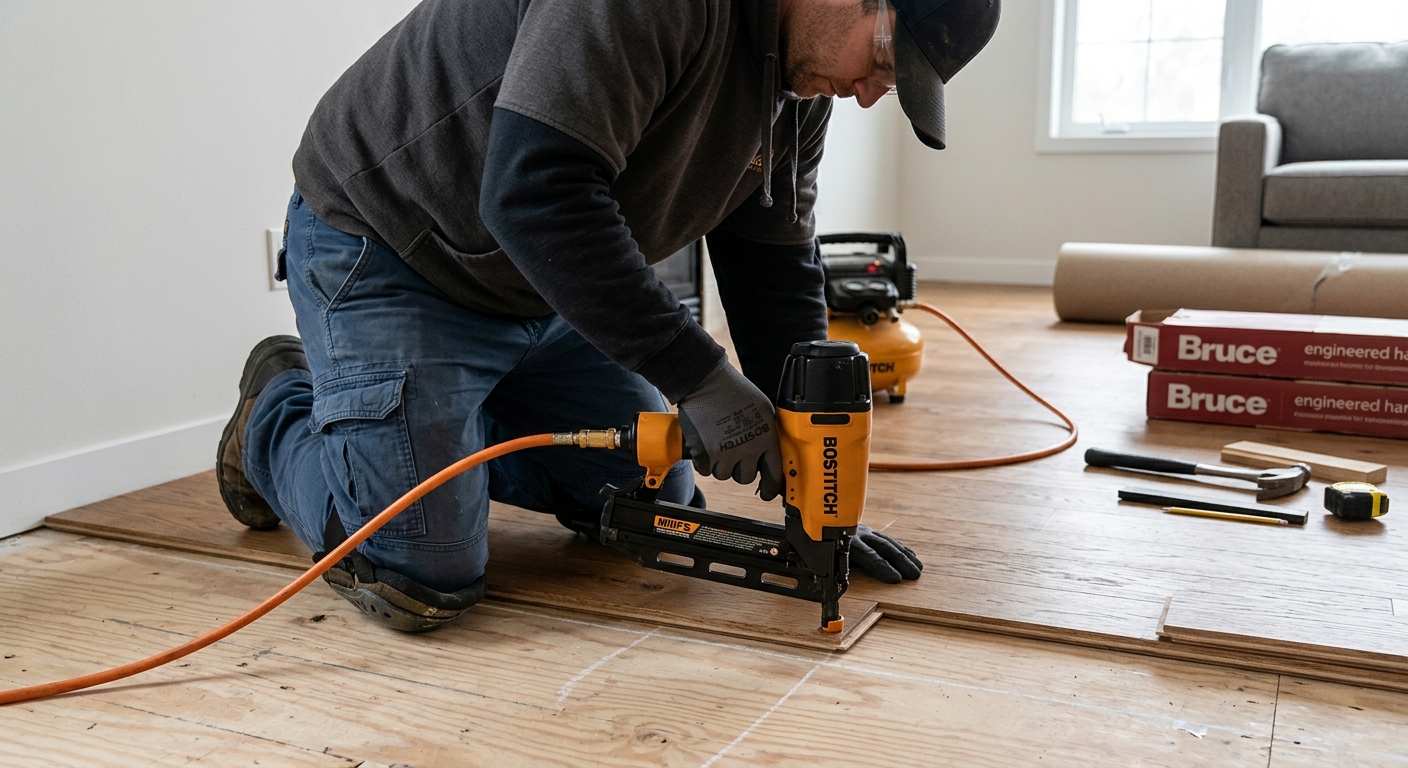
Flooring options and costs in University Endowment Lands
University Endowment Lands, British Columbia sits in the Lower Mainland–Southwest, where the air is often humid and indoor humidity swings can be noticeable in winter and shoulder seasons. For many homeowners, the biggest cost surprise isn’t the finish—it’s the prep. In a community with a lot of established housing, many homes still have older construction features that can lead to uneven plywood or concrete, so levelling and patching are common before flooring goes down. With a population of 16,920 in the 2021 Census, the local renovation pace is steady enough that you’ll usually find installers quickly, but labour demand can tighten around spring and summer starts. That combination is why two quotes for the same room size can differ meaningfully.
Moisture behaviour also matters in this area. Basements and slab-on-grade zones in the Vancouver/Burnaby/Richmond/Surrey orbit frequently show moisture wicking through concrete, so we typically avoid solid hardwood below grade. Instead, engineered hardwood or luxury vinyl plank (LVP) performs better because their layered cores handle humidity and minor temperature changes far more consistently. For main living areas (living, dining, bedrooms), solid hardwood remains popular, but we specify proper expansion gaps and keep indoor humidity in check to reduce cupping and gapping. In University Endowment Lands specifically, this trade work is especially in demand around the University Village/UBC-adjacent residential pockets where upgrades are frequent.
Below is a realistic comparison of options you’ll see in Lower Mainland–Southwest projects, and what homeowners usually budget per square foot.
| Type |
Best Room |
Moisture Resistance |
Lifespan |
Price per sq ft |
| Solid hardwood (nail-down, above grade only) |
Living / dining (main floor) |
Low to moderate (above grade only) |
20–50 years |
$9 – $18 |
| Engineered hardwood (float or glue, above + on-grade) |
Living / dining, bedrooms |
Moderate to good (with proper underlayment) |
15–30 years |
$8 – $15 |
| Laminate (click-lock, above-grade) |
Bedrooms, hallways |
Low to moderate (not for wet basements) |
10–25 years |
$4 – $10 |
| Luxury vinyl plank / LVP (waterproof, any level) |
Kitchen, finished basements |
High (waterproof core) |
10–25 years |
$5 – $12 |
| Porcelain / ceramic tile |
Kitchen, bathrooms, entries |
Very high |
25–50+ years |
$10 – $20 |
| Carpet (broadloom or modular tile) |
Bedrooms, stairs (comfort) |
Low (needs good moisture control) |
7–15 years |
$6 – $12 |
Prices are estimates only and vary by project scope, site access and material selection.
What affects the price of flooring in University Endowment Lands
In University Endowment Lands and across the Lower Mainland–Southwest, it’s common to see 30–50% differences between quotes for the same “headline” flooring type. The reason isn’t only brand pricing—it’s the prep work and the labour intensity required by local building conditions. First, indoor humidity swings and below-grade moisture are technical drivers. Solid hardwood expands and contracts with humidity, and it also performs poorly in basements or any concrete-on-grade situation because it can’t be floated or glued over moisture-prone slabs the way engineered products can. Second, colder regions paired with radiant heating can limit options; while Lower Mainland isn’t “cold like the prairies,” radiant heating is increasingly used in new builds, and that affects compatible underlay and installation method.
Older housing stock is another key cost lever. Many homes have uneven subfloors—patching and levelling can easily add roughly $1–$4 per sq ft once you account for labour, materials, and floor flatness requirements. For example, a laminate project might start near the $4–$10 per sq ft band, but once levelling and careful moisture management are included, the practical budget often moves upward. Conversely, LVP can look higher on paper than laminate, yet it can reduce rework risk in moisture-prone zones and basements—so the installed cost can land closer to the laminate band than homeowners expect.
Concrete local scenarios also change the number. If your concrete slab has visible dampness or past water intrusion, an LVP system often avoids expensive replacement while solid hardwood becomes a poor fit. If stair transitions require matching stair nosing and multiple reducer trims, that can add labour and material fast. And if your existing floor is glued carpet tile or old hardwood, removal and disposal can be a bigger line item than the new material itself.
| Price Factor |
Why It Matters |
Cost Impact |
| Room area in sq ft |
Materials and labour are largely calculated by coverage and waste |
Direct: larger areas usually lower unit cost, but raise totals |
| Subfloor condition — levelling or repair needed before install |
Uneven plywood or concrete requires prep to meet flatness standards |
Often adds about $1–$4 per sq ft depending on scope |
| Moisture / below-grade install — rules out solid hardwood |
Concrete moisture vapour can damage wood and some underlay systems |
May shift choice to engineered wood or LVP |
| Material choice — solid vs. engineered vs. LVP vs. tile |
Product cost and installation method vary significantly by flooring type |
Solid hardwood often highest; LVP and laminate usually lower |
| Removal and disposal of existing flooring |
Time spent on demo, hauling, and subfloor scraping is labour intensive |
Can add a noticeable chunk to total project cost |
| Stair nosing / transitions — charged per step or per linear foot |
Transitions require precision and add trim, labour, and sometimes edging systems |
Commonly increases budget on multi-level homes |
| Radiant heat compatibility — limits material options |
Some underlays and flooring types are sensitive to heat cycles |
May require upgraded products or specific installation details |
| Installation method — float vs. glue-down vs. nail-down |
Different methods demand different prep, adhesives, and sequencing |
Can change labour intensity and schedule |
Permits & regulations in British Columbia
In British Columbia, the flooring installation itself typically does not require a building permit. You usually do not need permits just to remove old carpet, install hardwood, LVP, laminate, or tile, or to replace normal flooring finishes. Where permits can enter the picture is when the project includes associated work that affects structural elements, electrical circuits, or building services. For example, if your scope includes structural subfloor repair beyond cosmetic patching, moisture remediation that involves engineered repair methods, or modifications related to in-floor heating circuits (electrical work), you may need electrical permits and inspections.
In condominiums across British Columbia (including University Endowment Lands buildings), sound transmission rules often affect flooring choice. Condo corporations commonly require specific underlay or assemblies to meet sound performance expectations for hard flooring on upper floors, and they may restrict nail-down hardwood due to noise. Always review the condo declaration and the specific unit/board rules. When in doubt, request approval in writing before starting demolition.
Before work begins, verify your contractor’s legitimacy in three steps: (1) licensing/registration status using the appropriate B.C. online registry or professional listing they provide, (2) liability insurance—ask for a current certificate of insurance naming you as the certificate holder where possible, and (3) workers’ compensation coverage (WSIB/WCB)—request a clearance letter or proof of coverage. Make sure the certificate dates cover the project start and completion dates. Finally, ask for itemised pricing and written scope so you can confirm what is included (levelling, underlay, moisture barriers, disposal) and what is excluded.
Best flooring for each room in your University Endowment Lands home
Choosing the right flooring in University Endowment Lands comes down to matching each room’s moisture exposure, foot traffic, and comfort needs to a product that can tolerate the Lower Mainland–Southwest’s indoor humidity swings. For living and dining areas, engineered hardwood or high-quality laminate is a practical balance: you get a warmer look than tile and improved stability compared to solid wood in the face of humidity changes. Bedrooms are usually best served with carpet for comfort and quiet—though engineered hardwood also works well if you manage indoor humidity and choose the correct underlayment.
Kitchens are where water and spills are common, so luxury vinyl plank (LVP) or large-format porcelain tile are the safest bets. Tile holds up to moisture and cleaning products, while LVP provides a warmer feel and softer underfoot response without worrying as much about minor water exposure. Basements (finished) are the clearest case: in this region, slab-on-grade areas can wick moisture through concrete, so LVP is the clear winner because it’s waterproof and tolerant of minor subfloor moisture conditions that would make solid hardwood a problem.
For bathrooms, porcelain or ceramic tile only—anything wood-based generally isn’t worth the long-term risk. If you have radiant heat, it’s increasingly common in newer British Columbia builds, and it pairs best with engineered wood, LVP, tile, and some laminates rated for higher temperatures. Solid hardwood over radiant heating needs careful manufacturer approval.
As a dollars-and-sense example: if carpet installation lands around the $4–$8 per sq ft band (installation portion) and LVP is typically $5–$12 per sq ft depending on product, the extra cost of LVP is often justified in basements because you avoid moisture-related failures and expensive rework.
| Room |
Best Material |
Why |
Moisture Risk |
Price Band per sq ft |
| Living / dining room |
Engineered hardwood |
Warm appearance with better humidity stability than solid |
Low to moderate (manage indoor humidity) |
$8 – $15 |
| Master bedroom |
Carpet or engineered hardwood |
Comfort and quieter steps; engineered suits stable main-floor conditions |
Low |
$6 – $12 |
| Secondary bedrooms |
Carpet (comfort) or laminate (budget) |
Carpet improves sound absorption; laminate is cost-effective |
Low |
$4 – $10 |
| Kitchen |
Luxury vinyl plank (LVP) or porcelain tile |
Easy cleaning and strong tolerance for spills and wet mopping |
Moderate |
$5 – $20 |
| Basement (finished) |
Luxury vinyl plank (LVP) |
Waterproof core handles moisture vapour better than wood products |
High (below-grade conditions) |
$5 – $12 |
| Bathroom |
Porcelain / ceramic tile |
Best durability and water resistance for wet areas |
High |
$10 – $20 |
How to choose a flooring contractor in University Endowment Lands
When you’re hiring in University Endowment Lands or anywhere in British Columbia, you want three things verified up front: licensing/registration where applicable, liability insurance, and workers’ compensation coverage. Ask for their proof of insurance (certificate of liability) and confirm coverage dates overlap your scheduled work. For workers’ compensation, request proof/clearance documentation for coverage (not a promise). A reputable flooring contractor will provide these documents without pressure and will match them to the crew who will be on-site.
Then get 2–3 itemised written quotes—labour and materials broken out line-by-line, not just one lump sum. Make sure the quote specifies what’s included: moving appliances or furniture, underlay/moisture barrier type, levelling/patching materials, stair nosings and transitions, and removal plus disposal. Also ask whether permits are included for any electrical work related to radiant heating modifications (if your scope includes it) and whether sound-rated underlay is included for condo requirements. A thorough scope reduces the “change order” risk that causes budgets to creep.
Warranty matters in two layers. Confirm the workmanship warranty length and what it covers (for example, installation defects, gapping issues from incorrect acclimation, or subfloor prep workmanship). Also check the manufacturer warranty for product defects and whether it’s transferable if you sell your home. Payment schedule should be conservative: never pay more than 10–15% upfront; hold back funds until the job is complete and you’ve received final touch-ups. Require a written start date and a completion estimate so you can plan around University-area occupancy and deliveries.
- Request proof of liability insurance and ensure it covers the work scope
- Confirm workers’ compensation clearance/coverage documentation
- Ask for their B.C. registration/licensing details and verify them online
- Get itemised quotes: materials, labour, underlay/moisture barriers, and trim
- Confirm whether removal and disposal are included
- Ask who does subfloor levelling and what flatness outcome is targeted
- For basements, require a written moisture plan (vapour barrier or system approach)
- Confirm stair nosing and transition pricing is per step/linear foot
- Verify warranty terms: workmanship coverage + product warranty
- Check if warranties are transferable at resale
- Use a payment schedule with ≤10–15% upfront and a holdback at completion
- Get start and completion timeline in writing
Red flags in University Endowment Lands: they won’t provide insurance or workers’ compensation proof; the quote is not itemised (no levelling, underlay, or disposal scope); they dismiss basement moisture concerns and still propose solid hardwood; they ask for large deposits (over ~15%) before any work starts; or they refuse to note the exact product model, underlay, and installation method in the contract.
Frequently asked questions — flooring in University Endowment Lands
How long does flooring installation take?
In University Endowment Lands, timelines depend mostly on room count, subfloor prep, and whether you’re doing glue-down or nail-down work. For a typical main-floor install over an already-flat subfloor, many projects turn around in about 2–5 days of installation, with a little extra time for trimming, transitions, and post-install cleanup. Basements can take longer because prep often includes levelling and moisture precautions—especially in Lower Mainland–Southwest homes where concrete can release moisture vapour. If your scope includes removing existing flooring and hauling it away, add 1–2 days. Your contractor should provide a written schedule including acclimation time where required and a clear completion date.
What flooring works with radiant heat?
In British Columbia, radiant heating is increasingly common, and the safest choices are materials specifically approved for in-floor heating. Generally, engineered hardwood (with the manufacturer’s recommended underlayment) and LVP are commonly compatible, along with porcelain/ceramic tile and certain laminates rated for higher temperature ranges. Solid hardwood needs very careful specification and approval because it can be sensitive to heat cycle changes and humidity. If your home has radiant heat, insist on the product’s installation instructions and temperature limits. A good installer will also coordinate the heating start-up procedure so the slab and flooring acclimate gradually—this is one reason quoted timelines and prices can vary.
Engineered vs solid hardwood — what's the difference?
Solid hardwood is one piece of wood through the thickness and is typically nail-down on above-grade subfloors. It’s more sensitive to humidity swings, so it’s generally not recommended in basements or directly over moisture-prone slabs. Engineered hardwood is built in layers, which makes it more dimensionally stable with humidity changes; it’s often a better fit for on-grade installs and can be installed with float or glue-down methods depending on product specs. In University Endowment Lands’ Lower Mainland–Southwest humidity conditions, homeowners usually choose engineered when they want the hardwood look but more resilience. Price-wise, solid hardwood commonly sits in the $9–$18 per sq ft band, while engineered hardwood often lands around $8–$15 per sq ft depending on grade and thickness.
Do I need to level my subfloor first?
Often, yes. You generally need a flat, stable surface before installing any floating floor, and it’s especially important for click-lock laminate, engineered hardwood, and LVP to prevent joint failure or hollow spots. In University Endowment Lands, uneven plywood and older patchwork are common enough that levelling may be required to meet flatness expectations—this is also why bids can vary by 30–50% across the Lower Mainland–Southwest. Levelling or repair can add roughly $1–$4 per sq ft depending on how bad the substrate is, whether additional patching is needed, and how much sanding or resurfacing is required. Your contractor should measure flatness and describe what they’ll do before pricing the install.
What's the most durable flooring for pets and kids?
For pets and kids in British Columbia, durability usually means two things: resistance to scratches and a floor that tolerates everyday moisture and cleaning. LVP is often the top practical choice because it’s waterproof and tends to handle minor spills and wet mopping better than wood or laminate—particularly helpful in a basement or on concrete where moisture vapour can be present. For main floors, engineered hardwood can work well with good finish selection and area rugs in high-traffic zones. If you want the most resilient wet-area solution, porcelain tile is also extremely durable, but it’s harder underfoot. Budget-wise, homeowners often compare LVP and laminate: laminate may fit the $4–$10 per sq ft band, while LVP can run about $5–$12 per sq ft, reflecting its moisture tolerance and practical longevity.
How do I choose flooring for humidity in University Endowment Lands?
Start with location in your home. In University Endowment Lands (Lower Mainland–Southwest), humidity swings are real, especially in winter and shoulder seasons, so solid hardwood is best kept to above-grade rooms where you can better control indoor conditions. Basements and slab-on-grade areas are where moisture vapour risk increases; that’s why homeowners commonly avoid solid hardwood there. Engineered hardwood and LVP handle humidity much better because of their layered or waterproof core structures. Laminate can work above grade if the product is rated for stability and your underlay is appropriate, but it’s usually not the first pick for below-grade moisture concerns. A clear plan—proper acclimation, correct underlay, expansion gaps (for wood), and moisture protection where needed—usually matters as much as the flooring brand.