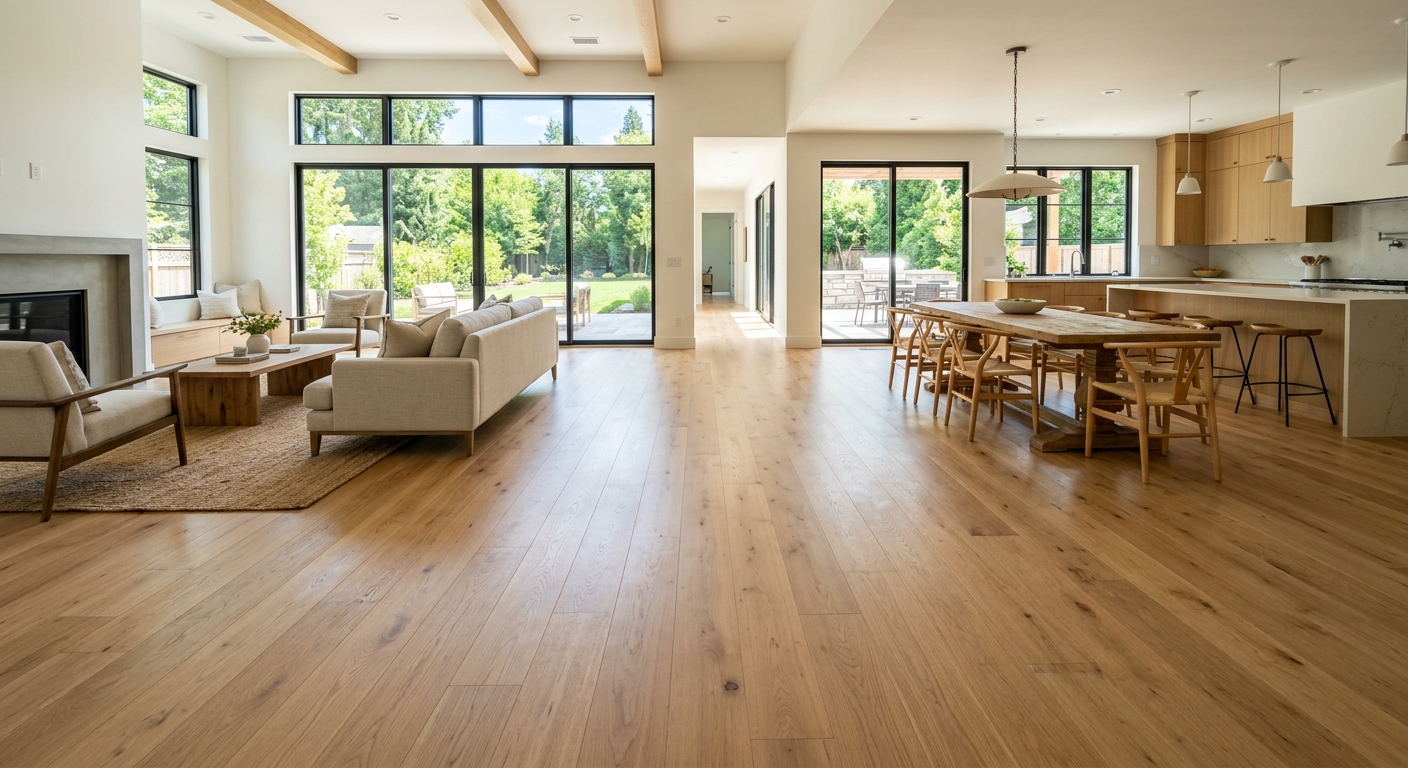
Flooring options and costs in Princeton
Princeton flooring choices look different from larger centres because the local housing stock leans older and many homes sit over basements or crawlspaces—exactly the situations where moisture control and subfloor flatness drive the real labour cost. With 66.2% of homes built before 1981, it’s common to encounter uneven subfloors, patchy repairs, and transitions that need careful levelling before new finishes can go down. In practical terms, that often means grinding, patching, or even an OSB overlay before you lay wood or tile, which can add roughly $2–$4 per sq ft depending on how far out-of-flat the surface is. If you’re updating a whole level, that preparation work can quickly become a larger portion of your quote than the flooring material itself.
In the Thompson–Okanagan, dry winters and hot, sometimes smoky summers create indoor humidity swings. Solid hardwood reacts to those seasonal changes—so it’s usually limited to above-grade installs—while engineered hardwood and luxury vinyl plank (LVP) typically tolerate humidity and occasional spills far better. Basements and below-grade areas are also where moisture management becomes a major cost driver, and local contractors often steer clients toward engineered wood or waterproof LVP rather than solid wood. Labour availability varies by season, and older homes in the town core and around the Princeton downtown/school-area tend to see steady demand for moisture-smart upgrades because many are being renovated block-by-block. That sets up how you’ll read the price ranges in the comparison table below.
| Type |
Best Room |
Moisture Resistance |
Lifespan |
Price per sq ft |
| Solid hardwood (nail-down, above grade only) |
Living rooms, hallways |
Low to moderate (humidity sensitive) |
25–50 years |
$12–$25 |
| Engineered hardwood (float or glue, above + on-grade) |
Living rooms, bedrooms |
Moderate (more dimensionally stable) |
20–35 years |
$13–$23 |
| Laminate (click-lock, above-grade) |
Secondary rooms |
Moderate (protect from standing water) |
10–20 years |
$4–$10 |
| Luxury vinyl plank / LVP (waterproof, any level) |
Kitchen, basements |
High (waterproof core) |
15–25 years |
$5–$12 |
| Porcelain / ceramic tile |
Kitchen, bathrooms |
High (with proper underlayment/grout) |
25–50 years |
$15–$30 |
| Carpet (broadloom or modular tile) |
Bedrooms |
Low to moderate (needs clean-up fast) |
7–12 years |
$6–$14 |
Prices are estimates only and vary by project scope, site access and material selection.
What affects the price of flooring in Princeton
In Princeton and across the Thompson–Okanagan, you can see the same flooring project priced 30–50% differently even when the material is “the same type.” The big reason is that quotes often include different levels of subfloor preparation and moisture protection. In British Columbia, seasonal humidity swings and lots of older homes (many built before 1981) mean installers frequently have to level, repair, and sometimes add moisture mitigation layers that a home in a flatter, drier climate might not need. Also, when contractors are working around basements, crawlspaces, and uneven slabs, labour time increases—so material-only comparisons can be misleading.
Technically, solid hardwood expands and contracts with indoor humidity, which makes it a poor match for below-grade installs; it also usually can’t be installed over concrete in most renovation scenarios without strict moisture conditions and the right system. In contrast, engineered hardwood is more dimensionally stable, and waterproof LVP can handle seasonal movement, minor slab moisture, and everyday spills much better. If your project includes radiant heating—common in newer British Columbia builds—most solid hardwood options get limited, and some laminate products aren’t rated for it. Older surfaces in Princeton may also require levelling or repair that can add roughly $1–$4 per sq ft, which is where your quote jumps beyond the base bands (for example, $12–$25 for hardwood versus $5–$12 for LVP).
Concrete examples from Princeton: (1) a finished basement typically adds moisture work and often shifts the decision to waterproof LVP, (2) a living-room swap in a pre-1981 home may require patching and re-screeding before tile—pushing the installed cost closer to the tile band $15–$30. If you’re already starting with a flat, dry subfloor, you’ll usually pay the low end of any band; if the surface is out-of-flat or there’s a known moisture issue, the labour portion rises quickly.
| Price Factor |
Why It Matters |
Cost Impact |
| Room area in sq ft |
Material and labour scale directly with square footage |
Lower cost per sq ft on larger areas; higher on small rooms |
| Subfloor condition — levelling or repair needed before install |
Uneven surfaces can cause lippage (tile), noise (floating floors) or movement (wood) |
Often +$1–$4 per sq ft in older Princeton homes |
| Moisture / below-grade install — rules out solid hardwood |
Basements and slab areas need moisture-tolerant systems |
May shift to engineered wood or waterproof LVP (+prep/membrane costs) |
| Material choice — solid vs. engineered vs. LVP vs. tile |
Different performance requirements and labour complexity |
Solid hardwood commonly runs $12–$25; LVP $5–$12; tile $15–$30 |
| Removal and disposal of existing flooring |
Old adhesive, underlay, and debris affect disposal and dump fees |
Can add several hundred to over a thousand dollars depending on build-up |
| Stair nosing / transitions |
Steps and doorways require extra finishing pieces |
Typically charged per step or per linear foot; adds noticeably to small jobs |
| Radiant heat compatibility |
Only certain products are rated for heat cycling |
May increase material cost or require a specific underlayment/system |
| Installation method — float vs. glue-down vs. nail-down |
Different prep, labour time, and performance tolerances |
Glue-down and nail-down usually cost more due to prep and fastening |
Permits & regulations in British Columbia
In British Columbia, flooring installation itself typically does not require a building permit. That means you usually don’t need a permit just to install carpet, laminate, vinyl plank, engineered hardwood, or tile over an existing subfloor, as long as you’re not altering structures or electrical systems. However, related work can trigger requirements. For example, if you’re doing structural subfloor repair, major rebuilds to joists, or significant changes to the framing, that may fall into permitting or engineering review depending on scope. If you have in-floor heating (or you’re adding/modifying electrical circuits for radiant heat), that is where you can run into electrical permit requirements and inspections.
In condominiums, the corporation’s rules matter. Even when a permit isn’t required, you may be limited by sound transmission requirements (often managed through approved underlay systems and impact-sound testing standards). Before installing hard surface flooring on upper floors, ask for the specific requirements in writing from the strata/board and confirm the proposed underlay and installation method meet their expectations.
For homeowners in Princeton, verify your contractor’s British Columbia standing by: (1) checking the provincial contractor registry/listing for the licence/registration that applies to their trade, (2) requesting a current certificate of insurance showing liability coverage, (3) confirming WSIB/WCB coverage where applicable for their workers, and (4) asking for a clearance/coverage letter if their insurance documentation isn’t direct. Get these documents before the job starts so there’s no delay once materials arrive.
Best flooring for each room in your Princeton home
Choosing the right flooring by room matters in Princeton because you’re balancing comfort and warmth with moisture risk and seasonal humidity swings. In living and dining areas, engineered hardwood or high-quality laminate often hits the best balance: warm underfoot, a more stable product than solid wood, and good durability for everyday traffic. In the master bedroom, carpet is still a strong comfort choice because it reduces noise and feels warmer in winter mornings, while engineered hardwood is a good option if you want easier vacuuming and fewer allergen traps.
For the kitchen, waterproof LVP or large-format porcelain tile makes sense in the Thompson–Okanagan climate where spills happen and summers can be smoky with windows opening/closing frequently. In the basement (finished), LVP is usually the clear winner: it’s fully waterproof, handles vapour pressure and below-grade installs far better than solid hardwood and most laminate. For bathrooms, use porcelain/ceramic tile only—because tile systems are designed for wet-room cleaning and long-term moisture exposure.
If your home has or is getting in-floor radiant heat, it’s increasingly common in British Columbia new construction and renovations. That typically favours engineered wood, tile, and only radiant-compatible LVP/laminate systems; solid hardwood is commonly limited due to heat cycling and dimensional movement.
Cost-wise, the upgrade story is often simple: switching a basement from carpet or laminate to waterproof LVP can reduce the risk of callbacks from moisture issues. For example, LVP installed is commonly within the $5–$12 per sq ft band, while tile flooring typically runs $15–$30 per sq ft—so you’d reserve tile for wet areas (bathrooms) and choose LVP for basements unless you want the look and don’t mind the higher installation complexity.
| Room |
Best Material |
Why |
Moisture Risk |
Price Band per sq ft |
| Living / dining room |
Engineered hardwood |
Stable in humidity swings; warm look with easier tolerance than solid |
Low to moderate (keep humidity managed) |
$13–$23 |
| Master bedroom |
Carpet or engineered hardwood |
Carpet adds comfort and sound control; engineered stays more dimensionally stable |
Low |
$6–$14 |
| Secondary bedrooms |
Laminate (click-lock, quality underlay) |
Good value with decent durability; easy to maintain |
Low to moderate (avoid standing water) |
$4–$10 |
| Kitchen |
Luxury vinyl plank (LVP) or porcelain tile |
Water resistance and easier clean-up; tile holds up to wet cleaning |
Moderate to high (spills and splash) |
$5–$30 |
| Basement (finished) |
Luxury vinyl plank (waterproof) |
Best tolerance for below-grade moisture and vapour conditions |
Moderate to high |
$5–$12 |
| Bathroom |
Porcelain / ceramic tile |
Designed for wet rooms; long service life with the right underlayment and grout |
High |
$15–$30 |
How to choose a flooring contractor in Princeton
Start by verifying the contractor’s British Columbia credentials and insurance. Ask for their current licence/registration status for the scope they’re performing, and request a certificate of insurance showing general liability coverage and that it includes flooring installation activities. Next, confirm WSIB/WCB coverage for workers (or provide proof their subcontractors carry their own coverage). If they hesitate, use that as a sign to move on—on a job involving removal, subfloor grinding, and heavy materials, you want full coverage before a single board is delivered.
Get 2–3 itemised written quotes rather than a single lump sum. You want a line-by-line breakdown separating material supply, labour, subfloor prep, underlayment/membranes, transitions, disposal, and any stair nosing. Read the scope carefully: is permit pull included if radiant heat electrical work is involved? Is disposal of old flooring and underlay included in the price? Are levelling compounds and primers included when they’re needed for tile and engineered systems? Confirm the product specifications: underlayment type, moisture mitigation system, and the installation method (float vs. glue-down vs. nail-down).
Warranty matters too. Ask for a workmanship warranty (length and what’s covered), the manufacturer warranty on the product, and whether your warranty is transferable to you if you’re not the original purchaser. Finally, plan payment: never pay more than 10–15% upfront; hold back the remainder until the job is complete and you’ve walked the finished area for quality checks. Get a start date and completion estimate in writing so you have clarity if weather or supply issues arise.
- Request a written quote with labour and materials separated (not a single total).
- Confirm they’ll assess flatness and moisture conditions before locking in the install plan.
- Verify BC registration/licensing for the trade scope they’re doing.
- Collect a current liability insurance certificate before work begins.
- Confirm WSIB/WCB (or subcontractors’ coverage) so you’re not exposed.
- Make sure subfloor preparation (grinding/levelling/patching) is clearly included or excluded.
- Ask what underlayment or moisture membrane system is being used and why.
- Clarify disposal: who hauls, what goes to the dump, and what fees are included.
- Check how transitions and stair nosing are priced (per step vs. per linear foot).
- Confirm radiant heat compatibility in writing if you have/plan radiant flooring.
- Read the warranty details: length, coverage, and whether it’s transferable.
- Keep payment milestones reasonable: small deposit, holdback until completion.
Red flags in Princeton: (1) quotes that omit subfloor flatness and moisture testing but still promise “no prep required,” (2) no written scope for disposal and transition work, (3) vague warranties (“covered if they feel like it”), (4) inability to provide insurance/coverage proof, and (5) pressure to pay large deposits before materials are staged and the schedule is confirmed.
Frequently asked questions — flooring in Princeton
Do I need to level my subfloor first?
Often, yes—especially in Princeton homes built before 1981, where older framing and past renovations can leave subfloors out of flat. For tile, flatness matters because lippage becomes a visible quality issue and cracked tiles can result from uneven support. For floating floors, uneven subfloors can cause clicking, gaps at seams, and early wear. Typically, contractors will check flatness, then decide whether grinding/patching is enough or whether a self-levelling compound and primer are needed. That prep can add roughly $1–$4 per sq ft depending on the condition. If you’re choosing engineered hardwood or LVP, you can still reduce risk through levelling, even though those products tolerate humidity swings better than solid wood.
What's the most durable flooring for pets and kids?
For pets and kids in Princeton’s humidity swings, waterproof LVP is usually the most forgiving day-to-day choice, because it handles spills and cleaning without worrying about swelling. It also tends to perform better in basements or on-grade areas where moisture conditions may vary. If you prefer the look of wood, engineered hardwood is durable but still benefits from good subfloor prep and consistent indoor humidity control. For higher-impact comfort and traction, carpet can last reasonably well if you use the right underlay and clean quickly after accidents, but it generally isn’t the best long-term option for frequent wet messes. In price terms, LVP often lands within the $5–$12 per sq ft band installed, while hardwood commonly starts higher at $12–$25 per sq ft.
How do I choose flooring for humidity in Princeton?
Humidity is the deciding factor in Princeton. Winters can be dry, and summers can be hot—sometimes with smoke—so indoor relative humidity can swing as you open/close windows and run heating. Solid hardwood moves with humidity and is typically limited to above-grade installations; it’s a poor match for basements and other below-grade areas. Engineered hardwood and waterproof LVP are better suited because their construction tolerates seasonal movement and minor moisture events. Tile is also dimensionally stable, but only when installed on a properly prepared base with the right underlayment and grout system. If your home is older, with many houses built before 1981, plan for subfloor levelling and moisture mitigation when needed—this is where your quote can increase by dollars per square foot.
Do condos restrict hard flooring?
Yes, often they do. In British Columbia condominium buildings, even when a permit isn’t required for the flooring itself, the corporation’s rules can restrict hard flooring to meet sound transmission requirements. That typically means you may need an approved underlay and a specific installation approach to address impact sound between units. Before you buy materials, review the condo declaration and ask the board/management what underlay thickness, product type, and test documentation are accepted. If you’re planning tile or hardwood in a multi-unit building, get written approval first so you don’t risk having to change the underlay or redo work. In Princeton, many upgrades happen in existing homes, but condos are especially paperwork-sensitive—so treat the sound rules as part of the project scope.
How do I compare flooring quotes?
Compare quotes the way you’d compare invoices: line-by-line. Look for a labour and materials breakdown (not a single lump sum), including subfloor prep (grinding/levelling), underlayment or membrane, stair nosing and transitions, and disposal fees. Confirm what’s excluded: is removal included, is leveling included “if needed,” and does the installer include primers and levelling compounds for tile and engineered systems? Also compare product specs: thickness, wear layer (for LVP/engineered), core type (waterproof vs. water-resistant), and whether the installer is recommending it for above-grade or below-grade. Finally, check whether warranties match—workmanship coverage length and what’s required to keep the manufacturer warranty valid. If one quote is within $5–$12 per sq ft for LVP but the other is similar yet “prep is extra,” that’s a major difference.
Can I install flooring over existing tile in Princeton?
Sometimes, but it depends on condition and the new flooring type. For LVP over tile, it’s often possible if the tile is solid, firmly bonded, and the surface is flat enough—though uneven grout lines may need grinding or a smoothing level to prevent clicking or telegraphing. For engineered hardwood, you generally need a very stable, clean, and flat surface; if the tile is cracked or rocking, it can cause movement and joint issues. For carpet and laminate, tile can be a problem unless you build up properly with an appropriate underlayment system to address height and flatness. If you’re planning tile over existing tile, that requires careful prep and adhesion system selection. In older Princeton homes built before 1981, previous renovations can complicate this—so insist on an on-site inspection before assuming “yes, it goes over everything.”