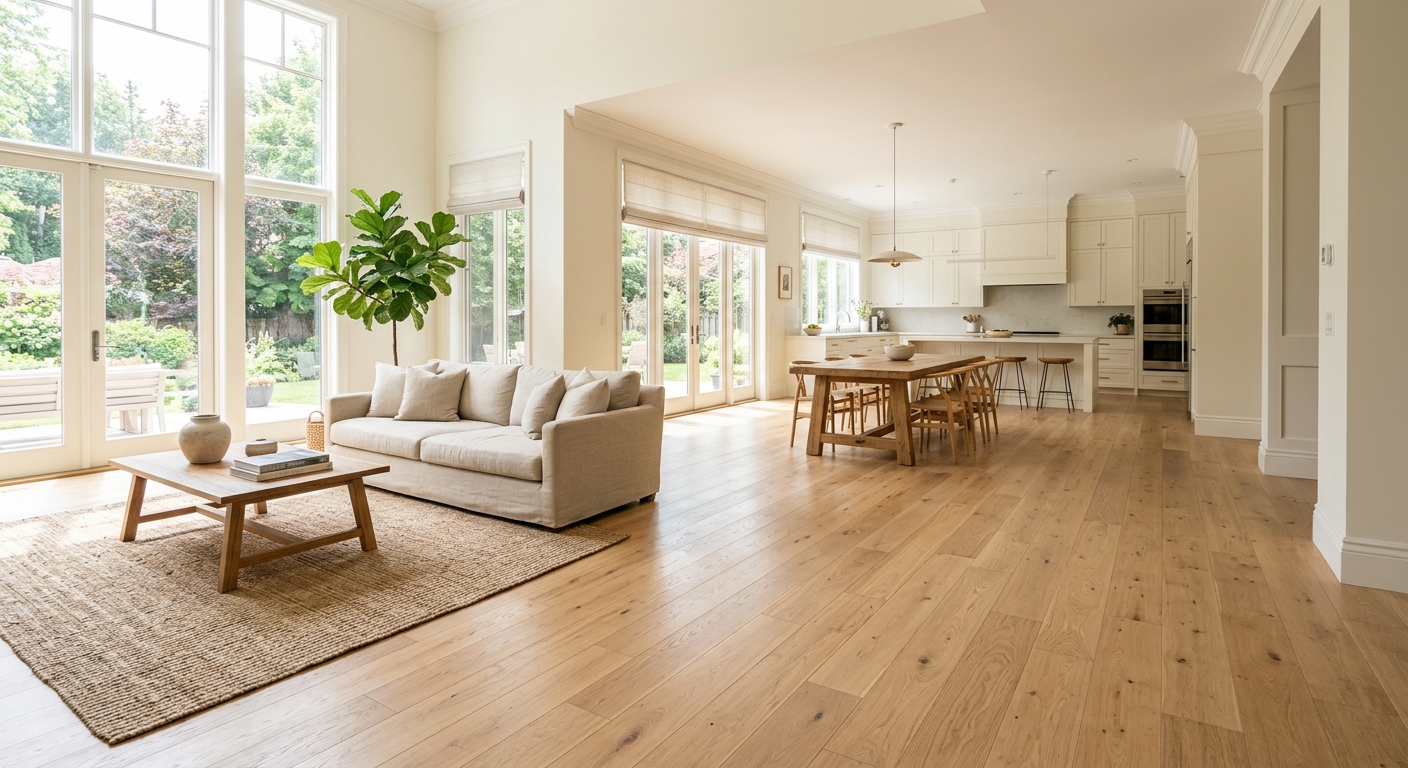
Flooring options and costs in Queensborough
Queensborough homeowners typically start by comparing looks and feel, but the real pricing conversation is about subfloor condition and moisture management. In Queensborough, there are a lot of older homes in the Lower Mainland–Southwest profile area, and that matters because worn or uneven plywood/subfloor panels often need levelling, patching, or even resurfacing before new flooring can go down—an added baseline of roughly $1–$3 per sq ft on many projects. With a local population around 11,000 (Statistics Canada, 2021 Census), you’ll find steady demand among families and renovators, and that keeps installers busy—especially in the busier summer and fall windows.
The wet, marine climate in the Lower Mainland–Southwest means indoor humidity swings are common, particularly in winter and shoulder seasons. In homes with basements or slab-on-grade areas, moisture can wick through concrete, so solid hardwood is usually limited to above-grade rooms only. That’s why engineered hardwood and luxury vinyl plank (LVP) are the go-to options for many Queensborough renovations: they tolerate humidity changes better and are more reliable on less-than-perfect subfloors. If your home has radiant heating, material selection also changes—solid hardwood needs very careful specification, while engineered wood, LVP, and tile are usually easier to get right.
In neighbourhood pockets close to the Queensborough waterfront and the more established residential lanes, contractors often see higher call volumes for living-area upgrades. Next, use the table below to compare the common materials, where they perform best, and what you can expect to pay per square foot in Queensborough.
| Type |
Best Room |
Moisture Resistance |
Lifespan |
Price per sq ft |
| Solid hardwood (nail-down, above grade only) |
Main living areas above grade |
Low to moderate; sensitive to humidity swings and not recommended below grade |
25–60 years |
$9,–$18 |
| Engineered hardwood (float or glue, above + on-grade) |
Living rooms, bedrooms, hallways |
Moderate to high; better tolerance for humidity and seasonal changes |
20–35 years |
$9,–$16 |
| Laminate (click-lock, above-grade) |
Bedrooms and living areas (not bathrooms) |
Moderate; can be affected by persistent moisture at seams |
10–25 years |
$4,–$10 |
| Luxury vinyl plank / LVP (waterproof, any level) |
Kitchen, basements (finished), main floor near exterior doors |
High; waterproof core handles spills and below-grade conditions better |
15–30 years |
$5,–$12 |
| Porcelain / ceramic tile |
Bathrooms, kitchens, entries |
Very high when properly installed with correct underlayment and grout |
25–50 years |
$10,–$20 |
| Carpet (broadloom or modular tile) |
Bedrooms, media rooms, stairs |
Low to moderate; needs good ventilation and dry indoor conditions |
8–15 years |
$4,–$8 |
Prices are estimates only and vary by project scope, site access and material selection.
What affects the price of flooring in Queensborough
In the Lower Mainland–Southwest, the same flooring job can land 30–50% apart between quotes because of how much prep work is included and how contractors handle moisture and subfloor variations. Labour tends to run higher here than in many other parts of British Columbia, and that’s only amplified when crews must level floors, manage dust, or correct challenging layouts. On top of that, product price differences can be wide: for example, a basic laminate or vinyl plank might sit in the $4–$10 per sq ft range, while higher-end engineered hardwood and better underlay upgrades commonly push living-area projects into the $9–$18 per sq ft backbone band. Tile is its own tier, often $10–$20 per sq ft depending on format and underlayment.
Technically, indoor humidity swings and below-grade moisture are key drivers. Solid hardwood expands and contracts with humidity, and it cannot be glued or floated over concrete; that limits it to above grade and requires clean, stable conditions. Engineered hardwood and LVP are built for layered or PVC core stability and handle minor temperature and humidity changes far better. For rooms served by radiant heating—more common in newer Queensborough builds—solid hardwood is often restricted, and some laminate products must be chosen carefully to match heat limits.
Concrete examples from Queensborough: (1) If your subfloor has dips or lippage, levelling can add roughly $1–$4 per sq ft in the project, plus extra labour time to feather compound and re-check flatness. (2) If you’re converting a damp-prone basement into a finished space, moisture barrier and correct underlayment choices usually steer the project toward LVP, which avoids callbacks tied to swelling at seams. (3) Replacing stair treads with matching transitions often increases the per-step charge, especially when you need stair nosing and custom moulding details.
| Price Factor |
Why It Matters |
Cost Impact |
| Room area in sq ft |
Directly drives material quantity and the hours for removal, prep, and install |
Typically the biggest cost driver; small rooms can cost more per sq ft due to setup |
| Subfloor condition — levelling or repair needed |
Uneven plywood/concrete requires correction to prevent squeaks, gaps, and joint failure |
Often adds about $1–$4 per sq ft depending on scope |
| Moisture / below-grade install — rules out solid hardwood |
Basements and slab-on-grade can wick moisture; materials must resist it |
Switching to engineered wood or LVP can raise material cost but reduces failure risk |
| Material choice — solid vs. engineered vs. LVP vs. tile |
Different cores and wear layers cost more and need different prep |
Solid hardwood often sits around $9–$18 per sq ft; tile commonly $10–$20 |
| Removal and disposal of existing flooring |
Old underlay, nails, and glue residue increase labour and disposal fees |
Can add a noticeable lump to total price; varies heavily by current flooring |
| Stair nosing / transitions |
Stairs require extra cuts, nosing pieces, and careful finishing |
Often priced per step or per linear foot; commonly adds 10–25% on stair-heavy jobs |
| Radiant heat compatibility — limits material options |
Heat exposure affects expansion and adhesives; not all products are rated for it |
May add cost by requiring an approved engineered wood or LVP specification |
| Installation method — float vs. glue-down vs. nail-down |
Method affects subfloor prep, adhesives, and labour time |
Glue-down and complex prep typically cost more than simple click-lock installs |
Permits & regulations in British Columbia
In British Columbia, installing flooring by itself usually does not require a building permit. The work that can trigger permitting is the associated electrical or structural scope around the floor. For example, if your project includes in-floor heating upgrades (or any new electrical circuits), you may need electrical permits and inspections through the appropriate channels. If there’s structural subfloor repair that involves altering framing members, significant joist modifications, or moisture remediation tied to building envelope concerns, that could also require additional approvals depending on what’s actually being changed.
For condominiums, the most common “regulation” isn’t a permit—it’s the building’s own rules. Sound transmission is typically governed through condo bylaws and corporation requirements (often referencing STC/IIC expectations). Hard flooring on upper floors may require an approved underlay system, and some corporations require board approval before hardwood or tile installations begin. Always review the condo declaration and ask for written board approval in advance, especially where you’re installing engineered hardwood, LVP, or tile.
To verify a Queensborough contractor in British Columbia, check three things before signing: (1) licence/registration details if applicable to the contractor’s trade scope (use the contractor registry or licensing portal relevant to their classification), (2) liability insurance showing adequate coverage and an active policy date, and (3) worker coverage—request documentation for WSIB/WCB coverage (commonly provided as a clearance letter or policy confirmation). If they can’t provide current certificates on request, that’s a major warning sign.
Best flooring for each room in your Queensborough home
In Queensborough, the Lower Mainland–Southwest climate drives comfort and durability choices because humidity can swing and basements can be vulnerable to moisture movement through concrete. For living and dining areas, engineered hardwood is a strong balance: it looks like wood, feels warm underfoot, and performs better than solid hardwood when indoor conditions aren’t perfectly stable. If you want a similar look at a lower upfront cost, high-quality laminate can work in above-grade rooms, provided the subfloor is flat and seams are protected from everyday spills.
In bedrooms—especially the master—carpet remains popular for comfort and sound absorption, while engineered hardwood also works well if you keep humidity controlled. For kitchens, the clear winners are luxury vinyl plank (LVP) or large-format porcelain tile. LVP handles splashes and quick mopping better, and tile is ideal when you want maximum water resistance and easy cleaning.
Basements (finished) are where the climate becomes decisive. LVP is usually the best practical choice because it’s waterproof and handles below-grade installs far more reliably than solid wood and most laminate. Bathrooms should be porcelain or ceramic tile only, with proper underlayment and grout practices to reduce moisture penetration.
If your home has radiant heat, prioritise materials designed for heat exposure—engineered wood, LVP, and tile are typically easier to specify correctly than solid hardwood. As a cost example, many homeowners find that choosing LVP at roughly $5–$12 per sq ft instead of solid hardwood at $9–$18 per sq ft makes sense for a basement, because it avoids expensive moisture-related problems later.
| Room |
Best Material |
Why |
Moisture Risk |
Price Band per sq ft |
| Living / dining room |
Engineered hardwood |
Warm feel, wood look, and better stability through indoor humidity swings than solid |
Low to moderate; manage everyday spills and maintain indoor humidity |
$9,–$16 |
| Master bedroom |
Carpet or engineered hardwood |
Carpet improves comfort and quiet; engineered wood maintains a cleaner, wood-forward look |
Low; humidity is usually manageable if ventilation is good |
$4,–$14 |
| Secondary bedrooms |
Laminate (above-grade) or LVP |
Laminate is cost-effective; LVP is more forgiving if kids track in moisture |
Low to moderate; protect against wet footwear near exterior doors |
$4,–$10 |
| Kitchen |
Luxury vinyl plank (LVP) or porcelain tile |
Handles spills, easy cleaning, and strong performance around sink/dishwasher areas |
Moderate; everyday wetting is common |
$5,–$20 |
| Basement (finished) |
LVP (waterproof) |
Best match for moisture vapour and below-grade conditions common in Lower Mainland basements |
High; moisture wicking through slab can occur |
$5,–$12 |
| Bathroom |
Porcelain / ceramic tile |
Maximum water resistance when installed with correct underlayment and grout methods |
Very high; expect splashes and wet mopping |
$10,–$20 |
How to choose a flooring contractor in Queensborough
Choosing a contractor in Queensborough is mostly about proof and process. First, verify they’re appropriately licensed/registered for their scope in British Columbia (where licensing applies), and request liability insurance certificates with a clear policy period. Next, ask for WSIB/WCB coverage documentation (often provided as a clearance letter or policy confirmation). If they’re working with crews, they should be able to show current coverage before site work begins.
Then, get 2–3 itemised written quotes—don’t accept a single lump sum without a line-by-line breakdown. A proper estimate lists: removal, subfloor prep/levelling, underlayment or moisture barrier, flooring supply, installation labour, transitions, and disposal fees. For condo jobs, insist the quote notes whether sound requirements (approved underlay systems) and board approval steps are included.
Read the scope carefully for what’s excluded. Common exclusions include subfloor correction beyond a stated tolerance, removal of thick adhesive pads, replacing damaged subfloor panels, or any permit-related work if electrical circuits are changed. You should also confirm the warranty: workmanship warranty length, whether the product warranty is manufacturer-backed, and whether coverage transfers if you sell the home. Payment schedule matters too—never pay more than 10–15% upfront; hold back a portion until the job is complete and final walk-through items are resolved. Finally, ask for a written start date and a completion estimate that reflects Queensborough weather realities and curing times for patching/levelling compounds.
- Request certificate of liability insurance and confirm dates are current.
- Ask for WSIB/WCB clearance letter (or equivalent coverage proof) before work starts.
- Verify licensing/registration for the contractor’s trade scope in British Columbia.
- Get 2–3 itemised quotes: materials + labour + prep + disposal + transitions.
- Confirm what’s included for subfloor levelling (tolerance and extent).
- Ask how they address humidity/moisture risk (vapour barrier, acclimation, on-grade vs below-grade plan).
- For hardwood/LVP transitions, ensure stair nosing and thresholds are costed per step or linear foot.
- Check underlay/moisture barrier specifications by brand and thickness where required.
- Require written warranty details for labour and product, and whether it’s transferable.
- Confirm payment schedule: 10–15% max deposit; holdback until completion.
- Get start and completion dates in writing, including cure times for patch/level products.
- Ask who handles debris removal and disposal—include it in the written scope.
Red flags in Queensborough include: refusing to show insurance/WSIB/WCB proof, quoting “solid hardwood everywhere” without discussing above-grade limitations, giving only a lump sum without a subfloor prep plan, promising completion without factoring levelling/moisture prep time, and using vague wording like “standard underlay” without specifying what it is.
Frequently asked questions — flooring in Queensborough
What's the most durable flooring for pets and kids?
For most Queensborough families with pets and kids, luxury vinyl plank (LVP) is the most practical “durable-for-real-life” choice. It’s designed to be waterproof, so common accidents (spills, tracked-in moisture) are easier to manage, and it’s typically more forgiving if your home has indoor humidity swings. In price terms, LVP commonly falls around $5–$12 per sq ft in this market tier, which is often easier to justify than solid hardwood at $9–$18 per sq ft when you’re thinking long term and risk reduction. If you prefer a harder surface, porcelain tile is also very durable, but it’s less forgiving for dropped toys and can be colder underfoot. Either way, the key is correct subfloor prep and proper underlayment so the floor stays stable.
How do I choose flooring for humidity in Queensborough?
Humidity is the deciding factor in Queensborough because the Lower Mainland–Southwest climate is wet and marine, and indoor moisture can swing in winter and shoulder seasons. Solid hardwood needs stable conditions and is best kept to above-grade areas; basements and slab-on-grade spaces often have moisture vapour that can cause cupping and gapping. That’s why engineered hardwood and LVP are popular here: their layered construction (and for LVP, a waterproof core approach) handles humidity changes far better. If your home has radiant heating, choose products rated for the heat conditions to avoid damage. A good contractor will also plan acclimation, specify an appropriate underlayment/moisture barrier, and confirm subfloor flatness—because installation on an uneven surface can magnify movement issues.
Do condos restrict hard flooring?
Often, yes—Queensborough condo rules frequently restrict or regulate hard flooring on upper floors due to sound transmission concerns. In British Columbia condominiums, the corporation’s requirements (commonly tied to STC/IIC expectations) may require specific approved underlay under hardwood, engineered wood, LVP, or tile. Many buildings also require written board approval before work begins. That means your contractor should not only quote materials and installation, but also coordinate the documentation you need for approval and use the correct underlay system named by your condo. Even when installation itself doesn’t require a building permit, condo bylaws can effectively control product selection and installation methods.
How do I compare flooring quotes?
Compare quotes the way you’d compare car repairs: line-by-line. In Queensborough, quotes differ because prep work and moisture protection are where costs swing. Ask each contractor to itemise labour and materials (removal, levelling/patching, underlayment or moisture barrier, transitions, disposal). Confirm what’s included for stair work—nosing is often charged per step or per linear foot. Make sure the moisture plan matches the space: solid hardwood should not be promised for below-grade areas, while LVP is typically the correct direction for basements. Also check warranty details and how payment is handled. If one quote is far cheaper—especially compared to common bands like $10–$20 per sq ft for tile or $9–$18 for solid hardwood—verify they aren’t skipping subfloor correction or moisture mitigation.
Can I install flooring over existing tile in Queensborough?
Sometimes, but it depends on the condition and height changes. Many homeowners in Queensborough ask this because removal is dusty and time-consuming. Tile can sometimes remain as a base if it’s stable, well-bonded, and properly prepared (e.g., flattened where needed, cleaned, and levelled to the required tolerance). However, if the tile is cracked, loose, or significantly uneven, installing on top can lead to lippage, squeaks, or joint failure—especially with click-lock laminate or floating floors. For tile over concrete, some systems allow direct installation, while others require self-levelling compound or a specific underlayment approach. A contractor should measure flatness, assess moisture conditions, and confirm the product’s installation instructions before recommending a “tile-on-tile” approach.
What is the best flooring for a high-traffic area in Queensborough?
For high-traffic areas like entries, hallways, and open-concept living zones, LVP or porcelain tile are usually the best performers in Queensborough. LVP is waterproof and handles daily scuffs and wet tracking better than laminate, and it’s generally more forgiving if humidity fluctuates. Porcelain tile is extremely wear-resistant and works great where you expect frequent mopping and spills, especially around kitchen-adjacent zones. Solid hardwood can be durable when installed above grade and maintained with indoor humidity control, but it’s not the first choice for areas with frequent moisture exposure or lower-level installs. In terms of pricing, many high-traffic upgrades land in the LVP $5–$12 per sq ft range or tile $10–$20 per sq ft range, depending on product tier and how much subfloor levelling is needed.