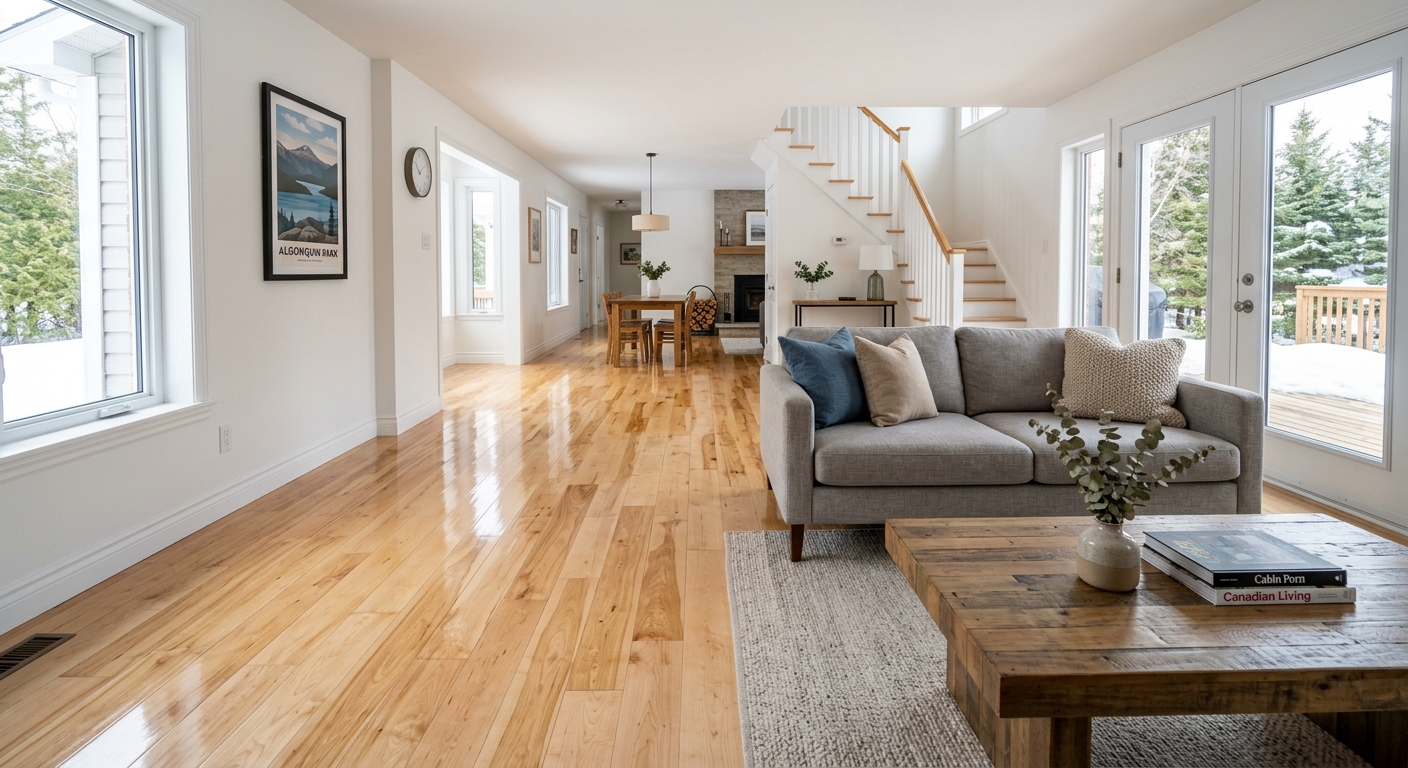
Flooring options and costs in Lions Bay
Lions Bay is a small, older, coastal community where flooring decisions come down to comfort, moisture control, and the realities of what’s under your existing finishes. With 65.3% of homes built before 1981, many properties have aged subfloors that may need levelling, patching, or selective resurfacing before new flooring can sit flat—often adding about $1–$3 per sq ft once you factor in labour and any underlayment or prep materials. In Lions Bay’s Lower Mainland–Southwest area (wet, marine conditions with indoor humidity swings), that prep step matters because solid products move with humidity; in particular, solid hardwood can cup or gap if indoor humidity isn’t kept stable.
In Greater Vancouver’s higher-cost labour market, installation is a significant portion of your total budget, so the “best value” option is usually the one that reduces subfloor work while matching the room’s moisture risk. For on-grade and upper floors, engineered hardwood and quality laminate are common choices because they tolerate normal humidity better than solid wood and are forgiving over minor subfloor irregularities. For basements, slab-on-grade areas, and any space where moisture wicking can occur, homeowners around Howe Sound and the Village core often switch to waterproof luxury vinyl plank (LVP) because its layered core (and waterproof surface) is far more tolerant than solid hardwood or standard laminate.
Below is a practical range of installed cost expectations by material type, to help you compare contractor quotes before you get into the details of your subfloor and layout.
| Type |
Best Room |
Moisture Resistance |
Lifespan |
Price per sq ft |
| Solid hardwood (nail-down, above grade only) |
Main living areas, bedrooms (above grade) |
Low to moderate (needs stable indoor humidity) |
25–50 years |
$9,XXX–$18,XXX |
| Engineered hardwood (float or glue, above + on-grade) |
Main living areas, bedrooms |
Moderate to high (better tolerance of humidity) |
20–40 years |
$10,XXX–$17,XXX |
| Laminate (click-lock, above-grade) |
Bedrooms, hallways, living rooms |
Low to moderate (water can ruin edges) |
10–25 years |
$4,XXX–$10,XXX |
| Luxury vinyl plank / LVP (waterproof, any level) |
Kitchen, finished basement, entry areas |
High (waterproof surface + tolerant core) |
15–25 years |
$5,XXX–$12,XXX |
| Porcelain / ceramic tile |
Bathrooms, kitchens, foyers |
Very high (with proper waterproofing/underlayment) |
25–50 years |
$10,XXX–$20,XXX |
| Carpet (broadloom or modular tile) |
Bedrooms, media rooms |
Low (can trap moisture if used below grade) |
8–15 years |
$4,XXX–$8,XXX |
Prices are estimates only and vary by project scope, site access and material selection.
What affects the price of flooring in Lions Bay
In the Lower Mainland–Southwest region, two quotes for the “same” flooring can swing by roughly 30–50% because the work isn’t actually the same. The material might be similar, but the subfloor prep, moisture mitigation, and installation method differ—especially in Lions Bay where older housing stock is common (65.3% pre-1981) and coastal humidity can create expansion and contraction cycles. On top of that, Greater Vancouver labour rates are typically higher than many parts of Canada, so inefficiencies in scheduling or extra site work hit the budget harder.
Technically, indoor humidity swings are a key driver. Solid hardwood expands and contracts with humidity, and it shouldn’t be glued or floated over concrete; it also performs poorly in basements where moisture vapour can rise. Engineered hardwood and luxury vinyl plank (LVP) handle humidity and on-grade/below-grade conditions far better because layered or PVC-based constructions tolerate small movement and resist water. If you add radiant heating—which is increasingly common in newer Lower Mainland builds—the options narrow further: solid hardwood needs very careful specification, while engineered wood, LVP, tile, and many rated laminates are more compatible. Finally, older floors often need levelling or repair; in practice that commonly adds about $1–$4 per sq ft depending on how uneven or delaminated the subfloor is.
Here are two concrete Lions Bay examples: (1) a main-floor engineered hardwood job over “wavy” plywood usually costs more than the same product over a flat base because levelling compounds and sanding/patching are labour-heavy; (2) switching a basement from laminate to waterproof LVP can cost more at the start, but it avoids repeat callbacks linked to edge swelling and trapped moisture—often the cheaper route over time. When comparing budgets, remember that laminate and vinyl often sit in the $4–$10 per sq ft band for materials/installs, while tile typically runs higher (about $10–$20 per sq ft), especially when layout and substrate prep require extra work.
| Price Factor |
Why It Matters |
Cost Impact |
| Room area in sq ft |
Directly drives material quantity, waste allowance, and labour hours |
High — larger areas reduce per-sq-ft overhead but increase total cost |
| Subfloor condition — levelling or repair needed before install |
Older plywood/concrete may be uneven or damaged, requiring patching/levelling |
Medium to high — commonly adds about $1–$4 per sq ft |
| Moisture / below-grade install — rules out solid hardwood |
Rising moisture vapour can ruin edge glues and cause cupping/gapping |
Medium — may require LVP and specific underlay/barriers |
| Material choice — solid vs. engineered vs. LVP vs. tile |
Each product type has different installation demands and price points |
High — tile and hardwood are typically higher than laminate/LVP |
| Removal and disposal of existing flooring |
Tear-out, underlayment removal, and haul-away take time |
Medium — often priced per sq ft or per room |
| Stair nosing / transitions — charged per step or per linear foot |
Transitions and stair profiles are labour-intensive and use specialty materials |
Medium — can add noticeable cost on multi-level homes |
| Radiant heat compatibility — limits material options |
Heat can cause movement; not all products tolerate it without spec controls |
Medium — may require engineered/LVP/tile-rated assemblies |
| Installation method — float vs. glue-down vs. nail-down |
Adhesives, subfloor prep, and fastening systems change labour effort |
Medium — nail-down may be simpler than glue-down only when base is perfect |
Permits & regulations in British Columbia
In British Columbia, installing floor covering itself typically does not require a building permit. What often triggers permits is the related work around your flooring—especially anything electrical or structural. For example, if you’re adding or modifying in-floor heating circuits, that electrical work may require electrical permitting and inspection. Likewise, if a contractor needs to address structural subfloor issues beyond simple patching—such as substantial repairs to framing or major moisture remediation involving recognized systems—additional approvals or trade involvement may be required depending on the scope.
In condominiums, the rules are frequently more restrictive than municipal requirements. Sound transmission requirements (STC/IIC ratings) can restrict hard flooring on upper floors or require specific underlay/underlayment systems and installation methods. Before starting, review the condo declaration/bylaws and request board approval in writing—particularly if you’re installing hardwood, tile, or any hard surface that can transmit impact noise.
To verify your contractor in Lions Bay (and across BC), start with three checks: (1) Licence/registration—confirm they’re in good standing using the province’s online directory when applicable to their trade scope; (2) Liability insurance—ask for a current certificate of insurance showing coverage limits that match your project risk; (3) Worker coverage—confirm WSIB/WCB coverage by requesting proof/clearance documentation. Then, keep a copy of those documents in writing with your contract so there’s no ambiguity if issues arise.
Best flooring for each room in your Lions Bay home
Choosing flooring in Lions Bay means matching each room to how it actually behaves in a wet marine climate: humidity swings, occasional condensation risk, and how much moisture vapour can come up through slab-on-grade or older subfloors. For living and dining areas, homeowners usually want warmth underfoot and a durable surface—engineered hardwood or high-quality laminate can deliver that balance while tolerating normal humidity better than solid hardwood. In bedrooms, comfort and sound matter; carpet (broadloom or modular) is a great comfort choice, or engineered hardwood for a cleaner look.
Kitchens and entryways need practical cleaning and water resistance. Luxury vinyl plank (LVP) is popular because it handles splashes and mopping well, and many products perform strongly at Lions Bay’s indoor humidity levels. Bathrooms should be porcelain/ceramic tile only, with appropriate waterproofing systems—this is one area where you don’t compromise. For basements (especially finished ones), LVP is the clear winner: it’s waterproof, tolerant of moisture vapour, and far less likely to fail than laminate or solid wood when moisture finds its way through concrete or aged subfloor assemblies.
Radiant heat compatibility is also a consideration in BC new builds and renovations: engineered wood, LVP, and tile are typically easier to specify over in-floor heating, while solid hardwood requires tight moisture-control and product selection to avoid movement. If you’re choosing between materials, it’s often worth paying the premium where failure risk is high. For example, a $1–$3 per sq ft increase to correct subfloor/levelling can be justified when it prevents cupping or uneven click-lock joints—whereas choosing a cheaper laminate for a basement can lead to costly replacement if edges swell.
| Room |
Best Material |
Why |
Moisture Risk |
Price Band per sq ft |
| Living / dining room |
Engineered hardwood |
Warm look with better humidity tolerance than solid |
Low to moderate |
$10,XXX–$17,XXX |
| Master bedroom |
Carpet or engineered hardwood |
Comfort and quieter sound; engineered keeps a cleaner finish |
Low |
$4,XXX–$12,XXX |
| Secondary bedrooms |
Laminate (quality click-lock) or carpet |
Easy maintenance; carpet is softer for kids |
Low |
$4,XXX–$10,XXX |
| Kitchen |
Luxury vinyl plank (LVP) |
Water resistance and forgiving underfoot during spills |
Moderate |
$5,XXX–$12,XXX |
| Basement (finished) |
Luxury vinyl plank (LVP) |
Waterproof performance for below-grade moisture vapour |
High |
$5,XXX–$12,XXX |
| Bathroom |
Porcelain / ceramic tile |
Best-in-class moisture resistance with correct installation |
Very high |
$10,XXX–$20,XXX |
How to choose a flooring contractor in Lions Bay
Choosing a flooring contractor in Lions Bay starts with proof, not promises. First, verify they operate legally for the work they’re proposing: confirm their British Columbia licence/registration status where applicable and ask for a current certificate of liability insurance. For worker coverage, request proof of WSIB/WCB coverage (or clearance documentation) so you’re not exposed if someone is injured on site. Second, get 2–3 itemised written quotes—each should break out labour and materials, include any removal/disposal, specify underlay/moisture barrier choices, and list transitions and stair work.
Read the scope line-by-line. What’s excluded? Is permit pulling included if electrical work is needed for radiant heating or baseboard tied into in-floor systems? Who is responsible for subfloor levelling repairs if the installer discovers uneven plywood mid-job? Ask whether their quote includes acclimation for wood products, proper fastener/adhesive requirements for engineered installations, and whether they’ll provide dump fees for disposal.
Warranty should be clear and in writing. You’re looking for two warranties: workmanship (how long the installer stands behind labour) and product/manufacturer warranty (what the flooring company covers for defects). Confirm whether the warranty is transferable to future owners if you sell. On payment, a safe structure is 10–15% maximum deposit; hold back the balance until the job is complete and punch-listed. Finally, get the start date and completion estimate in writing, including realistic timelines for material delivery.
- Ask for the contractor’s BC licence/registration details and confirm it matches the scope.
- Request liability insurance certificate and verify coverage limits are appropriate for your project.
- Confirm WSIB/WCB clearance or coverage proof before work begins.
- Require itemised quotes: labour, materials, underlayment/barriers, and transitions separately.
- Ask who handles subfloor levelling, patching, and any moisture mitigation discovery.
- Confirm whether disposal and haul-away/dump fees are included or billed separately.
- Get details on the installation method (float, glue-down, nail-down) and why it’s chosen.
- Ensure the quote specifies stair nosings, thresholds, and transition profiles.
- Check workmanship warranty length and whether it covers labour-only issues.
- Ask how they protect flooring during construction and whether they do site clean-up daily.
- Do a material warranty check: model numbers, thickness, wear layer, and exclusions.
- Set payment terms: no more than 10–15% upfront; schedule payments to milestones.
Red flags to watch in Lions Bay: a quote with no line-item breakdown, vague language like “prep included” without specifying levelling/compounds, pressure for a large deposit upfront, refusal to provide insurance/coverage proof, and no clear warranty details (especially when installing engineered hardwood or tile over complex subfloors).
Frequently asked questions — flooring in Lions Bay
Do I need to level my subfloor first?
In Lions Bay, it’s common to need levelling—especially with 65.3% of homes built before 1981, where plywood and older subfloor layers can be uneven or worn. Levelness matters for click-lock laminate, floating engineered hardwood, and LVP because high spots prevent proper locking and low spots can create bounce. If the floor is over concrete or slab-on-grade, levelling may also include moisture considerations (vapour control and patching that’s compatible with your flooring). A good contractor will measure with a straightedge and tell you what’s required. If you’re selecting LVP for a basement, ask how they handle transitions and whether levelling is still needed for a flat finish—small variations can show through visually.
What's the most durable flooring for pets and kids?
For pets and kids in British Columbia, most homeowners land on waterproof luxury vinyl plank (LVP) or porcelain/ceramic tile, depending on the room. LVP is forgiving when something gets spilled, and it handles the humidity swings typical of the Lower Mainland–Southwest climate better than laminate in day-to-day life. If you’re comparing budgets, LVP often falls within the $5,XXX–$12,XXX per sq ft band, while tile typically sits higher at about $10,XXX–$20,XXX per sq ft because of substrate prep and labour. Carpet can be comfortable, but it’s harder to keep looking new if accidents happen—especially in basements. If you want a warm feel, choose quality LVP for living areas and carpet in bedrooms, with a moisture-aware installation plan.
How do I choose flooring for humidity in Lions Bay?
Humidity choice starts with understanding where moisture can come from: indoor swings and, in many older Lower Mainland homes, moisture vapour that can wick up through concrete or slab-on-grade areas. Solid hardwood is best above grade only because it expands and contracts with humidity; it generally shouldn’t be glued or floated over concrete. For areas that are prone to moisture or basements, engineered hardwood and luxury vinyl plank (LVP) are the safer bets—both tolerate humidity far better than solid wood and are much more resilient to minor temperature and moisture changes. If you have radiant heat, this becomes even more important: choose products rated for those temperatures. In practice, a contractor should discuss acclimation and a humidity-stable plan—plus whether you need a barrier/underlay system for your specific substrate.
Do condos restrict hard flooring?
Often, yes. In many Lions Bay and Lower Mainland condo buildings, sound transmission rules matter more than the flooring type itself. Even if there’s no building permit required for the flooring installation, the condo corporation’s rules may require specific underlay systems and installation methods to meet STC/IIC expectations. Some buildings also require board approval before you start, especially for hardwood, tile, or other hard surfaces on upper floors. The right approach is to check the condo declaration and ask the board in writing before scheduling. If you’re installing hard flooring, ask your contractor to provide the underlay product name and installation method they’ll use so you can show the board compliance details upfront.
How do I compare flooring quotes?
To compare quotes fairly in Lions Bay, focus on scope and specifications—not just the final number. Ask for itemised breakdowns: labour, material (brand/model), underlayment/moisture barriers, removal/disposal, and transitions (stair nosing and thresholds). Confirm the installation method (floating vs. glue-down vs. nail-down) and whether levelling or subfloor repair is included or treated as an extra if conditions are worse than expected. Compare warranties: workmanship length and product warranty terms, including exclusions. A common mistake is comparing laminate and LVP only by the base material; LVP may cost more upfront, but if you’re installing in a basement, it can avoid moisture-related failures. If one quote claims solid hardwood for a below-grade area, it’s a major spec mismatch.
Can I install flooring over existing tile in Lions Bay?
Sometimes, but it depends on the condition and the type of tile/finish underneath. In Lions Bay, existing tile may be too uneven for a floating floor unless it’s properly evaluated and levelled. LVP can sometimes be installed over existing hard surfaces if the tile is well-bonded, flat, and the substrate meets manufacturer flatness requirements; transitions and edges also matter. For hardwood or many engineered floating systems, manufacturers often require specific substrate prep and a moisture barrier approach, and glue-down systems have different requirements. Before you move forward, ask the contractor to measure flatness, check for loose/broken tiles, and confirm what underlayment or prep they’ll use. Also consider height changes—door clearances can become an issue when adding flooring layers on top of tile.