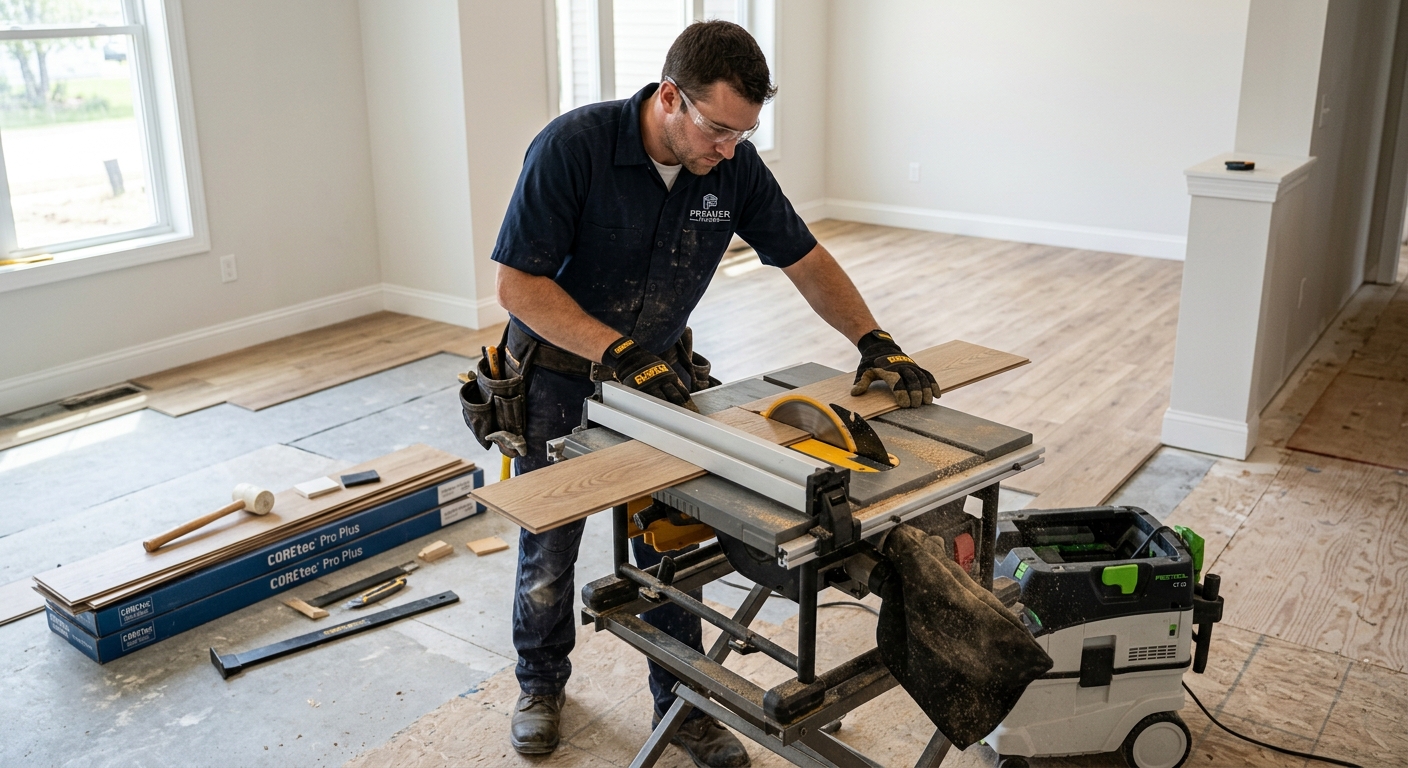
Flooring options and costs in Lions Gate
In Lions Gate, choosing the right flooring is as much about managing moisture as it is about style. With a population of 2,660 (Statistics Canada, 2021 Census), demand is concentrated around the older, well-established neighbourhoods where many homes have had multiple renovations. That matters because older housing stock often brings uneven plywood or concrete, and you may need levelling/repair and a proper underlayment system before any new surface goes down. In practice, that kind of prep is a common cost add, roughly $1–$3 per sq ft, before you even compare material prices.
In the Lower Mainland–Southwest, the wet, marine climate drives indoor humidity swings—especially in winter and the shoulder seasons. Moisture can wick up through slab-on-grade concrete, so we typically avoid solid hardwood below grade and recommend engineered wood or luxury vinyl plank (LVP) instead. Labour costs also run high in the Greater Vancouver area, so installation method and subfloor labour can strongly influence your total. For homes around the Lions Gate / North Shore corridor—where many basements are older or semi-finished—you’ll commonly see projects that start with moisture testing and subfloor assessment, followed by either an engineered wood solution above grade or waterproof LVP in lower levels.
Below is a practical comparison of the most common options homeowners choose in Lions Gate, including typical price ranges and where each performs best in this climate. Use this table as a baseline, then we’ll narrow it to your exact rooms and subfloor condition.
| Type |
Best Room |
Moisture Resistance |
Lifespan |
Price per sq ft |
| Solid hardwood (nail-down, above grade only) |
Living / dining on a stable subfloor |
Low–moderate (humidity-sensitive; avoid basements) |
25–50 years |
$9,00–$18,00 |
| Engineered hardwood (float or glue, above + on-grade) |
Living / dining, bedrooms, some on-grade areas |
Moderate–high (layered core handles swings better) |
15–30 years |
$9,00–$16,00 |
| Laminate (click-lock, above-grade) |
Bedrooms, hallways (dry zones) |
Moderate (needs careful edge protection) |
10–20 years |
$4,00–$10,00 |
| Luxury vinyl plank / LVP (waterproof, any level) |
Kitchen, hallways, finished basement |
High (waterproof core; tolerant of minor moisture) |
15–25 years |
$6,00–$12,00 |
| Porcelain / ceramic tile |
Kitchen, bathrooms, entry foyers |
High (with correct underlayment and sealing) |
25–50 years |
$10,00–$20,00 |
| Carpet (broadloom or modular tile) |
Master and secondary bedrooms |
Low–moderate (avoid damp areas) |
8–15 years |
$6,00–$14,00 |
Prices are estimates only and vary by project scope, site access and material selection.
What affects the price of flooring in Lions Gate
In Lions Gate and across the Lower Mainland–Southwest, the same flooring choice can land 30–50% apart from one quote to the next, even when the material looks identical. That gap is usually explained by subfloor prep, installation method, and how contractors handle moisture risk and transitions. Two homes can both be “engineered hardwood,” but if one needs levelling of uneven plywood and the other doesn’t, the labour and floor-raising work can change your total quickly.
Humidity swings and below-grade moisture are key technical drivers in this region. Solid hardwood expands and contracts with moisture, so it cannot be glued or floated over concrete and performs poorly in basements—where wicking through slab-on-grade is common. Engineered hardwood and LVP are far more tolerant of humidity fluctuations and minor temperature changes, which is why they’re common in finished basements. If your home uses or plans for radiant heating, it also limits material options: most solid hardwood needs very careful specification, while engineered wood, LVP, and many tile systems handle radiant heat far more predictably.
Older regional housing stock adds another cost layer. If your subfloor needs correction, homeowners often see roughly $1–$4 per sq ft added for levelling/repair before installation can begin—on top of typical material pricing. For example, moving from laminate at about $4–$10 per sq ft to engineered at roughly $9–$18 per sq ft may be justified when your lower level is borderline moisture-prone or you need better dimensional stability. Conversely, if the subfloor is already flat and dry, laminate can be a strong value in dry bedrooms.
Local contractor availability can also affect pricing, particularly in peak seasons when crews are booked for multiple North Shore and Lower Mainland projects. In practice, scheduling sooner and preparing access (moving furniture, clearing rooms) helps reduce delays and site labour.
| Price Factor |
Why It Matters |
Cost Impact |
| Room area in sq ft |
Direct driver of material quantity, underlayment, waste factor and labour hours |
Low–high depending on square footage and complexity |
| Subfloor condition |
Levelling or repair is often required before any click or glue system performs well |
Often adds ~$1–$4 per sq ft in older homes |
| Moisture / below-grade install |
Can rule out solid hardwood; requires correct vapour/moisture strategy for concrete |
Can add prep and testing costs; typically raises total for high-risk slabs |
| Material choice |
Solid, engineered, LVP, and tile differ in performance and installation requirements |
Shifts project cost toward the higher bands (e.g., tile vs laminate) |
| Removal and disposal of existing flooring |
Demo, dust control, and hauling can be labour-heavy, especially with tile or glued-down products |
Commonly adds a noticeable line item; higher for multi-room work |
| Stair nosing / transitions |
Charged per step or per linear foot; custom edges affect labour and material yield |
Moderate to high on homes with multiple stair runs |
| Radiant heat compatibility |
Limits material selection and may require specific underlay and installation method |
Can increase material cost; may reduce risk-related changes later |
| Installation method |
Float vs. glue-down vs. nail-down changes prep, time, and skill level required |
Typically shifts labour portion and affects final total |
Permits & regulations in British Columbia
In British Columbia, a flooring installation itself generally does not require a building permit. However, associated work may require permits—especially when electrical systems are involved or when you’re performing structural or code-related changes. For Lions Gate homeowners, the most common “permit-trigger” scenarios are: (1) installing or modifying in-floor radiant heating controls/circuits (often tied to electrical permitting), and (2) doing subfloor work that becomes more than cosmetic—for example, structural repairs that impact load paths or require engineering sign-off depending on what’s found.
In condominiums, even when permits aren’t required, the corporation’s rules can restrict or require specific underlay and impact-sound management. For hard flooring, boards commonly require underlay for sound transmission targets (STC/IIC considerations) and may require board approval in writing—especially for tile and hardwood on upper floors. Before starting, check the condo declaration and ask your board for approval confirmation.
To verify your contractor in British Columbia, do it step-by-step:
- Licence: confirm they have the appropriate provincial licence/registration for contracting scope (where applicable) via the BC registry/contractor listings.
- Insurance: request a certificate of insurance showing general liability coverage (and the correct project address where possible).
- WorkSafe coverage: ask for proof of WSIB/WCB coverage for their workers.
- Clearance letter: if required for payroll/safety compliance, ask how they document clearance and provide it on request.
- Keep it in writing: match insurance and coverage details to your signed scope and quote.
Best flooring for each room in your Lions Gate home
In Lions Gate, the “best” flooring usually comes down to how the room handles moisture, traffic, and comfort—then matching that to the Lower Mainland–Southwest climate and typical North Shore building conditions. In living and dining areas, you want warmth underfoot without fighting humidity. Engineered hardwood or high-quality laminate are often the sweet spot: they look sharp, feel warmer than tile, and cope better with seasonal moisture swings than solid wood over questionable subfloors.
For master bedrooms, comfort matters most. Carpet gives the quiet, soft feel many homeowners want, and it also helps with sound absorption. If you prefer a hard surface, engineered hardwood is still a strong choice. Kitchens, on the other hand, need water tolerance and easy cleanup—so luxury vinyl plank (LVP) or large-format porcelain tile typically wins.
Basements in Lions Gate are where climate and construction realities show. Finished basements commonly face moisture vapour and occasional seepage risk through slab-on-grade or older drainage paths. LVP is usually the clear winner because it’s waterproof and handles below-grade installations far better than solid hardwood or many laminates. Bathrooms should be porcelain or ceramic tile only, with proper installation underlayment and sealing details.
If you have radiant heating (or plan to), that’s increasingly common in new construction in British Columbia. Radiant heat compatibility becomes a specification item: engineered wood, LVP, and tile are the most straightforward matches, while solid hardwood may require tighter humidity control and careful product selection.
Cost-wise, it’s common to see LVP at roughly $6–$12 per sq ft compared with tile around $10–$20 per sq ft. That price difference is justified when you need the bathroom-level wet performance—otherwise, LVP in kitchens offers excellent value in day-to-day life.
| Room |
Best Material |
Why |
Moisture Risk |
Price Band per sq ft |
| Living / dining room |
Engineered hardwood |
Warm look with better stability through seasonal humidity swings |
Low (keep indoor humidity controlled; avoid basements) |
$9,00–$16,00 |
| Master bedroom |
Carpet or engineered hardwood |
Comfort and sound control for sleep; engineered for easy maintenance |
Low (dry zone) |
$6,00–$14,00 |
| Secondary bedrooms |
Laminate or engineered hardwood |
Laminate is cost-effective; engineered adds durability |
Low |
$4,00–$10,00 |
| Kitchen |
Luxury vinyl plank (LVP) or porcelain tile |
Water tolerance, easy cleaning; tile handles spills at the highest level |
Medium (spills and daily water use) |
$6,00–$20,00 |
| Basement (finished) |
LVP (waterproof) |
Built for vapour and below-grade conditions where solid wood is a risk |
High (vapour/moisture potential) |
$6,00–$12,00 |
| Bathroom |
Porcelain / ceramic tile |
Wet-area performance with correct underlayment and installation details |
Very high |
$10,00–$20,00 |
How to choose a flooring contractor in Lions Gate
For Lions Gate homeowners, the best protection is verification and clarity before work starts. First, confirm British Columbia contractor credentials: ask for their relevant licence/registration information (where applicable), and request proof of general liability insurance with your project details. Next, ask for WSIB/WCB coverage evidence for their workers. Don’t guess—request a certificate and/or clearance documentation if applicable for your contract. A reputable contractor won’t hesitate; if they do, treat it as a warning sign.
Then get 2–3 itemised written quotes with separate line items for labour and materials (including underlay/moisture barrier, transition pieces, and mouldings). Avoid “lump sum” pricing without an attached scope—especially in this climate where subfloor prep and moisture mitigation can change the job. Read the scope carefully: confirm what’s excluded (e.g., moving appliances or removing old baseboards), whether disposal is included, and whether a permit pull is required for any associated electrical or radiant heating work.
Warranty matters, too. Ask for the workmanship warranty length, whether it’s in writing, and whether the manufacturer’s product warranty is tied to your installation method. Clarify if the warranty is transferable to future owners. Payment should be controlled: never pay more than 10–15% upfront, and hold back until the job is complete and punch-listed. Finally, request a start date and a completion estimate in writing—crew schedules in the Lower Mainland can shift quickly.
- Ask how they test/assess moisture risk on slabs and concrete subfloors.
- Confirm what underlay and vapour barriers they use for LVP or engineered wood.
- Require an itemised quote (materials, labour, transitions, underlayment, disposal).
- Verify insurance certificate is current and includes the correct entity.
- Request WSIB/WCB clearance/coverage proof for worker safety compliance.
- Confirm stair nosing and transitions are priced per step or per linear foot.
- Check whether levelling/repair is included or quoted separately after inspection.
- Ask about acclimation time for engineered wood and laminate in Lions Gate.
- Get warranty details in writing: workmanship + product, and transferability.
- Set payment milestones tied to measurable completion (subfloor prep, install, finish).
- Confirm debris control and dust management plan during demo and cutting.
- Request a written timeline and who is responsible for jobsite coordination.
Red flags in Lions Gate include: refusing to provide itemised pricing, dismissing moisture concerns on concrete or below-grade areas, offering only a verbal warranty, asking for large deposits upfront, and not providing proof of liability coverage and WSIB/WCB coverage before starting.
Frequently asked questions — flooring in Lions Gate
How do I prepare my subfloor before new flooring?
Subfloor prep is the difference between a stable floor and a problem floor, especially in Lions Gate’s Lower Mainland–Southwest humidity swings. For any flooring, start with removing old flooring and checking flatness: high spots must be sanded and low spots corrected so click-lock systems sit correctly. For concrete slabs, moisture mitigation matters—contractors typically confirm conditions and install the right moisture barrier strategy before laying products. If you’re installing laminate or LVP, edge protection and a suitable underlay are essential. If you’re choosing engineered hardwood above grade, the subfloor still needs to be clean, dry, and reasonably level. In older homes, plan for levelling/repair often adding about $1–$3 per sq ft to the project scope (Statistics Canada, 2021 Census).
Is cork or bamboo flooring a good choice in Lions Gate?
Cork and bamboo can look great, but in British Columbia’s coastal climate the key question is moisture stability and product build quality. Cork is naturally resilient and comfortable, yet it can be sensitive to prolonged dampness, so it’s usually not the best choice for basements or any area with slab moisture risk. Bamboo performance depends heavily on whether it’s engineered or solid; engineered constructions generally handle humidity swings better than solid. In Lions Gate, where concrete moisture wicking and indoor humidity changes are common, most homeowners seeking a “warm” alternative to hardwood end up happier with engineered hardwood or LVP that’s built for waterproof performance. If you’re set on cork or bamboo, choose a product with strong dimensional stability specs and ensure your installer includes appropriate vapour control and acclimation. If you’re comparing budgets, remember tile is typically $10–$20 per sq ft and LVP is often $6–$12 per sq ft—those bands usually align better with local moisture realities.
What is the difference between floating and glued-down flooring?
Floating flooring “floats” over the subfloor using an underlay and click-lock joints (or sometimes loose-lay methods). It does not bond directly to the substrate, which makes it easier to install and sometimes easier to remove later. Glued-down flooring is bonded directly to the subfloor, which can improve stability on certain surfaces and reduce movement—but it demands a very well-prepared, dry, flat base. In Lions Gate and the Lower Mainland–Southwest, moisture condition is the deciding factor. Over concrete with moisture risk, a glue-down method can be problematic if vapour barriers and slab conditions aren’t right. Many homeowners therefore choose engineered hardwood or LVP with the appropriate installation method for above-grade/on-grade locations, and waterproof LVP for basements. If radiant heating is involved, the product’s compatibility and installation requirements matter more than “floating vs. glue” alone.
What flooring holds up best to pets in a Lions Gate home?
For pets, durability, scratch resistance, and comfort underfoot matter more than almost anything else. In British Columbia’s wet climate, waterproof flooring is also a big advantage if your pet tracks in rain or if accidents happen near doors. Luxury vinyl plank (LVP) is typically a top choice because waterproof cores tolerate minor moisture and cleanup is straightforward. Many LVP lines also handle daily impacts better than laminate. Engineered hardwood can work too, but it’s more sensitive to edge moisture and requires quick cleanup and consistent indoor humidity control. For carpet, you get the best comfort, but it’s harder to manage if pet messes soak in—so consider stain-resistant carpets and plan for professional-grade cleaning products. If you’re choosing between options, it’s common to compare LVP at around $6–$12 per sq ft versus laminate at roughly $4–$10 per sq ft, with LVP usually being the safer pet choice in Lions Gate’s damp, track-in lifestyle.
How do I fix squeaky floors in my Lions Gate home?
Squeaks usually come from movement between subfloor layers or between the subfloor and joists, not from the top flooring alone. In Lions Gate’s older housing stock, squeaks may be due to aged nails/screws, gaps between plywood sheets, or deflection in older framing. The most effective fix typically starts with identifying the squeak source: a contractor may walk the area and then lift a small section of flooring (or inspect access points) to confirm whether the issue is at the subfloor-joist connection. Sometimes the solution is tightening fasteners, adding screws to secure loose subfloor panels, or correcting a poorly fastened underlayment. Only after the structural noise is addressed should you re-install or replace the surface. If you’re planning flooring replacement anyway, it’s smart to ask the installer to evaluate subfloor condition first; that “prep” work can prevent you from covering a problem and hearing it forever.
What is luxury vinyl plank and is it worth it in Lions Gate?
Luxury vinyl plank (LVP) is a layered floor product designed for excellent moisture tolerance, with many waterproof options suited to coastal British Columbia conditions. In Lions Gate, the reason homeowners choose LVP is practical: it handles indoor humidity swings well and is commonly recommended for finished basements and on-grade areas where slab-on-grade moisture vapour can be an issue. LVP is also forgiving for everyday life—easy cleanup, good resistance to spills, and generally good performance with pets compared with laminate or solid hardwood. Is it worth it? Most often, yes—especially when you’d otherwise need extra moisture remediation or you’re avoiding solid hardwood below grade. Typical project pricing often lands in the $6–$12 per sq ft range for LVP, while tile is commonly $10–$20 per sq ft and solid hardwood can be $9–$18. In a climate like the Lower Mainland–Southwest, that value is usually tied to reduced risk and fewer moisture-related callbacks.