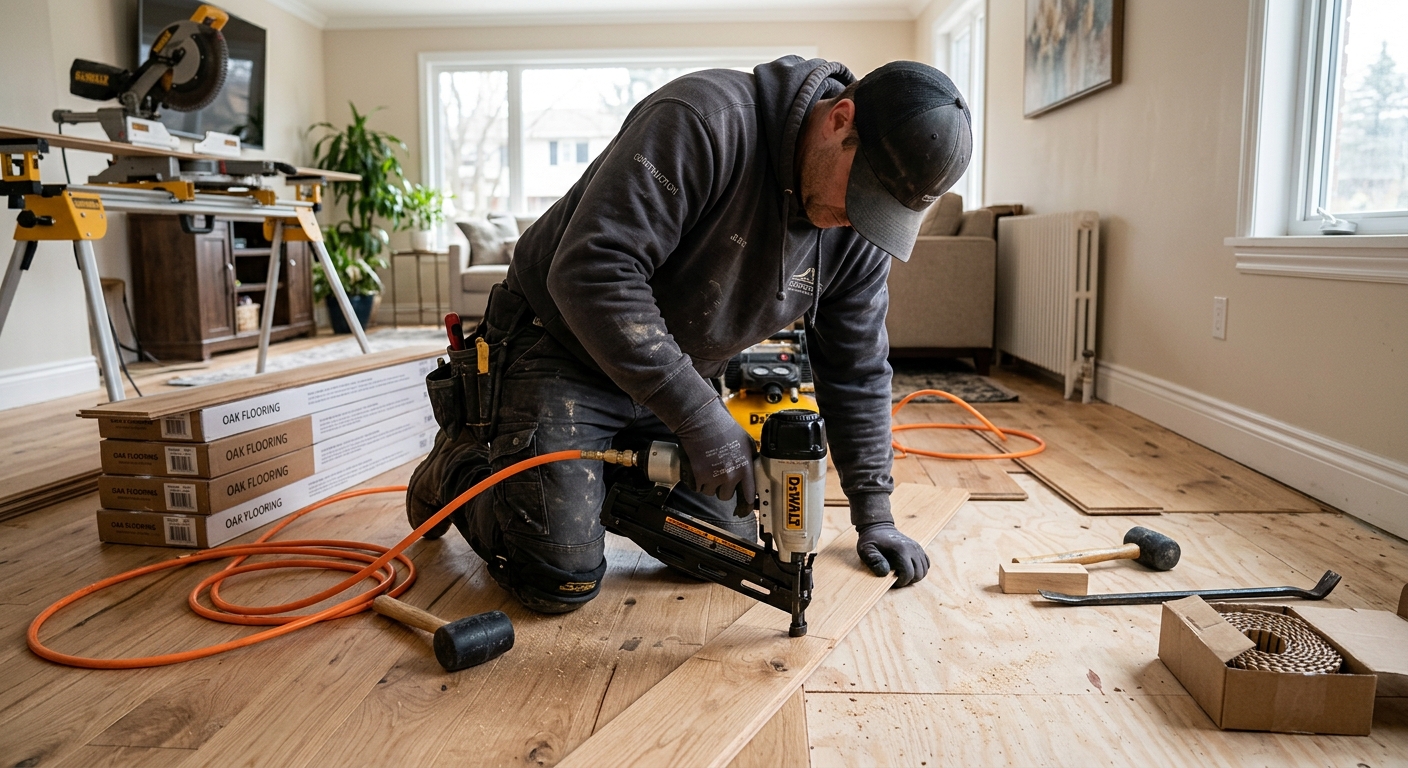
Flooring options and costs in Smithers
Smithers homeowners usually start by comparing looks and price, but in practice the right flooring option in your home is driven by age of the house and the Nechako climate. With many homes built before 1981 (51.6% per the Statistics Canada, 2021 Census), you often run into older subfloors that are wavy, uneven, or made of mixed materials. That’s one reason contractors commonly budget for subfloor levelling or repairs—an extra line item that can add roughly $2–$4 per sq ft before new flooring goes down.
Nechako winters can feel very dry indoors, then shoulder seasons bring humidity swings. Solid hardwood reacts to those changes and can gap or cup if it’s not installed in the right location and with proper climate control. That’s why below-grade spaces in Smithers (and other Bulkley-Nechako communities) are frequently steered toward engineered wood or luxury vinyl plank (LVP), which tolerate movement and moisture far better. If your project is in high-demand areas like the East Smithers corridor—where many older homes are updated during renovations—labour scheduling can also influence timelines and quote pricing.
Availability matters too: when crews are busy with baseboards, subfloor work, and transitions, you may see higher installation labour rates compared with simpler, urban-style installs. Below are realistic price bands you can use to compare flooring types before you request itemised quotes.
| Type |
Best Room |
Moisture Resistance |
Lifespan |
Price per sq ft |
Price Range |
| Solid hardwood (nail-down, above grade only) |
Main living areas with stable indoor climate |
Low to moderate (humidity sensitive) |
25–60 years |
$12–$25 |
$12–$25 |
| Engineered hardwood (float or glue, above + on-grade) |
Living areas, bedrooms, hallways |
Moderate to high (better with swings) |
20–40 years |
$12–$25 |
$12–$25 |
| Laminate (click-lock, above-grade) |
Bedrooms, hallways, light-traffic rooms |
Low to moderate (fears standing water) |
10–25 years |
$4–$8 |
$4–$8 |
| Luxury vinyl plank / LVP (waterproof, any level) |
Kitchen, basements, main floors needing resilience |
High (waterproof products) |
15–30 years |
$4–$8 |
$4–$8 |
| Porcelain / ceramic tile |
Bathrooms, entryways, kitchens |
Very high (properly sealed/installed) |
25–75 years |
$12–$25 |
$12–$25 |
| Carpet (broadloom or modular tile) |
Master/secondary bedrooms |
Low (needs protection from moisture) |
8–15 years |
$6–$12 |
$6–$12 |
Prices are estimates only and vary by project scope, site access and material selection.
What affects the price of flooring in Smithers
In the Nechako region, two quotes for what looks like the same flooring job can differ by 30–50% across Smithers and the rest of British Columbia because the “extras” are often where the cost hides. The biggest technical drivers are indoor humidity swings and any below-grade moisture. Solid hardwood expands and contracts with humidity, and it can’t be installed the way laminate or LVP can—especially not over concrete slabs or in basements. That’s why colder areas and radiant-heat homes often favour engineered wood, quality LVP, or tile, all of which handle movement and moisture far better than thick solid planks.
Older housing stock is another major factor. When a home was built before 1981 (51.6% per the Statistics Canada, 2021 Census), it’s common to budget for subfloor levelling or repair. Even if your chosen product is in the laminate/LVP band ($4–$8 per sq ft), levelling and transitions can pull the effective installed cost upward, commonly by $1–$4 per sq ft depending on how out of plane things are.
Concrete examples from Smithers: (1) If you’re finishing a basement, the installer typically has to address moisture mitigation and a vapour strategy—solid hardwood usually gets ruled out, while waterproof LVP stays practical. (2) If you have in-floor radiant heat, many solid hardwood options (and some laminate cores) require radiant-compatible flooring, reducing your choices and sometimes increasing material costs toward the engineered/tile range ($12–$25 per sq ft). Finally, crews often adjust labour based on subfloor accessibility—tight hallways and older joist spacing can add time.
| Price Factor |
Why It Matters |
Cost Impact |
| Room area in sq ft |
Directly affects labour hours, adhesive/underlay and trim length. |
Typically the largest portion of the budget; scales linearly. |
| Subfloor condition |
Uneven, damaged, or old subfloor materials need levelling/repair. |
Often adds $1–$4 per sq ft in older Nechako homes. |
| Moisture / below-grade install |
Moisture vapour limits solid hardwood and can affect some laminate. |
May add mitigation layers and higher-spec products; can shift you away from solid. |
| Material choice |
Solid, engineered, LVP, and tile vary in raw cost and install complexity. |
Material bands commonly range from $4–$8 up to $12–$25 per sq ft. |
| Removal and disposal of existing flooring |
Demo time, debris hauling and disposal fees add labour. |
Can noticeably increase labour-only line items. |
| Stair nosing / transitions |
Stairs and doorways require specialty trims and extra measuring. |
Charged per step or per linear foot; costs rise quickly with complexity. |
| Radiant heat compatibility |
Some flooring types aren’t rated for in-floor heating cycles. |
Can push selection toward engineered/LVP/tile and away from most solid. |
| Installation method |
Float, glue-down, and nail-down differ in preparation and labour. |
Glue-down and nail-down generally require tighter prep and may cost more. |
Permits & regulations in British Columbia
For most Smithers homeowners, flooring installation itself typically does not require a building permit in British Columbia. The main exception is when your flooring project includes associated work that touches regulated systems—most commonly electrical when there are changes to in-floor heating wiring or other electrical components. In-floor radiant heat updates, modifications to circuits, or work that involves electrical connections can require an electrical permit and must be completed by appropriately qualified trades.
Where permits are often missed isn’t the flooring—it’s the building context. In condominiums, the strata corporation usually has rules around sound transmission and may restrict or require specific underlay beneath hard surfaces to meet acoustic expectations (often described in terms like STC/IIC). Always review the condo declaration and ask for board approval in writing before installing hardwood or tile on upper floors. That step prevents costly rework if the underlay or installation method doesn’t meet building requirements.
To verify contractor credibility in British Columbia, start with licensing and coverage checks before you sign: (1) Look up the contractor on the provincial online registry for the applicable licence category, if they are registered for your scope. (2) Request a current certificate of insurance showing liability coverage. (3) If the contractor uses employees, ask for WSIB/WCB coverage information and clearance documentation—confirm dates and that coverage applies to the right business entity. (4) Don’t rely on “we’re insured”—get the documents.
Best flooring for each room in your Smithers home
In Smithers, the best flooring choice is the one that matches each room’s moisture exposure, foot traffic, and comfort needs while handling Nechako humidity swings. For living and dining rooms, engineered hardwood or high-quality laminate typically offers the best balance of warmth and durability. If you want the look of wood but you’ve got temperature swings or a less-than-perfect subfloor, engineered is the safer bet than thick solid.
For the master bedroom, carpet is still a top comfort choice—especially in colder months—because it reduces noise and feels warmer underfoot. Secondary bedrooms can go engineered hardwood if you prefer easy maintenance, but keep in mind that large spills and wet shoes should be dealt with quickly.
In kitchens, luxury vinyl plank (LVP) or large-format porcelain tile usually performs best. LVP handles minor splashes and daily cleaning without fear of swelling, while tile is ideal where you might drop a pot, splash water, or frequently mop. Basements are different: finished basements in Smithers usually see more vapour risk, so fully waterproof LVP is the clear winner compared with solid hardwood and many laminate products. Bathrooms should be porcelain or ceramic tile only.
If your home includes radiant heat—which is common in newer builds—choose radiant-compatible engineered wood, quality LVP, or tile. Radiant cycles can stress materials that aren’t rated for it, so don’t guess. As a cost example, moving from laminate in the $4–$8 per sq ft band to engineered wood in the $12–$25 band can be justified when you want wood aesthetics with better tolerance; you’re paying for stability and fewer moisture-related callbacks.
| Room |
Best Material |
Why |
Moisture Risk |
Price Band per sq ft |
| Living / dining room |
Engineered hardwood |
Warm feel, wood look, and better tolerance of humidity swings than solid. |
Low (if vents and humidities are managed) |
$12–$25 |
| Master bedroom |
Carpet or engineered hardwood |
Carpet adds comfort and sound damping; engineered keeps a cleaner look. |
Low |
$6–$12 (carpet) / $12–$25 (engineered) |
| Secondary bedrooms |
Carpet (comfort) or laminate (value) |
Carpet hides minor subfloor imperfections; laminate is economical for closets and low splash zones. |
Low |
$6–$12 (carpet) / $4–$8 (laminate) |
| Kitchen |
Luxury vinyl plank (LVP) or porcelain tile |
LVP handles splashes and cleaning; tile resists water and stains when grouted properly. |
Medium (spills and mopping) |
$4–$8 (LVP) / $12–$25 (tile) |
| Basement (finished) |
Luxury vinyl plank (waterproof) |
Designed to handle moisture vapour and below-grade conditions better than solid or most laminate. |
High |
$4–$8 |
| Bathroom |
Porcelain / ceramic tile |
Non-absorbent surface with proper installation and grout detailing. |
Very high |
$12–$25 |
How to choose a flooring contractor in Smithers
Choosing the right contractor matters more in Smithers than many homeowners expect because older subfloors and humidity swings often turn a “simple install” into a preparation-heavy job. Start by verifying British Columbia licensing for the scope they’re doing, then confirm they carry liability insurance. Ask for their certificate of insurance and make sure the policy is current and matches the legal name of the business on the quote. For workers, request proof of WSIB/WCB coverage (clearance documentation or corresponding proof) so you’re not left exposed if there’s an accident on site.
Next, get 2–3 itemised written quotes, not lump sums. A good quote breaks out labour and materials separately: underlay, levelling/patch compound, transitions, removal and disposal, and stair work. Read the scope line-by-line: what’s excluded (subfloor repair? mould remediation? moving appliances?), whether disposal fees are included, and if the price includes required acclimation and protection of adjacent surfaces. If radiant heat is involved, confirm the flooring is radiant-compatible and that the installer follows manufacturer temperature guidance.
Warranty should be explicit: ask for the workmanship warranty length and whether the product warranty applies through the original purchaser or is transferable. Payment scheduling is another key control—never pay more than about 10–15% upfront, and hold back funds until the job is complete and you’ve inspected the finished floor.
- Request licence/registration details for the exact work being quoted.
- Get a current liability certificate before work starts.
- Confirm WSIB/WCB coverage for employees and labour only contractors.
- Ask for an itemised quote (labour + materials + supplies + disposal + transitions).
- Confirm whether subfloor levelling is included or assessed after inspection.
- Ask what happens if the subfloor is worse than expected (change-order policy).
- Verify radiant heat compatibility in writing if your home has it.
- Confirm acclimation requirements (especially for hardwood/engineered).
- Get start date and completion timeline in writing.
- Confirm protection for stairs, baseboards, and doors during install.
- Ask how edges will be finished (T-moulding, reducers, caulking/expansion gaps).
- Review the warranty details: workmanship, product, and transferability.
Red flags in Smithers: (1) quoting without inspecting the subfloor and skipping levelling discussion, (2) vague “all-in” numbers with no disposal, transition, or trim line items, (3) no proof of liability/WSIB/WCB coverage, (4) offering solid hardwood in basements without moisture mitigation, and (5) pressure to pay most of the money upfront.
Frequently asked questions — flooring in Smithers
What flooring works with radiant heat?
In Smithers and across British Columbia, radiant heat compatibility is mainly about whether the flooring manufacturer rates the product for in-floor heating cycles. As a practical rule, engineered hardwood, quality LVP, and porcelain/ceramic tile are commonly used because they handle temperature changes more predictably than thick solid hardwood. Many solid hardwood products are either not rated for radiant heat or require strict installation and temperature controls, so it’s important to confirm the exact product spec sheet. Laminate can work only if it’s explicitly radiant-compatible—otherwise expansion and wear can be an issue. Before you buy, ask your contractor to list the rated flooring and underlay/adhesives for your system, and keep that paperwork with your warranty.
Engineered vs solid hardwood — what's the difference?
Solid hardwood is a single wood piece and is usually installed nail-down over appropriate above-grade subfloors. It’s sensitive to indoor humidity swings, which is a real factor in the Nechako region where winter dryness and shoulder-season moisture change how wood behaves. Engineered hardwood uses layers (a stable core with a real wood wear layer). That construction allows it to tolerate movement better, so it’s commonly installed over on-grade slabs and is often the preferred “wood look” in homes where basement moisture or climate variability is a concern. Price-wise, both can land in the $12–$25 per sq ft band depending on grade and thickness. In many Smithers renovations, engineered delivers the look with fewer moisture-related risks.
Do I need to level my subfloor first?
Often, yes—especially in older Smithers homes where uneven framing, patchy replacements, or mixed subfloor panels can create humps and dips. If you install click-lock laminate, LVP, or engineered without addressing major variation, you can get joint separation, squeaks, or uneven wear. Leveling needs show up during measurement: a small amount can be handled by underlay or self-levelling compounds, but poor structure may require repairs. The cost impact is why reputable contractors quote preparation after an onsite check; levelling and repair commonly adds about $1–$4 per sq ft in older housing stock. If you’re budgeting for floors in the $4–$8 per sq ft laminate/LVP range, set aside for subfloor work so the final installed cost doesn’t surprise you.
What's the most durable flooring for pets and kids?
For pets and kids in Smithers, the durability winner is usually waterproof LVP or porcelain/ceramic tile—because they handle accidents and cleaning without swelling. Waterproof LVP can also resist everyday scratches better than budget laminate, and it’s forgiving in basements where moisture vapour may be present. If you prefer a softer feel, carpet is comfortable, but it’s lower durability for repeated spills and muddy paw traffic unless you use good stain protection and clean promptly. Hardwood can work for active households, but solid hardwood may be less forgiving in humidity-swing homes, and it should generally stay above grade. For price reference, LVP often sits around the $4–$8 per sq ft band, while tile frequently comes in the $12–$25 per sq ft range due to labour and installation complexity.
How do I choose flooring for humidity in Smithers?
Humidity management starts with picking a product that tolerates movement and then matching it to the room’s moisture exposure. In Smithers, indoor humidity can swing between dry winters and more humid shoulder seasons, so solid hardwood is more sensitive—especially if the home has basements or on-grade areas that see vapour. That’s why engineered hardwood or waterproof LVP is commonly chosen: engineered is more stable than solid, and LVP is designed to handle moisture significantly better. In basements, avoid installing solid hardwood and be cautious with laminate unless it’s explicitly suited for your moisture conditions. Also, make sure the contractor uses proper expansion allowances and correct underlay. If your home’s air circulation is inconsistent, improve it before installation; otherwise even good flooring can fail prematurely.
Do condos restrict hard flooring?
Yes, they often do. In British Columbia condominiums, strata rules frequently restrict or require specific underlay to meet sound transmission expectations on upper floors. Even when flooring itself doesn’t require a building permit, the strata corporation may require board approval because hard flooring can create noise impacts. Before you install hardwood or tile, review the condo declaration and request approval in writing. Your contractor may need to use a particular acoustic underlay and installation method to meet the building’s requirements (commonly referenced through acoustic performance metrics). If you already have carpeting, switching to hard flooring can be a major change for the building, so don’t start demolition until you have documentation. This is one reason itemised quotes should include underlay selection and sound-system details.