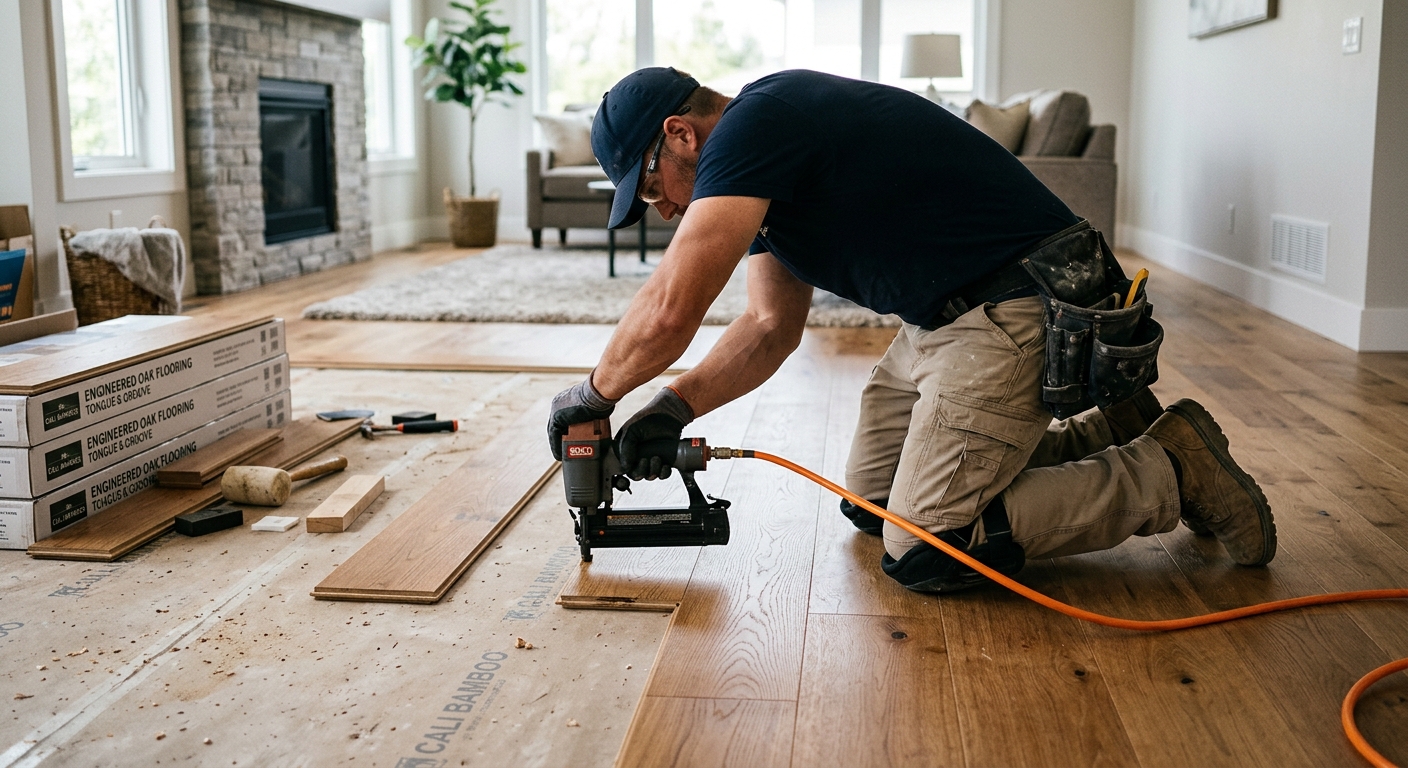
Flooring options and costs in Cumberland
Cumberland is a small but active flooring market on Vancouver Island, and the choices you make there usually start with comfort and durability, then quickly shift to moisture behaviour. With 39.1% of homes built before 1981 (Statistics Canada, 2021 Census), many projects begin with correcting older subfloors—loose plywood, wavy OSB, or uneven concrete—before any new material goes down. That preparatory work can add roughly $1–$4 per sq ft, depending on how much repair and levelling is needed.
On the Vancouver Island and Coast, coastal moisture and indoor humidity swings are real cost drivers. Even when the home feels “dry,” indoor relative humidity commonly drifts outside the ideal 35–55% band, which can cause cupping or gapping in solid hardwood if it’s not conditioned and installed properly. That’s why, for most basements and below-grade areas, engineered hardwood and luxury vinyl plank (LVP) are preferred over solid wood. In Cumberland, trades are also busy around nearby residential corridors, including the areas people often reference when shopping for services—like the wider Comox Valley region—so accurate measuring, scheduling, and subfloor planning can influence labour availability and final pricing.
Because of those factors, your quote will typically bundle materials, labour, and the moisture-appropriate underlayment system. Use the ranges below as a practical baseline, then compare your options by room and moisture risk.
| Type |
Best Room |
Moisture Resistance |
Lifespan |
Price per sq ft |
| Solid hardwood (nail-down, above grade only) |
Main living areas above grade |
Low (humidity sensitive; avoid basements) |
25–60 years |
$10 – $18 |
| Engineered hardwood (float or glue, above + on-grade) |
Living rooms, bedrooms, hallways |
Medium to high (more stable) |
20–40 years |
$9 – $16 |
| Laminate (click-lock, above-grade) |
Bedrooms, offices, hallways |
Medium (protect seams; not a flood-proof choice) |
10–25 years |
$5 – $10 |
| Luxury vinyl plank / LVP (waterproof, any level) |
Kitchen, main floor, basement (finished) |
High (waterproof cores) |
15–25 years |
$6 – $12 |
| Porcelain / ceramic tile |
Bathrooms, entries, kitchens |
Very high (with proper underlayment) |
25–50 years |
$12 – $25 |
| Carpet (broadloom or modular tile) |
Bedrooms, stairs (comfort-focused) |
Low to medium (depends on pad and moisture control) |
8–15 years |
$4 – $9 |
Prices are estimates only and vary by project scope, site access and material selection.
What affects the price of flooring in Cumberland
In Cumberland, the same “type” of flooring can land in meaningfully different totals—often 30–50%—because Vancouver Island and the Coast have a lot of variable prep conditions and moisture management requirements. Two homes can both be 800 sq ft, but one has a flat subfloor and stable indoor humidity control, while the other has older plywood, a damp crawl/basement area, or poor transitions that require grinding and patching. In a region where homes built before 1981 make up 39.1% of the stock (Statistics Canada, 2021 Census), subfloor corrections are a common reason quotes diverge.
Technically, indoor humidity swings matter. Solid hardwood expands and contracts with humidity and, as a rule, it shouldn’t be installed over concrete slabs or in basements where moisture vapour is an ongoing risk. That limitation can remove “cheap solid wood” from the shortlist and steer budgets toward engineered hardwood or LVP. Engineered products and waterproof LVP tolerate day-to-day expansion and contraction better, especially when paired with the right underlayment and vapour-control plan.
Older regional housing also affects levelling. If your plywood is wavy or you need an OSB overlay, you’re often looking at an added $1–$3 per sq ft in labour and materials before flooring even starts. For a concrete example: moving from mid-range laminate (often in the $5–$10 per sq ft band) to engineered hardwood (commonly $9–$16 per sq ft all-in) can be justified when your subfloor is already stable and you want better longevity. But if levelling is required either way, that prep cost can narrow the gap—so the “best value” option isn’t always the cheapest material, it’s the one that matches the moisture risk profile.
Radiant heat compatibility can also change the quote. As more homes in the area add electric radiant or hydronic retrofits, many solid hardwood installs are avoided while LVP, most laminates, tile, and many engineered planks become the practical choices—often keeping you within the $6–$12 per sq ft LVP ranges rather than increasing costs with a less-compatible selection.
| Price Factor |
Why It Matters |
Cost Impact |
| Room area in sq ft |
Materials scale directly; labour is partly linear and partly fixed |
Small rooms can cost more per sq ft than large open areas |
| Subfloor condition |
Levelling/repair determines whether your underlayment and locking joints will perform |
Often adds $1–$4 per sq ft on older homes |
| Moisture / below-grade install |
Solid hardwood is humidity sensitive and not ideal for basements over slabs |
May increase cost by switching to engineered or LVP ($6–$12 per sq ft band) |
| Material choice |
Cost varies widely between solid, engineered, LVP, and tile |
Solid typically lands higher than laminate; tile is usually the highest |
| Removal and disposal of existing flooring |
Demo time, waste handling, and subfloor exposure affect labour |
Can add substantial labour; increases total even with “budget” materials |
| Stair nosing / transitions |
Transitions aren’t “free”—they need matching reducers, trims, and accurate fitting |
Often charged per step or per linear foot, adding noticeable extras |
| Radiant heat compatibility |
Some materials require specific underlayment and temperature controls |
May limit choices and steer you toward LVP/tile/compatible engineered |
| Installation method |
Glue-down and nail-down require different prep and labour intensity |
Float installs can be faster; glue-down may cost more where done correctly |
Permits & regulations in British Columbia
In British Columbia, the flooring installation itself typically does not require a building permit. What often changes the permit picture is the related work around the floor: structural subfloor repair (especially if it involves framing changes), moisture remediation work that addresses a problem source, and in-floor heating circuits. If you’re working with hydronic or electric radiant systems—such as replacing thermostats, modifying wiring, or tying into electrical circuits—electrical permits and qualified electrical work requirements can apply.
For condominium owners, the next constraint is usually sound transmission. Corporations often restrict hard flooring on upper floors and may require specific underlay systems to meet sound-performance expectations (commonly discussed as STC/IIC targets). Before installing hardwood or tile, request board approval in writing and confirm the required underlay and installation method—especially for floating engineered floors and tile assemblies.
To verify your contractor in Cumberland, ask for: (1) licence information where applicable and the company’s trades credentials for any related electrical scope, (2) proof of liability insurance, and (3) WSIB/WCB coverage. A reliable contractor will provide certificates on request and can show you the coverage details quickly. For due diligence, check the contractor’s public records online, then verify the certificate’s policy limits and dates. If they won’t share documents before starting, that’s a major red flag. Finally, confirm in writing whether disposal, subfloor repair, and any required site protection are included—so you’re not surprised when permits or extra prep work are needed.
Best flooring for each room in your Cumberland home
Your best flooring in Cumberland is the one that fits the room’s moisture profile, traffic level, and underfoot comfort—while respecting Vancouver Island humidity swings. Living and dining rooms usually benefit from engineered hardwood or high-quality laminate: both deliver warmth, and engineered planks handle normal daily humidity changes better than solid hardwood. The master bedroom often becomes a comfort-first choice; carpet is excellent for softness and sound absorption, but engineered hardwood is also a strong option if you want easier maintenance.
In kitchens, choose luxury vinyl plank (LVP) or large-format porcelain tile. That’s because spills, tracked-in moisture, and frequent cleaning are unavoidable. LVP’s waterproof core helps it perform through coastal humidity and everyday wet messes, while porcelain tile resists water even when the floor stays exposed for longer periods.
Basements in the Cumberland area commonly have elevated moisture risk. For finished basements, LVP is usually the clear winner because it’s waterproof and works well with vapour management systems; solid hardwood and many laminates aren’t reliable in these conditions. Bathrooms should be porcelain or ceramic tile only—tile assemblies are designed to handle wet environments and can be built with appropriate underlayment and waterproofing details.
Radiant heat compatibility is also increasingly relevant on Vancouver Island. Many homeowners adding or maintaining electric radiant floors tend to favour LVP, compatible laminates, tile, and many engineered hardwood options. Solid hardwood is often limited by temperature and humidity requirements.
If you’re deciding between two options, use a simple value check: for example, tile might run $12–$25 per sq ft installed, while LVP may be $6–$12 per sq ft installed. If your space is a kitchen or basement where splashes are frequent, the LVP-to-tile price difference can be justified by tile’s long lifespan and wet-room performance—or you may find LVP gives you most of the practical benefit at roughly half the cost.
| Room |
Best Material |
Why |
Moisture Risk |
Price Band per sq ft |
| Living / dining room |
Engineered hardwood |
Warm look, stable construction for humidity swings |
Low to medium (depends on ventilation) |
$9 – $16 |
| Master bedroom |
Carpet or engineered hardwood |
Comfort and sound dampening; engineered stays more stable than solid |
Low (humidity is usually manageable) |
$4 – $16 |
| Secondary bedrooms |
Laminate or engineered hardwood |
Good durability and easier maintenance than carpet |
Low to medium |
$5 – $14 |
| Kitchen |
Luxury vinyl plank (LVP) |
Waterproof core; forgiving underfoot for daily spills |
Medium to high |
$6 – $12 |
| Basement (finished) |
Luxury vinyl plank (LVP) |
Best fit for vapour management; avoids solid-wood moisture risk |
High (below-grade vapour pressure) |
$6 – $12 |
| Bathroom |
Porcelain / ceramic tile |
Designed for wet areas; durable and cleanable surface |
Very high |
$12 – $25 |
How to choose a flooring contractor in Cumberland
Choosing the right flooring contractor in Cumberland is mostly about verifying coverage, then verifying the quote. Start with British Columbia licensing where relevant to the scope (especially if any electrical or structural-related work is proposed). Next, require proof of liability insurance and WSIB/WCB coverage. Ask for the certificate directly—don’t accept verbal assurances. You’ll typically see policy dates, company names, and coverage limits on the certificate; make sure it’s current for the project start window.
Then get 2–3 itemised written quotes. You want a line-by-line breakdown of materials (flooring, underlayment/vapour barrier, stair nosing, transitions) and labour (demo, prep/levelling, install, finishing). A lump-sum number is hard to compare. Check the exclusions: is subfloor levelling included only up to a certain amount? Is mould remediation or moisture mitigation included if a damp test is needed? Confirm whether disposal and clean-up are part of the price.
Warranty matters in two ways. Ask for the workmanship warranty length and what it covers (and for how long after completion). Also confirm the manufacturer warranty and whether it transfers to you as the homeowner. Payment schedule should be conservative: never pay more than 10–15% upfront; hold back funds until the job is complete and you’ve done a walkthrough. Finally, get the timeline in writing with a start date, material lead-time assumptions, and an estimated completion date.
- Provide liability insurance certificate with policy number and dates
- Provide WSIB/WCB clearance or evidence of coverage (for their workers and subcontractors)
- Offer 2–3 itemised quotes showing materials and labour separately
- Include scope details for demo, disposal, and prep/levelling
- Specify underlayment and vapour-control plan for your exact room moisture risk
- Confirm stair nosing and transition parts are included (priced per step/linear foot if applicable)
- List grout/installation methods for tile and whether waterproofing membranes are included
- State whether radiant heat is accommodated and under what product requirements
- Write the workmanship warranty terms in the contract
- Use a clear payment schedule with a holdback until completion
- Schedule a subfloor moisture check (or at least measure conditions) if the home is older
- Provide a start date and completion estimate in writing
In Cumberland, common red flags include: (1) no insurance/coverage documents on request, (2) quotes that only list “flooring installed” without prep details, (3) ignoring moisture risk by pushing solid hardwood into basements or slabs, (4) vague warranties or “we’ll see” on workmanship issues, and (5) requiring large deposits (more than 10–15%) before any materials arrive or work begins.
Frequently asked questions — flooring in Cumberland
What's the most durable flooring for pets and kids?
For pets and kids in Cumberland (British Columbia), the most consistently durable, practical choice is usually waterproof luxury vinyl plank (LVP) or high-performance laminate, depending on your moisture risk. LVP’s waterproof core handles everyday accidents and is more forgiving when humidity swings nudge dimensional stability. If your home has an older basement or concrete slab areas (39.1% of local homes were built before 1981, Statistics Canada, 2021 Census), LVP is especially sensible because solid hardwood can struggle where vapour is present. Budget-wise, LVP often fits the $6–$12 per sq ft range installed, which can be easier to justify than tile at $12–$25 per sq ft in big family zones. If you want the best “scratch + spot-repair” experience, choose a thicker wear layer and good underlayment, then prioritize toe-kick protection in the kitchen entry paths.
How do I choose flooring for humidity in Cumberland?
Humidity is the deciding factor in Cumberland and across the Vancouver Island and Coast. Indoor relative humidity can drift outside the ideal 35–55% band, which can lead to cupping or gapping in solid hardwood if conditions aren’t stable. Solid hardwood should be kept for above-grade rooms with good ventilation; it’s a poor fit over concrete slabs and for chronic below-grade moisture risk. For higher tolerance, engineered hardwood and LVP are typically better because they handle expansion and contraction more predictably. When you’re planning a basement or any on-grade space near moisture sources, ask the installer for the vapour-control and underlayment plan—proper assembly is what keeps a “waterproof floor” truly performing. As a budgeting anchor, engineered hardwood often lands around $9–$16 per sq ft installed, while LVP frequently sits in the $6–$12 per sq ft band. Your quote should also include subfloor correction if your home is older, since levelling affects how well floors move and lock over time.
Do condos restrict hard flooring?
Often, yes—condominiums in British Columbia commonly restrict or regulate hard flooring on upper floors due to sound transmission expectations (STC/IIC). In Cumberland, the rule is not “provincial flooring law,” it’s usually the condo corporation’s declaration, by-laws, and required underlay specifications. Before you install hardwood or tile above another unit, confirm whether the corporation requires a particular underlay thickness or a complete approved system, and request board approval in writing. This is especially important for floating engineered hardwood and tile, because installation method and underlay can change impact sound significantly. If you’re comparing quotes, ensure each proposal states the underlay and installation method they plan to use so you don’t get stuck after purchase. If your condo demands an approved system, the “cheapest” flooring may not be cheapest once you add the required underlayment package.
How do I compare flooring quotes?
To compare flooring quotes in Cumberland, insist on apples-to-apples scope and a line-item breakdown. Compare: (1) material brand and grade (including wear layer for LVP or thickness for laminate), (2) underlayment and vapour barrier details, (3) subfloor prep/levelling amounts included, (4) demo and disposal, and (5) transitions/stair nosing. A quote that only shows a per-sq-ft number can hide extras—older homes frequently need levelling or repair before install, which commonly adds $1–$4 per sq ft depending on the condition. Also check what’s excluded: permit pulls (usually only for related electrical or structural work), moisture remediation if needed, and whether the contractor includes cleanup and dust protection. Finally, verify warranty terms and payment schedule; you should not pay more than 10–15% upfront. As a reality check, if one option is offered in the $5–$10 per sq ft laminate band and another claims engineered hardwood pricing but lacks prep/underlayment details, ask for clarification before you sign.
Can I install flooring over existing tile in Cumberland?
Sometimes, but it depends on the tile condition and the floor height build-up. In Cumberland (and across Vancouver Island), tile can be stable enough to install over if it’s firmly bonded, level, and free of significant cracks or lippage. The bigger concerns are uneven grout lines, surface flatness, and whether additional height will create awkward transitions at doorways and stairs. Many installers will recommend grinding high spots and using a flattening approach so the new floor doesn’t telegraph imperfections, which can cause gaps or clicking noise in laminate and stress locking joints. For LVP, a clean, smooth, well-prepared surface is critical even though the product is waterproof. Always ask the contractor to describe their prep steps, not just the install. If your quote doesn’t mention how they’ll address lippage and flatness, request that detail. In moisture-prone areas, also confirm whether they’ll add the appropriate vapour management layer.
What is the best flooring for a high-traffic area in Cumberland?
For high-traffic areas in Cumberland—entries, hallways, and open living zones—LVP with a strong wear layer or engineered hardwood usually performs best, provided the subfloor is prepped correctly. LVP is popular because it resists everyday wet messes and handles humidity swings better than solid hardwood, which is why you’ll often see it chosen for busy main floors and finished basements. Engineered hardwood can also be excellent if you maintain stable indoor conditions and your installer uses the proper method (float or glue) for the product. Carpet can work in bedrooms but tends to show matting and wear sooner in heavily used hallways unless you use commercial-grade materials. Price-wise, LVP commonly lands in the $6–$12 per sq ft installed range, which is often a practical middle ground compared with tile at $12–$25 per sq ft when you’re covering large areas. The real deciding factor, though, is how flat the subfloor is—on older Vancouver Island homes, that prep can be the difference between a floor that stays locked and one that starts to shift.