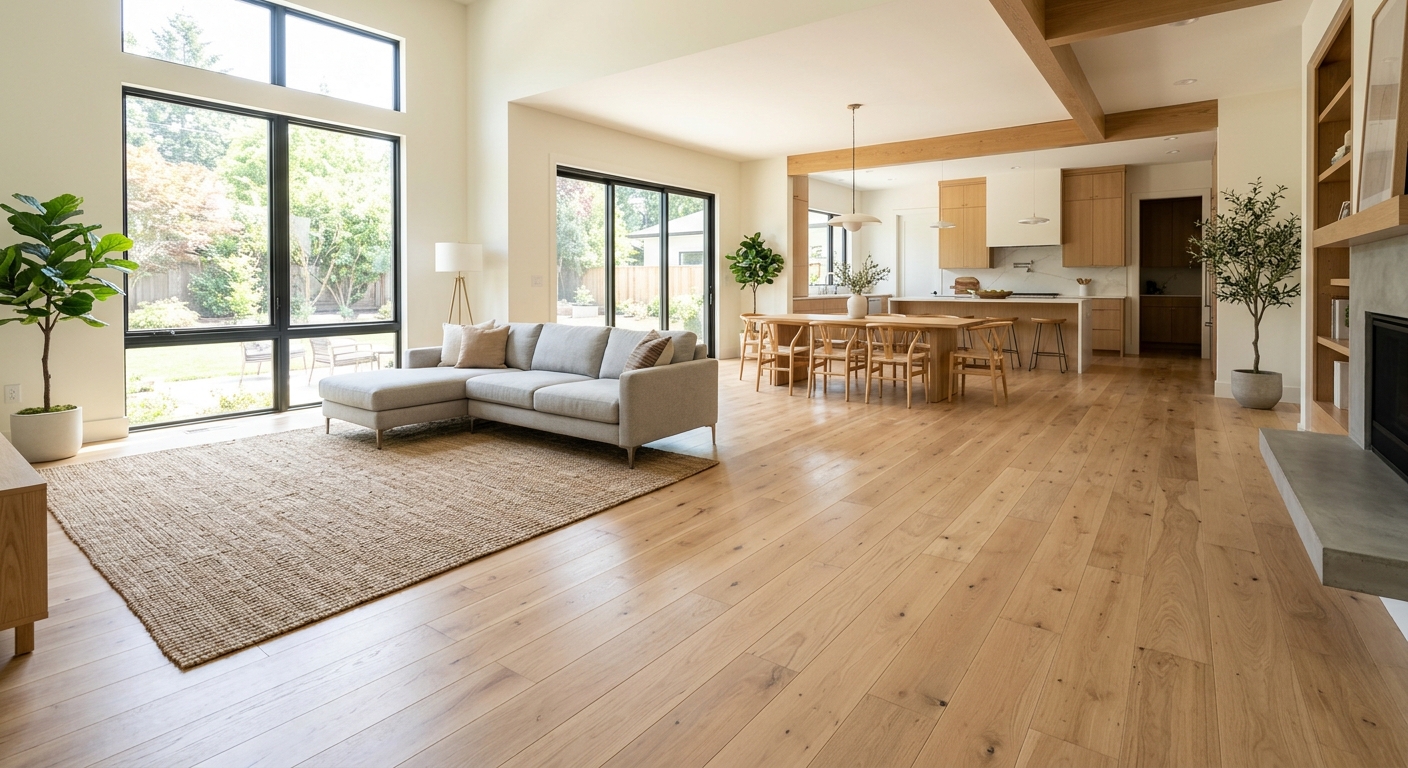
Flooring options and costs in Peachland
In Peachland, choosing the right flooring is as much about the home you have as it is about the product you like. With a population of 5,789 (Statistics Canada, 2021 Census) and about 2,200 homeowner households, many projects are updates to long-standing homes rather than brand-new builds. One big driver is that 33.1% of local homes were built before 1981 (Statistics Canada, 2021 Census), which often means older subfloor layouts, patchy repairs, or uneven areas that need levelling or an OSB overlay before install. Depending on the room, that prep work can add meaningful cost to your quote.
In the Thompson–Okanagan, you also feel the impact of dry winters and hot, sometimes smoky summers. Indoor humidity swings can cause movement in wood products and can expose slab or below-grade moisture issues. For crawlspaces and basements, contractors here typically recommend engineered hardwood or luxury vinyl plank (LVP) over solid hardwood, because engineered cores and vinyl’s synthetic construction tolerate seasonal expansion, minor slab moisture, and the occasional spill better. Radiant heating is common in colder pockets and new builds; as a result, engineered wood, tile, and quality LVP are often the safer choices.
In Peachland’s waterfront and older lakeside pockets, where basements and crawlspaces are common and renovations are frequent, moisture management and subfloor flatness are especially in demand—so plan for that in budgeting. Use the table below to compare typical installed price bands for each option in Peachland.
| Type |
Best Room |
Moisture Resistance |
Lifespan |
Price per sq ft |
| Solid hardwood (nail-down, above grade only) |
Living / dining on main floor |
Low (must be above grade) |
25–60 years |
$12,00 – $25,00 |
| Engineered hardwood (float or glue, above + on-grade) |
Living / dining; bedrooms |
Medium to high (better tolerance) |
15–35 years |
$9,00 – $19,00 |
| Laminate (click-lock, above-grade) |
Bedrooms and hallways |
Low to medium (stands up to wiping; standing water is risky) |
10–25 years |
$4,50 – $10,00 |
| Luxury vinyl plank / LVP (waterproof, any level) |
Kitchen; basement (finished) |
High (waterproof surface) |
15–30 years |
$6,50 – $13,00 |
| Porcelain / ceramic tile |
Kitchen; bathrooms; entry |
Very high (water-friendly) |
25–75 years |
$15,00 – $30,00 |
| Carpet (broadloom or modular tile) |
Bedrooms; stairs |
Medium (needs clean-up for spills) |
8–15 years |
$6,00 – $17,00 |
Prices are estimates only and vary by project scope, site access and material selection.
What affects the price of flooring in Peachland
In Peachland and across the Thompson–Okanagan, quotes for the same “flooring replacement” can swing by 30–50% because the hidden drivers aren’t the flooring brand—they’re moisture management, subfloor prep, and how much labour is required to get the surface flat and stable. In British Columbia, many homes have crawlspaces, split levels, or basements, plus older renovations that left patchwork subfloors. That means the installer’s prep plan matters as much as the finish product.
Technically, indoor humidity swings are the constant: solid hardwood expands and contracts with moisture and temperature. That’s why solid wood is generally restricted to above-grade installs and why you typically should not glue or float it over concrete. In basements and any below-grade area, engineered hardwood and luxury vinyl plank (LVP) handle humidity and minor slab moisture far better. Likewise, radiant heating is common in newer builds; it limits your choices because many solid hardwoods (and some laminate categories) aren’t rated for direct radiant conditions.
Older regional housing stock also frequently needs levelling, grinding, or replacement of damaged subfloor panels. In practice, that can add roughly $1–$4 per square foot depending on how extensive the corrections are. For example, if your main floor is uneven, moving from laminate (often in the $4–$10 per square foot band) to engineered hardwood can still be cost-effective because the extra material cost can be offset by avoiding repeated future repairs from movement. Conversely, tile can climb toward the $15–$30 per square foot range quickly once you factor in underlayment, flatness requirements, and labour-heavy setting and grouting.
Two quick Peachland examples: (1) a finished basement with slab moisture concerns usually pushes the budget toward LVP or engineered cores plus primer/membrane steps; (2) an older main floor with dips may require self-levelling underlayment to meet the flatness standard—often the difference between a smooth install and a future squeak or gap.
| Price Factor |
Why It Matters |
Cost Impact |
| Room area in sq ft |
Materials and labour scale with square footage and waste factor |
Low to high (typically 1:1 increase, plus waste for cuts) |
| Subfloor condition |
Levelling or patching can be required for flatness and soundness |
Often adds about $1 – $4 per sq ft |
| Moisture / below-grade install |
Solid hardwood is a poor fit; vapour control may be needed |
Can add several dollars per sq ft for membranes/primers |
| Material choice |
Solid vs engineered vs LVP vs tile changes material pricing and install method |
Wide spread (e.g., laminate often lower than tile) |
| Removal and disposal of existing flooring |
Demo time and dump fees vary by product thickness and fastening |
Commonly a mid-project cost increase, especially with carpet pad + underlay |
| Stair nosing / transitions |
Steps and transitions require extra mouldings, labour, and trim precision |
Typically charged per step or per linear foot |
| Radiant heat compatibility |
Not all products are rated for radiant temperatures |
May force a switch to engineered, tile, or rated LVP |
| Installation method |
Float vs glue-down vs nail-down changes prep, adhesives, and labour time |
Glue-down and tile generally cost more than simple click installs |
Permits & regulations in British Columbia
In British Columbia, the flooring installation itself typically does not require a building permit. Replacing flooring on top of an existing subfloor is usually considered a finish trade. However, associated work can trigger permitting—especially when you’re changing structures, correcting moisture problems that require specific remediation methods, or altering in-floor heating systems.
What commonly DO require a permit (or at least involve a permitted trade) includes structural subfloor repair (for example, replacing joists or major framing components), electrical work connected to in-floor radiant heating circuits, and any work that involves opening walls/ceilings in a way that affects electrical or fire-safety components. If you’re adding or modifying radiant heating, the electrical portion is generally the permitting trigger. For condominiums, the larger issue is usually not municipal permitting—it’s the corporation’s rules on sound transmission and installation specifications.
Step-by-step for Peachland homeowners: (1) ask the contractor for their business details and confirm they hold the appropriate British Columbia licence for their trade; (2) request a current certificate of insurance showing general liability (and any applicable coverage); (3) obtain proof of workers’ compensation coverage (WSIB-style coverage where applicable in B.C.); and (4) if you’re in a condo or strata, request written board approval and confirm underlay requirements before installing hard surfaces like hardwood or tile. If you’re using a professional flooring installer, these documents should be provided before work starts and typically can be verified through the contractor registry and via the insurer’s certificate documentation.
For moisture-heavy basements or below-grade areas, don’t skip the conversation about membranes and primers—while that’s not usually a permitting matter, it is a code-and-performance matter for longevity in Peachland’s climate.
Best flooring for each room in your Peachland home
Choosing the right flooring room-by-room matters in Peachland because the Thompson–Okanagan climate drives indoor humidity swings, and many local homes have basements or crawlspaces where moisture management is a major cost driver. For living and dining areas, engineered hardwood or high-quality laminate gives you a comfortable look and feel while better tolerating seasonal movement than solid wood—especially on the main floor where the home envelope is more stable. In a master bedroom, many homeowners either prioritize comfort and sound absorption with carpet, or choose engineered hardwood for an easier long-term maintenance routine.
Kitchen spaces need water resistance and frequent cleaning. Luxury vinyl plank (LVP) with a good wear layer is a practical fit, and it’s also often radiant-compatible depending on the product rating. Large-format porcelain tile is a great alternative if you want maximum water resistance and a long lifespan. For basements (finished), LVP is usually the clear winner: it’s waterproof at the surface and handles below-grade installs far better than solid wood or most laminate. Bathrooms should be porcelain or ceramic tile only, because you’re dealing with direct water exposure.
Radiant heat compatibility is increasingly important in British Columbia new construction and renovated systems. In practice, that typically steers you toward engineered wood, tile, and rated LVP, while many solid hardwood products are either not recommended or require specific installation conditions.
To see where the price difference is justified: upgrading from laminate to LVP may look like a jump on paper, but if you’re dealing with humidity swings or occasional splashes, LVP’s waterproof surface can reduce future replacement risk—especially in basements where the cost of correcting moisture-related failures can exceed the material difference quickly.
| Room |
Best Material |
Why |
Moisture Risk |
Price Band per sq ft |
| Living / dining room |
Engineered hardwood |
Warmth and realistic wood look with better dimensional stability |
Low to medium (main floor, but seasonal swings can still move materials) |
$9,00 – $19,00 |
| Master bedroom |
Carpet or engineered hardwood |
Carpet boosts comfort; engineered hardwood stays durable with less day-to-day upkeep |
Low |
$6,00 – $17,00 |
| Secondary bedrooms |
Laminate (good quality) or LVP |
Laminate is budget-friendly; LVP is more forgiving if spills happen |
Low to medium |
$4,50 – $13,00 |
| Kitchen |
LVP or porcelain / ceramic tile |
Handles spills, easy cleaning, and everyday wear |
Medium (water and grease events) |
$6,50 – $30,00 |
| Basement (finished) |
LVP |
Waterproof surface and better tolerance for below-grade conditions |
High (vapour and occasional moisture can occur) |
$6,50 – $13,00 |
| Bathroom |
Porcelain / ceramic tile |
Superior water resistance and long service life |
Very high |
$15,00 – $30,00 |
How to choose a flooring contractor in Peachland
Start by verifying licensing and coverage the right way—especially in British Columbia where you may be hiring installers who also do subfloor prep, moisture remediation, or radiant-related work. For licensing, ask for the contractor’s business information and confirm the appropriate B.C. licence/registration status through official online resources where applicable. For insurance, request a certificate of insurance (general liability at minimum) and check the dates are current. For workers’ coverage, ask for proof of workers’ compensation coverage—your contractor should provide it on request before scheduling starts.
Next, get 2–3 itemised written quotes. You want a breakdown that separates labour, removal and disposal, subfloor prep (levelling/primers/membranes), and materials. Avoid vague “all-in” pricing without scope detail. Carefully read exclusions: is underlay included? Are transitions and stair nosings included? Is disposal included and where will waste be hauled? If you have radiant heating, ensure the quote notes product compatibility and installation method (glue-down/float) so you don’t end up with an unapproved product.
Warranty matters. Ask for the workmanship warranty length, the manufacturer’s product warranty terms, and whether the warranty is transferable if you sell your home. Payment schedule should be conservative: typically no more than 10–15% upfront, with a holdback until the job is complete and cleaned up. Finally, timelines should be written: start date, estimated duration, and what happens if materials are backordered (common in seasonal demand).
- Ask for written proof of liability insurance and confirm coverage is active during the project dates.
- Request workers’ compensation documentation (and confirm it covers the crew doing your install).
- Verify contractor registration/licence status using official British Columbia resources before signing.
- Get itemised pricing (materials vs labour vs prep vs disposal), not a single lump sum.
- Confirm flatness/levelling scope in writing (especially for older homes built before 1981).
- Clarify moisture mitigation steps: primers, membranes, or self-levelling underlayment if needed.
- Ensure transitions, stair nosings, and mouldings are listed with quantity and unit pricing.
- Check underlay requirements for laminate and the sound/impact rules if you’re in a condo.
- Ask for the workmanship warranty wording and what voids it (e.g., improper maintenance).
- Confirm disposal: what’s included (carpet pad, old underlay, trim) and where it goes.
- Agree on a payment schedule with a holdback until final inspection and cleanup.
- Get a written start/completion timeline and a plan for weather/material delays.
Red flags to watch for in Peachland: (1) “too-good-to-be-true” pricing with no line-item for subfloor prep or moisture mitigation, (2) refusing to provide insurance or workers’ compensation proof, (3) no written scope for transitions/stairs, (4) sketchy or missing warranty details, and (5) pressure to pay most of the total upfront before any materials arrive.
Frequently asked questions — flooring in Peachland
What is the best flooring for a high-traffic area in Peachland?
For high-traffic areas in Peachland, LVP and tile usually make the strongest practical case. LVP is waterproof at the surface and handles day-to-day messes—important when you get muddy boots from the rainy shoulder seasons and dusty dry spells in summer. In many Thompson–Okanagan homes, basements and crawlspaces can also create humidity swings, and LVP’s construction tolerates that movement better than solid hardwood. If you want something that will look sharp for decades, porcelain/ceramic tile is very durable, though installation and prep can be more labour-intensive. If your budget is tight, high-quality laminate can work in main-floor hallways, but avoid it for areas that might see standing water. As a reference point, LVP commonly lands around $6,50 – $13,00 per sq ft installed, while tile is often $15,00 – $30,00 per sq ft depending on layout and prep.
How do I prepare my subfloor before new flooring?
Proper subfloor prep is where most Peachland flooring projects are won or lost. First, your installer should check flatness with a straightedge and identify dips, ridges, and soft spots—especially in older homes where subfloors may have been patched multiple times. Next, they should address squeaks and any movement in the structure (which can come from loose subfloor panels or joist issues). If you’re over a concrete slab or below grade, moisture testing and vapour control steps may be required before you install engineered wood or tile. For levelling, some projects use grinding/skim coating; others require self-levelling underlayment after primer. Expect older housing stock (33.1% built before 1981, Statistics Canada, 2021 Census) to sometimes need additional prep, commonly adding about $1–$4 per sq ft depending on the corrections. Always ask for the prep plan in writing so you know exactly what’s included.
Is cork or bamboo flooring a good choice in Peachland?
Cork and bamboo can be good choices, but in Peachland they’re more “conditional” than LVP or tile. Cork is dimensionally stable compared with some natural woods, and it offers comfort underfoot, but it still needs a dry, well-prepped subfloor. Bamboo ranges from solid to engineered; engineered bamboo is generally the safer bet where humidity swings exist, because the core construction resists movement better than solid boards. That said, for basements (finished) and any below-grade areas where moisture vapour is common, LVP is typically the safer recommendation in the Thompson–Okanagan due to waterproof performance. If you choose cork or bamboo, ask whether the product is rated for your installation conditions (including radiant heat compatibility if applicable) and whether the installer will include a proper moisture barrier. Budget-wise, cork/bamboo pricing varies widely by brand; the most direct comparison is against engineered hardwood and LVP, which in Peachland are commonly about $9,00 – $19,00 (engineered) or $6,50 – $13,00 (LVP) installed.
What is the difference between floating and glued-down flooring?
Floating flooring “locks” together (usually click-lock laminate or click LVP) and sits over an underlay without being directly bonded to the subfloor. Glued-down flooring is adhered to the subfloor with an appropriate adhesive, which can help reduce movement and sometimes improve the feel underfoot. In Peachland’s climate—dry winters, hot summers, and humidity swings—floating installs benefit from allowing minor movement within the system, but they still require a flat, clean base to avoid hollow spots and squeaks. Glued-down installs demand stricter prep, including correct moisture conditions and adhesive selection, because bonding over a damp or uneven surface can lead to failure. For radiant heat, always use product systems that are explicitly rated for it, whether floating or glued. Practically: laminate click and many LVP products are typically floating; engineered hardwood is available both ways. If your home has below-grade moisture concerns, gluing solid hardwood is generally not the right answer; engineered or LVP is usually the better fit.
What flooring holds up best to pets in a Peachland home?
For pets in Peachland, LVP is often the best overall performer because it’s waterproof and easier to clean after accidents or muddy tracking from walks. A quality wear layer matters, and you’ll still want to address claw maintenance and use felt pads, but the big advantage is that spills and repeated cleanups don’t ruin the floor the way they can with wood. Engineered hardwood can be a great option for main floors too—especially if you choose a tougher top veneer and keep humidity stable—but it’s not as forgiving for standing water. Tile is also excellent for durability, though it can be harder underfoot. Laminate can work, but standing water and swollen edges are the risk if an accident isn’t cleaned quickly. Cost comparisons help: LVP is commonly around $6,50 – $13,00 per sq ft installed, while tile typically sits in the $15,00 – $30,00 per sq ft range depending on tile size, layout, and prep needs.
How do I fix squeaky floors in my Peachland home?
Squeaks usually come from movement between joists and subfloor panels, or from loose fasteners—not from the finish flooring itself. In Peachland’s older housing stock, it’s common to find squeaks tied to nailed subfloor sections that have loosened over time, especially after humidity and temperature cycling. The right fix starts with locating the source: your installer may need to remove a small section of the floor to check fasteners, add screws where appropriate, or replace damaged subfloor materials. If you’re planning new flooring, address squeaks before installing because new floors can conceal movement and make squeaks worse, particularly with floating products that don’t “mask” movement. For basements and crawlspaces, sometimes the fix involves better bracing or insulation access—moisture conditions matter here. Once the structure is quiet and stable, choose the finish system: LVP often feels more stable over corrected subfloors, while carpet can reduce perceived squeak noise. Ask contractors to include subfloor diagnostics in the scope before you sign, and don’t assume a squeak repair is free—older homes frequently need that prep.